
Nexorion Initium Novum EA MT5 Review: An Honest, Critical Look at This XAUUSD Gold EA (2026)
Last updated: May 2026
Nexorion Initium Novum arrived in May 2026 wrapped in some of the most elaborate marketing we’ve seen on a gold EA: “Mathematical Hegemony,” “Vector Phase Resonance,” “computational transparency,” liquidity geometry projected onto the chart. It’s a XAUUSD H1 system from Valentina Zhuchkova, and underneath the language there’s a real product with a real live signal — which is more than many of its rivals can say.
View product details and current pricing.
But we sell EAs to people risking their own money, so this review does two jobs: it tells you what Nexorion actually is, and it’s honest about the parts that deserve a raised eyebrow. There are a few.
⚠️ Looking for a Nexorion Initium Novum “free download”? Don’t.
Every MQL5 marketplace EA ships with built-in DRM. There is no working cracked file in existence — so a “free” copy is always one of two things:
- malware, or
- bait for a Telegram payment scam where you pay and get nothing.
The only safe routes are the MQL5 marketplace or a reputable reseller. CheaperForex offers it at a significant discount versus the marketplace price — Get Nexorion Initium Novum EA MT5 at CheaperForex.
The Developer: Valentina Zhuchkova

Nexorion Initium Novum is published by Valentina Zhuchkova, and it’s worth being clear-eyed about what that means for a buyer in May 2026: this is a new seller with a new product. The EA went live on the marketplace on 9 May 2026, and the accompanying signal account opened the same week. There is no multi-year catalogue or long-standing reputation to lean on here — the developer’s credibility currently rests almost entirely on the single live signal and the marketing around it.
That isn’t a red flag by itself. Every established developer started with a first product, and a brand-new seller can absolutely ship a sound EA. But it does change how much weight you can responsibly put on the claims. With an established name, a long public track record does some of the trust work for you. With a debut product, you have far less history to go on, so the burden falls on you to verify rather than assume. Throughout this review, that’s the lens we’re applying: not “is the developer dishonest” — we’ve no reason to say that — but “how much has actually been proven versus asserted.” For a new seller, the honest answer is: not much yet, and that’s simply a function of time.
What Nexorion Actually Does
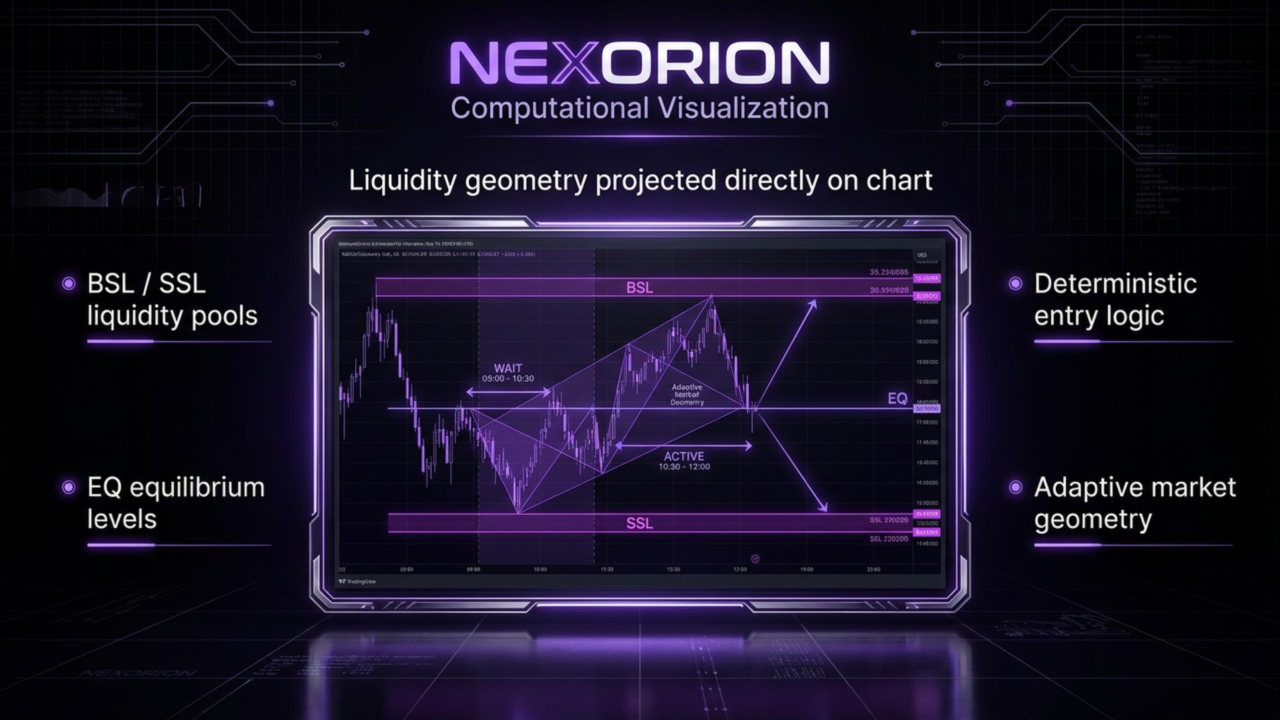
Strip away the vocabulary and the core idea is reasonable, even familiar. Nexorion trades XAUUSD on H1 using a liquidity model: it marks Buy-Side and Sell-Side liquidity pools (BSL/SSL), works out equilibrium (EQ) levels to separate “premium” from “discount” zones, and takes entries with reference to that structure. This is the same smart-money / ICT-style framework dozens of gold systems use — the novelty here is mostly in how it’s packaged.
To the developer’s genuine credit, two things stand out as real positives. Every trade is opened with a deterministic stop loss, and the listing explicitly excludes martingale, grid, and averaging — the three habits that blow up most gold accounts. And the EA draws its decision zones on the chart, so you can see what it’s reacting to rather than trusting a black box.
About the buzzwords, though: “Vector Phase Resonance” and “computational transparency” and “Mathematical Hegemony” are marketing, not mathematics. “EQ equilibrium levels” is just the midpoint of a range dressed up in capital letters. None of it is disqualifying — but treat the sci-fi language as branding, and judge the EA on its trades, not its thesaurus.
The Live Signal — Read It Carefully
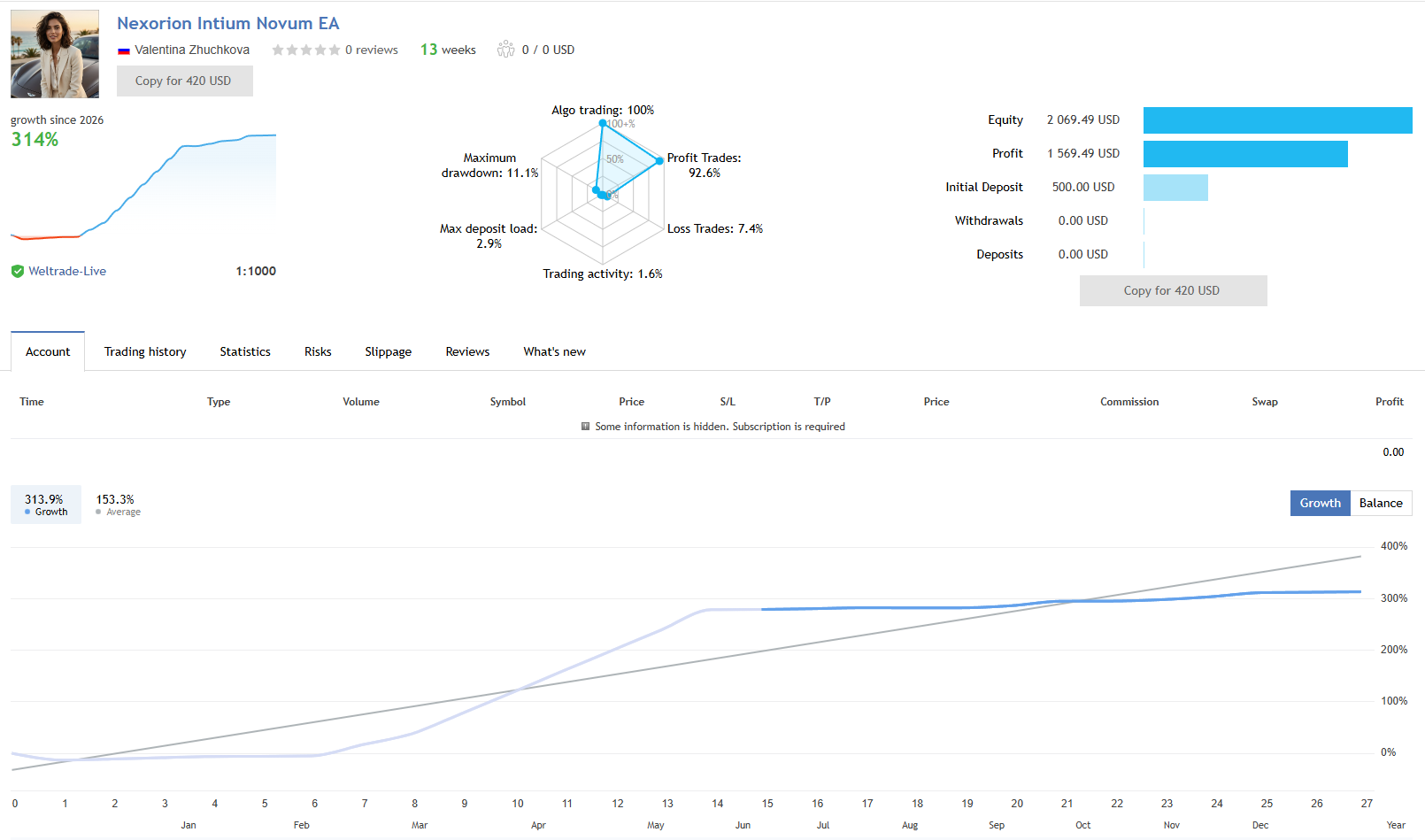
Nexorion has a public, real-money MQL5 signal — and a live signal is always worth more than a backtest. The headline is striking: roughly +314% from a $500 deposit, 92.6% winning trades, an 11.1% maximum drawdown. So far, so good. Now the parts to weigh before you get excited.
It runs on Weltrade at 1:1000. This is our biggest reservation. Weltrade is a broker with a mixed reputation, and 1:1000 leverage on a small account is exactly the recipe that produces spectacular-looking curves that don’t survive contact with a tighter, more transparent execution environment. We’d want to see this strategy on a top-tier ECN broker before treating the returns as representative. On your own reputable broker, expect a different — likely tamer — picture.
The curve looks back-filled. Read the growth chart closely and most of the rise to roughly +280% happens in a steep early run, after which the genuinely tracked portion grows a more modest amount with that ~11% drawdown attached. A near-vertical early leg followed by a flatter tracked tail is a pattern worth being cautious about — the headline +314% leans heavily on the part of the history that’s least informative about future behaviour.
It’s 13 weeks old. Three months — on one high-leverage account, during one stretch of gold’s behaviour — is an encouraging start and nothing more. It hasn’t been tested across a sustained hostile period.
The Sharpe ratio undercuts the win rate. A 92% win rate sounds elite, but the live signal’s Sharpe ratio is only around 0.65. That mismatch tells you the risk-adjusted quality is mediocre despite the gaudy hit rate — the returns are coming with more volatility and risk-taking than the win percentage implies. MQL5’s own automated system has repeatedly flagged the account with “too much growth in the last month indicates a high risk.”
Reading the equity curve honestly. The shape of the growth chart matters as much as the final number. A healthy live track record looks like a steady, grinding climb. Nexorion’s instead shows a near-vertical surge early on, carrying the account to roughly +280%, followed by a flatter, more realistic-looking stretch where the genuinely tracked trading sits — and that later portion is where the ~11% drawdown lives. When the bulk of a headline return is concentrated in a single early burst rather than spread across the whole history, the average growth line and the actual growth line diverge sharply, which is exactly what we see here. The practical takeaway: don’t annualise or extrapolate that +314%. The part of the curve that tells you how the system behaves week to week is the calmer tail, and that paints a far more modest picture than the headline.
A tiny account and a thin trade count. This is a $500 deposit with a low trade frequency — the signal has booked only a few dozen trades in its life. A 92% win rate across a small sample on a small account is statistically fragile: a single cluster of losers, or one bad gold spike against open exposure, can reshape those numbers quickly. The low deposit load looks reassuring, but on a small balance at 1:1000 it doesn’t tell you much about behaviour under stress.
The Backtest Claims — A Closer Look
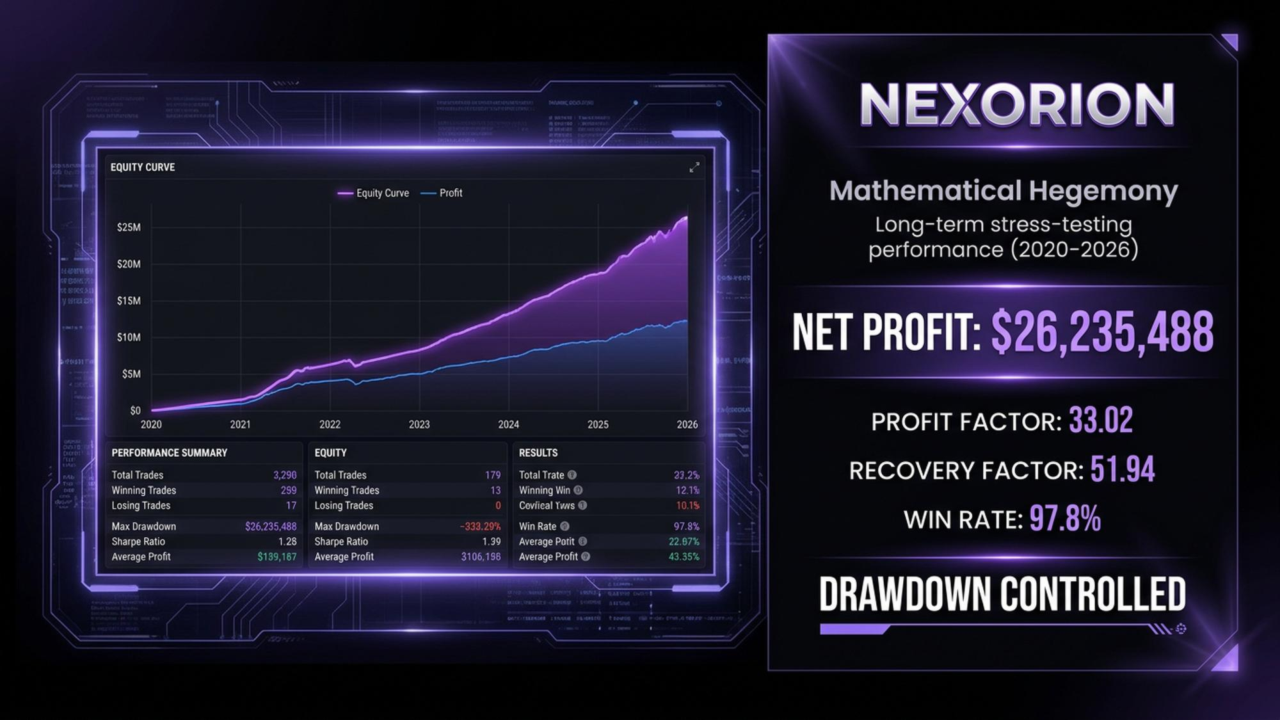
Here’s where we’d urge the most caution. The promotional backtests are eye-watering — and they don’t quite hang together.
One graphic claims a 2020-2026 test producing $26.2M net profit, a profit factor of 33.02, and a 97.8% win rate. A profit factor of 33 is, frankly, not a number that survives live trading — for context, world-class systems live in the 1.5-3 range. Look closer at that same panel and the figures don’t reconcile: it lists 3,290 total trades but only a couple of hundred winners and a handful of losers, and a “maximum drawdown” cell that mirrors the net-profit figure. These are the fingerprints of a marketing render, not a clean Strategy Tester report.
A second backtest graphic shows a different period (2025-today), a different net profit ($1.62M), a different win rate (99.1%), and a Sharpe of 24.85 — versus the live account’s 0.65. When two of a developer’s own promo images disagree with each other and with the live signal, the honest conclusion is simple: ignore the backtests and judge this EA on its live results alone.
What the Reviews Tell Us

The listing carries a handful of five-star reviews, all very recent, and we’d take them with a pinch of salt. Several are short and generic — “EA did a great job; EA is doing very well” — and read like the kind of brief, low-detail comments that tend to appear on newly launched products. One reviewer’s praise that the bot “only opens winning positions” isn’t how any honest trading system works.
None of this proves anything underhanded, and the EA may well be performing fine for early buyers. But a cluster of thin, enthusiastic, near-launch reviews is weak evidence on its own. We’d give them little weight next to the live signal, which is the only thing here worth judging on.
Who It’s For — And Who Should Pass
Worth a look if you:
- Want a single-pair XAUUSD H1 system with visible, rule-based entry logic
- Like that it uses a deterministic stop and excludes martingale, grid, and averaging
- Will run it on your own reputable ECN/RAW broker — not blindly replicate the Weltrade signal
- Treat it as a young system to validate carefully, with money you can afford to risk
Probably pass if you:
- Need a long, proven live track record before committing — this one is 13 weeks old
- Are swayed mainly by the backtest numbers — we’d discount those entirely
- Want to run it at the signal’s leverage and risk profile
- Trade only on MT4 — this is MT5 only
How to Test a Young, Unproven Gold EA Like This
If you do buy Nexorion, how you deploy it matters more than the EA itself at this stage. A new system with a three-month signal isn’t something to trust with real size on day one — it’s something to put through its paces. Here’s the disciplined way to do that.
Start on demo, on your own broker. Don’t judge it by the developer’s Weltrade signal — run it on a demo account at the reputable ECN/RAW broker you actually intend to trade. Gold spreads and execution vary enormously between brokers, and a strategy this execution-sensitive can look very different on a tighter, more honest feed. Give it a few weeks across different gold conditions, not just a quiet stretch.
Then go live small. Demo fills are optimistic — real slippage, requotes, and spread widening only show up with real money. Move to the smallest live account you’re comfortable with, at conservative risk, and let it trade. What you’re checking is whether live behaviour resembles the demo, and whether the drawdowns stay within what you saw in testing.
Watch the right things. Track the maximum drawdown it actually produces on your account, not the signal’s headline 11%. Note how it behaves around high-impact news (NFP, CPI, FOMC) — does it stand aside or get caught? Watch whether the win rate holds once you’ve accumulated a meaningful number of trades, since a small sample flatters easily.
Only scale once it’s earned it. Add capital gradually, and only after the EA has shown you consistent behaviour through at least one rough patch on your own broker. If it can’t survive a hostile week at small size, it certainly shouldn’t be managing a large balance. This is exactly why buying at the lowest possible price makes sense for a system like this: the cheaper you test, the less the experiment costs if it doesn’t work out.
Our Verdict
We rate Nexorion Initium Novum 4 out of 5 — a good score, with caveats we want you to read rather than skip.
The good is real. It’s a clean, single-pair gold system with a sensible liquidity-based premise, a deterministic stop on every trade, no martingale or grid, transparent on-chart logic, and — crucially — an actual public live signal. That combination puts it ahead of the countless gold EAs that offer nothing but a tester screenshot.
The caveats are equally real: a high-leverage Weltrade signal we’d want to see replicated on a better broker, a live history that’s only three months old, an early growth curve that leans on a back-filled-looking run, marketing backtests that contradict each other and shouldn’t be trusted, and a thin set of near-launch reviews. The score reflects a product worth trying with eyes open — not a sure thing.
And here’s the honest part, because it’s the whole reason we exist: if you’re going to try a young, unproven gold EA, the smart move is to spend as little as possible doing it. We sell Nexorion at a significant discount to the marketplace price — so if it doesn’t live up to the marketing, you’ve lost as little as possible finding out. Demo it first, run it on a proper broker, keep risk small, and let the live trades — not the buzzwords — decide.
How to Get Nexorion Initium Novum Safely
Two legitimate sources, and only two.
CheaperForex — the same EA as a standalone file at a significant discount versus the marketplace price, installable on your own terminals without activation limits. Get Nexorion Initium Novum EA MT5 at CheaperForex.
The MQL5 marketplace — direct from Valentina Zhuchkova’s developer page. Here is the official MT5 listing.
Anywhere else offering it free or via a Telegram seller is a trap — a marketplace EA can’t be cracked, so those files are malware or pay-and-vanish scams.
Frequently Asked Questions
Is Nexorion Initium Novum legit, or a scam?
The product is a legitimate, published MQL5 marketplace EA with a real public live signal — it’s not a scam. Our caution is about the marketing: the backtest claims are inflated and contradictory, the live signal runs on a high-leverage account, and the early reviews are thin. Buy from MQL5 or a reputable reseller, and judge it on its live results.
How reliable is the live signal?
It’s genuine and real-money, which counts for a lot. But it’s only ~13 weeks old, runs on Weltrade at 1:1000, and most of its headline +314% comes from a steep early run that looks back-filled. MQL5’s own system has flagged it for excessive recent growth. Read it as a promising early indication, not a proven record.
Why is the win rate so high but the Sharpe ratio low?
The live signal shows ~92% winning trades but a Sharpe ratio of only ~0.65. That gap means the risk-adjusted quality is mediocre despite the high hit rate — the account is taking on more volatility and risk than the win percentage suggests. A high win rate alone doesn’t make a system safe.
Should I trust the backtest numbers?
No. One promo graphic claims a profit factor of 33 and a 97.8% win rate; another shows a different period, a 99.1% win rate and a Sharpe of 24.85. They contradict each other and the live account, and one panel’s figures don’t even reconcile internally. We’d disregard the backtests entirely and judge the EA on its live signal.
What’s the concern with the broker?
The live signal runs on Weltrade at 1:1000 leverage. That combination tends to produce dramatic-looking curves that don’t translate to tighter, more transparent ECN brokers. We’d strongly recommend running Nexorion on a reputable ECN/RAW broker and expecting a more modest result than the signal shows.
If the live signal is so risky, what’s actually good about it?
The construction is the strong part. Unlike most gold EAs, it applies a deterministic stop to every trade and the developer excludes martingale, grid, and averaging — so there’s no hidden recovery mechanism waiting to wipe the account. The reservations are about the proof (young, high-leverage, back-filled curve, inflated backtests), not the underlying risk design, which is more disciplined than the category norm.
What does CheaperForex’s price get me?
The same EA as a standalone file, installable on your own MT5 terminals without activation limits, at a significant discount to the marketplace price. For a young, unproven system, paying less is the sensible way to test it — you risk less if it doesn’t perform.
What settings and broker should I start with?
Run it on a reputable ECN/RAW broker with tight XAUUSD spreads, on a VPS for continuous H1 operation, and start with conservative position sizing — not the leverage the live signal uses. Demo first, then a small live account, before any thought of scaling.