
SixtyNine EA MT5 Review: Signal, Settings & Customer Feedback
SixtyNine EA MT5 trades XAUUSD using six strategy layers, directional entries and stop-loss-based exits. Farzad Saadatinia’s system offers several sizing modes and trading schedules, with no grid or martingale recovery in its stated design.
Our assessment: the public signal and defined-exit approach give buyers useful evidence to examine. The main consideration is execution sensitivity: strong provider results sit alongside a customer loss report and a documented broker discrepancy. Treat the signal as one account, not a return forecast.
View SixtyNine EA MT5 — $79.95 →

Strategy and settings
The developer listing describes six layers with different entry and management parameters. It does not publish the full entry formula. Both market directions are supported, but opposite positions are not opened together as a hedge. The suggested chart is H1 or H4; this does not mean every trade lasts an hour or four hours.
Fixed Lot, Auto Lot and Risk of Previous Trade are separate sizing options. Compare them using the same broker data and realistic costs. A mode’s name alone does not establish its precise exposure after a losing trade; check the inputs and test its behaviour.
Stops, profit targets and trailing exits are central to the description. Spread filtering, trading hours and weekend order handling also matter. A stop loss defines an intended exit, but it cannot guarantee the fill price during a gap or fast move.
Public signal: growth and cash flows
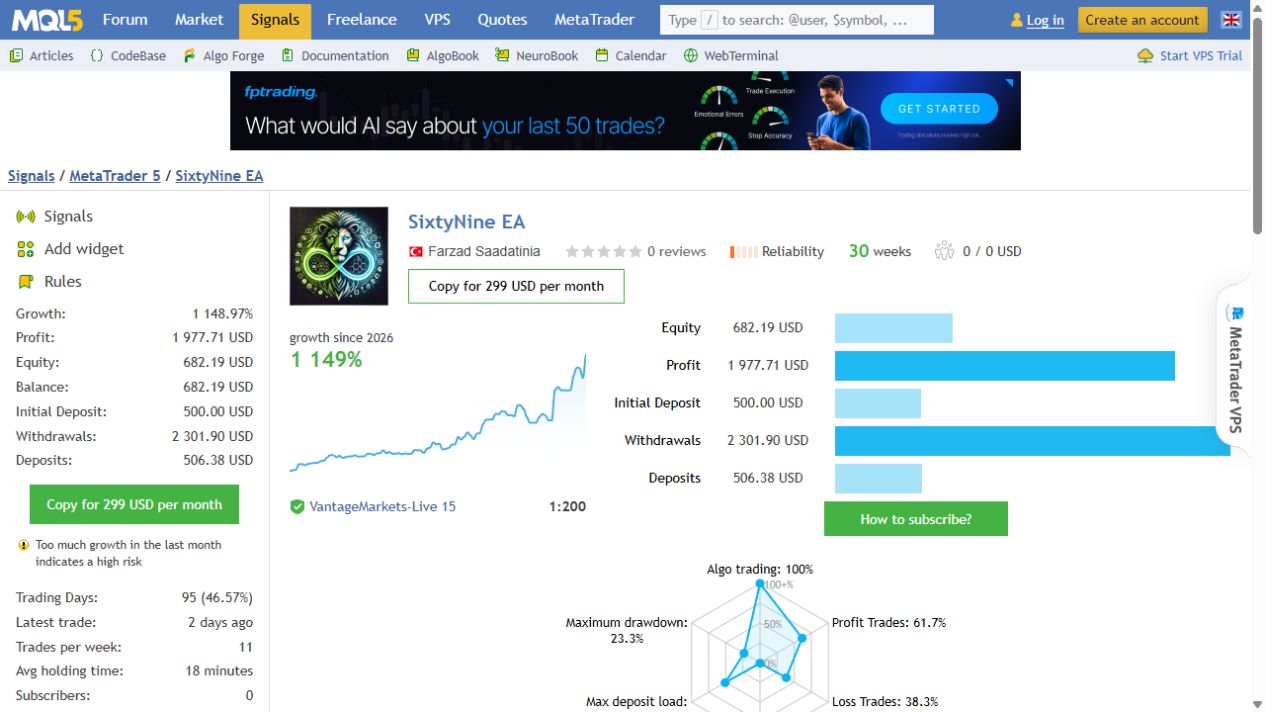
The MT5 signal runs on VantageMarkets-Live 15 at 1:200 leverage. At our check it showed 1,148.97% growth, 454 trades and a 1.94 profit factor. Its win rate was 61.67%, with an average holding time of 18 minutes.
The cash figures are important: $500 initial deposit, $506.38 additional deposits, $2,301.90 withdrawals, $1,977.71 trading profit and $682.19 remaining equity. The growth percentage is therefore not a claim that the original $500 remains in an untouched account multiplied by that percentage. Deposits and withdrawals affect the relationship between percentage growth and cash profit.
MQL5 reported 23.29% relative balance drawdown and 10.34% equity drawdown. Those are distinct displayed measures; quoting only the smaller number would omit relevant loss history. Maximum deposit load reached 50.96%, and MQL5 displayed a high-risk warning about recent growth.
The account showed 30 weeks and a signal start date of 28 February 2026. Its history predates the 2 August release of version 1.30, so the whole return cannot be credited to that build. These are dated observations, not guaranteed future returns.
Developer backtests: H4 and H1 compared
The MQL5 developer gallery includes two detailed simulated reports. Their headline returns are striking, but the drawdowns, test periods and settings matter just as much. These images do not establish which software build was tested, and both test periods end before version 1.30 was released.
H4: January 2020 to February 2026
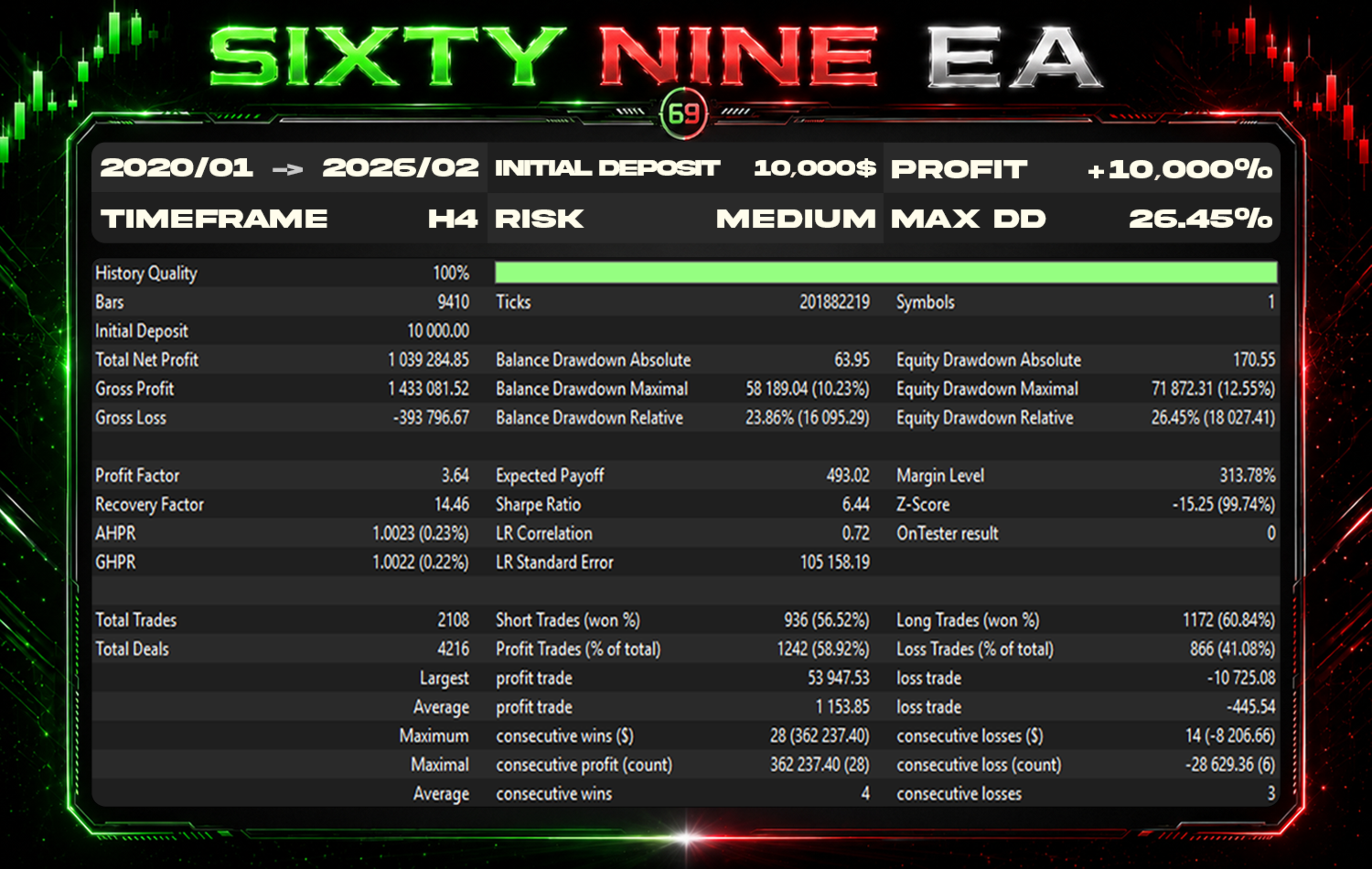
The H4 report uses a $10,000 starting balance and a medium-risk label. It reports 2,108 trades, a 3.64 profit factor and 58.92% winning trades. Relative equity drawdown is 26.45%; relative balance drawdown is 23.86%. The report also records 14 consecutive losing trades. That losing sequence is useful context for anyone attracted by the headline return.
H1: January 2025 to February 2026
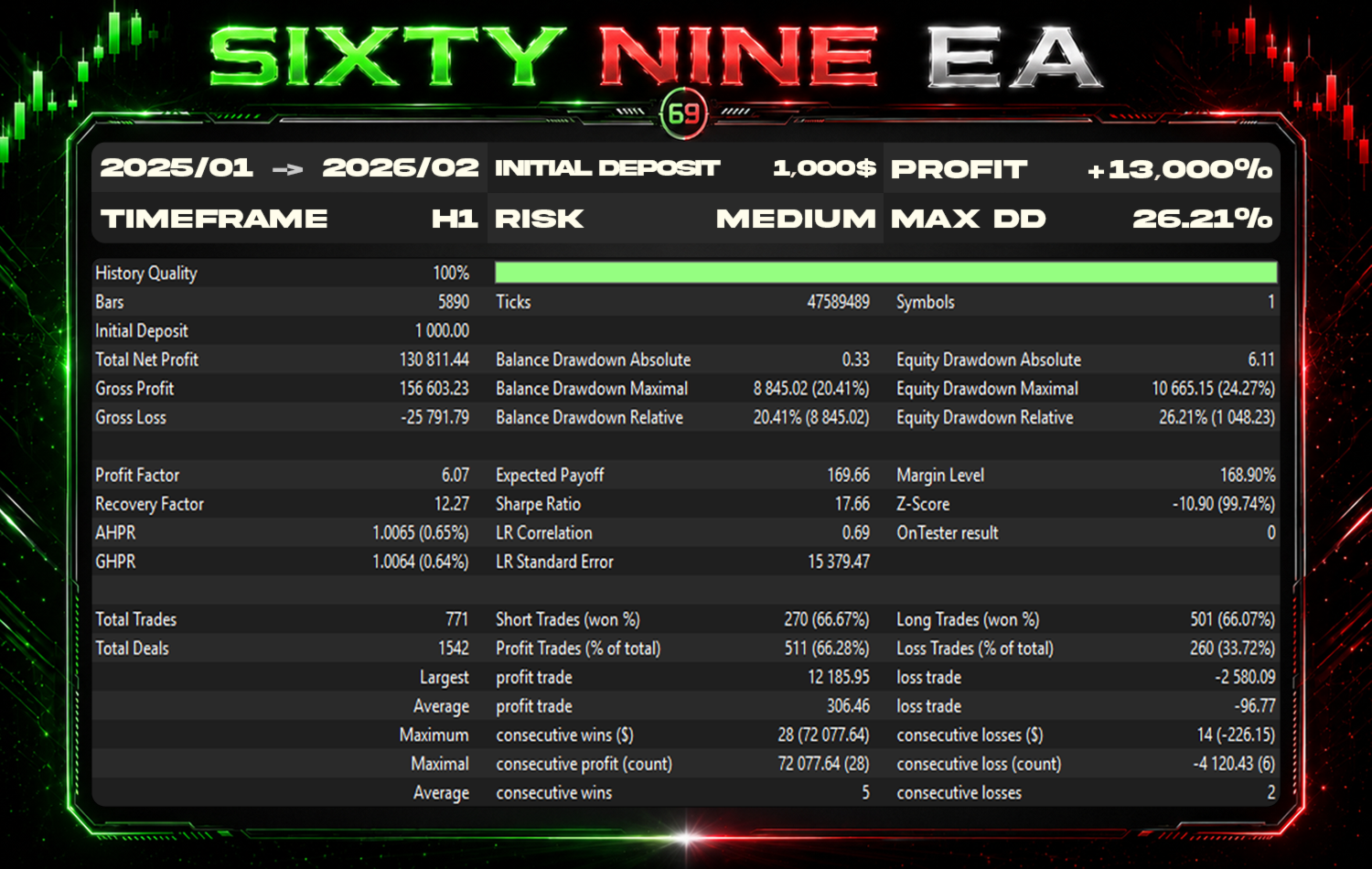
The shorter H1 test starts at $1,000 and reports 771 trades, a 6.07 profit factor and a 66.28% win rate. Relative equity drawdown reaches 26.21%, with relative balance drawdown of 20.41%. It also contains a 14-trade losing sequence. The higher headline return does not make this a like-for-like improvement: the period, starting capital and chart differ.
Both screenshots display 100% history quality, but that field alone does not prove realistic spread, slippage or future execution. The images do not supply enough information to reproduce the exact settings and broker conditions. Treat them as developer simulations to investigate, alongside the live account and customer experiences.
An older signal snapshot
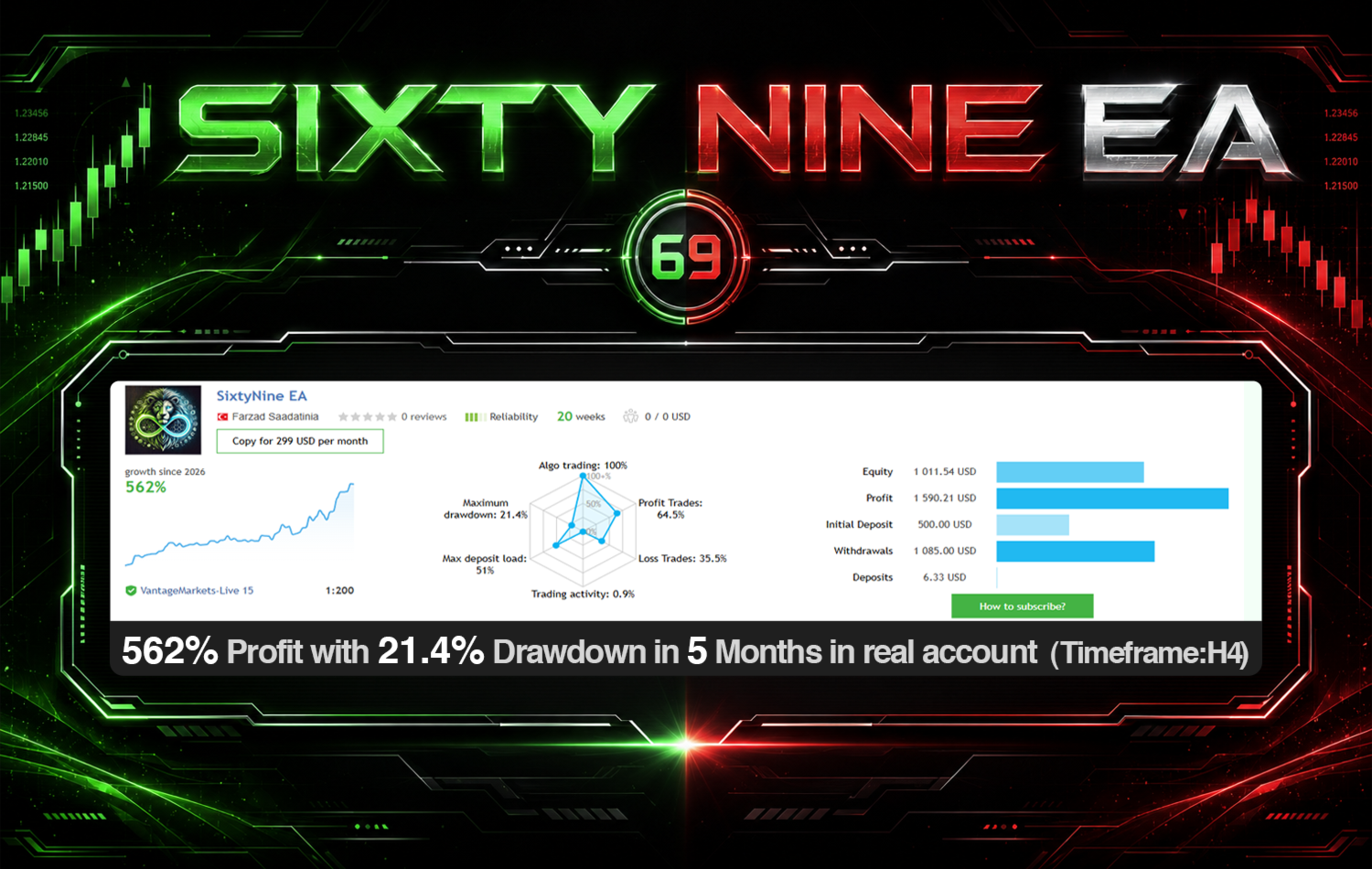
This gallery image preserves an earlier stage of the signal: 562% growth, 20 weeks of history and a displayed 21.4% maximum drawdown. It is historical context, not another independent account or the current result. The newer dated capture above is the reference for our present signal discussion.
What the promotional overview claims

The overview highlights management choices, a public signal and support. Its broad safety claim is not supported by the loss history shown elsewhere. Likewise, prop-firm suitability depends on the individual firm’s rules and the chosen exposure; the graphic is not evidence that a challenge will be passed.
Why broker results can differ
A useful September customer discussion compares losing trades on VT Markets with a profitable trade on the Vantage signal. The entries occurred at different times and used different lot sizes, so this was not a controlled identical-trade comparison.
In his 5 September follow-up, the developer attributed the discrepancy to feeds, spread, slippage and execution. He said the signal benefited from its trailing stop while the customer’s positions reached their stops. This is the developer’s explanation, not an independently reproduced diagnosis.
That exchange matters more than a generic low-spread recommendation. Test the actual broker and settings you plan to use, and compare entries, exits and costs. Even using the same broker does not guarantee a match.
Customer feedback: praise and a clear negative report

The six visible entries included praise for the signal, performance and support. Bifrost’s August comment points to the signal history; other buyers describe encouraging experiences. These are personal reports rather than audited comparisons.
The negative entry from bc01, dated 28 July and updated 30 July, reports losses outweighing small wins and says the reviewer stopped using the EA. It predates version 1.30, but there is no evidence here that the later update resolved that customer’s outcome. Both the positive and negative reports belong in the assessment.
More of the customer feedback
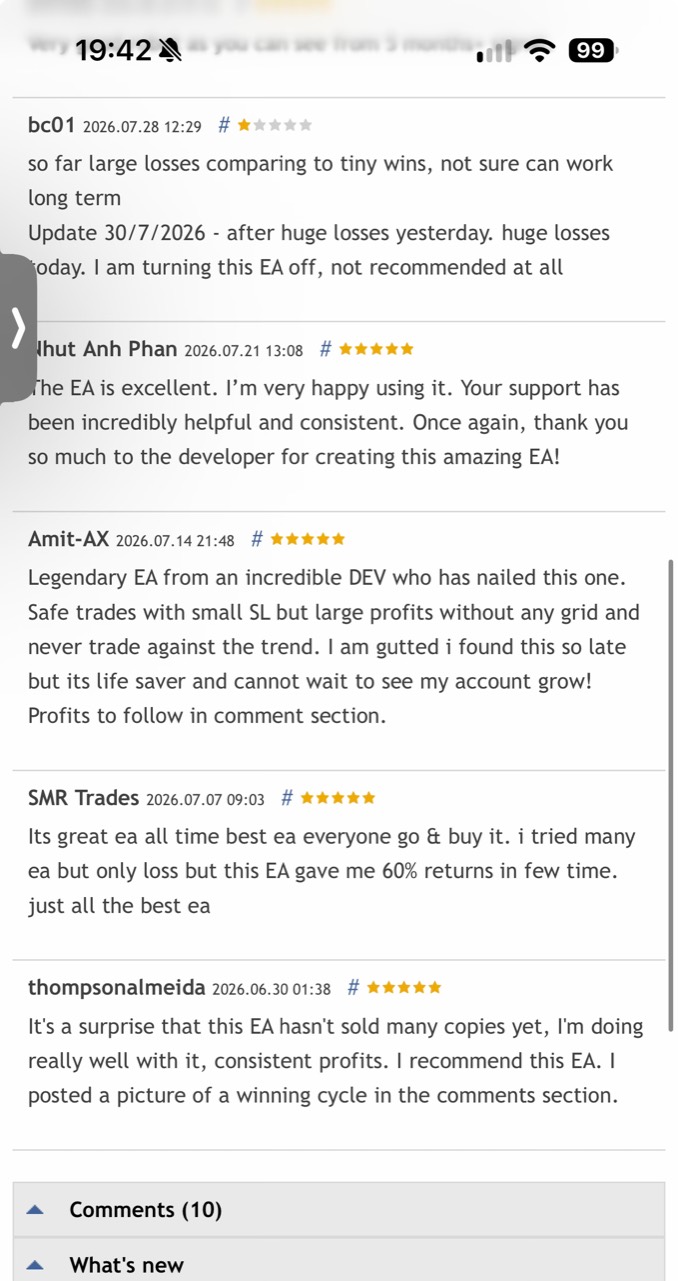
Nhut Anh Phan’s 21 July entry particularly praises ongoing developer support. Amit-AX’s 14 July review is enthusiastic about the stop-loss and trend approach, but its promised follow-up results are not a verified account record in that review. SMR Trades claims a 60% return without a dated statement that would establish risk or repeatability. Thompsonalmeida describes consistent profits and refers to a winning-cycle image in the comments; an individual cycle cannot show the full account drawdown.
The same screenshot includes bc01’s July loss report and update. Showing that alongside the praise gives a more useful picture than selecting positive stars alone. These entries predate the August version 1.30 release, so neither their praise nor their criticism establishes how that specific build performs. The sample is small, and broker settings and account histories are not consistently supplied.
What changed in version 1.30?
The 2 August release notes describe revisions to the six-layer strategy, parameter optimisation and minor stability fixes. Earlier updates addressed Maximum Spread in 1.21, weekend order deletion and panel drawdown display in 1.20, and a Daily Drawdown Control inconsistency in 1.11.
Those changes make build and preset consistency important when comparing old screenshots or tests. The developer’s stated aim of improving performance does not prove that every configuration improved. No separate public manual or public signal preset was found; comments direct original customers to private setup guidance.
Who is it for?
At $79.95, SixtyNine EA is an accessible option for an MT5 gold trader who wants defined exits and is willing to evaluate execution and sizing carefully. Its documented structure is appealing if you prefer to avoid averaging recovery, but that preference does not remove loss risk.
Start by comparing the intended preset with your broker’s contract, spread and trade history. Assess drawdown and losing sequences alongside growth. This review uses public sources and original dated captures; we have not independently live-tested the software.
SixtyNine EA review FAQs
Is the SixtyNine EA signal on MT5?
Yes. The linked signal runs on VantageMarkets-Live 15 and trades XAUUSD+. It is a separate account whose results are not guaranteed for another installation.
Is the full signal history a test of version 1.30?
No. The account history predates the August 2026 release of version 1.30, so the entire return must not be attributed to that version.
Are all customer reviews positive?
No. The six visible MQL5 entries included praise and one strongly negative report about losses. These are customer opinions, not CheaperForex verified-purchase ratings.
Have we independently live-tested the EA?
No. This review examines the developer listing, public signal, release notes and customer discussion captured on 12 September 2026.