
WeekAnchor Eight EA MT5 Review: Weekly Strategy, Signal and Preset Risks
WeekAnchor Eight EA MT5 manages an eight-pair, long-only Forex portfolio from one chart. It anchors entries to the weekly open, uses daily ATR-based protective levels and normally enters early Monday for a roughly one-day holding cycle. Our assessment: the appeal is a distinct weekly schedule with explicit pair controls and detailed sizing disclosures. The main consideration is correlated currency exposure: a short live record and optional protection should not be mistaken for a permanently low-drawdown portfolio.
View WeekAnchor Eight MT5 features and current pricing

- Developer source link: WeekAnchor Eight EA MT5 on MQL 5
- Live signal link: Current WeekAnchor Eight EA MT5 account
- Manual / presets: Developer downloads and setup comments
Sources checked 16 September 2026: current listing, release notes, public comments, current preset ZIP and README, five gallery images, live signal and two customer reviews. This is a source-based analysis, not our own executable test.
A weekly anchor, not an everyday scalper
Entry timing is built in around the beginning of the broker’s trading week. Daily ATR defines protective distances and positions are generally closed about 24 hours later. Running it on additional charts does not add useful coverage; the developer instructs one instance to manage the basket. A VPS matters because missing the short Monday window can mean no entries for that week.
The supported list contains five JPY pairs, two additional CHF crosses and GBPUSD. One source paragraph says six of eight are JPY crosses, but the actual eight-symbol list contains five; the currency concentration remains material either way. Long-only does not mean low risk when several related pairs fall together.
Current presets supersede the old comments
The newest public preset pack contains twelve files and explicitly sets the equity-stop percentage to zero. Older July comments still advertise a 15% equity stop and describe a fixed-lot file as matching the live signal. The current listing and README override those statements: the signal is a separately operated account whose lot sizes and options can change without preset updates.
The developer reports that a 15% stop interrupted the long historical run rather than providing a rarely used backstop. That is a trade-off, not proof that disabling protection is universally preferable. In another disclosed test, the fixed-lot basket on $300 reached a 74% drawdown relative to starting capital. The ability to submit 0.01-lot trades on a small balance should not be confused with prudent funding.
Per-pair risk and broker minimum lots
The current README gives approximate balance thresholds for taking every measured trade: $10, 000 at 1%, $5, 000 at 2%, and $1, 500 at 3% per pair. These are developer-measured configuration thresholds, not guarantees or a recommendation to increase risk. When the calculated lot is below the broker minimum, trades can be skipped. Forcing the minimum lot instead raises effective risk above the selected percentage.
The spread filter is part of the strategy. The developer’s long test changed from profitable to slightly negative when it was disabled, with much deeper drawdown. That is a simulation claim, but it explains why a wider-spread broker producing fewer trades is not a reason to turn the filter off.
Crisis Guard and basket de-risk do different jobs
Crisis Guard is an optional reaction to yen-strength stress: it can skip entries, bring profitable positions toward break-even and close this EA’s positions when a basket crisis develops. It is off by default and cannot eliminate gap risk. Basket de-risk instead uses the prior trading day’s activity to reduce the next weekly lot. It never increases the configured lot and is also off by default.
At 0.01 lots on the documented volume-step setup, reductions round back to the minimum and the feature disables itself. At 0.02–0.04 only coarse steps remain; 0.05 and its multiples allow the full intended ratios. The developer estimates around $5, 000 for the 0.05-per-pair example. More capital and a smaller exposure ratio matter more than the presence of a switch.
Long and short simulations must stay separate
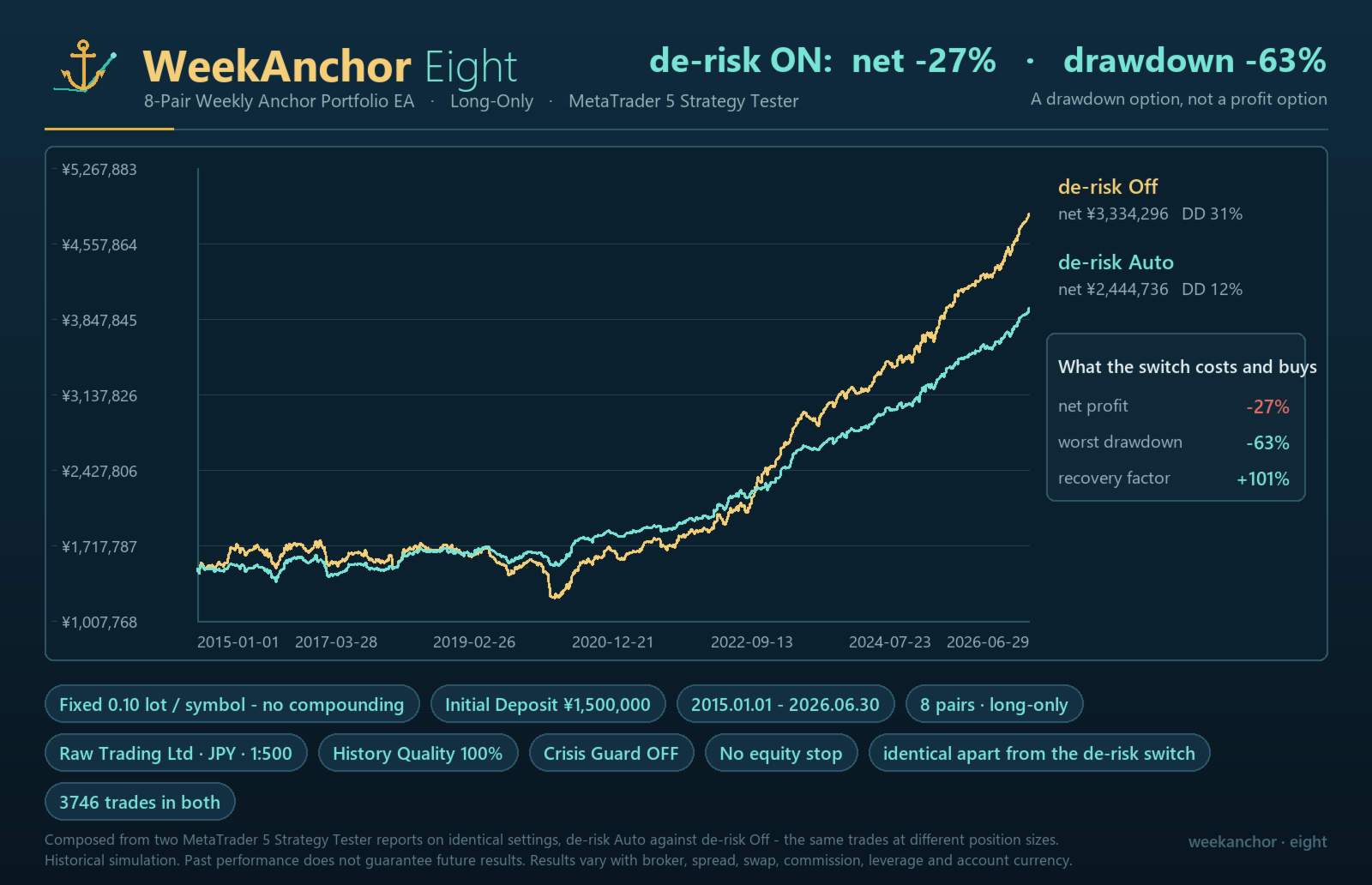
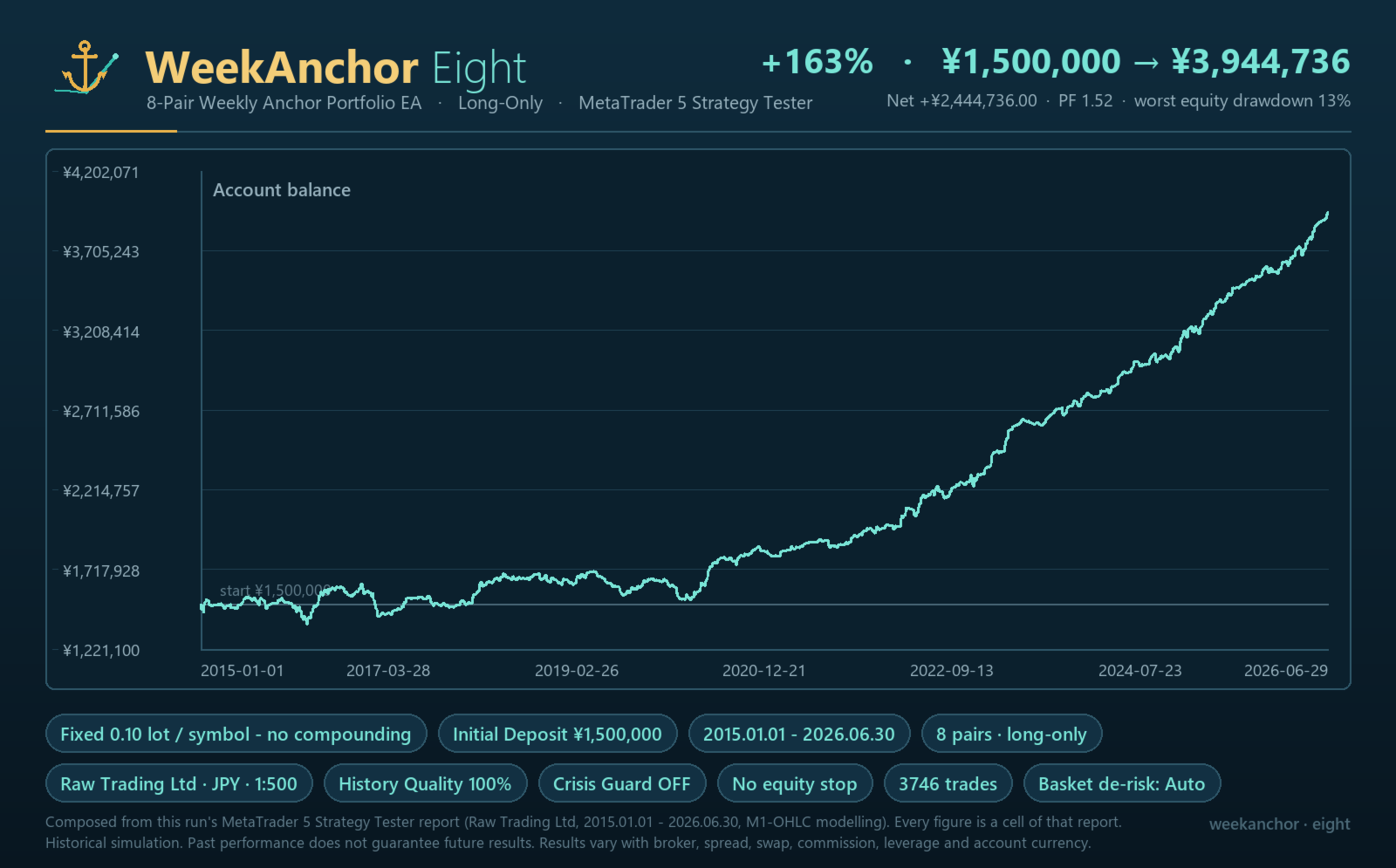
The long gallery example runs January 2015–June 2026 with fixed 0.10 lots per symbol, JPY 1.5 million starting capital, basket de-risk Auto, Crisis Guard off and no equity stop. It displays +163%, profit factor 1.52 and roughly 13% worst equity drawdown. Its footer identifies M1-OHLC modelling: a 100% history-quality label does not turn it into a real-tick test.
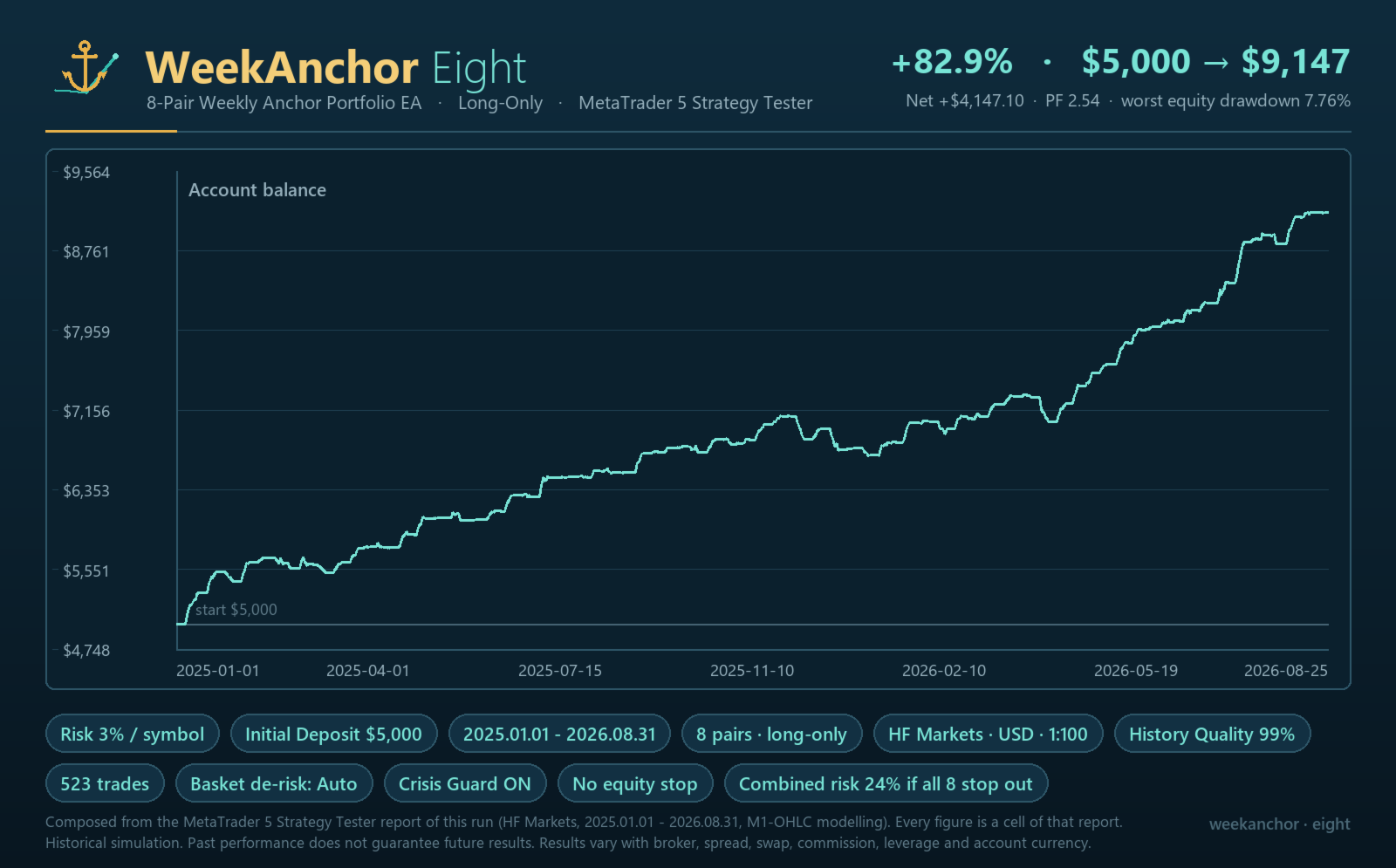
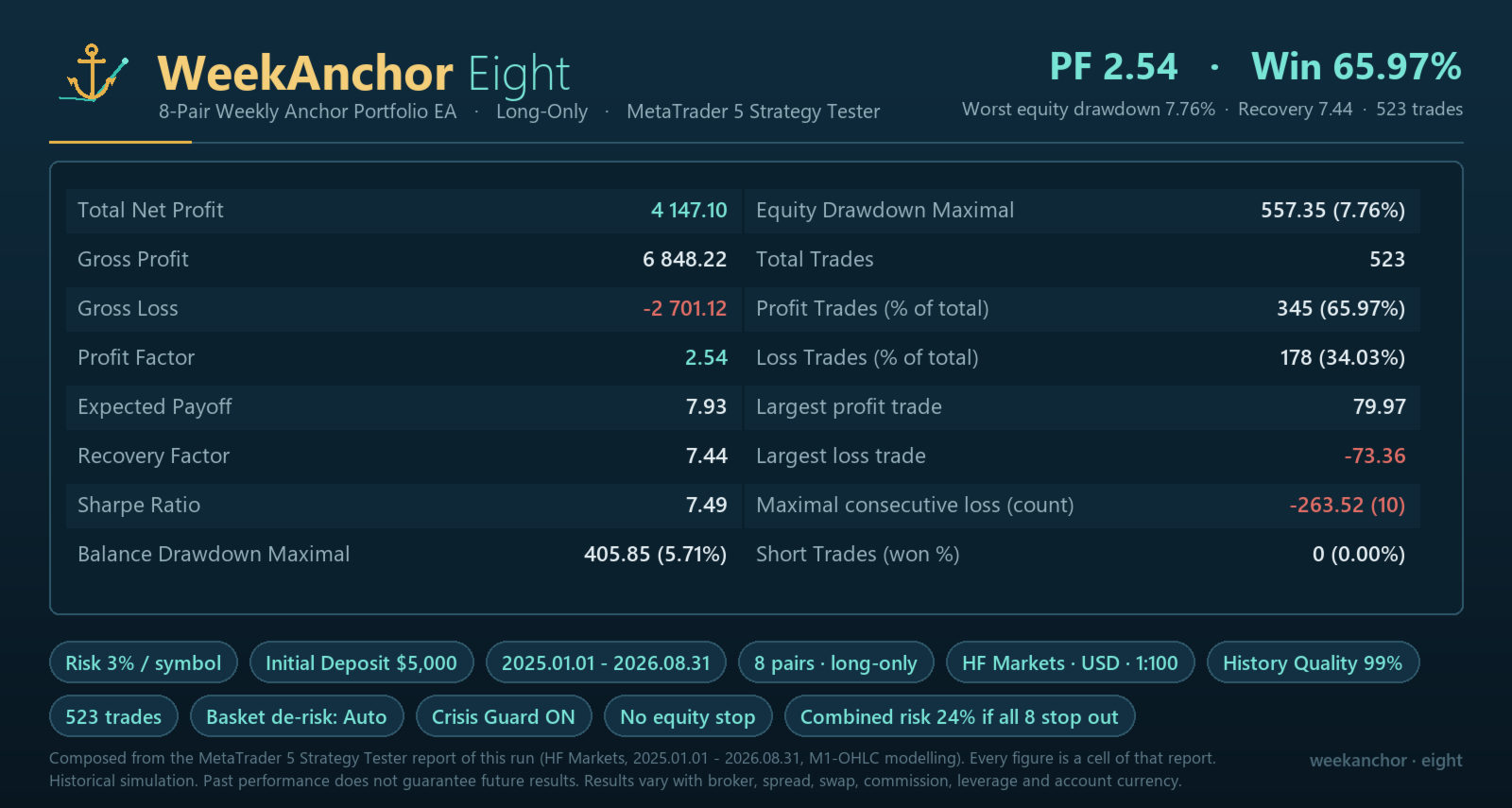
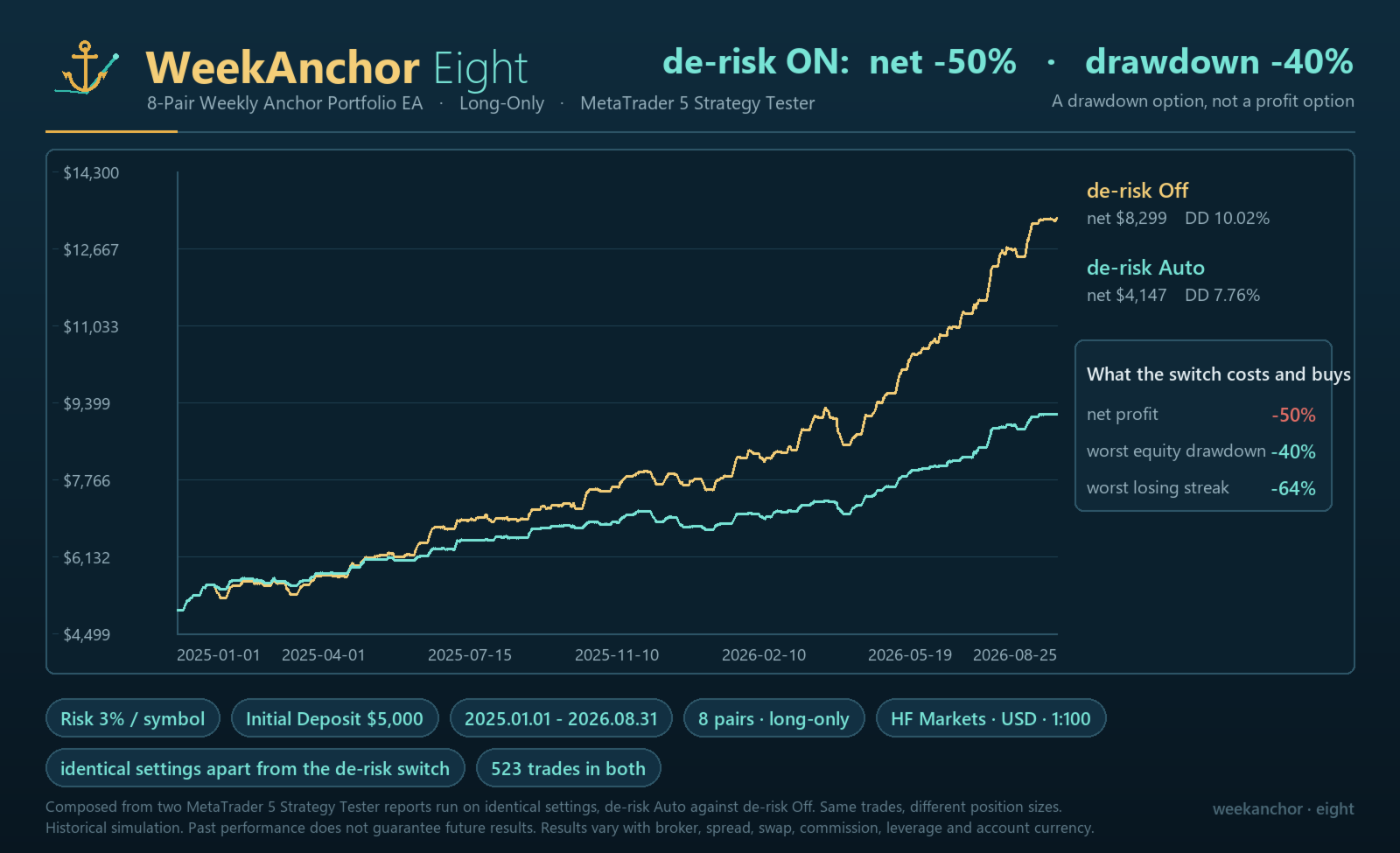
A separate January 2025–August 2026 USD simulation uses 3% risk per symbol, $5, 000 starting capital, 523 trades and Crisis Guard on. It reports about +82.9%, profit factor 2.54 and roughly 7.8% equity drawdown. These figures belong to a different configuration, period, currency and sizing method.
The corresponding de-risk comparison labels a 40% drawdown reduction while displaying 10.02% versus 7.76%, a reduction of approximately 22.6% in those printed percentages. Different denominators or monetary measures may be involved, but the image does not reconcile them. We retain the original and do not repeat its headline as a verified calculation. The longer comparison and the developer’s own out-of-sample notes also show that protection costs profit and effects vary by sample.
Live signal: encouraging early results, changing capital
On 16 September 2026, signal 2378669 was labelled a real MT5 account on HFMarketsGlobal-Live 17. It showed 41.08% growth, $128.18 profit, 78 trades, 62.82% winners and profit factor 3.51. Relative balance drawdown was 4.63%; relative equity drawdown was 3.90%. These are distinct fields, not interchangeable risk figures.
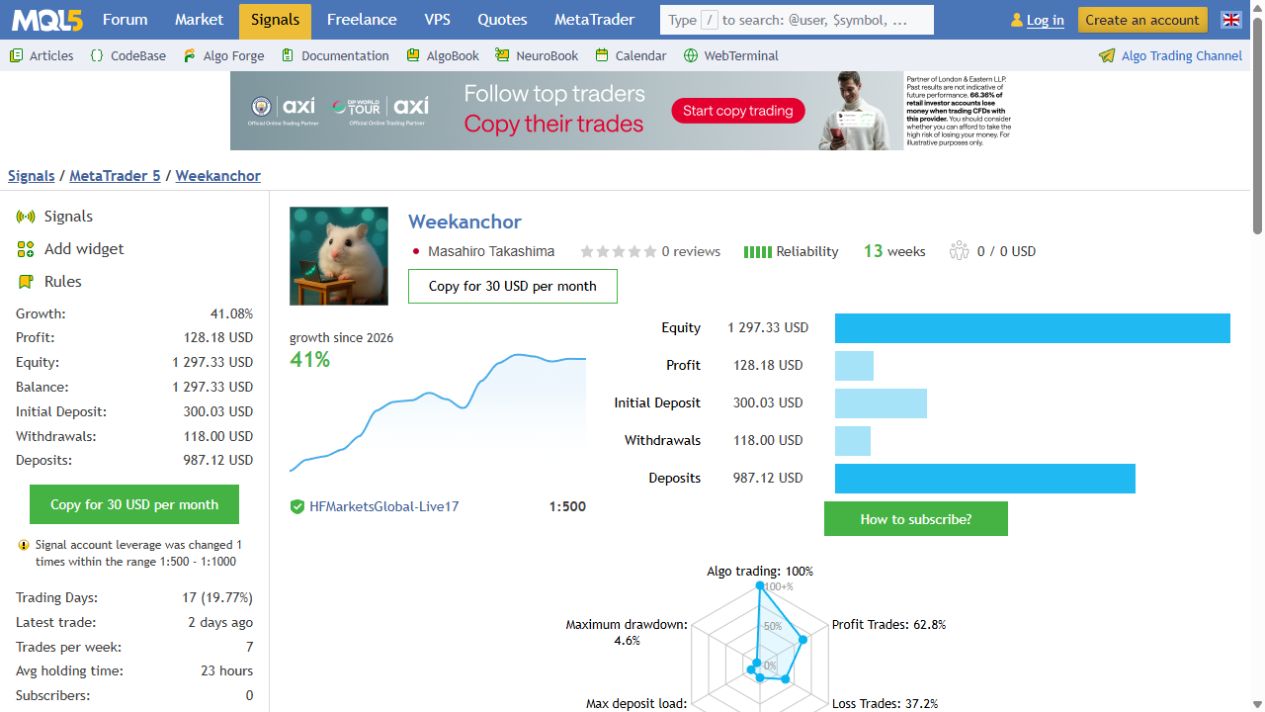
The page displayed 13 weeks and a Started date of 20 June 2026. All 78 trades were long, with a 23-hour average holding period. September was−0.64% to the check. Initial deposit was $300.03, later deposits $987.12 and withdrawals $118; current balance/equity was $1, 297.33. Those cashflows mean balance growth alone is not a performance calculation, and the small initial deposit is not a recommended capital level.
The live account does not validate the entire 11.5-year backtest or the latest optional features across that span. Its current configuration is discretionary, so a downloaded preset is not a promise of the same trades or returns.
Customer reviews: supportive, but short histories
Two MQL 5 product reviews were visible. Thomaslampe 65 described about a month on a Fusion Markets demo account, reported 6.9% growth over 49 trades, praised detailed support and said a real-account trial had just begun. Those are the reviewer’s statements, not independently verified results. Autumn’s earlier recommendation followed only two weeks of use, too short to establish long-term robustness.

The captured rating header identifies the first review; the source link opens its complete written account. Both reviews predate the September preset change. We do not import their stars as CheaperForex verified-purchase ratings.
Practical conclusion
The weekly schedule, per-pair controls and unusually explicit trade-offs give buyers useful material to evaluate. Keep the current spread filter and preset documentation in view, distinguish per-pair from aggregate risk, and assess the live record as a young account. Optional Prop Firm Mode observes account equity but only closes this EA’s trades; it is not a guarantee of meeting any firm’s rules.
Also by Masahiro Takashima
NightAnchor EA MT5 uses night-session mean reversion across up to twenty pairs. Read its separate strategy and signal review. Shared currency exposure means running both does not automatically create independent diversification.