
NightAnchor EA MT5 Review: Live Signal, Overnight Exits and Basket Risk
NightAnchor EA MT5 trades night-session Forex mean reversion across up to twenty pairs from one chart. Two-sided limit entries, small profit targets and a time-decay exit ladder aim to capture a return toward the overnight price anchor. Our assessment: its appeal is a clearly described overnight entry-and-exit process with adjustable selectivity. The main issue is the unequal payoff: many small wins can be offset by fewer large losses, especially when CHF-linked positions share a shock.
View NightAnchor MT5 features and current pricing

- Developer source link: NightAnchor EA MT5 on MQL 5
- Live signal link: Current NightAnchor EA MT5 account
- Manual / presets: Developer downloads and setup comments
Sources checked 16 September 2026: current listing, release notes, public owner’s manual and preset, four original gallery images, live signal and one customer review. This is source-based research, not our own trading or code audit.
How the night-session entry works
Buy limits sit below the anchor and sell limits above it. The intended opportunity is an overnight extension that reverts rather than continues. Regime checks can cancel pending orders in an unfavourable trend or volatility expansion. A small target of about 8–11 pips and a gradually reduced exit target handle successful reversions. Unfilled orders are cancelled as the window closes.
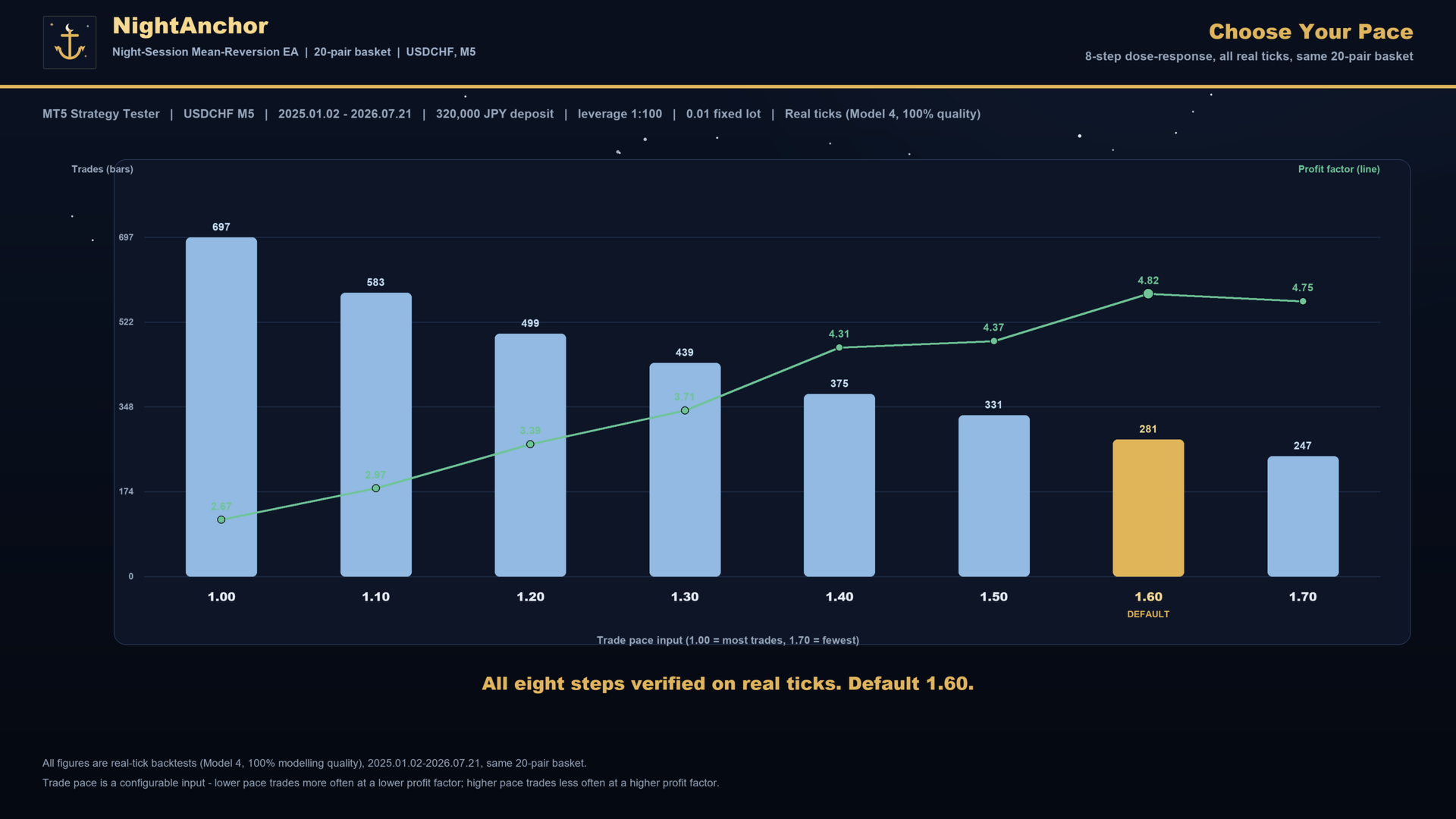
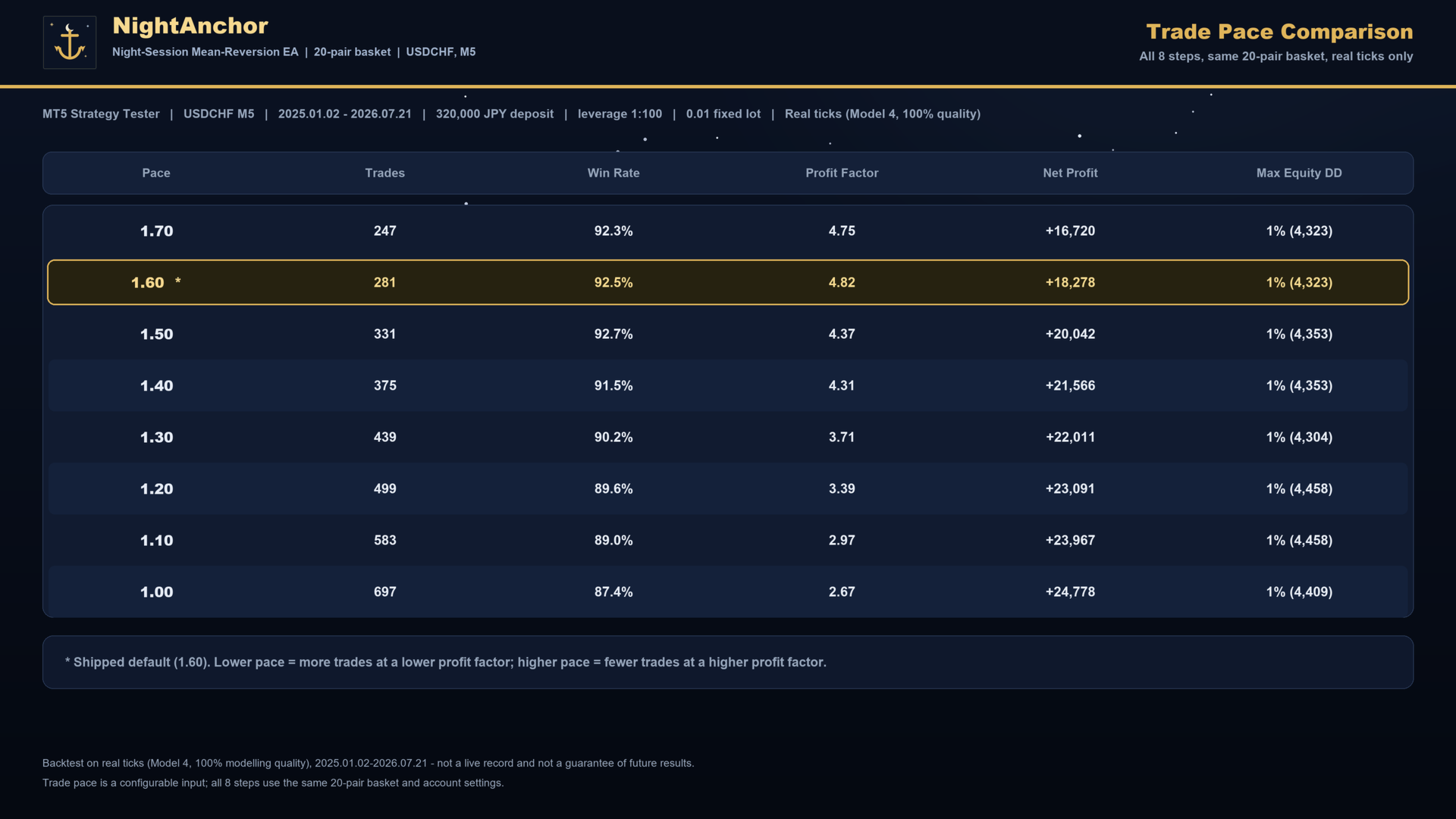
Trade pace 1.60 is the default. Moving toward 1.00 places orders closer and generally increases fills, while 1.70 is more selective. A raw-spread broker, commissions and the actual rollover spread strongly influence a small-target strategy. Daytime spreads do not describe the cost at the entry window.
Hold-to-recovery and the meaning of the equity stop
When the exit ladder reaches its final step, an underwater trade is not forcibly flattened. It can remain until recovery or its wide 40–80-pip stop, sometimes into the next day and occasionally across a weekend. The equity stop only stops new orders. Existing positions continue to their own exits, and a gap can cross the stop price.
The older gallery’s claim that the EA never holds into the next day conflicts with both the current listing and its manual. The current hold-to-recovery explanation takes precedence. Small realised drawdown can conceal deeper temporary floating losses; this is why the funding ratio and equity history matter.
Funding and correlated basket exposure
The stated funding guidance is 150, 000–320, 000 JPY equivalent per 0.01 lot, with a hedging account, raw/tight spreads and recommended leverage of at least 1:100. The manual’s illustrative simultaneous-stop scenario reaches about 7% on its default 320, 000 JPY account, 14% at Risk 1, 29% at Risk 2 and 43% at Risk 3. These are modelled scenarios, not guaranteed worst-case caps: discontinuous gaps can be worse.
Several basket pairs share CHF exposure. The manual separately describes a much more severe theoretical gap scenario, so its nominal-stop figures should not be presented as a maximum possible loss. One instance per account is supported; adding another chart can duplicate exposure rather than diversify it.
Current releases correct older manual instructions
The public PDF is labelled an earlier release. It remains useful for setup and structural risk, but current notes supersede several details: withdrawals now re-anchor the equity-stop baseline; the optional news filter uses a fixed FOMC-date table; and the year-end pause is now optional and off by default. We do not repeat the old manual’s manual-reset, live-only-calendar or automatic-holiday-pause claims as current behaviour.
The 15 September release fixes a position-cap check that previously ran only before pending orders filled. It now checks each tick and cancels remaining pending orders when the cap is reached. Multiple fills within the same tick can still exceed the cap. This matters if using a cap below the default 20.
Shock Guard is optional and off by default. It detects unusually large daily ranges already visible before orders are placed; currency propagation can also block related pairs. It cannot predict a new shock that begins afterwards. Trailing is also off by default, with the developer reporting that its test cut winners without improving drawdown.
Backtest figures: older images and current table differ
The original gallery and manual show a January 2025–July 2026 real-tick sample of 281 trades, 92.5% wins, profit factor 4.82 andJPY 18, 278 net profit onJPY 320, 000. The current description instead gives 292 trades, 92.1% wins, profit factor 4.91 andJPY 19, 182 at default pace. Both are developer simulations; we have not reproduced either and do not silently blend their figures.
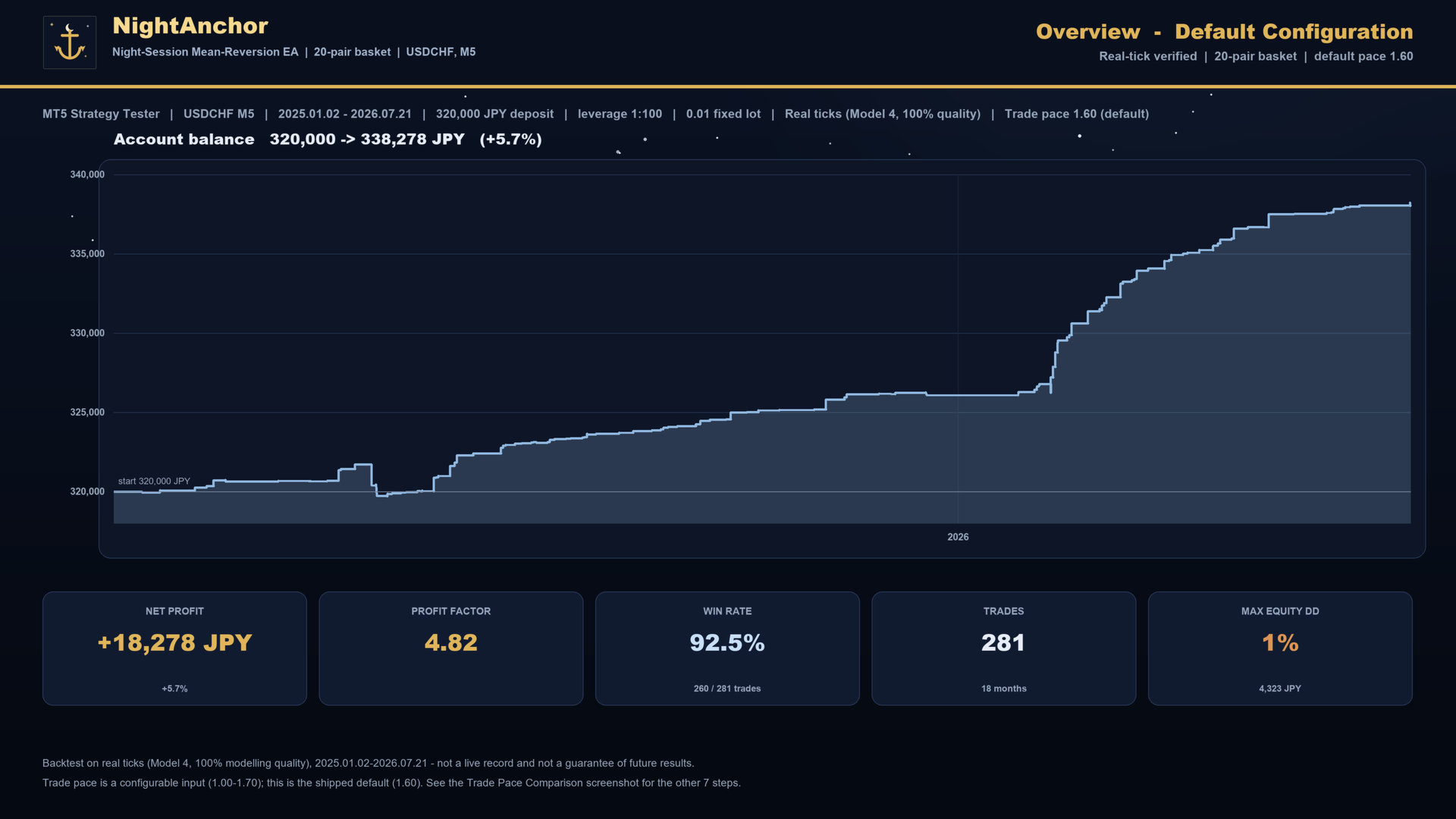
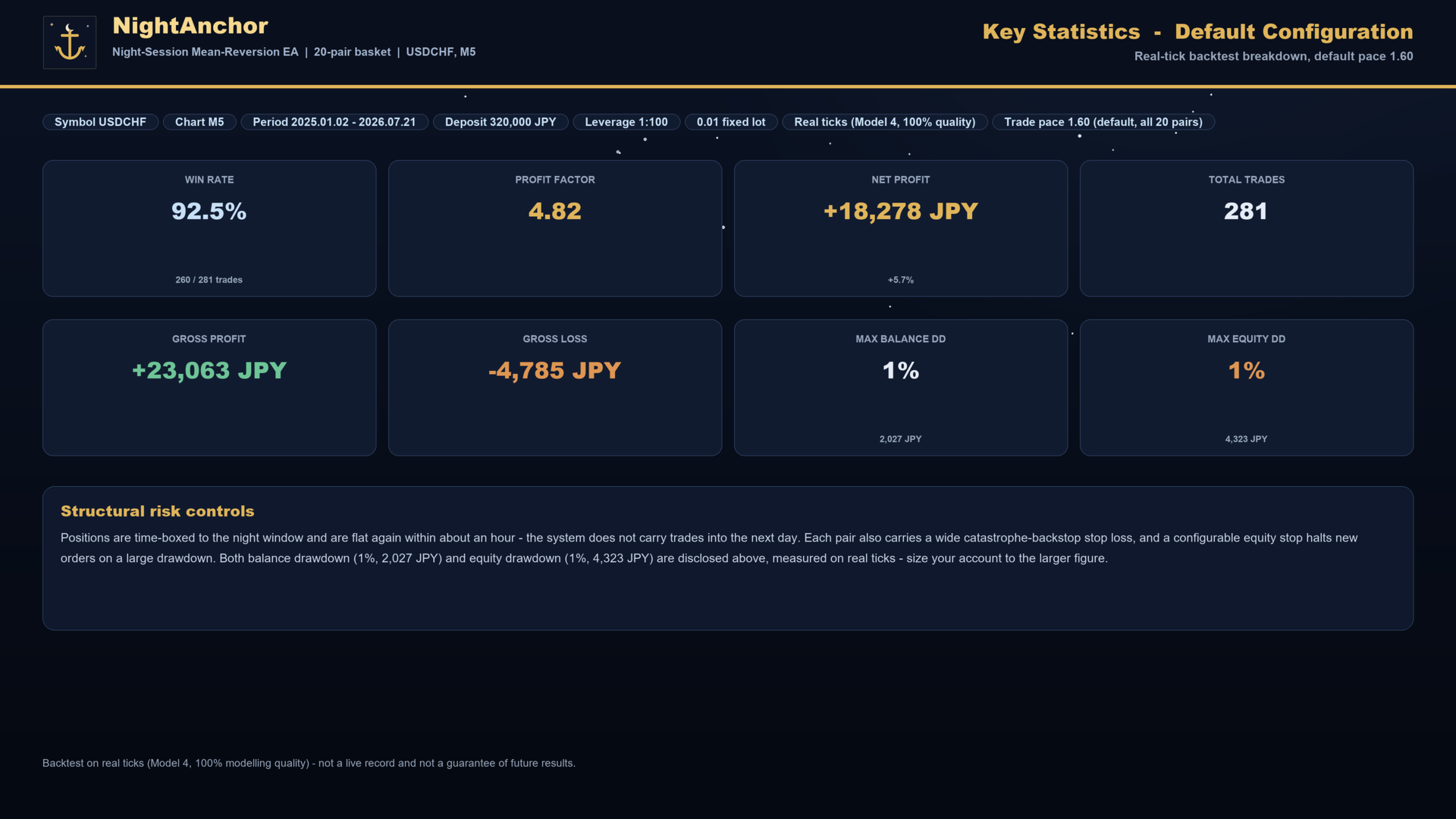
The gallery rounds maximum equity drawdown to 1%, but also printsJPY 4, 323; its balance drawdown amount isJPY 2, 027. Rounded labels conceal differences. The pace table compares selectable configurations on the same historical data and does not establish that its best-performing setting will remain best on a different feed.
Live signal: modest growth with a different setup
Signal 2380654, named NightAnchor SG ON Lookback 1 at the check, was labelled real on HFMarketsGlobal-Live 9. It showed 5.47% growth, $9.68 profit, 95 trades, 86.31% wins and profit factor 1.54. Relative equity drawdown was 7.89%, versus 4.69% relative balance drawdown. Average win was $0.34 and average loss $1.38; the worst trade was−$5.13.
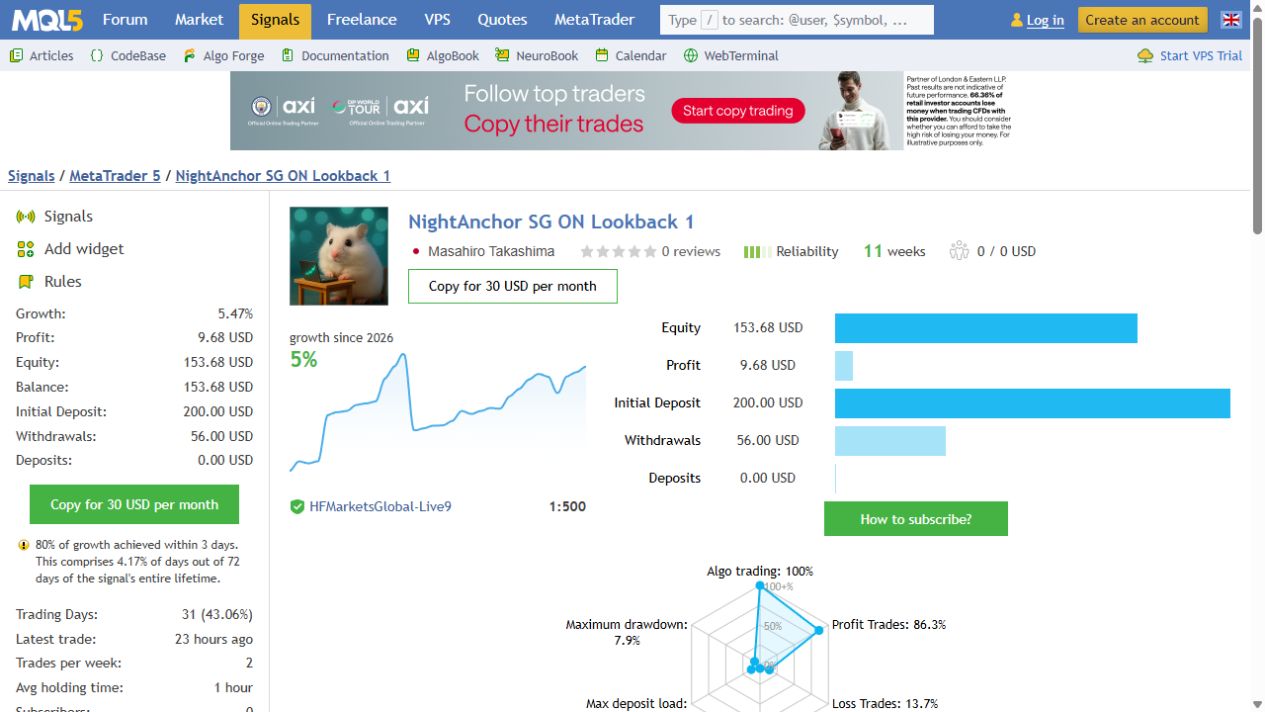
The page showed 11 weeks and a Started date of 4 July 2026, with initial deposit $200 and withdrawals $56. The resulting $153.68 balance is consistent with those cashflows and profit; it is not evidence of a 46-dollar trading loss. Nor does that small account establish that the recommended funding floor can safely be ignored.
MQL 5 warned that 80% of growth occurred within three days. The current signal name identifies Shock Guard ON, whereas published default simulations use it off. The name does not prove that all earlier trades used the same settings. A high win rate over this short record does not resolve the overnight tail risk.
Customer review and practical setup
One product review was visible: Autumn’s 29 July recommendation praises its use alongside another night scalper. It offers no dated account statement or detailed drawdown evidence. This is useful sentiment about a user’s experience, but not verification of profitability or proof that combining night scalpers diversifies risk.

Attach once, preferably to USDCHF M5, and deploy during server daytime. Read the startup report for hedging mode, resolved symbols and the trading window. Live GMT/DST detection does not remove the need to set the correct manual timezone inputs in Strategy Tester. When removing the EA, check broker-side pending orders: disabling the terminal’s algorithmic trading does not automatically cancel them.
Also by Masahiro Takashima
WeekAnchor Eight EA MT5 uses a weekly long-only portfolio across eight pairs. Read its separate strategy and signal review. Shared currency exposure means running both does not automatically create independent diversification.