
Prototype AI MT5 Review: Presets, Backtests and Customer Feedback
Prototype AI MT5 is an XAUUSD trading robot built around adaptive market analysis, with public M15 presets, position-count controls and ATR-based trailing settings. Developer Aleksei Butler describes momentum, volatility and market-phase filtering for both trending and ranging gold markets. Our assessment: the public preset files make its controls more concrete than the broad AI description. The main considerations are substantial historical drawdown, no linked live signal and a customer-reported operating error.
View Prototype AI MT5 features and current pricing

- Developer source link: Prototype AI on MQL5
- Live signal link: No public live signal was linked from the checked product listing or seller page on 16 September 2026.
Source check: 16 September 2026. We inspected the listing, both original gallery images, the seller page, customer review, release notes and all three public settings files. This is a source-based review, not an independently traded test or code audit.
What the adaptive strategy claim establishes
The developer describes a system that evaluates gold-market momentum, volatility, liquidity and market phases, changing entry and trade management with conditions. This is a description of intended behaviour. The public material does not disclose a model architecture, training dataset, entry formula or independently validated AI advantage. It also does not establish that grid or martingale behaviour is absent.
The public presets: M15 and concrete controls
Each file explicitly identifies Gold (XAUUSD), M15. Conservative sets Money_Lot_Percent to 1.0 and maximum positions in one direction to 1. Balanced uses 2.0 and 3. Aggressive uses 3.0 and 0. The files do not explain whether zero removes the cap or has another meaning, so treating it as a safe limit would be unjustified.
All three select Money_Management=2 and include a fixed-lot input of 1.0. The enum mapping and whether that fixed field is active are not documented in the archive. A percentage input can refer to allocation or margin rather than loss at a protective stop; do not read these values as a proven 1%, 2% or 3% maximum account loss. Confirm the actual calculated lots in a demo account.
The presets share an InpGMT value of 15, a magic number, a position-mode setting and a digits adjustment. The GMT encoding is unexplained and must not be blindly treated as a conventional UTC offset. Entry-distance filtering and breakeven are disabled. ATR trailing settings include period 96 and minimum/maximum percentage values of 0.6 and 2.0. Those settings describe controls, not independently verified protective behaviour.
Download the original developer preset archive · View the dated developer settings post
Long backtest: rising curve, substantial relative drawdown
The first report covers 1 January 2020 to 1 August 2026 and is labelled Fixed Margin, Percent 10. It shows an initial deposit of 1,000, 2,991 trades, profit factor 17.30 and a 90.87% winning-trade rate. Its net profit is an extraordinary 539,733,290.51 in the report’s unspecified account currency. This is the developer’s simulation, not money independently shown to have been earned.
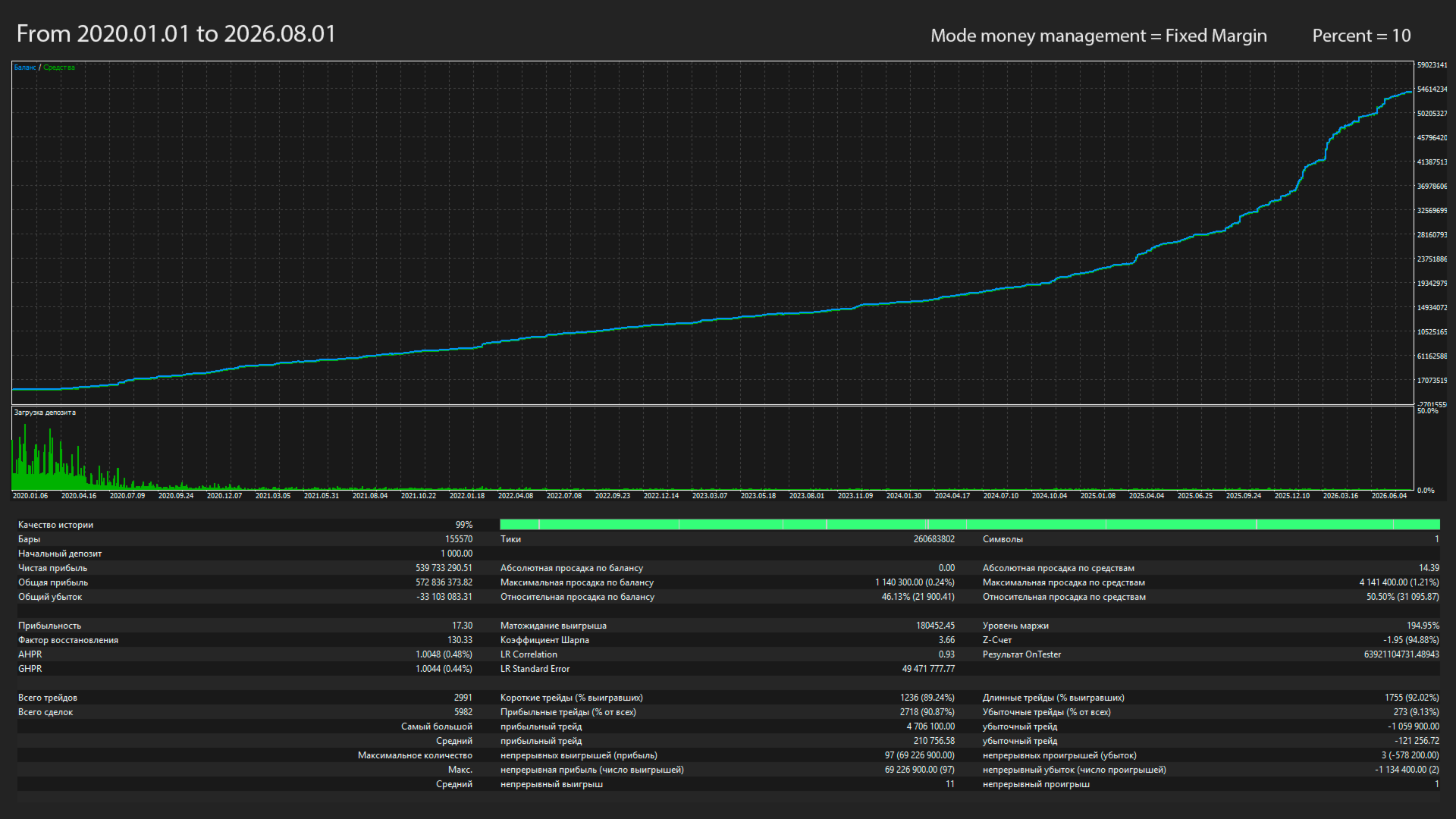
Crucially, relative balance drawdown is 46.13% and relative equity drawdown is 50.50%. The separate maximal-money drawdown rows show much smaller percentages at different points on the compounded balance curve. Those small percentages do not replace the relative drawdown figures. A large final balance can make a historical chart appear smoother than the early account risk was.
Shorter backtest: overlapping history, different drawdown
The second report covers 1 January 2025 to 1 August 2026, again with Fixed Margin, Percent 10 and a 1,000 initial deposit. It reports 785 trades, profit factor 26.56, 93.89% winning trades and net profit 300,987,283.84. Relative balance drawdown is 16.46%; relative equity drawdown is 23.85%.
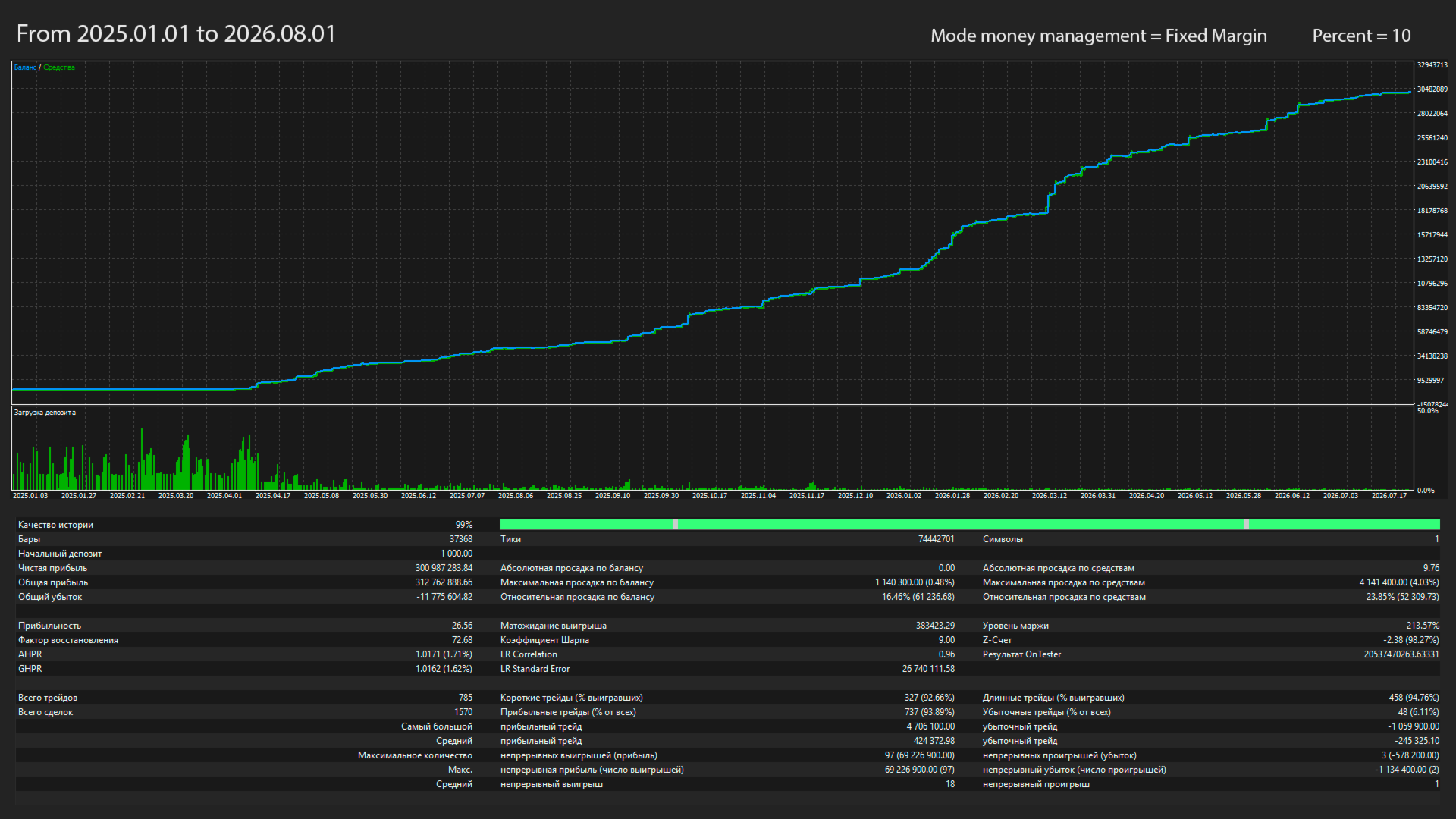
This period sits inside the longer test. It is not a second independent live record or an out-of-sample validation merely because it appears as a separate image. Both show 99% history quality, but that label alone cannot establish realistic execution, spread assumptions, commissions, slippage or reproducibility. The gallery’s 10% setting also differs from the later published presets. We have not reproduced either result.
Customer review: read the text, not just the stars
The one visible MQL5 review, dated 5 September 2026, says: “i losed my money error 4806”. The interface displays five stars, yet the written experience is negative. Presenting the stars alone as endorsement would misrepresent the feedback.

The comment is too brief to establish account settings, the sequence of trades, the cause of losses or whether the error persists. It is nevertheless relevant operational feedback. It is not a CheaperForex verified-purchase review, and its rating has not been imported into our product ratings. Read the current MQL5 customer review
What the later update does—and does not—confirm
The 12 September 2026 release notes mention stability, error fixes, calculation and signal-processing improvements. That update follows the customer comment, but does not name error 4806 or provide a specific resolution. We therefore do not claim the complaint has been fixed. Read the developer release notes
Live evidence and practical fit
Neither the checked listing nor the seller page links a public live signal. The public evidence here consists of historical simulations, presets and one short customer experience. The high MQL5 asking price is not evidence of trading quality. Prototype AI is most relevant to users willing to test gold automation carefully, inspect terminal logs and validate sizing and exits on their intended broker before committing live capital.