
Last updated: May 2026
Gold Safe EA is a relatively new entrant on the MQL5 marketplace — Anton Zverev’s M1 XAUUSD algorithm first appeared in February 2026 and has accumulated 12 weeks of verified live signal history alongside a perfect 5★ rating from early MQL5 buyers. The MT5 build (the original release) and the newer MT4 port both implement the same architectural approach: multiple adaptive entry strategies combined with a multi-tier Safe Close virtual stop-loss system that closes losing positions at controlled levels before drawdown can compound. The verified live signal shows a 99.04% win rate across 105 trades with a worst trade of just -$1.95 — eye-catching numbers that warrant both serious attention and honest scrutiny.
View product details and current pricing.
This review examines what Gold Safe actually does, what the verified data really shows, where the “200% in 30 days” marketing language overstates realistic forward expectation, and whether the algorithm is appropriate for your specific trading profile. We’ll look at the Safe Close architecture in detail (the feature that sets Gold Safe apart from typical XAUUSD algorithms), break down the 3-year backtest including the parts that should temper enthusiasm, and assess the 12-week live signal track record against the broader landscape of XAUUSD EAs.

⚠️ Searching for Gold Safe EA free download? Gold Safe is an MQL5 marketplace product with built-in DRM. Cracked .ex4 / .ex5 files do not exist for marketplace EAs — sites offering “free downloads” deliver malware or non-functional files leading to Telegram payment scams. The EA’s algorithm logic is encrypted within the compiled executable; the file requires legitimate MetaQuotes activation to function. CheaperForex offers Gold Safe at a significant discount with the full unlocked file — MT4 version here | MT5 version here.
The Safe Close Architecture — Gold Safe’s Defining Feature
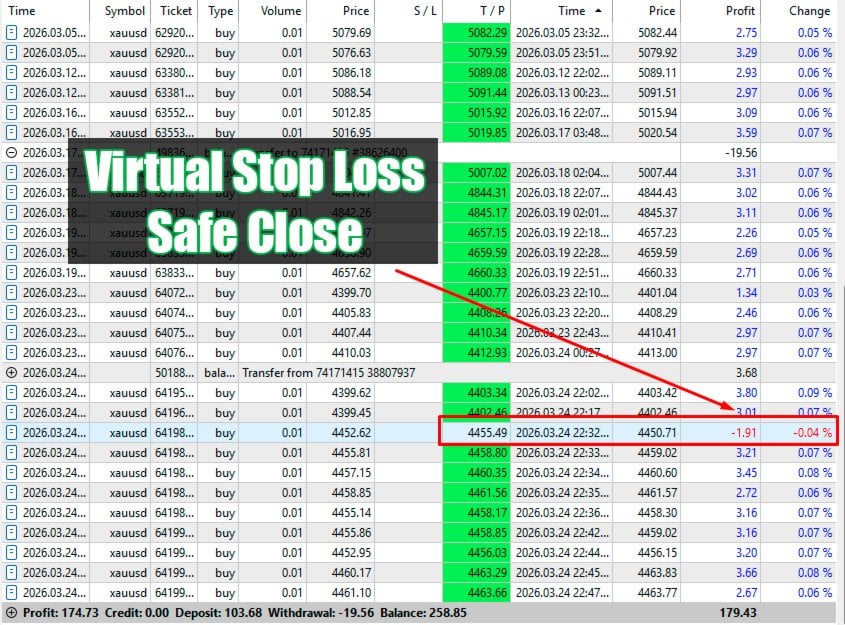
Most XAUUSD algorithms fall into one of two risk-management camps. The first group uses broker-side hard stop-losses — visible to the broker, executed at market when triggered. These provide certainty of execution but are vulnerable to stop-hunting (where market makers move price specifically to trigger clustered stop orders) and can produce poor fills during fast moves where price gaps through the stop level. The second group omits stops entirely, relying on grid or martingale recovery to eventually close baskets in profit. These produce smooth equity curves until they don’t, at which point the lack of stops produces catastrophic single-event drawdowns that destroy accounts.
Gold Safe operates differently. The algorithm uses virtual stop-loss layers — internal logic that monitors each open position and closes exposures at controlled levels when the algorithm determines that further holding would produce worse outcomes than accepting the small loss. The Safe Close annotation in the chart above shows the mechanism in practice: a XAUUSD long position closed at -$1.91 rather than being held through deeper drawdown. The trade still registers as a loss, but the loss is contained at a small fraction of what an unmanaged position might have produced.
Looking at the verified live signal data, this architecture produces a distinctive trade-quality distribution. The signal shows 104 winning trades averaging modest gains (best $32.96) and just 1 losing trade closed at -$1.95. That single losing trade is the Safe Close working exactly as designed — the algorithm identified a trade that wasn’t going to recover and exited at minimal damage rather than holding through worse outcomes. Across 12 weeks and 105 trades, this is the only loss the algorithm has produced. Whether that pattern continues across longer timeframes and different XAUUSD market regimes is the central question Gold Safe will need to answer over time.
The honest limit of Safe Close: The architecture works by closing losing trades at controlled small losses before they grow. It does not work by eliminating losing setups. If market conditions shift such that the algorithm’s adaptive entry strategies stop aligning with subsequent XAUUSD price action, Safe Close will reduce damage on each individual loss but cannot prevent a string of small losing trades from accumulating into meaningful drawdown. The 3-year backtest shows a maximum equity drawdown of 14.67% — modest but not negligible — confirming that even with Safe Close active, the strategy has produced extended periods of unrealised losses. The verified live signal’s 29% maximum drawdown is materially larger and reinforces that “safe” should not be read as “no drawdown”.
The 3-Year Backtest — Honest Analysis
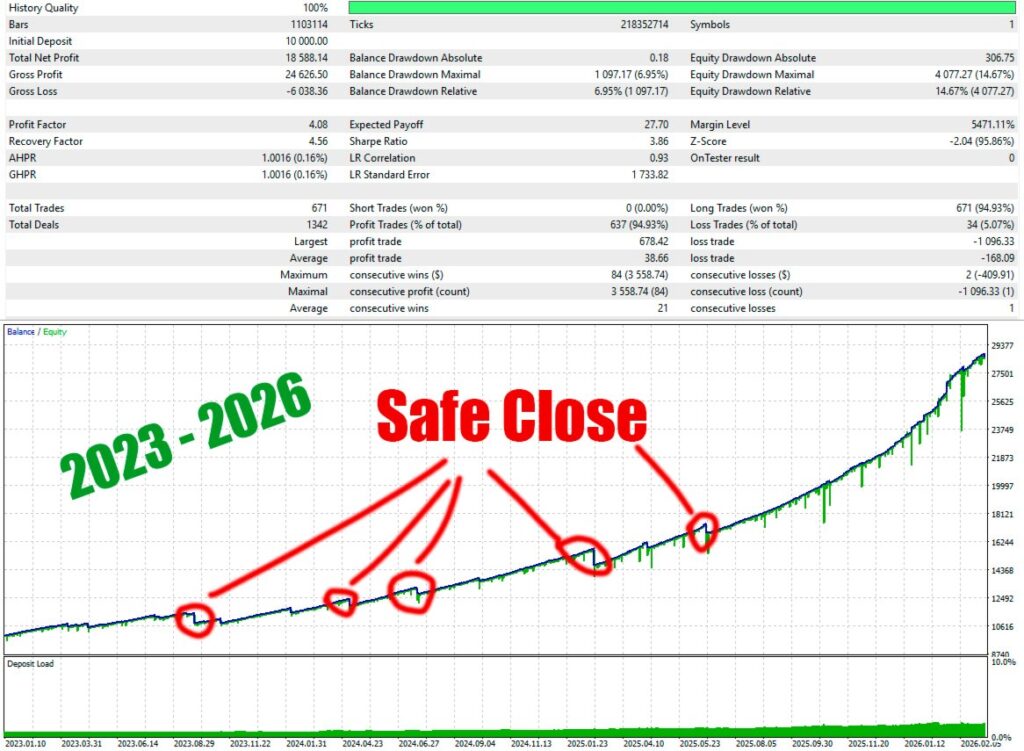
The developer has published a 3-year backtest covering M1 XAUUSD from 2023 to early 2026 at 100% history quality on 218,352,714 ticks. This is exceptional backtest infrastructure — most XAUUSD backtests run at 90% modelling quality or less, and the difference between 90% and 100% on M1 timeframes is substantial because the missing 10% of ticks typically contains the worst slippage events. A 100% history quality backtest is the right starting point for evaluating an M1 strategy.
The headline numbers are strong: $10,000 initial deposit grew to $28,588 net over three years (185.9% return), with a 4.08 profit factor and 4.56 recovery factor. The 94.93% win rate matches the live signal’s even higher 99.04% win rate — consistent with a Safe Close strategy that resolves most uncertain setups by closing at small profits or small losses rather than letting positions run into trouble. The Sharpe Ratio of 3.86 is excellent.
But there are details in the backtest that deserve scrutiny rather than just enthusiasm:
The asymmetric win/loss profile: Average winning trade was $38.66. Average losing trade was -$168.09 — over four times the size of the average win. The largest single losing trade was -$1,096.33, which is 28 times larger than the average winning trade. This asymmetric profile is what gives Safe Close its character: the algorithm produces many small wins, occasional very small losses (per the live signal), but cannot prevent some larger losses when adverse moves outpace the virtual stop evaluation logic. The high win rate masks this asymmetry — the 5% of losing trades carry disproportionately large per-trade losses.
Long-only on Gold during a Gold bull market: The backtest shows 671 long trades and zero short trades. Gold Safe is structurally long-only on XAUUSD. The 2023-2026 backtest period covers a strong Gold bull market driven by central bank buying, geopolitical risk, and currency debasement concerns. A long-only Gold algorithm performs well in this environment — but the same algorithm during a bear Gold cycle (where Gold trends downward over months) would face a fundamentally different challenge. The Safe Close mechanism would still work to cap individual trade losses, but the entry signals would be trying to catch falling knives, and small losses would accumulate without offsetting wins.
The Safe Close events on the equity curve: The backtest equity curve shows five clearly marked “Safe Close” annotations — points where the virtual stop layer triggered to cap drawdown on trades that would otherwise have drawn down further. These annotations are honest disclosure by the developer (most published backtests airbrush such moments). The fact that the curve continues upward after each Safe Close event demonstrates that the architecture works, but the events also show that the strategy is not without losing periods — they’re managed, not avoided entirely.
Equity vs balance drawdown: Balance drawdown was 6.95%, equity drawdown was 14.67%. The 7.7 percentage point gap between balance (realised losses) and equity (unrealised floating losses) tells us that the algorithm at times holds positions in significant unrealised drawdown before Safe Close resolves them. This isn’t a flaw — it’s the normal operation of any algorithm that uses virtual stops rather than hard market stops — but it’s important context. A trader watching their MT5 terminal in real time during a 14.67% equity drawdown event would have experienced very meaningful psychological pressure even though the eventual realised loss was much smaller.
The 12-Week Verified Live Signal
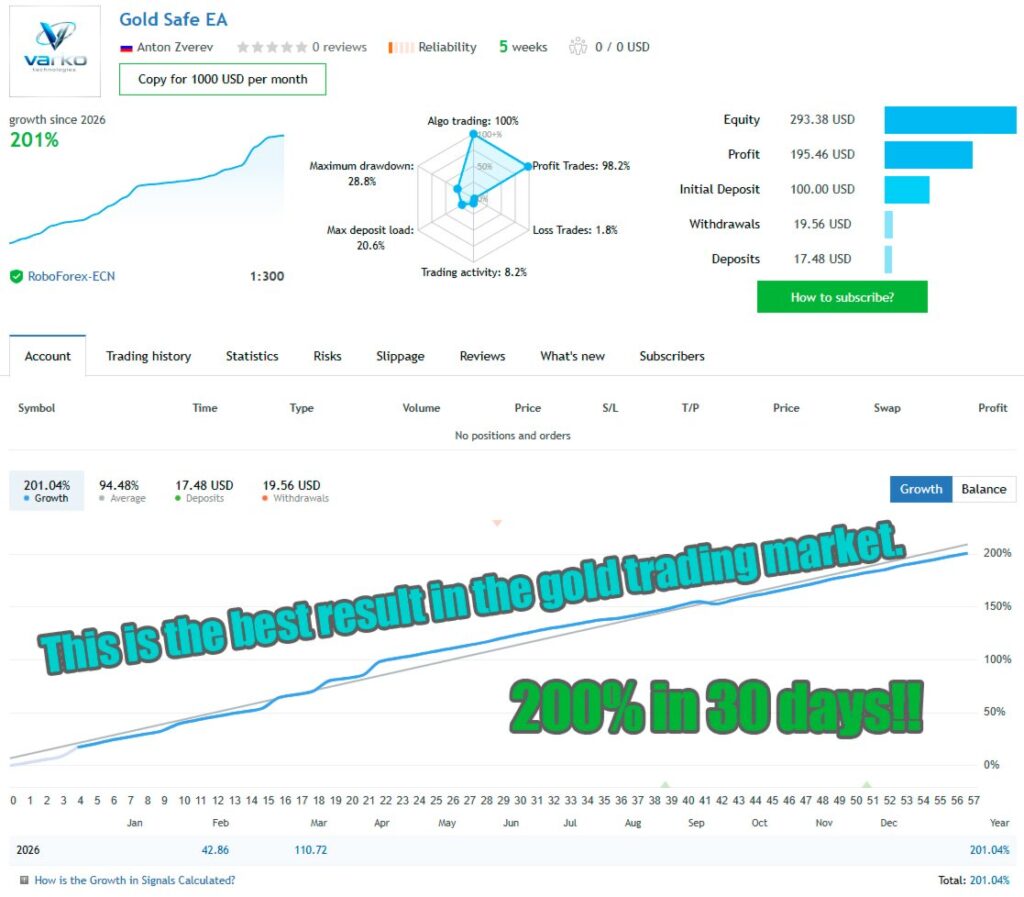
The developer’s verified live signal (signal #2360479) is running on RoboForex-ECN with 1:300 leverage. As of latest fetch, the signal has been tracked for 12 weeks since MQL5 monitoring began. Here’s what the public data shows:
- Track Record: 12 weeks
- Total Trades: 105
- Profit Trades: 104 (99.04%)
- Loss Trades: 1 (0.95%)
- Best Trade: $32.96
- Worst Trade: -$1.95
- Gross Profit: $377.48
- Gross Loss: -$6.99
- Maximum Consecutive Wins: 63 trades
- Maximum Drawdown: 29%
- Trading Activity: 11.12%
- Max Deposit Load: 20.58%
- Sharpe Ratio: 0.98
The 99.04% win rate is the headline number and it’s genuinely remarkable. 63 consecutive winning trades without a loss is the kind of run that XAUUSD algorithms rarely produce. The worst trade of -$1.95 demonstrates the Safe Close architecture working exactly as designed to cap individual loss damage. The 11.12% trading activity tells us the algorithm is selective — it doesn’t overtrade, which is consistent with high-quality entry filtering.
But there’s important context that the celebratory annotation on the screenshot (“200% in 30 days!!” and “This is the best result in the gold trading market”) obscures:
The signal account is tiny. The initial deposit was $100. Total profit across 12 weeks is $377.48. The signal’s published “growth since 2026” percentage is calculated on this small base — a $377 profit on a $100 initial deposit produces dramatic-looking percentage returns, but the absolute dollar amounts are modest. More importantly, percentage returns on small accounts do not necessarily scale proportionally when applied to larger capital. Slippage characteristics, partial fill behaviour, and broker response time during volatile XAUUSD ticks can all differ materially at larger position sizes. A 1.0 lot deployment of the same algorithm on the same broker would face different execution dynamics than the 0.01 lot deployments running on the signal account.
12 weeks is short. Live signal track records under 6 months on the MQL5 marketplace should be treated as proof-of-concept rather than as forward-projection. Many XAUUSD algorithms produce strong 3-month tracks during favourable market regimes, then deteriorate as conditions shift. Gold Safe has not yet been observed through a full XAUUSD market cycle including a bear gold period, a flash crash, a central bank emergency intervention, or any of the other extreme events that test algorithms in ways no backtest can replicate.
The “200% in 30 days” claim is marketing language. The signal annotation positions Gold Safe as “the best result in the gold trading market” — this is not editorial assessment but promotional framing. The 200% in 30 days reflects strong performance during a favourable XAUUSD window on a small account, not a sustainable monthly return projection. Treating this number as a forward expectation would set up unrealistic confidence that real deployment outcomes would inevitably disappoint.
The 29% maximum drawdown matters. Despite the 99% win rate, the signal has experienced a 29% peak-to-trough drawdown at some point in its 12-week history. This is significantly larger than the 14.67% equity drawdown in the backtest, suggesting that live execution has produced harder drawdown events than the historical simulation predicted. This is exactly the kind of finding that argues for treating new EAs cautiously even when the verified data looks strong.
What Early Buyers Are Reporting
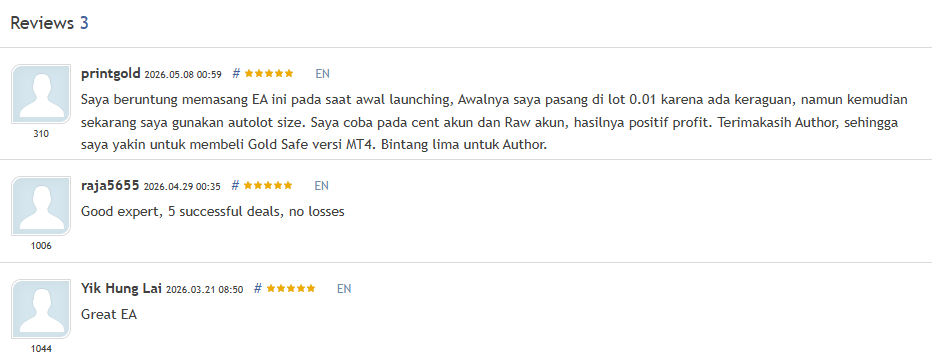
The MT5 listing has accumulated 3 verified buyer reviews, all 5★. The MT4 listing has 2 reviews, also 5★. Combined, that’s 5 reviews across both platforms at a unanimous 5★ rating. The most substantive review is from printgold (May 2026), who described their experience:
“I was lucky to install this EA at the time of initial launch. Initially I deployed at 0.01 lots due to uncertainty, but later switched to autolot sizing. I tested on cent accounts and Raw accounts — results positive profit on both. Thanks to the author, so confident that I’m going to buy the Gold Safe MT4 version too. Five stars for the author.”
The other two MT5 reviews are briefer — raja5655 noted “Good expert, 5 successful deals, no losses” (April 2026), and Yik Hung Lai simply wrote “Great EA” (March 2026).
This is positive feedback but with important caveats:
Small absolute sample size. 5 reviews across both platforms is a tiny sample. By comparison, mature XAUUSD algorithms on the MQL5 marketplace typically have 50-500+ reviews accumulated across multiple years. The unanimous 5★ rating reflects early adopters during a favourable XAUUSD period — these reviews don’t tell us how Gold Safe performs across different market regimes or how the algorithm handles negative buyer experiences (because no negative reviews have surfaced yet on either platform).
Launch-period reviews skew positive. Buyers who purchase near launch and have positive early results tend to post enthusiastic reviews. Buyers who have negative early results tend to wait, troubleshoot, or quietly disengage. The first wave of reviews on any new MQL5 product is typically more positive than the long-term average. Gold Safe’s 5★ rating will likely move toward 4-something over time as a more representative sample of buyers reports across more varied conditions.
Cent and Raw account testing is meaningful. The printgold review specifically notes testing on both cent accounts (small lots, low capital risk) and Raw accounts (real deployment, full broker conditions). Both produced positive profit. This is the right deployment progression and the fact that it produced consistent results on a real buyer’s accounts is encouraging.
MT4 vs MT5 — Which Version To Buy
Gold Safe is available for both MetaTrader 4 and MetaTrader 5. They are separate products on the MQL5 marketplace. The underlying algorithm logic is the same between platforms — same Safe Close virtual SL architecture, same adaptive entry strategies, same XAUUSD M1 focus.
The MT5 version offers:
- Original platform build — first published February 2026, multiple iterations of refinement since launch
- 3 verified MQL5 reviews at 5★ — slightly more buyer feedback than the MT4 version
- The verified live signal runs here — 12 weeks of public broker-confirmed trade data is specifically on the MT5 build
- Faster M1 execution — MT5’s superior order execution speed matters for an M1 algorithm on volatile XAUUSD ticks
- Better backtest infrastructure — MT5’s 100% tick-quality backtests are materially more accurate than MT4’s M1 modelling
- 32 purchases per month on the MT5 listing — the established demand is on this platform
The MT4 version offers:
- MT4 platform compatibility — runs on legacy MT4 brokers and accounts where MT5 isn’t available
- 2 verified MQL5 reviews at 5★ — smaller sample but consistent with MT5 feedback
- Lower system resource footprint — MT4 uses meaningfully less RAM and CPU than MT5, useful for VPS configurations with multiple EAs
- MQL4 ecosystem compatibility — if you run other MT4 EAs you want to keep alongside, the MT4 build fits naturally
Our recommendation:
- Choose MT5 if you have a free choice between platforms. This is where the algorithm originated, where the verified live signal runs, where the version maturity is higher (2.5 vs 1.0), and where the development priority sits.
- Choose MT4 if you’re already running MT4 by preference, your broker only offers MT4, or you’re running multiple EAs and the MT4 resource efficiency matters.
Both versions implement the same Safe Close methodology and should produce equivalent live results over time. Choose based on platform fit rather than expecting one version to outperform the other.
Setup and Installation
Step 1: Delivery. When purchased from CheaperForex, Gold Safe arrives as the full unlocked .ex4 or .ex5 file (depending on which platform version you ordered). Copy this file into your platform’s MQL4/Experts folder (for MT4) or MQL5/Experts folder (for MT5). Restart the terminal, and the EA appears in your Navigator under Expert Advisors.
Step 2: Open a XAUUSD M1 chart. Gold Safe trades XAUUSD only on the M1 timeframe — no other instruments, no other timeframes. The algorithm is purpose-built for this market and any attempt to run it on other instruments will produce undefined behaviour.
Step 3: Verify your account type. Gold Safe requires a hedging-enabled account. On MT5 specifically, check that your account type is “Hedging” rather than “Netting” — netting accounts cannot run the Safe Close architecture because the virtual stops can hold opposing exposures during evaluation phases. Most ECN brokers offer hedging by default; confirm with your broker if uncertain.
Step 4: Configure the time-shift parameter. This is the only EA input you must set. The time-shift value aligns the algorithm’s internal timing with your broker’s GMT offset. The developer recommends RoboForex or IC Markets brokers specifically — both because of their trading conditions and because their time-server configurations match the developer’s reference signal, simplifying the time-shift configuration. CheaperForex provides time-shift configuration notes with delivery.
Step 5: No SET file required. Gold Safe stores all optimised parameters internally. Unlike many XAUUSD algorithms that ship with multiple SET files for different risk profiles, Gold Safe uses a single internal configuration. The simplicity is intentional — it reduces user error and ensures all buyers run consistent settings.
Step 6: Deploy on VPS. M1 algorithms must run 24/5 to capture the full set of entry signals. A reliable VPS is required — OVH ($13/month) is the cost-effective standard, but any reputable VPS provider close to your broker’s data centre works. Don’t attempt to run Gold Safe on a home computer with intermittent connectivity.
Step 7: Enable AutoTrading. Click the AutoTrading button in the platform toolbar so it turns green. A smiley face icon appears in the top-right of the chart when the EA is running correctly. Verify trades start appearing in your terminal’s Trade tab during active XAUUSD market hours.
Where to Download Gold Safe Legitimately
Two legitimate sources, and only two:
MQL5 Marketplace — direct purchase from Anton Zverev / Varko Technologies’ developer page. MT5 listing | MT4 listing. Activation count limited.
CheaperForex — significant discount on the MQL5 price with the full unlocked file delivered. Same EA, free lifetime updates, plus a 7-day money-back guarantee before activation and an extra 20% discount for crypto payments. MT4 version | MT5 version.
Anywhere else claiming to offer Gold Safe — for free, at suspiciously discounted prices, via Telegram payment scams, via cracked .ex4/.ex5 files — should be treated as fraudulent. The MQL5 DRM cannot be cracked for marketplace products.
Frequently Asked Questions
Where can I download Gold Safe legitimately?
Two sources only: MQL5 marketplace at the official Varko Technologies developer page (with activation count limits), or CheaperForex at a significant discount with the full unlocked file and a 7-day money-back guarantee. The MT4 and MT5 versions are sold separately on both platforms.
Is the 99% win rate sustainable?
No algorithm sustains a 99% win rate indefinitely across all market conditions. The verified live signal’s 99.04% win rate across 105 trades reflects 12 weeks of trading during a favourable XAUUSD period using a Safe Close architecture that resolves uncertain setups at small profits or losses. Over longer timeframes and across more varied market regimes, the win rate will almost certainly decline — possibly into the 80-90% range that’s more typical of well-designed XAUUSD algorithms. The absolute return profile depends on whether the average winning trade size grows faster than the loss rate increases.
What is the Safe Close mechanism?
Safe Close is the multi-tier virtual stop-loss architecture defining Gold Safe’s approach to risk. The algorithm monitors each open position with internal logic and closes exposures at controlled levels when continuing to hold would produce worse outcomes than accepting the small loss. This produces the asymmetric win/loss profile visible in the live signal — many small wins, occasional very small losses, no catastrophic single-event drawdowns. The architecture has limits: it caps individual trade losses but cannot prevent accumulated drawdown if entry signals deteriorate across many trades.
How does Gold Safe MT4 differ from the MT5 version?
The underlying algorithm is the same — both implement Safe Close virtual SL and the same adaptive entry strategies. The MT5 build was published first (February 2026) and is the more mature platform release. The MT4 build was published later (March 2026). The verified live signal runs on the MT5 version. Choose MT5 if you have the option; choose MT4 if you’re already running that platform or your broker only supports MT4.
Is the “200% in 30 days” claim realistic?
It’s a real historical data point on the verified live signal account, but it should not be treated as a forward expectation. The signal account holds a small initial deposit ($100), and percentage returns at small account size do not scale proportionally when applied to larger capital. Real-world deployment with conservative position sizing and realistic broker execution will produce dramatically lower monthly returns. Treat the 200% figure as marketing language, not as a return projection.
What’s the maximum historical drawdown?
Two numbers to track. The 3-year backtest shows 6.95% balance drawdown and 14.67% equity drawdown. The 12-week verified live signal shows 29% maximum drawdown — meaningfully larger than the backtest equity drawdown, which means live execution has produced harder drawdown events than the simulation predicted. Plan capital deployment around the higher number (29%) rather than the lower (6.95%).
What broker should I use?
The developer recommends RoboForex or IC Markets specifically — both for trading conditions and time-server consistency with the reference live signal. Other suitable brokers include FP Markets, Pepperstone, IC Trading, and BlackBull Markets. A hedging-enabled account is required (most ECN brokers offer hedging by default). The verified live signal runs on RoboForex-ECN at 1:300 leverage.
Is Gold Safe prop firm compatible?
With significant caution. The Safe Close mechanism does reduce single-trade loss risk, but the 29% maximum drawdown on the verified live signal exceeds typical prop firm rules (8-10% total DD, 4-5% daily DD). The long-only XAUUSD concentration also clashes with prop firm diversification requirements. If attempting prop firm deployment, use the smallest allowable lot sizing, monitor floating drawdown continuously, and treat early profit-taking aggressively to bank gains before drawdown events.
How does Gold Safe handle news events?
The developer’s published documentation does not detail an explicit news filter. M1 XAUUSD strategies are particularly vulnerable to news-driven volatility (FOMC announcements, NFP releases, geopolitical shocks) where spread can widen dramatically and slippage can produce poor fills. If running Gold Safe live, consider manually pausing the EA during scheduled high-impact news events until the developer confirms whether news handling is built into the algorithm.
The Verdict
Gold Safe is a promising algorithm with a thoughtfully designed risk-management architecture, a strong 3-year backtest, and an early-stage verified live signal that shows the Safe Close mechanism working as intended. The 99.04% win rate across 105 trades is genuinely remarkable, the worst trade of -$1.95 demonstrates effective downside capping, and the 5★ early-buyer feedback is consistent with Safe Close producing positive experiences for buyers who deploy with appropriate sizing on appropriate brokers.
But Gold Safe is also genuinely new. 12 weeks of verified live signal data is a meaningful proof-of-concept window, not a multi-year track record. The signal runs on a small $100 account where percentage returns don’t scale linearly to larger deployments. The “200% in 30 days” marketing claim sets expectations that will almost certainly disappoint anyone projecting it forward as a sustainable monthly return. The long-only XAUUSD focus performs well in the current Gold bull market but has not been observed through a bear Gold cycle. The 29% maximum drawdown on the verified live signal demonstrates that “Safe” does not mean “no drawdown”.
We rate Gold Safe EA 4 out of 5. The strong rating reflects the genuinely thoughtful Safe Close architecture, the strong backtest fundamentals (4.08 profit factor, 4.56 recovery factor across 671 trades at 100% tick quality), the verified 12-week live signal showing the architecture working in practice, the active developer engagement (Anton Zverev responds personally to MQL5 reviews), and the version maturity progression from 1.0 to 2.5 on the MT5 build over three months of iteration. The full point held back reflects the youth of the product (only 3 months of verified live data), the small signal account size that distorts percentage return optics, the marketing hyperbole around “200% in 30 days” that creates unrealistic forward expectations, the long-only Gold structural exposure that hasn’t been stress-tested in a bear regime, and the 29% historical drawdown that shows the risk profile honestly.
For XAUUSD algorithm buyers who want exposure to a thoughtful new entrant with verified live signal proof-of-concept, who will deploy with conservative position sizing, who will demo-test for 2-4 weeks and cent-account test for 4-8 weeks before scaling, and who understand they’re buying into a product that has not yet been tested across a full Gold market cycle — Gold Safe is a credible choice and the Safe Close architecture is the genuine differentiator. For traders who require multi-year verified track records, who cannot tolerate 29%+ drawdown periods, or who project the “200% in 30 days” headline as a sustainable expectation — this isn’t the right product for you, at least not yet.