
Last updated: July 2026
My Last Strategy EA is a fully automated Expert Advisor for MetaTrader 5 by Inrexea Limited, described by the developer as a technical, rule-based systematic strategy that trades 24/5. It is a new release, and it arrives with an unusually transparent evidence base for a new product: rather than a single cherry-picked account, the developer runs two public real-money accounts on Exness — a main live signal and a separate stress-test signal — so buyers can see the strategy under two different risk settings.
View product details and current pricing.
That transparency is the heart of the positive case, but this review also has one clear job to do for you as a prospective buyer: separate what is verifiable from what is marketing. The product’s promotional graphics headline figures like “+1,320% total” and “+189% monthly,” and those numbers run well ahead of what the two live signals actually verify. So the honest framing throughout is straightforward — a genuinely interesting, reasonably transparent new system, with headline marketing that needs to be read with a heavy pinch of salt.
We rate My Last Strategy EA 4 out of 5. The positive lean comes from the two-account transparency, a realistic win-rate distribution (around 80%, with a genuine 19–20% loss rate rather than an implausibly perfect number), and a main account that shows measured, controlled exposure. The points we hold back reflect the gap between the marketing figures and the verifiable returns, the youth of the record (four weeks on the main account, twelve on the stress test), and an internal mechanism that is not publicly documented.
⚠️ Looking for a My Last Strategy EA “free download”? Don’t.
Every legitimate marketplace EA ships with built-in DRM or licensing. There is no working cracked file in existence — so a “free” copy is always one of two things:
- malware, or
- bait for a Telegram payment scam where you pay and get nothing.
The only safe routes are the MQL5 marketplace or a reputable reseller. CheaperForex offers My Last Strategy EA at a lower price than the marketplace — Get My Last Strategy EA MT5 at CheaperForex.
The Developer: Inrexea Limited

My Last Strategy is published by Inrexea Limited, a registered company that develops MetaTrader Expert Advisors. A named company behind a product is a mild positive over an anonymous single-product account — there is an identifiable entity attached to it — though it does not, on its own, tell you anything about the strategy’s durability.
The more meaningful signal is how the developer presents the evidence. Two separate public real-money accounts, one deliberately labelled a stress test, is a more open posture than most new EAs take. It lets a buyer see not just a best-case account but also how the strategy behaves when it is pushed harder. That openness is genuinely to the developer’s credit, and it is the main reason this product earns a positive-leaning score despite being new and despite the overstated marketing figures we will come to shortly.
The Main Live Signal
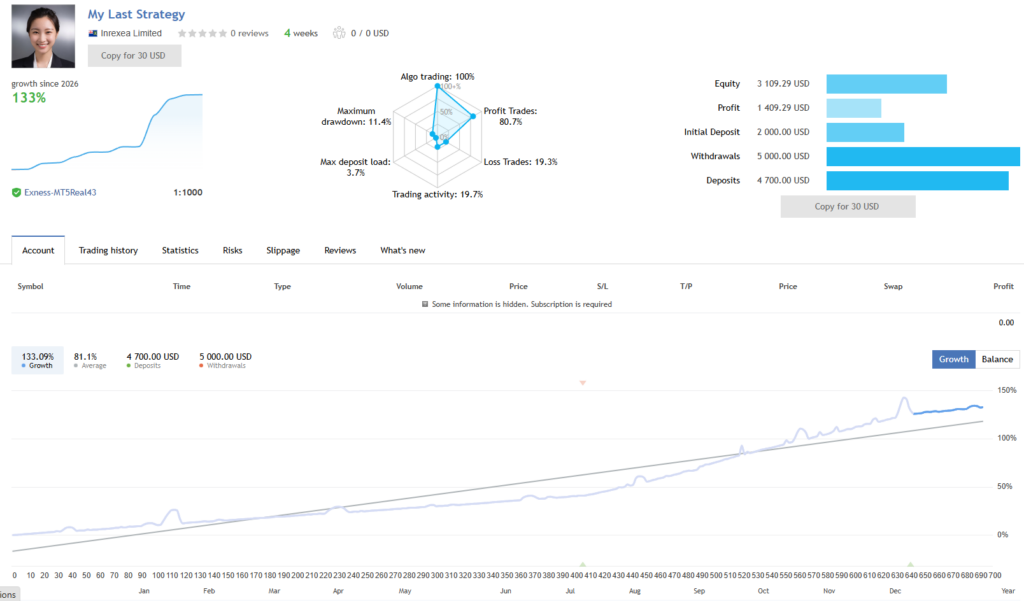
The main live signal runs on Exness at 1:1000 leverage, with roughly four weeks of tracked history at the time of writing.
The verifiable record. The account opened with a $2,000 initial deposit and generated approximately $1,409 in profit over the period. The proportion of winning trades is 80.7%, with a genuine 19.3% of trades losing — a realistic distribution rather than the near-perfect figures some marketplace EAs advertise. Maximum drawdown was 11.4%.
The stand-out figure. The maximum deposit load on this account was just 3.7%. Deposit load measures how much of the account’s usable margin is committed to open positions at once, and 3.7% is low — it means the strategy was carrying small concurrent exposure rather than loading the account heavily. That is a genuinely reassuring number, and it is the kind of thing that points away from a heavy grid or martingale on this account, even though the full mechanism is not published.
The honest caveat. The signal’s displayed growth percentage is inflated by account flows — the account took additional deposits and made withdrawals during the period, which distorts the headline growth figure well above the roughly $1,409 of actual profit. Read the dollar profit and the risk metrics, not the growth percentage, and remember this is only four weeks of data.
The Stress-Test Account
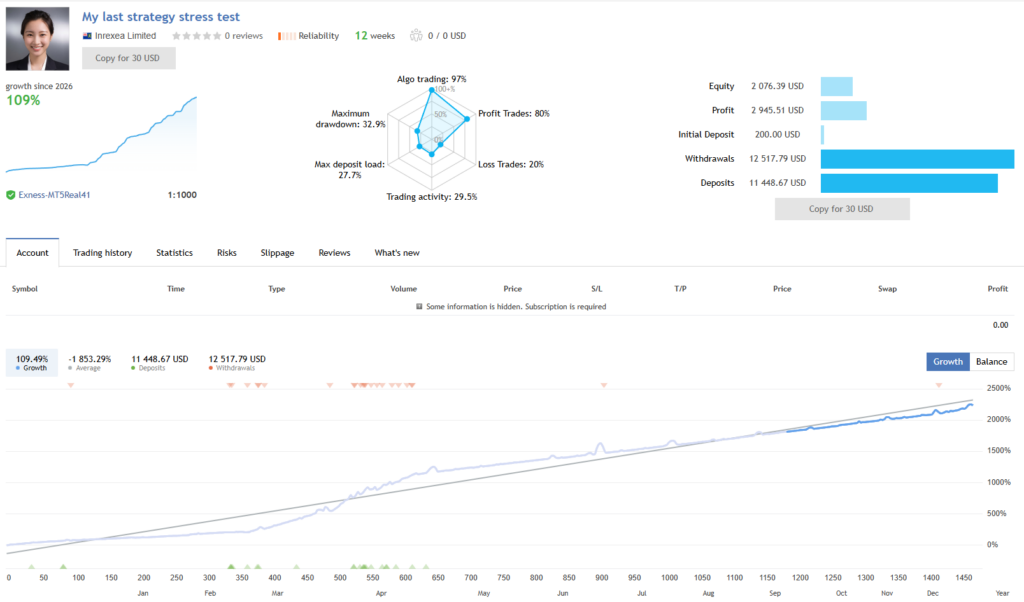
The stress-test signal is the more valuable of the two for understanding risk, and it also has the longer record — roughly twelve weeks. It runs the same strategy at a more aggressive setting on a $200 initial deposit, with heavy deposit and withdrawal activity through the period and approximately $2,945 of profit.
The numbers that matter here are the risk ones. Maximum drawdown reached 32.9% and maximum deposit load 27.7% — both markedly higher than the main account. In other words, when the strategy is pushed, the drawdown deepens to roughly a third of the account. That is a sobering figure, but publishing it openly is exactly the point of a stress-test account: it shows a buyer the downside rather than hiding it. The realistic 80% win rate holds across both accounts, which is at least internally consistent.
The practical takeaway from the two accounts together is a risk range. Run conservatively, the strategy looks like the main account: low load, drawdown around 11%. Pushed harder, it looks like the stress test: drawdown around 33%. Where you sit on that range is a function of how aggressively you size — which makes conservative sizing the single most important decision a buyer makes.
About Those Headline Numbers
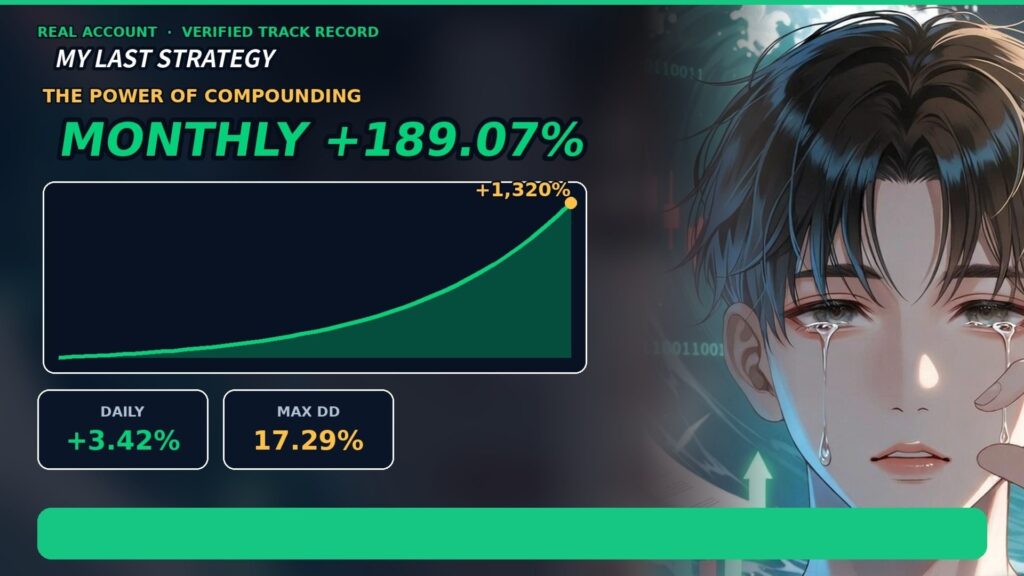
This is the section to read before you let any marketing image influence a buying decision. The product’s promotional graphics headline some very large figures: a “total gain” above 1,320%, a “monthly” figure around 189%, and a “daily” figure of 3.42%. These do not match what the two live signals verify.
The verifiable records, as covered above, are roughly $1,409 of profit over four weeks on the main account and roughly $2,945 over twelve weeks on the stress test — solid early results, but a long way from a sustained 189% per month. Figures like “+189% monthly” are best understood as compounding projections: the arithmetic of compounding a high daily percentage forward produces spectacular totals on paper, but real trading does not compound smoothly, and the drawdowns and account flows on the actual signals tell a more grounded story.
None of this means the product does not work — the live accounts show it does generate profit. It means the honest number to plan around is the verifiable dollar profit at a conservative risk setting, not the compounding headline. Any system advertised with a “+189% monthly” style figure should be approached with the assumption that the real, sustainable return is a fraction of it. Treat the marketing as marketing, and let the two live signals and your own testing be the evidence.
The Risk Profile — Read This Before Buying
Buying My Last Strategy sensibly comes down to a few points.
Leverage. Both live accounts run at 1:1000. Leverage amplifies outcomes in both directions; there is no obligation to run 1:1000 yourself, and using less is the sensible choice while you are validating.
Your chosen risk setting decides your drawdown. The two accounts show the same strategy producing an 11% drawdown run conservatively and a 33% drawdown pushed hard. That range is largely in your hands through position sizing. Size for the main-account profile, not the stress-test one, unless you fully understand and accept a one-third drawdown.
An undisclosed engine. The full input set is not published, so we do not assert a specific internal mechanism — we will not claim it does or does not use any particular position-management method, because that cannot be verified from the materials available. The main account’s low 3.7% deposit load is a reassuring data point that points toward controlled exposure, but it is not a substitute for seeing the behaviour yourself. Test on demo first and watch how it opens, manages and closes positions on your own account.
Instrument and timeframe. The developer presents this as a technical, rule-based systematic MT5 strategy trading 24/5. Confirm the exact instrument and timeframe on the official MQL5 listing and match your broker symbol and chart before going live.
Who My Last Strategy EA Is For
It might be a fit if you:
- Value transparency — two public real-money accounts, including a stress test, is more evidence than most new EAs provide
- Prefer a realistic win-rate distribution (around 80%, with a genuine loss rate) over an implausibly perfect figure
- Will size conservatively toward the main account’s controlled-exposure profile rather than the stress test’s
- Can read past marketing figures and plan around the verifiable dollar returns instead
- Run a reliable broker and a low-latency VPS
- Want a low-cost automated MT5 system to test carefully before committing meaningful capital
Look elsewhere or wait if you:
- Are drawn in by the “+189% monthly” or “+1,320%” figures — those are not what the live signals verify, and buying on that expectation will disappoint
- Want a long, established multi-year track record — the main account is four weeks old and the stress test twelve
- Are uncomfortable with 1:1000 leverage or with a strategy whose pushed-hard drawdown reaches roughly a third of the account
- Need a fully documented, independently verifiable trading mechanism before you buy
- Trade only on MT4 — this is an MT5 product
Our Verdict
We rate My Last Strategy EA 4 out of 5.
The positive lean is earned by transparency and by realistic numbers where it counts. Running two public real-money accounts — including one openly labelled a stress test that shows a 33% drawdown — is a more honest posture than most new EAs adopt, and the roughly 80% win rate with a genuine loss rate is the kind of distribution that suggests a real strategy rather than a curve-fit demonstration. The main account’s low deposit load and contained drawdown are genuinely reassuring.
The points we hold back are about the marketing and the youth of the record, not about whether the system works. The promotional figures — a monthly return around 189%, a total above 1,320% — run well ahead of what the live signals verify, and a buyer who plans around them will be disappointed. The record is also short (four and twelve weeks), and the internal mechanism is not documented.
Practical recommendation: judge this product on its two live signals, not its graphics. Run less leverage than 1:1000, size toward the main account’s conservative profile, use a reliable broker with a low-latency VPS, and validate on demo and then a small live account for several weeks before deciding whether to scale. Bought at CheaperForex’s lower price, the cost of running that evaluation is modest — which is the sensible way to approach a new system with strong marketing and a genuinely transparent, if short, live record.
How to Get My Last Strategy EA Safely
Two legitimate sources, and only two.
CheaperForex — the same EA at a lower price than the marketplace. Get My Last Strategy EA MT5 at CheaperForex.
The MQL5 marketplace — direct from Inrexea Limited’s developer page. Here is the official MT5 listing.
Anywhere else offering it free or via a Telegram seller is a trap — there is no working cracked file, only malware or pay-and-vanish scams.
Frequently Asked Questions
Is My Last Strategy EA legit, or a scam?
It is a legitimate published MQL5 marketplace product from Inrexea Limited, a registered company, backed by two public real-money live signals on Exness. The scams are the “free download” sites and Telegram sellers offering cracked copies that cannot exist — every legitimate marketplace EA is licence-protected, so a free copy is either malware or a payment scam. Legitimate does not mean the marketing is accurate, though: the headline gain figures run well ahead of the verifiable record.
Are the “+189% monthly” and “+1,320%” figures realistic?
No — treat them as marketing, not as expected returns. The verifiable live records show roughly $1,409 profit over four weeks on the main account and roughly $2,945 over twelve weeks on the stress test, and both accounts’ growth percentages are distorted by heavy deposits and withdrawals. Figures like “+189% monthly” are compounding projections that real trading does not sustain. Plan around the verifiable dollar returns at a conservative risk setting.
How risky is it?
It depends on how you size it. The main account shows a low deposit load and a maximum drawdown around 11%; the stress-test account, run harder, shows a maximum drawdown around 33%. The same strategy produces both, so your position sizing largely determines your risk. Both run at 1:1000 leverage — use less, size conservatively, and test on demo first.
What does it trade, and on which timeframe?
The developer presents it as a technical, rule-based systematic MT5 strategy trading 24/5. The exact instrument and timeframe are not stated in the promotional materials we reviewed, so confirm them on the official MQL5 listing and match your broker symbol and chart before setup.
Does it use a grid or martingale?
The developer has not published the full input set, so we do not claim a specific mechanism. The verified data shows a realistic win rate and, on the main account, a low 3.7% deposit load, which points toward controlled exposure rather than heavy averaging. Because the engine is not documented, test on demo first and watch how it manages open positions and drawdown on your own account before committing capital.
What broker, account and VPS do I need?
A reliable broker with competitive spreads and fast execution, with ECN or Raw Spread accounts preferred, and a low-latency VPS near the broker’s server for uninterrupted 24/5 operation. The live signals run on Exness at 1:1000 leverage, but you do not need to match that leverage — using less is the sensible choice.
How long is the live track record?
Roughly four weeks on the main account and twelve weeks on the stress-test account at the time of writing. That is genuinely short, so treat both as early evidence — encouraging, and more transparent than most, but not yet a long-term record. Let your own longer-window testing be the deciding factor.
Why is it cheaper at CheaperForex?
The product is identical — the same EA and free lifetime updates. You pay less. For a newer system you will want to validate carefully on demo and on your own broker before scaling, so paying less to do that testing is the practical approach.
More from Inrexea:
Each is a separate system, sold on its own, with its own strategy, settings and results. Running several together adds to your total exposure.