
Last updated: May 2026 (product launched 12 May 2026)
Sentinel KMZ is a XAUUSD account flipping Expert Advisor from Luca Barone, an Italian developer with an established MQL5 marketplace presence. Where most algorithmic EAs focus on risk control and capital preservation, Sentinel KMZ is positioned at the opposite end of the spectrum: explicitly high-risk, aggressive grid + martingale recovery, designed for traders attempting to flip small Gold accounts into substantial balances quickly.
View product details and current pricing.
This is one of the rare cases where the developer’s own marketing accurately describes what the product is. The MQL5 listing openly states the EA is “designed for high-risk account flipping” with “very high risk” profile and explicit warnings that it “can also cause significant drawdown or full account loss during extreme market conditions.” We respect that transparency — and this review approaches the EA the same way.
The published 12-month backtest shows $200 growing to $9.1 million alongside an 84.38% maximum equity drawdown. The 1-week verified live signal shows 86% growth with already-meaningful 20.6% drawdown. These two numbers — the dramatic returns and the dramatic drawdowns — are inseparable. They describe the same trading strategy from two angles. Understanding both is essential before any deployment.

⚠️ Searching for Sentinel KMZ EA free download? Sentinel KMZ is an MQL5 marketplace product with built-in DRM. Cracked .ex5 files don’t exist for marketplace EAs — sites offering “free downloads” deliver malware or non-functional files leading to Telegram payment scams. CheaperForex offers Sentinel KMZ at a significant discount with the full unlocked .ex5 file — view product page.
The Developer: Luca Barone
Sentinel KMZ is developed by Luca Barone, an Italian MQL5 developer with an established marketplace presence. What makes his positioning of Sentinel KMZ editorially noteworthy is the transparency — he openly markets the EA as a high-risk account flipper rather than dressing it up as something else.
This matters because many MQL5 developers try to market high-risk grid/martingale systems as “AI-driven” or “smart risk management” when they aren’t. Sentinel KMZ’s product page on MQL5 explicitly describes it as “designed for high-risk account flipping, aggressive capital growth, and fast profit extraction” with clear warnings about potential full account loss during extreme market conditions. That honesty is genuinely valuable in a marketplace full of misleading risk positioning — with Sentinel KMZ, you know exactly what you’re buying.
The developer’s transparency also extends to providing set files on request, maintaining an active live signal account on a real broker (VTMarkets), and not making implausible promises about returns or risk. None of this changes the fundamental nature of the strategy — grid + martingale is still grid + martingale — but it does mean the buyer-developer relationship starts from honest positioning rather than marketing spin.
What Account Flipping Actually Is
Account flipping is a trading approach distinct from traditional algorithmic trading. The objective isn’t slow, sustainable compounding — it’s rapid percentage growth on a small account with an explicit exit plan. The standard account flipper playbook:
- Start with risk capital you’ve fully written off. The starting deposit is money you’ve decided you can afford to completely lose. This mental positioning is essential to the strategy working.
- Run an aggressive system on the small account. Grid, martingale, or other high-risk strategies that can produce rapid returns during favorable conditions.
- Withdraw the original deposit early. Once the account reaches a target growth (typically 100%-200% return), withdraw your original capital. You’ve now recovered your risk capital — the remaining balance is house money.
- Continue with house money only. Trade with secured profits, performing regular withdrawals to lock in further gains. Accept that this account may eventually blow — but you’ve already secured your original capital plus accumulated withdrawals.
- Treat each flip as a separate experiment. Some accounts will flip successfully and produce significant returns; others will blow. The successful flips, in aggregate, can produce meaningful returns over time. But this requires deploying multiple small attempts rather than scaling a single large account.
The mathematics work as long as you follow the playbook strictly. The mathematics fail catastrophically if you get greedy and skip the withdrawal step — leaving everything compounding indefinitely on a grid/martingale system means eventually an adverse trend will give back all gains. The discipline to actually withdraw is what separates successful account flippers from blown accounts.
The Strategy: Aggressive Grid + Martingale
Sentinel KMZ operates an aggressive grid and martingale recovery engine specifically on XAUUSD. The mechanics matter because they explain both the EA’s strengths and its risks:
Grid Positioning: The EA opens an initial position based on its signal logic, then opens additional positions as price moves against the initial entry. This creates a “grid” of orders at progressively unfavorable prices — averaging down the basket’s effective entry price.
Martingale Lot Scaling: Successive grid positions can use larger lot sizes than the initial position (this is the “martingale” element). If the initial trade is 0.01 lots and price moves against it, the next grid position might be 0.02 lots, then 0.04, then 0.08, and so on. The lot scaling amplifies the basket’s recovery — when the market eventually reverses, even a small move back is sufficient to close all positions in profit.
Basket Management: Positions aren’t closed individually — they’re closed as a group when the combined basket reaches a defined profit target. This means you’ll see periods where multiple positions are open simultaneously, with the basket gradually building until the closure event.
Dynamic Lot Sizing: The EA adjusts all lot sizes based on current account balance, maintaining consistent risk percentage as the account grows or shrinks. As the account doubles, lot sizes double.
This architecture produces a characteristic pattern of returns:
- Extended periods of consistent small wins as baskets close profitably. The win rate appears high (77.73% in the backtest) because most baskets eventually recover.
- Occasional large drawdown events when sustained trends move against open grids before reaching recovery. These are the 22.27% losing trades — the ones that create the 84% equity drawdown shown in the backtest.
- The big risk: if a sustained trend exhausts the grid’s recovery capacity before reversal, the algorithm hits margin call territory and the account can blow. This is the failure mode of grid/martingale systems.
The 12-Month Backtest
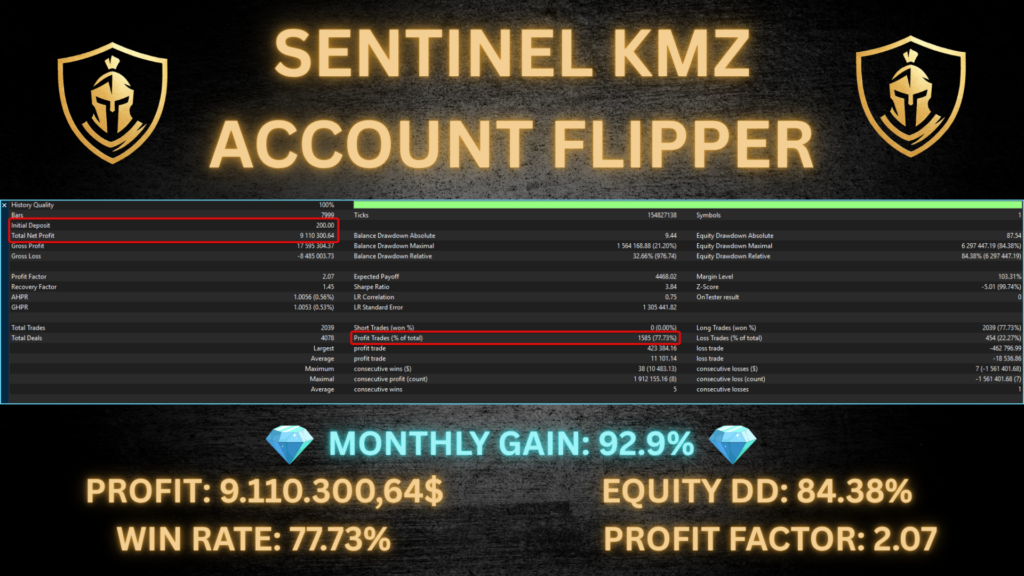
The developer’s published backtest covers approximately 12 months at 100% history quality. Headline metrics:
- Initial Deposit: $200
- Total Net Profit: $9,110,300.64 (compounded)
- Profit Factor: 2.07
- Recovery Factor: 1.45
- Sharpe Ratio: 3.84
- Total Trades: 2,039 (all long, 0 short)
- Win Rate: 77.73%
- Maximum Balance Drawdown: 21.20% ($1.56M absolute)
- Maximum Equity Drawdown: 84.38% ($6.30M absolute)
- Maximum Consecutive Losses: 7 trades
- Monthly Gain: 92.9% compounded
The honest interpretation of these numbers requires unpacking each one:
The 84.38% equity drawdown is the headline risk metric. Forget the $9.1M number for a moment — that’s the compound interest math of 92.9% monthly growth without withdrawals over 12 months, and it’s not what would happen in live trading. The number that matters for risk planning is the equity drawdown: the algorithm experienced a point where floating positions were worth 84.38% less than account balance. If you’d been monitoring during that adverse period, you’d have watched your account lose 84% of equity before eventually recovering. Most retail traders would have intervened — closing positions manually at a loss before the EA’s grid could complete its recovery. That manual intervention would have turned a recoverable backtest drawdown into a real catastrophic loss.
The 92.9% monthly gain compounds unrealistically. Sustained 92.9% monthly compounding produces astronomical returns mathematically but doesn’t reflect real-world account flipping. In live trading, you would withdraw profits regularly (that’s the entire point of the strategy). The actual outcome would be a series of $200 starting capitals + accumulated withdrawals, not a $9.1M account balance.
2,039 trades all long, zero short. The backtest only took long positions on XAUUSD. During the 2024-2025 period, Gold was in a sustained bull market that strongly favored long-bias strategies. A bearish XAUUSD year would likely produce materially worse results, since the EA appears biased toward buy-side accumulation. This is a meaningful concern — the backtest captures a favorable period, not a representative cross-section of market conditions.
The 77.73% win rate is real but misleading. Grid systems naturally produce high win rates because most baskets eventually close profitably when markets reverse. The 22.27% “losing” trades represent the specific events where the grid couldn’t recover — these are the trades that cause the 84% equity drawdown periods. High win rate doesn’t mean low risk for grid systems; it means most trades are small wins punctuated by occasional large losses.
Profit factor of 2.07 is genuine but provides limited safety margin. PF of 2.07 means $2.07 in profits for every $1 in losses. That’s a real edge, but for a grid system the small base of losing trades means each loss is large. A single adverse trend that exhausts the grid’s recovery capacity can produce a loss that takes years of small wins to recover.
The 1-Week Live Signal
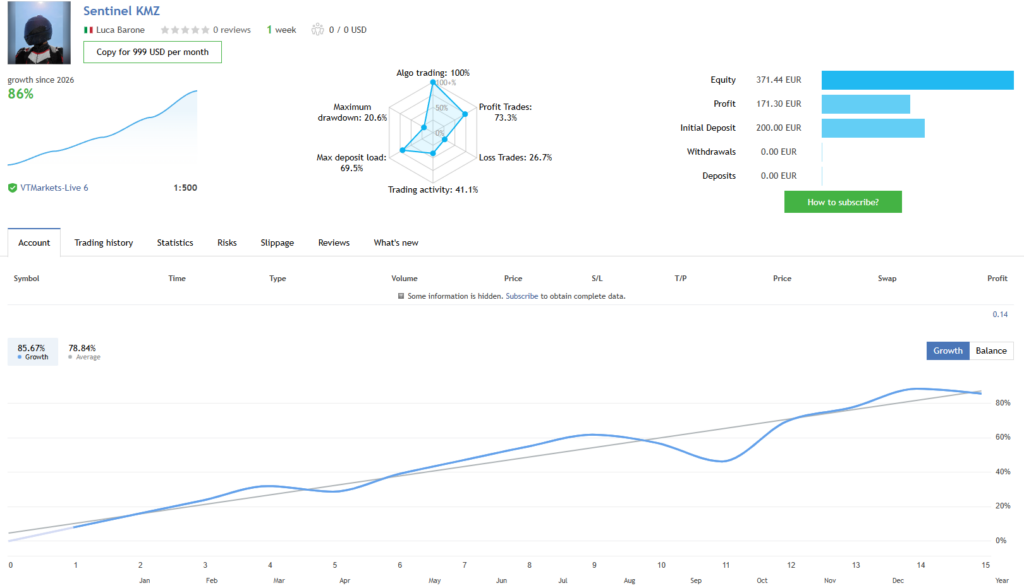
The developer’s verified MQL5 Signals account (signal #2373957) runs on VTMarkets-Live 6 at 1:500 leverage. The signal is brand new — only 1 week old. Current metrics:
- Track Record: 1 week of public verification
- Growth: 86%
- Initial Deposit: €200
- Current Equity: €371.44
- Profit: €171.30
- Profit Trades: 73.3%
- Maximum Drawdown: 20.6%
- Max Deposit Load: 69.5%
- Trading Activity: 41.1%
What this 1-week sample tells you and doesn’t tell you:
1 week is not a meaningful track record for grid/martingale. Grid systems can produce extraordinary returns during favorable conditions and catastrophic losses during adverse periods. The 86% growth in 1 week shows the algorithm working during a market regime favorable to its long-bias strategy. It does not predict next week’s outcome, let alone next month’s or next year’s.
The 69.5% deposit load is the warning sign. This means at peak exposure, 69.5% of available margin was tied up in open positions. On a €200 account at 1:500 leverage, that represents substantial relative position size. Sustained adverse moves on positions of that size could quickly reach margin call territory. The deposit load metric reveals more about the strategy’s risk than the headline growth number does.
20.6% drawdown in 1 week is meaningful. The backtest’s 84.38% drawdown wasn’t a one-off — significant drawdown is a normal feature of this strategy. The live signal already touched 20.6% drawdown within 7 days, suggesting adverse periods are not rare. Over a longer track record, expect drawdown events that materially exceed the 1-week figure.
1:500 leverage is high. The live signal runs at 1:500 leverage, which is well above what most retail traders (especially in EU-regulated environments at 1:30) can access. Lower leverage will reduce the EA’s effective position sizing capability and may impact returns. Higher leverage also amplifies risk during adverse periods.
How Sentinel KMZ Compares to Conservative EAs
Luca Barone’s portfolio gives buyers a clear choice between the two main Sentinel products:
| Typical Conservative EA | Sentinel KMZ | |
|---|---|---|
| Strategy | Risk-controlled, hard SL/TP discipline | Aggressive grid + martingale |
| Risk Profile | Conservative / capital preservation | Very high / account flipping |
| Prop Firm Suitable | Yes | No |
| Typical Drawdown | Low (single-digit %) | High (84% in backtest) |
| Typical Returns | Modest, steady | Dramatic, volatile |
| Suitable For | Long-term accounts, capital you need to preserve | Risk capital only, short flipping cycles |
| Deployment Mindset | Investment | Calculated gamble with capital you can lose |
If you want capital preservation and steady returns, Sentinel KMZ is not the right product. The aggressive grid + martingale architecture is fundamentally incompatible with capital preservation — you’d be deploying a flipper strategy on capital you don’t want to flip. Choose a risk-controlled EA with hard SL/TP discipline for any account you need to preserve.
If you want to attempt account flipping with risk capital, Sentinel KMZ is the appropriate product. Deploy a small amount ($100-$200) that you’ve already mentally written off, follow the withdrawal discipline strictly, and treat each deployment as a separate experiment.
Who Sentinel KMZ Is For
Consider Sentinel KMZ if you:
- Have $100-$200 of risk capital you have already mentally written off as potentially lost
- Understand grid and martingale strategies and accept their inherent risk profile
- Are committed to withdrawing initial capital + profits as soon as growth targets are reached
- Will not scale up position sizes or leave large balances exposed to the EA indefinitely
- Can mentally tolerate watching the account experience 20-50%+ floating drawdown without intervening
- Treat account flipping as one component of a diversified approach, not your primary strategy
- Are deploying on a broker with 1:500 leverage available (or accept lower returns at lower leverage)
Don’t buy Sentinel KMZ if you:
- Are running prop firm challenges (grid/martingale violates prop firm rules)
- Are deploying capital you cannot afford to lose completely
- Need consistent risk-controlled monthly returns rather than rapid percentage gains
- Cannot psychologically tolerate large floating drawdown periods
- Want to scale up position sizing as the account grows beyond the flip target
- Are looking for long-term sustainable trading returns — this is explicitly a flipper, not a sustainable system
- Have any expectation of capital preservation as a priority
Where to Download Sentinel KMZ Legitimately
Two legitimate sources, and only two:
MQL5 Marketplace — direct purchase from Luca Barone’s developer page. MT5 listing. Activation count limited.
CheaperForex — significant discount on the MQL5 marketplace price with the full unlocked .ex5 file delivered. Same EA, free lifetime updates, plus a 7-day money-back guarantee before activation and an extra 20% discount for crypto payments. Sentinel KMZ MT5.
Anywhere else claiming to offer Sentinel KMZ for free or via Telegram — fraudulent. The MQL5 DRM cannot be cracked for marketplace products.
Installation and Setup
Step 1: Mental positioning. Before installing, confirm to yourself that the deposit you’re planning to use is risk capital you can afford to lose entirely. If that’s not true, stop here — Sentinel KMZ is not the right product for capital you need to preserve.
Step 2: Set up a fresh account. Use a dedicated MT5 account for Sentinel KMZ — don’t deploy it alongside other EAs or your main trading capital. The account should be funded with only the amount you’re willing to lose ($100-$200 recommended).
Step 3: Set your withdrawal trigger. Before deploying, decide your withdrawal plan. Common approaches: “withdraw $200 (original) when account hits $400-$500”, “withdraw 50% of accumulated profits monthly”, “withdraw all profits when account hits 3x initial deposit”. Write the trigger down. Stick to it.
Step 4: Contact the developer for set files. Luca Barone provides recommended set files on request — message him via MQL5 before testing. The default settings may not be optimal for your specific broker and account size.
Step 5: Test on demo first. Run the EA on demo for at least 1-2 weeks before live deployment. Observe the deposit load patterns, drawdown periods, and basket closure behaviour. Get psychologically used to seeing the account experience drawdown.
Step 6: Deploy on VPS. Grid systems must run continuously. Brief disconnections during open baskets can leave positions unmanaged at critical moments. OVH or any reputable low-latency VPS service works.
Step 7: Don’t watch obsessively. Account flippers experience meaningful drawdown by design. Constantly watching the account creates psychological pressure to intervene, which usually makes outcomes worse. Set the EA running, check it periodically, execute withdrawals at your predetermined triggers — but don’t override the EA’s decisions in real time.
Frequently Asked Questions
Where can I download Sentinel KMZ legitimately?
Two sources only: MQL5 marketplace at Luca Barone’s developer page, or CheaperForex at a significant discount with the full unlocked .ex5 file delivered. Free lifetime updates with both. CheaperForex also offers a 7-day money-back guarantee before activation.
Is Sentinel KMZ really a high-risk EA?
Yes. This is one of the few cases where the developer’s own marketing accurately describes a high-risk strategy. The 84.38% backtest equity drawdown isn’t a worst-case theoretical scenario — it’s the actual maximum drawdown the algorithm experienced during the 12-month historical period. Live trading drawdown can be similar or worse. Treat this as risk capital deployment, not investment.
How does Sentinel KMZ differ from typical conservative EAs?
Conservative EAs use risk-controlled architectures: hard stop loss on every trade, single-position discipline, no grid/martingale recovery. They aim for steady, modest returns with low drawdown — appropriate for capital you need to preserve and for prop firm challenges. Sentinel KMZ does the opposite: aggressive grid + martingale recovery, dramatic returns during favorable conditions paired with significant drawdown during adverse periods, account flipping rather than capital preservation. The two approaches are not interchangeable — they’re for fundamentally different use cases.
Can I scale up Sentinel KMZ to a large account?
Strongly not recommended. Account flipping mathematics work because you’re deploying small amounts of risk capital. Scaling up to large balances exposes meaningful capital to the strategy’s inherent drawdown risk. If a $200 account blows up, you’ve lost $200. If a $20,000 account blows up, you’ve lost $20,000. The strategy is the same in both cases — only the amount at risk has changed.
What if the live signal continues to perform well?
Good performance on the live signal would extend the favorable observation window. But grid/martingale strategies’ nature means future adverse events are mathematically certain — the question is when, not if. The 84.38% backtest drawdown is the warning of what an adverse event looks like. Even if the live signal runs successfully for 6 months, the next 6 months could include the equivalent of the backtest’s worst drawdown period.
Should I deploy Sentinel KMZ on a prop firm challenge?
No. Grid/martingale strategies violate the maximum drawdown rules of essentially every prop firm. The 1-week live signal already touched 20.6% drawdown — past the 8-10% maximum drawdown limit of typical prop firms. For prop firm challenges, choose a risk-controlled EA with hard SL/TP discipline instead — Sentinel KMZ is specifically the wrong product for that use case.
What broker and leverage should I use?
ECN or Raw Spread account on a broker offering XAUUSD with tight spreads. The live signal uses 1:500 leverage on VTMarkets, which is high by retail standards. Lower leverage reduces effective position sizing and may impact returns. Note that higher leverage also amplifies risk during adverse periods. Use whatever leverage your jurisdiction and broker allow, but understand the trade-off.
How do I know when to stop trading the EA?
Two scenarios warrant stopping: (1) you’ve successfully flipped the account to your target growth, withdrawn your original capital plus profits, and want to take a break or reset; or (2) the account has lost a significant portion of equity and you’ve reached your psychological or financial pain threshold. Set both triggers before deploying — don’t decide in the moment under emotional pressure.
The Verdict
Sentinel KMZ is honest about what it is — an aggressive XAUUSD account flipper using grid and martingale recovery. The developer (Luca Barone) is transparent in the product description, doesn’t dress up the risk profile, and labels it clearly as high-risk. That transparency is genuinely valuable in a marketplace full of high-risk strategies marketed as “AI-driven smart risk management.”
The strategy itself does what grid/martingale account flippers do. The backtest shows the characteristic pattern: extended periods of consistent small wins (77.73% win rate, profit factor 2.07) punctuated by major drawdown events (84.38% maximum equity drawdown). The 1-week live signal shows the favorable side of this pattern (86% growth) while already revealing the underlying risk (20.6% drawdown in just 7 days). Neither sample is long enough to validate long-term forward performance, but both are consistent with what grid systems typically produce.
We rate Sentinel KMZ 3 out of 5. The rating reflects honest assessment of what this product is rather than how dramatic the returns look. The strengths: transparent positioning by the developer (not pretending to be something it isn’t), genuine grid/martingale execution that works as advertised during favorable periods, clear withdrawal-based strategy that can produce significant returns when used with discipline, available at a meaningful discount through CheaperForex with money-back guarantee, and the developer’s broader Sentinel portfolio providing alternative products for different risk profiles. The held-back points reflect the fundamentally high-risk strategy that will blow accounts during adverse periods, the very short live track record (1 week) that hasn’t yet been observed through meaningful adversity, the 1:500 leverage requirement that not all traders can access, and the fact that successful account flipping requires more discipline than most retail traders actually possess — meaning many buyers will not execute the withdrawal strategy and will eventually give back all gains during a drawdown event.
For risk-tolerant traders who specifically want to attempt account flipping with capital they’ve fully written off, who will deploy small amounts and execute strict withdrawal discipline, and who treat the inevitable blown accounts as the cost of the strategy rather than disasters — Sentinel KMZ is a credible tool. For everyone else (conservative traders, prop firm aspirants, anyone who cannot afford to lose the deposit) — this is not the right product.