
Last updated: June 2026
Zerqon EA launched on the MQL5 marketplace on 25 May 2026 — a XAUUSD M15 system from Israeli developer Vladimir Lekhovitser, built around a Deep LSTM neural network model integrated through ONNX, with defined stop loss and take profit on every trade, break-even and trailing stop management, and a public live signal that’s shown +394% growth across roughly 15 weeks. On the surface, that’s a striking opening.
View product details and current pricing.
This review is going to take a different shape than most of our editorial coverage, because the honest answer here isn’t about the architecture of Zerqon EA specifically. The architecture is fine. The question that actually matters is about the developer’s broader track record — and that’s where we have reservations significant enough to say so on the record, even though we still offer Zerqon at a discount for buyers who want it. We do not actively recommend this purchase. The rest of this review explains exactly why, and lets you make your own call from there.
⚠️ Looking for a Zerqon EA “free download”? Don’t.
Every MQL5 marketplace EA ships with built-in DRM. There is no working cracked file in existence — so a “free” copy is always one of two things:
- malware, or
- bait for a Telegram payment scam where you pay and get nothing.
The only safe routes are the MQL5 marketplace or a reputable reseller. CheaperForex offers Zerqon at a significant discount versus the marketplace price — Get Zerqon EA MT5 at CheaperForex — though we encourage you to read this full review before committing.
Decided Zerqon EA MT5 fits your plan?
$99.96 with crypto · $124.95 by card
Official version · Instant download · Free lifetime updates · 7-day money-back guarantee
Why This Review Reads Differently

Most of our EA reviews land somewhere between 4 and 4.5 out of 5 — we generally only stock products we believe in, and the editorial work goes into honest caveats around products we think are credible. Zerqon EA is different. The product itself has a reasonable architecture. The reason we hold the score back to 3 out of 5 — and the reason we tell buyers to read this review carefully before purchasing — is the developer’s track record across his prior releases.
CheaperForex still offers Zerqon at a significant discount because buyers who want it should be able to get it cheaper rather than paying full marketplace price elsewhere. That’s the role we play. But the editorial role we also play is telling you honestly what we think — and on Zerqon, what we think is “be careful, this is your call, here’s why.”
The Developer: Vladimir Lekhovitser
Vladimir Lekhovitser (“prizmal” on MQL5) is an Israeli algorithmic trading developer with a real history in the field. His verifiable career highlight is genuine: silver medal at the MetaQuotes Automated Trading Championship 2008, with a strategy that generated over 1,500% profit across three months of live competition. He has been publishing on MQL5 since 2004. None of that is fabricated, and we’ve referenced his championship background positively in our coverage of his earlier products.
What’s also true is the broader pattern. His current MQL5 profile carries a 3.3 average rating across 143 reviews — that’s a substantive sample, not a launch-week artefact. A 3.3 across 143 doesn’t mean every product is bad; it means enough products have accumulated enough unhappy buyers over time to drag the overall figure down to that level. It’s the signature of a developer whose products tend to sell well, look great early, then accumulate negative reviews as live behaviour diverges from launch expectations.
His current portfolio across MQL5 includes Zerqon EA and a handful of other active products. CheaperForex stocks several from his back catalogue: PrizmaL Gold EA (XAUUSD multi-mode system), PrizmaL Scalper EA (intraday gold scalping), PrizmaL Lux EA (XAUUSD M30 adaptive swing system), and Monic EA (AUDCAD averaging system). All four have at one stage shown impressive early performance — and Vladimir has a pattern of releasing products, watching them gain traction during a favourable opening period, and either deleting or quietly retiring them from the active marketplace when later live performance disappoints buyers and reviews turn negative. He then goes quiet for a few months and lists something new.
Zerqon EA, listed on 25 May 2026 after a quiet stretch, fits that timing pattern precisely. Whether this release breaks the pattern or repeats it is what the next six to twelve months of live data will tell us. Our editorial position is that the pattern is meaningful enough to warrant explicit caution, even when the current product’s headline numbers look encouraging.
How Zerqon EA Is Built
For completeness, here’s what the product actually is — the architecture is the part we don’t have significant issues with.
Zerqon EA runs on XAUUSD M15 and uses a Deep LSTM (Long Short-Term Memory) neural network model integrated through ONNX. ONNX is the standard format for trained machine-learning models, which MetaTrader 5 supports natively. The model evaluates sequential gold price behaviour, volatility patterns, and timing conditions, and opens trades when its internal scoring crosses a threshold for actionable setups. This is genuinely different from indicator-stack EAs that just bolt RSI and MACD together.
Every trade is opened with a predefined stop loss and take profit. Open positions are managed through break-even (move SL to entry once a defined profit threshold is reached) and a trailing stop. The system allows up to five concurrent positions — not unlimited basket stacking, but enough to be in multiple trades during favourable conditions. Time-based filters block trading during low-quality windows. A news filter reduces exposure around abnormal price behaviour, including sharp moves and gaps around scheduled releases.
The developer is explicit that the design excludes martingale, grid, and averaging. The backtest’s trade-size distribution supports that claim — wins and losses are of comparable individual magnitude rather than the runaway losses you’d see on a recovery system. Whatever else there is to question about this product, the trade-level architecture is not where the concerns sit.
The Backtest — Read the LR Correlation Honestly
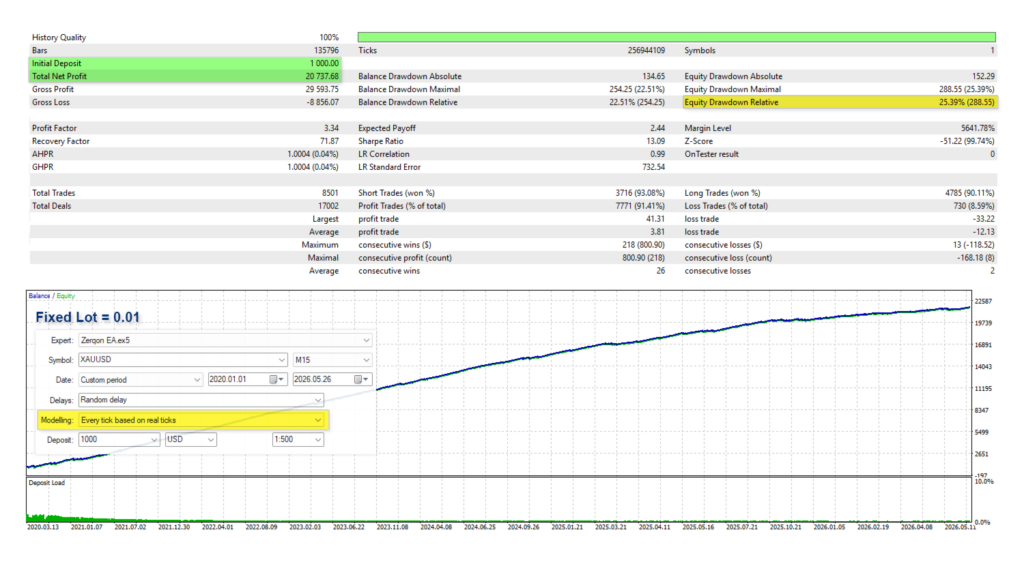
The backtest covers January 2020 to end May 2026 on real-tick data at 99% history quality — about 256 million ticks across more than six years. That’s a serious testing window, longer than most marketplace products provide. The fixed-lot 0.01 result on $1,000 starting balance produces a 3.34 profit factor, a 91.41% win rate across 8,501 trades, and a 25.39% equity drawdown.
Then there’s the Linear Regression correlation: 0.99. That number deserves the same honest framing we’ve given on other products. An LR correlation of 0.99 means the equity curve is nearly a mathematically perfect straight line across six years of gold trading — through the 2020 crash, the 2022 inflation regime, the 2024 cuts, every regime change in between. Real strategies don’t trade gold like that. Even excellent real-world strategies land between 0.85 and 0.98 — there’s always some natural variance in real returns. A 0.99 is the signature of a strategy optimised against the historical dataset, not a forward-looking forecast.
That doesn’t make the backtest useless. It tells you the strategy was tested on real tick data and produces a defensible-looking equity curve when fitted to past gold behaviour. It does not tell you what will happen on your broker, with your spreads, on the next 12 months of unseen gold data. Treat the 0.99 LR as a description of the past, not a prediction of the future.
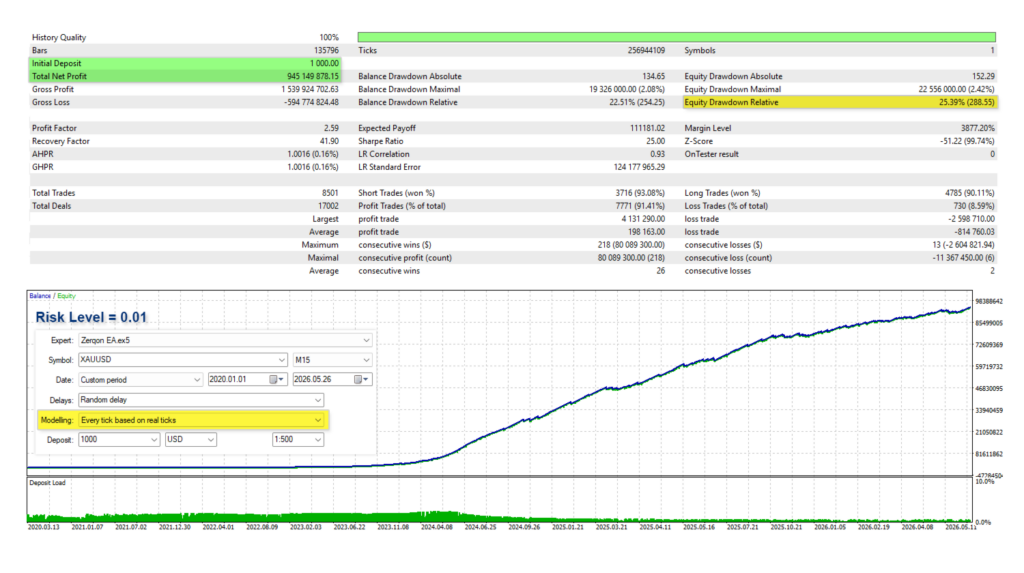
The second backtest shows the system run with risk-based compounding turned on, producing a theoretical nine-figure profit projection from a small starting balance over six years. This is the standard tester-mode compounding result that exists primarily for marketing graphics — the projected number assumes the strategy continues to compound at backtest performance indefinitely without ever hitting a sustained drawdown. Real accounts cannot compound this way, and showing such projections from a thousand-dollar starting balance is the kind of marketing tactic that distinguishes serious commercial products from less serious ones. Disregard the headline number; the underlying win rate and drawdown are unchanged from the fixed-lot test.
The Live Signal — Striking, Young, And in Context
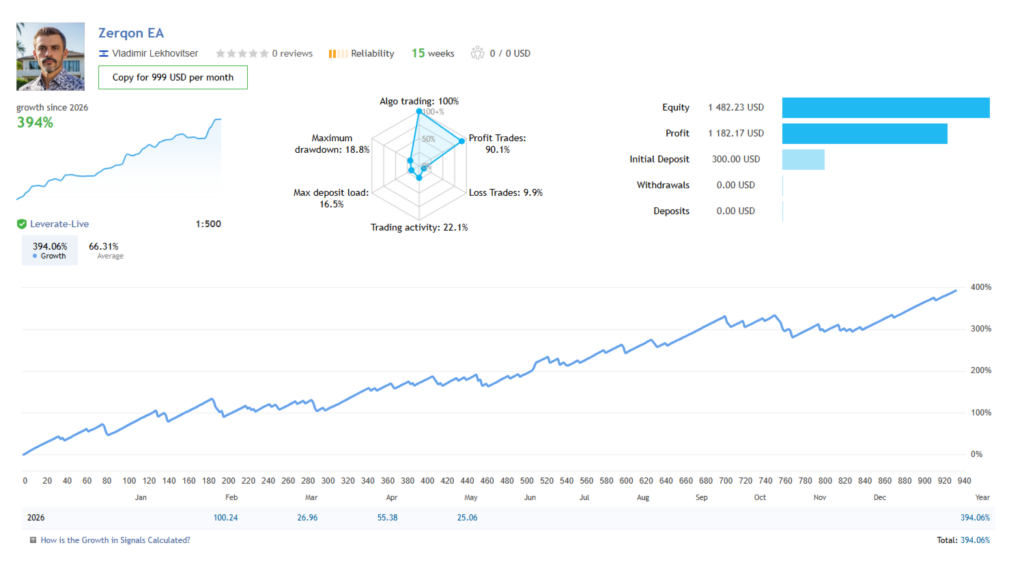
The live signal is published, real money, on the Leverate broker at 1:500 leverage from a $300 starting deposit. Fifteen weeks in, it shows roughly +394% growth at a 90.1% win rate with 18.8% maximum drawdown so far. The growth chart climbs smoothly with periodic small corrections — a credible-looking real-money trajectory.
A few honest things to weigh.
15 weeks is encouraging, not proven. Four months of live data on one account, in one gold environment, is enough to show the system is genuinely placing real trades and producing real returns. It is not enough to demonstrate that those returns will continue across different gold conditions, broker conditions, or market regimes. Vladimir’s previous products have also shown strong live signals in their early months before later disappointing buyers.
The 394% percentage figure is amplified by leverage and starting size. A $300 starting balance at 1:500 leverage in real-money trading will produce dramatic percentage moves in both directions. The dollar-equivalent growth on the account is around $1,180 — meaningful absolute return, but the headline percentage gets large because the starting base is small. On a $5,000 account at more conservative leverage, the same strategy would produce a different-looking percentage chart even on identical trades.
The 18.8% drawdown is more meaningful than the 90% win rate. Win rate on 15 weeks of an EA with a 91% backtest win rate is largely a function of the backtest matching — the impressive bit is that it’s actually delivering it live, but the win rate itself isn’t surprising. The drawdown figure tells you more about how the system handles adverse stretches. 18.8% on a young account is consistent with — and a small sample of — the 25% backtest equity drawdown, which is the more honest expectation for longer-term operation.
Broker matters. The live signal runs on Leverate. Your broker will be different, and gold execution conditions vary materially across brokers — spreads, slippage on news, swap, fill quality. The signal’s results don’t directly translate to a different broker’s behaviour.
Read the live signal as: the system is currently doing what the backtest said it would, on one account, in a young live history. That’s neither dismissible nor proof of long-term performance. Vladimir’s previous products have walked through this exact early-period state before, with different outcomes from where they ended up.
What One Early Buyer Says

The product currently has one published review on the MQL5 listing — a five-star comment from an early buyer noting that the EA places a stop loss on every order and operates without grid or recovery-style risk. Useful operational confirmation that the trade-level architecture works as described, but a single review covering the first two orders is far too thin to support any meaningful conclusion about the product. The next several months of buyer feedback will determine whether the early operational positives translate into longer-term satisfaction.
The “Your Call” Section
To be transparent about why CheaperForex sells this product while editorially urging caution: we extend the same discount we extend to every product we stock, because buyers who want a particular EA should be able to get it cheaper rather than paying full marketplace price for what is identical software. We don’t gatekeep based on our editorial view, and we won’t refuse to sell a legitimate listed product to a buyer who’s made an informed decision.
What we will do is tell you what we think. On Zerqon EA, our editorial view is that the developer’s history across previous releases is a substantial enough signal to warrant explicit caution, even when the current product looks promising on its early metrics. We don’t know whether Zerqon will break the pattern of Vladimir’s previous releases or repeat it, and the next six to twelve months will tell us. We do know that buyers committing capital now are buying earlier in that timeline than the buyers who’ll be reading retrospective reviews in a year.
If you want to buy it, buy it. Buy it cheaper through us. Run conservative sizing on demo or your smallest live account, treat the first months as evaluation rather than scaling, and don’t extrapolate the early percentage gains forward. If you’d rather wait six to twelve months for the picture to mature, that’s a defensible call too.
Who Zerqon EA Might Suit
It might be a fit if you:
- Specifically want exposure to Vladimir Lekhovitser’s latest XAUUSD release and have already made peace with the developer-track-record question
- Will buy at conservative sizing on demo or your smallest live account, treating the first months as validation rather than scaling
- Plan to make your own informed decision after reading our editorial concerns and forming your own view
- Want a XAUUSD neural-network architecture with defined SL/TP and want to test it cheaply
Look elsewhere or wait if you:
- Need a developer with a multi-year unblemished catalogue to commit — Vladimir’s 3.3/143 profile rating tells a more complicated story
- Read the 394% live signal as a forecast rather than a young sample on a small account
- Aren’t prepared to size around the realistic 20%+ live drawdown likely to emerge over time
- Trade only on MT4 — this is MT5 only (the neural network requires ONNX)
- Would rather wait six to twelve months and re-evaluate when there’s more live history to read
Our Verdict
We rate Zerqon EA 3 out of 5.
The product itself isn’t bad. The architecture is defensible — defined SL/TP on every trade, no martingale or grid, real ONNX neural network integration, six years of real-tick backtest, public live signal from launch, news filter, break-even and trailing stop logic, selective rather than constant trading. If a debut developer with a clean reputation shipped exactly this product, we’d probably be rating it 4 out of 5 and writing a much more positive review.
The 3 out of 5 reflects what we can’t ignore: a developer track record that includes a 3.3/143 profile rating accumulated across previous releases, and a pattern of products that have shown early promise before later disappointing the buyers who committed to them. We don’t know whether Zerqon will be the product that breaks that pattern. We do know that “buy it and find out” is not a recommendation we can make with conviction, even when the early evidence on this specific product looks encouraging.
Our practical position: if you’re going to buy it, buy it through CheaperForex at a significant discount, run conservative sizing on demo or your smallest live account, and treat the first six to twelve months as evaluation rather than commitment. If you’d rather wait for the picture to clarify before committing, that’s a defensible choice too. Both paths preserve your optionality.
How to Get Zerqon EA Safely
Two legitimate sources, and only two.
CheaperForex — the same EA at a significant discount versus the marketplace price. Get Zerqon EA MT5 at CheaperForex. Our editorial view above applies; the discount applies regardless.
The MQL5 marketplace — direct from Vladimir Lekhovitser’s developer page. Here is the official MT5 listing.
Anywhere else offering it free or via a Telegram seller is a trap — there’s no working cracked file, only malware or pay-and-vanish scams.
Frequently Asked Questions
Is Zerqon EA legit, or a scam?
Legitimate as a published MQL5 marketplace product from a developer with a real history in the field. The scams in this space are the “free download” sites and Telegram sellers offering cracked copies that can’t exist. Our editorial concerns are not about whether the listing is legitimate — they’re about how to weigh the developer’s broader track record against the current product’s early-stage strengths.
Why does CheaperForex sell this if you don’t recommend it?
Because the role we play is making MQL5 marketplace products available at a significant discount, and we extend that to buyers regardless of our editorial view. We don’t gatekeep what’s a legitimate listed product. What we will do is tell you what we think editorially — and on Zerqon, our view is that the developer’s track record warrants explicit caution. Your call.
What’s actually wrong with the developer?
His current MQL5 profile carries a 3.3 average rating across 143 reviews — a substantive sample reflecting accumulated buyer feedback over time. The pattern across his releases is that products often look impressive in their early months before later live performance disappoints buyers and reviews turn. He has built a real career around championship trading credentials, but the buyer-side experience across his product catalogue hasn’t matched the marketing positioning consistently. Zerqon EA may break that pattern. We don’t know yet.
How should I read the 394% live signal?
As encouraging early evidence on a young account, not as a forecast. 15 weeks is enough to confirm the system is trading and producing real returns; it is not enough to demonstrate longer-term behaviour. The percentage figure is also amplified by the small starting balance and high leverage — the absolute dollar growth on the account is around $1,180, which is meaningful but more grounded than the headline percentage suggests.
What about the 0.99 LR backtest correlation?
A 0.99 LR means the equity curve is near-mathematically-linear across six years of gold trading. Real strategies don’t produce that — typical robust systems land between 0.85 and 0.98. A 0.99 reflects optimised conditions rather than a forward-looking forecast. The backtest is useful for confirming the strategy was tested on real tick data; it is not a prediction of live returns.
What about the compounding-mode backtest figure?
That’s the standard tester-mode compounding result, which assumes returns continue indefinitely without sustained drawdown. Real accounts cannot compound this way. The figure is essentially a marketing graphic; ignore it. The underlying win rate and drawdown numbers are the metrics that matter.
If I buy it, how should I run it?
Conservatively. Start on demo or your smallest live account, run the developer’s default settings rather than overlay risk multipliers, size around the realistic 20%+ drawdown that’s likely to emerge over time rather than the early signal’s 18.8%, and treat the first six to twelve months as evaluation rather than scaling. Don’t extrapolate the early percentage gains forward.
Why buy from CheaperForex instead of MQL5?
The product is identical — same EA, free lifetime updates. You pay significantly less. For a system we have editorial reservations about, paying less to test it is the only sensible way — you cap the cost of finding out whether the system suits your account.