
Price Action Robot EA Review (MT4 + MT5) — Honest Take on MQL TOOLS SL’s New EURUSD + XAUUSD Algorithm
Last updated: May 2026 (product launched 15 May 2026)
Price Action Robot is the newest product from MQL TOOLS SL — the Spain-based development team behind Bitcoin Robot, Wall Street Robot, XIRO Robot, Big Forex Players, and 30+ other MQL5 marketplace products. Launched on 15 May 2026 for both MetaTrader 4 and MetaTrader 5, the EA represents a methodology shift for the developer: where their other products typically combine indicators with custom logic, Price Action Robot explicitly rejects indicators entirely in favour of pure price action structure analysis on EURUSD and XAUUSD M15.
The 6-year backtest numbers are exceptional — profit factor of 150.54, win rate of 99.04% across 519 trades, maximum equity drawdown of 1.85%, $3,000 starting capital growing to over $1.6 million in the simulation. These figures are well outside the range typical algorithmic systems produce. They warrant both serious attention from traders who appreciate structure-based methodology, and honest scrutiny from anyone who’s evaluated enough EA backtests to recognise when numbers look too good to be true.
This review breaks down what Price Action Robot actually does, what the backtest data reasonably implies and where it likely overstates forward expectations, why the verification gap (no live signal, zero MQL5 reviews) is material for a brand new EA regardless of how strong the backtest looks, and whether the structure-based methodology is appropriate for your specific trading profile.
⚠️ Searching for Price Action Robot EA free download? Price Action Robot is an MQL5 marketplace product with built-in DRM. Cracked .ex4 / .ex5 files do not exist for marketplace EAs — sites offering “free downloads” deliver malware or non-functional files leading to Telegram payment scams. The EA’s price action analysis logic is encrypted within the compiled executable. CheaperForex offers Price Action Robot at a significant discount with the full unlocked file — MT4 version here | MT5 version here.
The Developer: MQL TOOLS SL
Price Action Robot is developed by MQL TOOLS SL, a Spain-based forex programming company led by Marzena Maria Szmit. The company maintains an active developer profile on MQL5 with over 3,500 followers and a published portfolio of 32+ products spanning forex pairs, Gold, stock indices, Bitcoin, multi-currency systems, and standalone indicators and utilities. This is one of the more prolific and active development teams on the marketplace — most MQL5 developers maintain 3-5 products at most.
The developer’s existing product portfolio provides meaningful context for assessing Price Action Robot. Their established EAs accumulated substantial review bases over multiple years: Bitcoin Robot has 200+ combined reviews across MT4 and MT5, Big Forex Players has 180+ combined reviews, Wall Street Robot has 16+ reviews, XIRO Robot has 30+ reviews. The ratings sit consistently in the 4.1-4.85 range — neither perfect nor catastrophic, which is the realistic profile for genuine commercial EAs with diverse buyer experiences.
The developer also operates the mqlblue.com website as a custom forex programming service. This dual focus (consumer products plus commercial development services) suggests engineering depth — the company isn’t a single-product operation depending entirely on Price Action Robot’s success. The developer maintains active engagement on MQL5 review threads, responding personally to user feedback (both positive and critical) across their product lineup.
What makes Price Action Robot interesting in the context of this portfolio is that it represents a methodology shift. Most of MQL TOOLS SL’s other EAs use technical indicators combined with custom logic — Bitcoin Robot uses two proprietary indicators alongside price action, Big Forex Players combines bank-position data with technical signals, XG Gold Robot uses price action plus weekly levels. Price Action Robot explicitly rejects indicators entirely, betting purely on structure-based analysis. Whether this methodology shift is a refinement of the developer’s approach or a departure that lacks the established techniques’ edge will only become clear with forward live results.
The Strategy: Pure Price Action, No Indicators
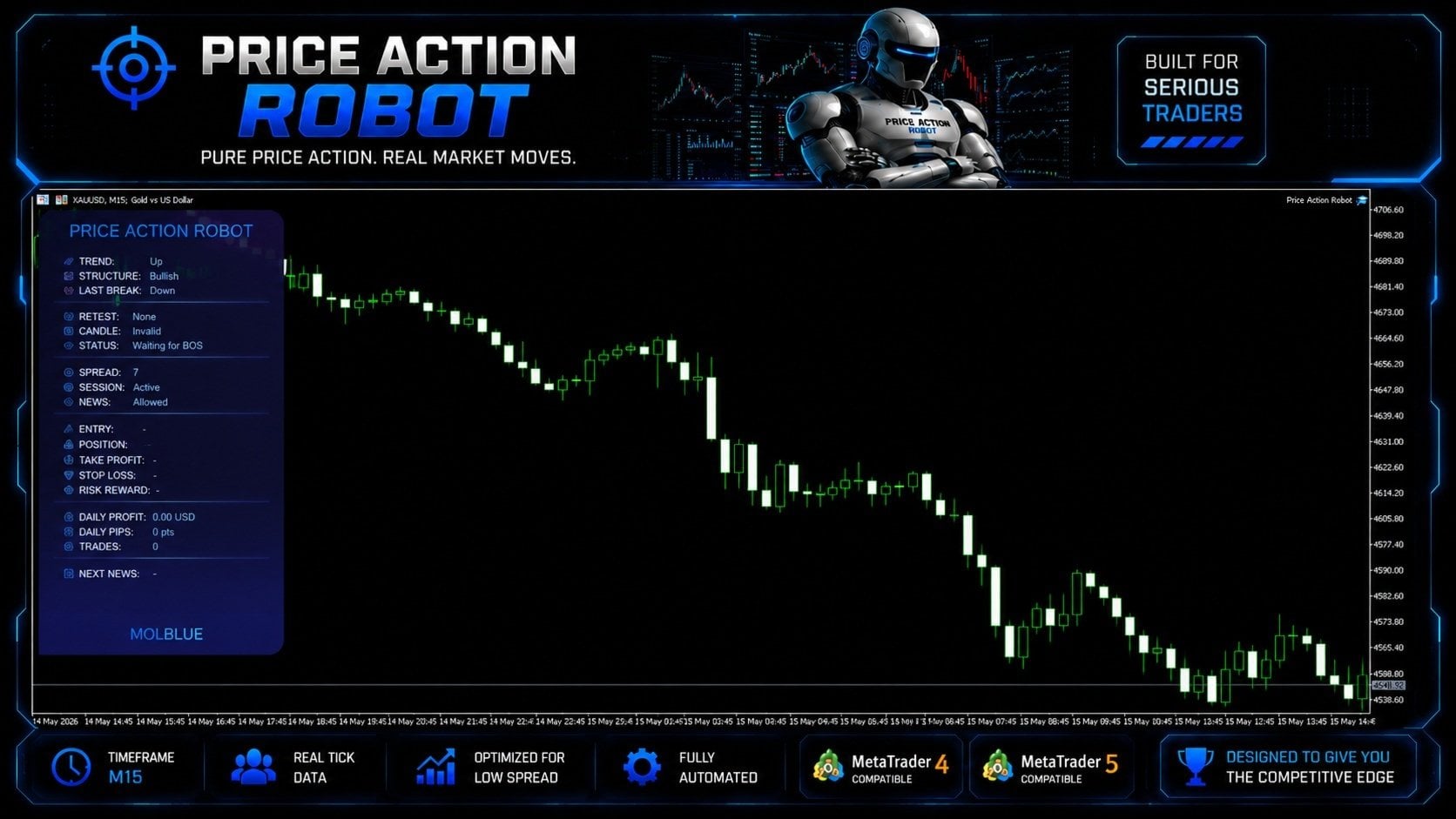
The EA reads markets the way an experienced discretionary trader would. Rather than processing indicator outputs (which by definition lag the price they’re derived from), the algorithm analyses raw price action across four signal layers:
Trend Bias Detection: The EA establishes whether the broader market is trending up, trending down, or ranging. Trend bias serves as a directional filter — long setups only get full consideration when trend bias is up, short setups when bias is down. This prevents the EA from taking counter-trend reversal trades during strong directional moves, which is the failure mode most price-action retail strategies suffer from.
Market Structure Analysis: Within the trend bias, the EA identifies the current structural state — bullish structure (higher highs and higher lows), bearish structure (lower highs and lower lows), or neutral. The “STRUCTURE” field visible in the chart panel reflects this real-time assessment. Structure provides the framework within which trade setups develop.
Break-of-Structure (BOS) Detection: The EA monitors for break-of-structure events — points where price breaches a previous swing high or low that the algorithm has identified as significant. The “LAST BREAK” field in the chart panel records the direction of the most recent BOS event. A bullish BOS within an established uptrend is one of the highest-quality long setups in price-action methodology; the same pattern in reverse provides high-quality short setups.
Retest Validation and Candle Confirmation: After a BOS event, the EA waits for price to retest the broken level (the “RETEST” field tracks this) and then for a confirming candle to signal entry (the “CANDLE” field validates this). Only when all four layers align — trend bias, structure, BOS, retest, candle confirmation — does the EA actually execute a trade entry.
This is fundamentally how disciplined discretionary price-action traders make entry decisions. The algorithm just automates the pattern recognition and enforces consistent execution discipline that humans struggle to maintain across hundreds of consecutive setups.
The Trade Management Layer
Once an entry is executed, four risk-management components govern the trade:
1. Structure-Based Stop Loss. SL is placed at the swing high or swing low that defined the trade setup, not at a fixed pip distance from entry. This is materially different from typical EA risk management. A fixed-pip SL (say 30 pips on EURUSD) might be appropriate during quiet ranging conditions but completely inadequate during a high-volatility XAUUSD session. Conversely, a 200-pip SL might be appropriate for XAUUSD during the London open but absurdly wide for EURUSD during the Asian session. Structure-based SL adapts automatically — SL distance is determined by what the market is actually doing, not by an arbitrary number the algorithm carries from setup to setup.
The practical effect is that SL placement reflects the actual invalidation point of the trade thesis. If the algorithm enters a long after a bullish break-of-structure with retest, the SL sits below the swing low that defined the BOS. If price moves through that swing low, the bullish structure has been broken and the trade thesis is invalidated — the algorithm exits at small loss rather than holding through a structure-invalidating move.
2. Risk-Reward-Based Take Profit. TP is calculated as a fixed multiple of the SL distance. If the SL is 25 pips below entry and the configured RR ratio is 2:1, TP sits 50 pips above entry. Consistent RR ratios across all trades means each position carries the same risk-reward profile regardless of underlying market volatility — the EA isn’t accepting worse rewards on volatile setups or worse risk on tight ranges.
3. Break-Even Function. Once a trade reaches a defined profit threshold (typically equal to the original SL distance), the EA moves SL to the original entry price. This eliminates the risk of a winning trade reversing into a loss. After break-even activation, the worst-case outcome on the trade is a small commission charge if the trade closes at entry; the actual SL risk has been removed from the position.
4. ATR Trailing Stop. Beyond break-even, the EA activates an ATR-based trailing stop. The trailing distance is calculated from current Average True Range, which means it adapts to volatility — loose enough during volatile sessions to avoid premature exits, tight enough during quiet periods to lock in available profit. This is fundamentally different from fixed-pip trailing stops, which are typically either too tight (giving up profit during normal volatility swings) or too loose (giving back too much profit when momentum reverses).
Single position discipline. The EA opens a maximum of one position at a time across both EURUSD and XAUUSD combined. No stacking trades, no adding to losing positions, no lot multiplication, no grid recovery. When a position closes, the algorithm evaluates conditions before opening the next entry.
The 6-Year Backtest: What It Shows and What It Doesn’t
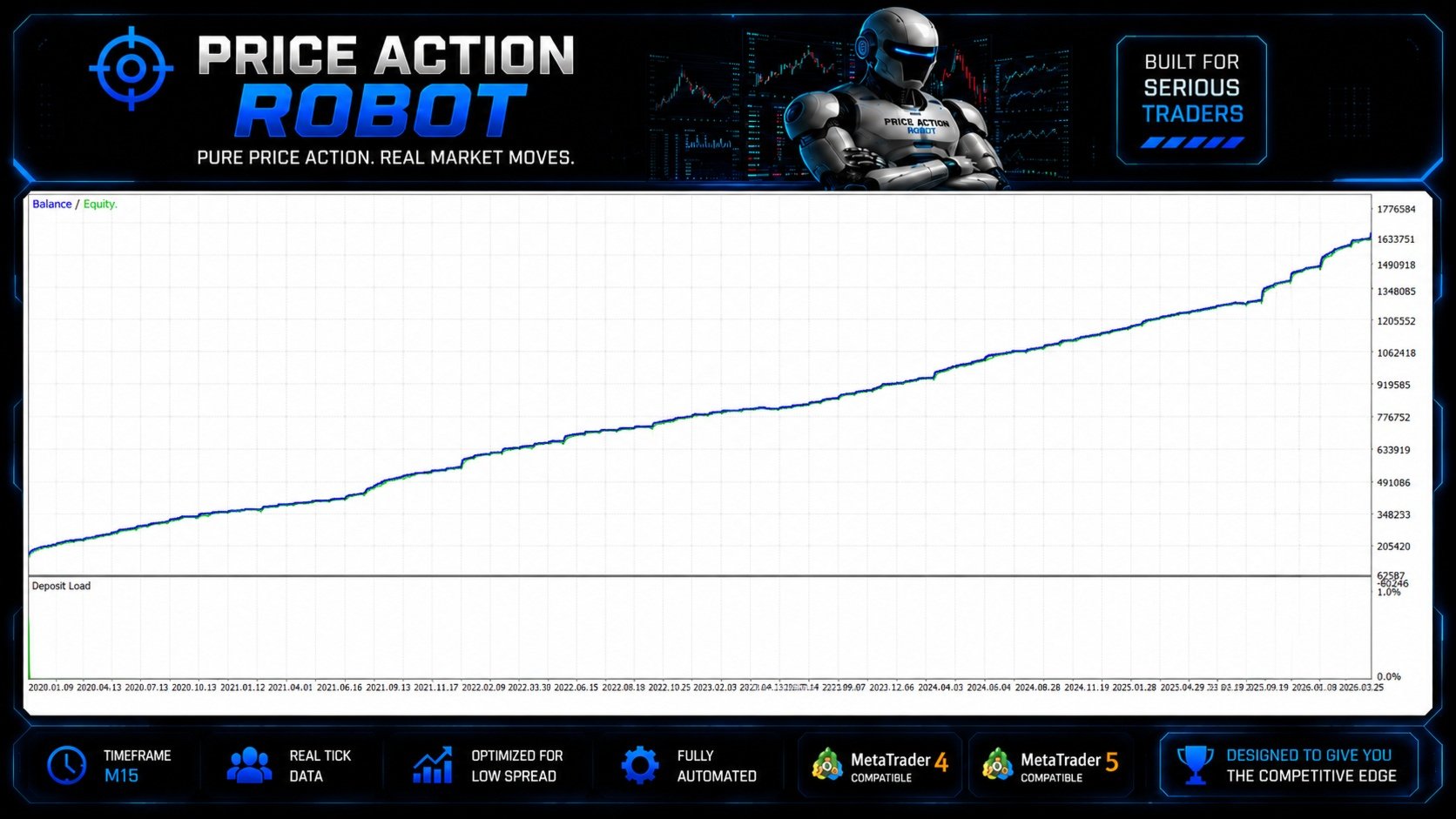
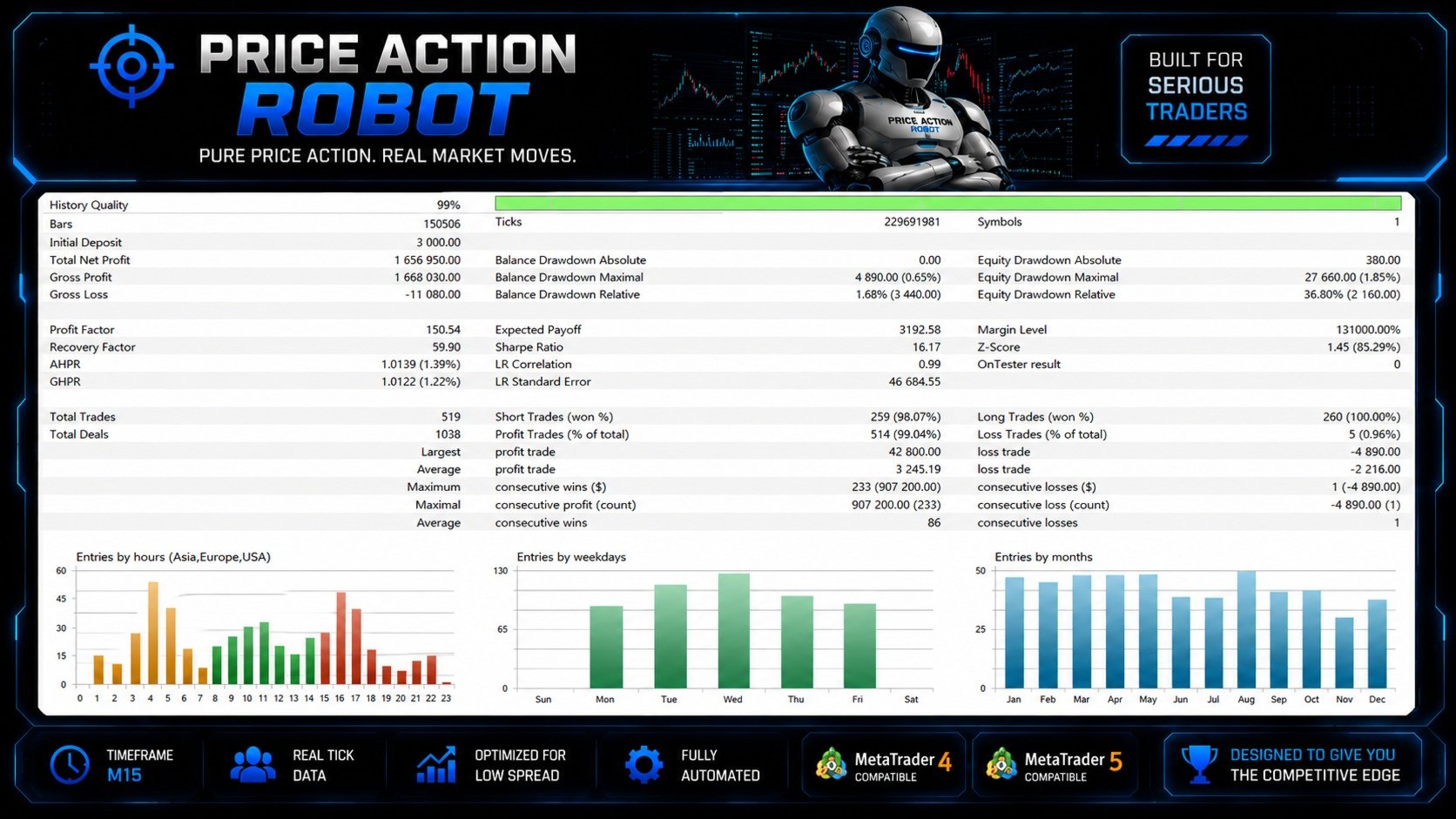
The developer’s published backtest covers 6 years of EURUSD and XAUUSD M15 data from January 2020 to March 2026 at 99% history quality across 229,691,981 ticks. The headline metrics:
- Initial Deposit: $3,000
- Total Net Profit: $1,656,950
- Profit Factor: 150.54
- Recovery Factor: 59.90
- Sharpe Ratio: 16.17
- Total Trades: 519 (260 long, 259 short)
- Win Rate: 99.04% (514 winning trades, 5 losing trades)
- Maximum Balance Drawdown: 0.65%
- Maximum Equity Drawdown: 1.85%
- Largest Loss: -$4,890
- Maximum Consecutive Wins: 233 trades
- Maximum Consecutive Losses: 1 trade
The honest interpretation of these numbers requires careful nuance. They are simultaneously impressive (the strategy logic clearly fits the backtest data well) and concerning (the fit is so good that over-optimisation is a serious possibility). Let’s break down what each metric realistically implies:
Profit factor of 150.54 is extraordinary. Typical good algorithmic systems produce profit factors in the 1.5-3.0 range. A profit factor above 5 is unusual; above 10 is exceptional; above 50 is essentially never seen in honest trading systems. A profit factor of 150 means the algorithm produces $150 in profits for every $1 in losses — that’s a level of efficiency that has very few historical precedents in any market. The most likely explanation is that the backtest reflects optimised parameters fitted to the specific historical data being evaluated, rather than reflecting forward-trading expectations.
Win rate of 99.04% over 519 trades is implausibly high. Most disciplined price-action systems produce win rates in the 50-70% range. Mean-reversion strategies on overbought/oversold conditions can produce win rates of 80-90% but with poor reward-to-risk ratios. A 99% win rate across 519 trades would represent some of the strongest pattern recognition ever seen in retail algorithmic trading. The more likely explanation is that the backtest’s entry filters are tight enough to reject all but the highest-probability setups, but at the cost of relatively few trades over the 6-year period (519 trades across 6 years is roughly 86 trades per year — modest frequency).
Maximum equity drawdown of 1.85% is also very low. Even good algorithmic systems typically produce equity drawdowns in the 10-25% range over multi-year backtests. A 1.85% maximum DD across 6 years would be one of the lowest drawdown profiles ever achieved by a backtested retail EA. Combined with the high win rate, this suggests the algorithm rarely accepts losing trades at all, and when it does, exits them quickly.
The Sharpe ratio of 16.17 is in territory that essentially no real-world trading system achieves. Renowned hedge funds operate with Sharpe ratios in the 1-3 range. The famous Renaissance Technologies Medallion Fund achieved roughly 2.5 Sharpe over its lifetime. A backtest Sharpe of 16 indicates either an extraordinary strategy or — more likely — backtest-specific conditions that won’t translate to forward performance.
What’s actually happening here? The most likely explanation is over-optimisation. The strategy logic was developed using this historical data and refined to the point where it captures the specific patterns that worked in 2020-2026 EURUSD and XAUUSD price action with near-perfect accuracy. This doesn’t mean the EA will fail in live trading — but it does mean the live performance will almost certainly be materially less impressive than the backtest implies. Realistic forward expectations should be calibrated to maybe 20-40% of the backtest’s implied returns, with drawdown potentially 5-10x larger than the historical 1.85%.
The backtest is still useful — it confirms that the strategy logic works on historical data, validates that the entry criteria are restrictive enough to filter out most losing setups, demonstrates that the trade management layer (structure-based SL, RR-based TP, break-even, ATR trailing) interacts coherently across hundreds of trades, and shows the strategy works on both EURUSD and XAUUSD across multiple market regimes. None of this validates forward profitability, but it does validate that the developer has built a coherent algorithmic system.
The Verification Gap
The single biggest issue with Price Action Robot at this point is the gap between the impressive backtest and the complete absence of forward verification:
Zero MQL5 reviews. The EA was launched on 15 May 2026. As of the date of this review, no verified buyer reviews have appeared on either the MT4 or MT5 listing. This is normal for a brand new product but means there’s no third-party buyer feedback to assess the EA’s live performance, support quality, or any unexpected behaviours.
No verified MQL5 Signal. The developer’s MQL5 listing references “live results available on our website” but does not link to a publicly accessible MQL5 Signal. MQL5 Signals provide MetaQuotes-verified third-party trade verification — every trade, every fill, every drawdown event is recorded and auditable. Without an MQL5 Signal, there’s no way for buyers to independently verify how the EA is actually performing in live trading conditions versus the backtest projection.
No publicly visible community. The developer’s listing mentions post-purchase support arrangements, but there’s no public discussion of the EA’s live performance anywhere — no Telegram channel with live signal posts, no FXBook account, no public forum discussion. Buyers are essentially purchasing on the strength of the backtest and the developer’s reputation from their other products.
This gap matters because the backtest’s impressive metrics need forward validation to be meaningful. The developer is asking buyers to trust the backtest projection without providing the verification that would make that trust reasonable.
MT4 vs MT5 — Which Version To Buy
Price Action Robot is available for both MetaTrader 4 and MetaTrader 5. Both versions were launched on 15 May 2026 and both implement the same pure price action methodology.
The MT5 version offers:
- Native multi-symbol support (the EA trades EURUSD and XAUUSD from a single chart attachment, which works more efficiently on MT5)
- Faster order execution speed on volatile XAUUSD ticks
- Superior real-tick backtesting infrastructure for verifying behaviour on your specific broker’s data
- The modern platform with broader institutional broker support
The MT4 version offers:
- Compatibility with legacy MT4 broker accounts and the broader MQL4 EA ecosystem
- Lower system resource footprint, useful for VPS configurations running multiple EAs
- Compatible with brokers that still primarily support MT4 (some prop firms specifically)
Our recommendation:
- Choose MT5 if you have free choice between platforms. The original development target, superior backtest infrastructure for validation, and faster execution all favour the MT5 build.
- Choose MT4 if you’re already running MT4 by preference, your broker only offers MT4, or you’re running multiple EAs and the MT4 resource efficiency matters.
Who Price Action Robot Is For
Buy Price Action Robot if you:
- Want EURUSD and XAUUSD algorithmic exposure from a single chart attachment
- Specifically prefer pure price action methodology over indicator-driven systems
- Trust MQL TOOLS SL based on their 32+ product portfolio and active marketplace presence as a reasonable proxy for engineering quality
- Are willing to demo test extensively (4-6 weeks minimum) before committing real capital
- Will configure conservative position sizing well below the backtest’s implied levels
- Accept the verification gap — buying a new EA without live signal verification, on the strength of the backtest and developer reputation
- Can absorb a deployment scenario where forward returns are 20-40% of backtest projection and drawdown is 5-10x the historical 1.85%
Don’t buy Price Action Robot if you:
- Require verified live signal data before deploying any algorithm — this EA has none yet
- Will be tempted to scale aggressively based on the backtest numbers — that path is almost certain to disappoint
- Need a system with extensive verified user reviews — the EA’s review base is currently empty
- Want a multi-pair EA — Price Action Robot is hard-coded for EURUSD and XAUUSD only
- Are uncomfortable with the gap between exceptional backtest numbers and unverified forward performance
- Trade with a broker whose EURUSD or XAUUSD spreads are wide enough to materially impact M15 algorithmic performance
Where to Download Price Action Robot Legitimately
Two legitimate sources, and only two:
MQL5 Marketplace — direct purchase from the MQL TOOLS SL developer page. MT5 listing | MT4 listing. Activation count limited.
CheaperForex — significant discount on the MQL5 price with the full unlocked file delivered. Same EA, same lifetime updates, plus a 7-day money-back guarantee before activation and an extra 20% discount for crypto payments. MT4 version | MT5 version.
Anywhere else claiming to offer Price Action Robot — for free, at suspiciously discounted prices, via Telegram payment scams, via cracked .ex4/.ex5 files — should be treated as fraudulent. The MQL5 DRM cannot be cracked for marketplace products.
Installation and Setup
Step 1: Delivery. When purchased from CheaperForex, Price Action Robot arrives as the full unlocked .ex4 or .ex5 file. Copy the file into your platform’s MQL4/Experts folder (for MT4) or MQL5/Experts folder (for MT5). Restart the terminal — the EA appears in your Navigator under Expert Advisors.
Step 2: Open EURUSD or XAUUSD M15 chart. The EA can be attached to either pair. From a single chart attachment, it monitors both EURUSD and XAUUSD for setups across both instruments.
Step 3: Verify your account type. A hedging-enabled MT4 or MT5 account is recommended. On MT5 specifically, the EA also supports netting accounts.
Step 4: Configure lot size. The primary configuration step is your position size. Start with the minimum (0.01 lots) on initial deployment. Don’t scale based on the backtest’s implied position sizing until you’ve validated forward behaviour for 4-6 weeks of demo testing followed by a similar period of small-size live testing.
Step 5: Review the additional safety settings. The MQL5 listing mentions risk percent settings, fixed lot configuration, trading hours filters, and spread filters. Configure these conservatively for initial deployment — wider spread tolerance protects you from poor execution on volatile sessions, restricted trading hours can avoid the worst news periods, and conservative risk percentage prevents aggressive position sizing during the early validation phase.
Step 6: Set up demo testing first. Before any live deployment, run the EA on a demo account on your intended broker for at least 4-6 weeks. Document every trade — entry conditions, SL placement, TP target, actual exit, profit/loss. Compare your observed metrics against the backtest projection. Material divergence is the signal to investigate before scaling.
Step 7: Deploy on VPS. M15 algorithms benefit from continuous operation. OVH ($13/month) is the cost-effective standard, but any reputable VPS provider with low-latency connection to your broker works.
Step 8: Enable AutoTrading. Click the AutoTrading button in the platform toolbar so it turns green. A smiley face icon appears in the top-right of the chart when the EA is running correctly.
Frequently Asked Questions
Where can I download Price Action Robot legitimately?
Two sources only: MQL5 marketplace at the official MQL TOOLS SL developer page (with activation count limits), or CheaperForex at a significant discount with the full unlocked file and a 7-day money-back guarantee. The MT4 and MT5 versions are sold separately on both platforms.
Are the 150 profit factor and 99% win rate believable?
The numbers are real backtest results from 99% history quality data — they’re not fabricated. But they’re almost certainly the result of strategy optimisation fitting the historical data, not a realistic forward projection. Profit factors above 5 are unusual; above 50 is essentially never seen in honest live trading. Realistic forward expectations should be calibrated to maybe 20-40% of the backtest’s implied returns, with drawdown potentially 5-10x larger than the historical 1.85%.
What makes price action methodology different from indicator-based systems?
Indicators are mathematical derivatives of price — moving averages, RSI, MACD, etc. They lag the price action they’re measuring. Pure price action systems analyse raw price behaviour directly: swing highs and lows, break-of-structure events, retest patterns, candle confirmations. The advantage is that price action analysis reacts to actual market events rather than to lagging mathematical derivatives. The disadvantage is that price action signals are harder to define algorithmically, which makes pure price action EAs less common than indicator-based systems.
How is the stop loss placed?
SL is placed at the recent swing high or swing low that defined the trade setup, rather than at a fixed pip distance from entry. This means SL distance adapts to market volatility — wider during volatile regimes when swing distances are larger, tighter during quiet ranging periods. The SL sits at the invalidation point of the trade thesis — if price moves through that swing point, the structural setup is broken and the trade exits.
What about the take profit?
TP is calculated as a fixed multiple of the SL distance (configurable risk-reward ratio). If the SL is 25 pips from entry and the RR ratio is 2:1, the TP sits 50 pips from entry in the trade direction. Consistent RR ratios across all trades means each position carries the same risk-reward profile regardless of underlying volatility.
Does the EA have a news filter?
The MQL5 listing references trading hours and spread filters but does not explicitly detail a news filter. EURUSD and XAUUSD are both highly news-sensitive, so this is a meaningful question. Until live behaviour clarifies how the EA handles scheduled news, consider manually pausing the EA before high-impact economic events (NFP, CPI, FOMC, ECB decisions).
Is Price Action Robot prop firm compatible?
The architecture is designed for prop firm compatibility — single-position discipline, hard SL on every trade, no grid mechanics, structure-based stop placement. The 1.85% historical equity drawdown is well within typical prop firm rules (8-10% total DD). However, as a brand new EA with no verified live track record, prop firm deployment should use conservative position sizing well below the backtest’s implied levels.
How does Price Action Robot MT4 differ from MT5?
Strategy is identical between platforms — same structure-based methodology, same risk controls, same dual-pair focus. The MT5 build is the original development target with native multi-symbol support and superior real-tick backtest infrastructure. The MT4 port is the right choice for traders running MT4 by preference. Both versions should produce equivalent live results over time.
What if backtests show 150+ profit factor but real performance is much worse?
That’s the most likely outcome and you should plan for it. The 7-day money back guarantee available through CheaperForex gives you a window to demo test before activation. The full unlocked file with unlimited installations also means you can run extensive demo testing across multiple broker accounts without using up activation slots. Set realistic expectations going in — 20-40% of backtest returns with 5-10x backtest drawdown is a sensible baseline for a new EA with strong backtest numbers but no live verification.
The Verdict
Price Action Robot is a thoughtfully designed algorithmic trading system from an established developer with a substantial portfolio of MQL5 products. The structure-based methodology is genuinely interesting — pure price action analysis without indicator dependence is uncommon and theoretically sound, and the risk-management architecture (structure-based SL, RR-based TP, break-even, ATR trailing, single-position) is exactly what risk-conscious traders should look for in an algorithmic system.
The 6-year backtest is extraordinary but almost certainly overstates forward expectations. A profit factor of 150 and 99% win rate are well outside the range typical honest trading systems produce — they’re far more likely the product of strategy optimisation fitting the historical data than they are a reliable projection of live performance. Realistic forward expectations should be calibrated conservatively.
The verification gap is the single biggest concern. No live signal, no MQL5 reviews, no public community discussing the EA’s actual live performance. Buyers at this stage are purchasing on the strength of the backtest and the developer’s reputation from their other products — not on independently verifiable forward trading evidence.
We rate Price Action Robot 4 out of 5. The strong rating reflects the thoughtful strategy architecture (genuinely sound structure-based SL placement is rare among retail EAs), the comprehensive risk-management layer covering SL/TP/breakeven/ATR trailing on every trade, the dual-pair EURUSD and XAUUSD coverage from a single chart attachment, the developer’s substantial product portfolio and active marketplace engagement, and the 99% history quality backtest demonstrating that the strategy works coherently across 6 years of historical data. The point held back reflects the absence of any live signal verification, the absence of any MQL5 buyer reviews, the implausibly strong backtest numbers that almost certainly overstate forward expectations, and the resulting forward-performance uncertainty that buyers are accepting when they purchase a brand new EA.
For EURUSD and XAUUSD algorithmic traders who appreciate structure-based methodology, who will demo test for 4-6 weeks before live deployment, who will configure conservative position sizing well below the backtest’s implied levels, who trust MQL TOOLS SL’s broader track record as a reasonable proxy for engineering quality, and who accept the inherent uncertainty of purchasing a new EA without verified live results — Price Action Robot is a credible choice. For traders who require verified live signal data, multi-year track records, or extensive verified user reviews before deploying — this isn’t the right product at this stage. Re-evaluate in 3-6 months when live performance data starts accumulating.