
ArtQuant Gold EA MT5 Review: An Honest Look at This XAUUSD Grid System (2026)
Last updated: May 2026
Most gold grid EAs hide what they are. ArtQuant Gold doesn’t — its developer, Miguel Angel Vico Alba, calls it a structured grid system openly, publishes a real-money live signal, and even pushes back on buyers chasing unrealistic returns. That candour is rare in this corner of the market, and it’s the right place to start a review.
View product details and current pricing.
Released in May 2025 and now on version 2.4, ArtQuant Gold trades XAUUSD only. This review covers how the grid works, the settings that actually matter, an honest read of the live signal and the eye-watering backtest, the real drawdown picture, and our verdict.
⚠️ Looking for an ArtQuant Gold “free download”? Don’t.
Every MQL5 marketplace EA ships with built-in DRM. There is no working cracked file in existence — so a “free” copy is always one of two things:
- malware, or
- bait for a Telegram payment scam where you pay and get nothing.
We’ve watched this play out for years. The only safe routes are the MQL5 marketplace or a reputable reseller. CheaperForex offers it at a significant discount versus the marketplace price — Get ArtQuant Gold EA MT5 at CheaperForex.
🚀 Ready to Buy ArtQuant Gold EA MT5?
$239.96 with crypto · $299.95 by card
Official version · Instant download · Future updates included · 7-day money-back guarantee
The Developer: Miguel Angel Vico Alba
Miguel Angel Vico Alba is a Spanish MQL5 developer with a large, long-standing presence on the platform. ArtQuant Gold is his flagship Gold EA, maintained through a steady run of version updates since launch.
What stands out, reading the product page and the review thread, is the tone. When a buyer posted expecting 5-10% per day from a $1,000 account, the developer publicly told them that’s not realistic and no serious EA can promise it. A seller talking a customer down from fantasy returns is a good sign — it suggests the product is being sold on what it actually does, not on hype.
How the Grid System Works
ArtQuant Gold is, by the developer’s own description, a structured grid. Rather than firing on a single entry signal, it manages exposure across a controlled set of positions, with an internally optimised engine deciding when cycles open and how they’re handled.
You don’t tune strategies or indicators. You select a broker profile, pick a risk level, and the engine does the rest. It’s deliberately selective — buyers consistently note it can sit quiet for days, then act when Gold’s conditions line up, rather than forcing trades to look busy.
The important honesty here is about what “grid” means for risk. A grid can show a very high win rate because positions are managed in clusters that mostly close green — but the flip side is floating drawdown that builds when price runs against the grid before it resolves. That’s inherent to the approach, not a flaw unique to this EA, and it’s why the risk controls below matter so much.
To its credit, ArtQuant Gold does not use martingale or progressive lot multiplication — the single most dangerous habit in grid trading. That’s a meaningful distinction from the blow-up-prone grids that flood this category.
The Settings: What You Actually Tune
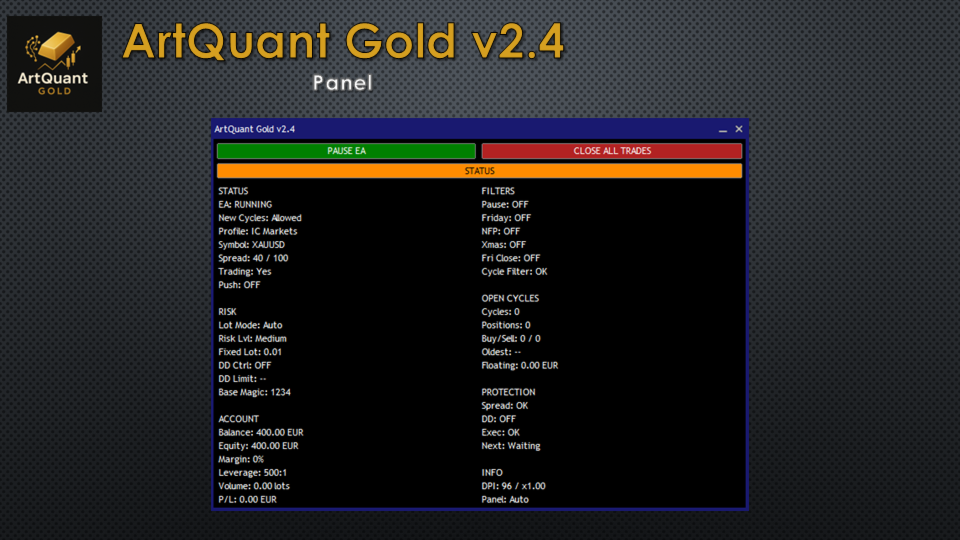
The setup is simple by design, but two choices carry almost all the weight.
Risk level. The automatic risk setting runs from Very Low to Very High, and on a grid this is the dial that decides everything. The live signal’s strong return comes from a Medium-High setting — and so does its ~20% drawdown. Most users should start lower than that and only step up once they’ve seen the behaviour first-hand.
Floating drawdown control. This is the safety valve. You set a floating-DD limit and the action taken when it’s hit. On a grid system, configuring this sensibly is not optional — it’s the line between a controlled pullback and a runaway one. Several reviewers specifically credit running with DD control active for their peace of mind.
Beyond those, you choose a lot mode (Automatic, Fixed, or Fixed per Balance), the matching broker profile, and optional Friday / NFP / holiday filters to keep the grid out of thin, high-risk sessions.
The Live Signal, Examined
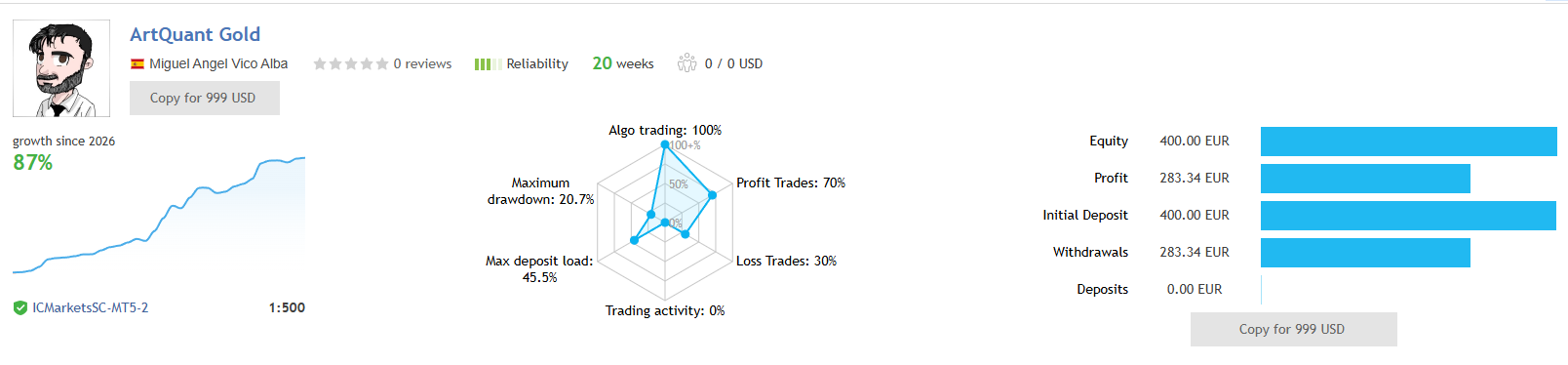
This is the proof that lifts ArtQuant Gold above the backtest-only crowd: a public, real-money signal on IC Markets RAW, tracked for around 20 weeks, up roughly 87%. You can check it yourself.
The developer is upfront that it runs a Medium-High risk profile and shouldn’t be read as the recommended level for everyone — a useful, honest caveat.
Read it with two things in mind.
The drawdown is the real story. About +87% over five months looks great, but it came with a ~20.7% maximum drawdown. That’s the trade-off you’re accepting at that risk setting — and on a grid, a future adverse run could test it harder. Size to the drawdown, not the return.
Five months is a start, not a verdict. A 20-week live record is genuinely better than most rivals offer, but it hasn’t yet been through a sustained hostile stretch for a gold grid. Treat it as encouraging real-money evidence, not a finished track record.
The Backtest, Examined
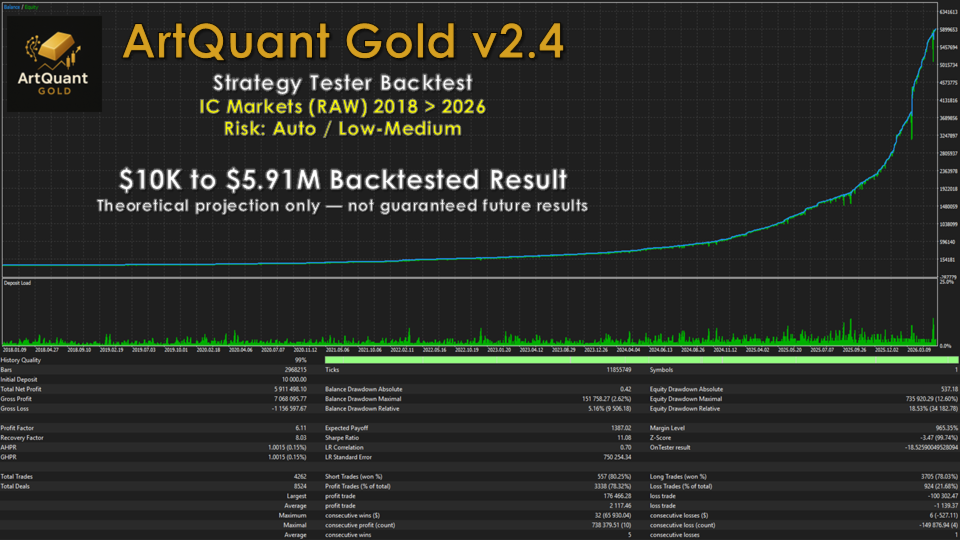
The backtest is spectacular on paper: $10,000 growing to $5.91M from 2018 to 2026, a 6.11 profit factor, a ~78% win rate across 4,262 trades, and a relative equity drawdown around 18.5%.
Give the developer credit again — the image itself is labelled “theoretical projection only, not guaranteed future results.” That’s the right framing, and we’ll hold to it.
Two cautions apply. The headline multiple is compounding an aggressive grid on a small base over eight years; no live account should expect that curve. And a grid backtest is especially sensitive to the spread, slippage, and execution model assumed in the tester — real fills on Gold will differ. The ~18.5% backtest drawdown, like the live ~20.7%, is the number that actually tells you how this system behaves.
What Buyers Are Saying
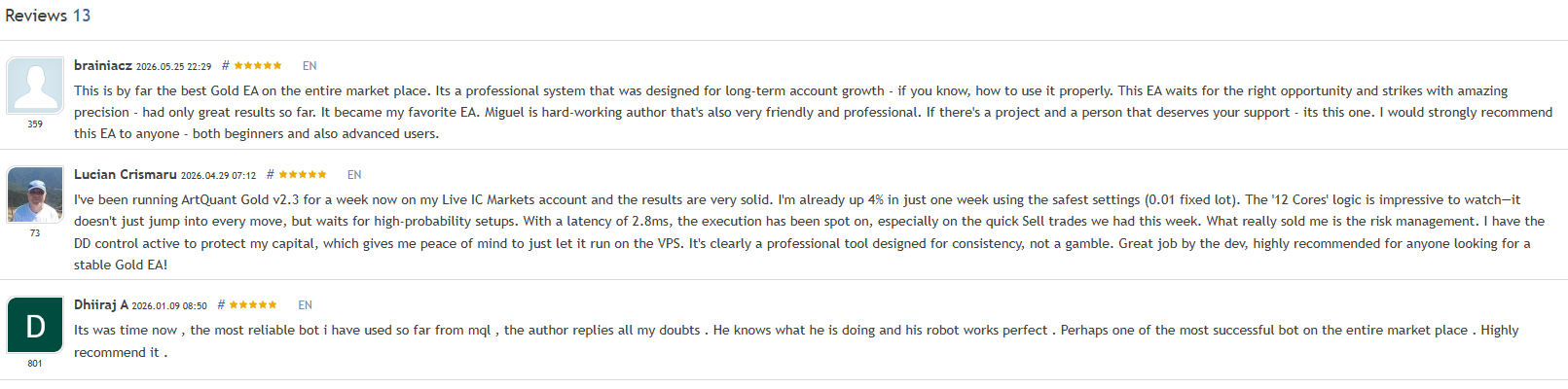
With a 4.64 rating across a dozen reviews, the sentiment is consistent. Buyers describe it as a professional, stable Gold tool built for long-term consistency rather than a gamble, and several highlight that it waits for high-probability setups instead of trading constantly.
The most-praised feature is the risk management — specifically running with drawdown control active for capital protection. Multiple users note the same behaviour pattern: infrequent trades, but solid results when it does act, even on lower-risk settings.
There’s a dissenting note worth airing: one early reviewer complained it traded too rarely and later said it hurt their account. The developer’s public reply is instructive — the buyer had run it eight days and expected 5-10% daily returns, which is simply not a realistic ask of any EA. It’s a reminder that on a selective grid, patience and sane risk expectations are part of the deal.
As always, weight these as user impressions, not guarantees.
Who ArtQuant Gold Is For
It’s a good fit if you:
- Want a Gold-only system and understand grid trading’s risk profile
- Value a published real-money live signal over a backtest alone
- Will run conservative risk and configure the floating-DD control properly
- Trade on a hedging ECN / RAW account with one of the built-in broker profiles
- Can fund the account with enough headroom to absorb floating drawdown
Look elsewhere if you:
- Are uncomfortable with grid systems and floating drawdown in any form
- Want frequent daily trades or fixed daily returns — that’s not this EA
- Trade only on MT4 — this is MT5 only
- Can’t give the account the headroom a grid needs
Our Verdict
We rate ArtQuant Gold 4.5 out of 5.
It earns the high mark on three things: a published real-money live signal, a strong and unusually long review record on the marketplace, and a developer who sells honestly — labelling the backtest a projection and openly correcting unrealistic expectations. The no-martingale, no-lot-multiplication construction, wrapped in a proper floating-DD control and event filters, is about as disciplined as a gold grid gets.
The half-point we hold back is simply the nature of the beast. This is a grid, and grids carry floating-drawdown risk that no amount of polish removes — the live signal’s ~20% drawdown is real, and a future hostile stretch could test it further. That’s not a knock on ArtQuant Gold specifically; it’s the honest ceiling for the category.
If you understand what a grid is, respect the drawdown, run sensible risk, and treat the live signal as strong-but-young evidence, ArtQuant Gold is one of the more credible and transparently sold gold grids available. Validate it on demo, start conservative, and let the floating-DD control do its job.
How to Get ArtQuant Gold Safely
Two legitimate sources, and only two.
CheaperForex — the same EA at a significant discount versus the marketplace price. Get ArtQuant Gold EA MT5 at CheaperForex.
The MQL5 marketplace — direct from Miguel Angel Vico Alba’s developer page. Here is the official MT5 listing.
Everything else is a trap. A marketplace EA can’t be cracked, so any “free download” or Telegram seller undercutting both sources is either malware or a pay-and-vanish scam. The real discount is the legitimate reseller price — not a free file that doesn’t exist.
Frequently Asked Questions
Is ArtQuant Gold legit, or a scam?
It’s a legitimate, published MQL5 marketplace product from a long-established developer, backed by a public real-money live signal and a solid review record. The scams are the “free download” sites and Telegram sellers offering a cracked copy that can’t exist. Buy from MQL5 or a reputable reseller.
Is ArtQuant Gold a grid or martingale system?
It’s a structured grid, and the developer states clearly it does not use martingale or progressive lot multiplication. That’s an important distinction — it avoids the most dangerous grid habit — but it’s still a grid, so floating drawdown during adverse runs is part of the package.
How good is the live signal?
It’s genuine and verifiable — a real IC Markets RAW account up around 87% over roughly 20 weeks. The developer notes it runs a Medium-High risk profile, and it carries a ~20.7% maximum drawdown, so read the return alongside that risk rather than on its own.
Are the backtest results realistic?
The developer labels the $10K-to-$5.91M backtest a theoretical projection, not a guarantee, and that’s the right way to read it. The dollar headline reflects aggressive compounding over eight years; the ~18.5% backtest drawdown is the figure that actually describes the risk.
What’s the real risk?
Floating drawdown. As a grid, ArtQuant Gold can build unrealised losses when price runs against open cycles before they resolve. The no-martingale design and the floating-DD control mitigate this, but it can’t be eliminated — match your risk level and account size accordingly.
What settings should I start with?
Start at a lower risk level than the live signal’s Medium-High, set the floating-DD control to a limit you’re comfortable with, and pick the broker profile matching your account. Increase risk only after you’ve watched it trade live on your own broker.
What account and deposit do I need?
A hedging ECN / RAW account on a supported broker (IC Markets / VT Markets RAW, RoboForex ECN, or Fusion Markets Zero), with around $1,000 minimum and ideally more headroom for a grid. Recommended leverage is 1:500, and a stable 24/7 VPS is advised.
Why does it trade so infrequently?
By design. ArtQuant Gold is selective and waits for specific Gold conditions rather than trading every day. Quiet stretches are normal — judging it over a few days, as one reviewer learned, gives a misleading picture. Evaluate it across active weeks, quiet weeks, and drawdown phases.