
Precise Pair Trading Pro EA MT5 Review: An Honest Look at This Quantitative Gold-Euro Pair Trader (2026)
Last updated: June 2026
Most gold EAs are either trend followers chasing momentum or grid systems averaging into adverse moves. Precise Pair Trading Pro does something different — and rarer. It treats Gold and the Euro as a statistical pair, watches the relationship between them, and only trades when the pair drifts unusually far apart on the model’s terms. The profit comes from the convergence, not from picking a direction.
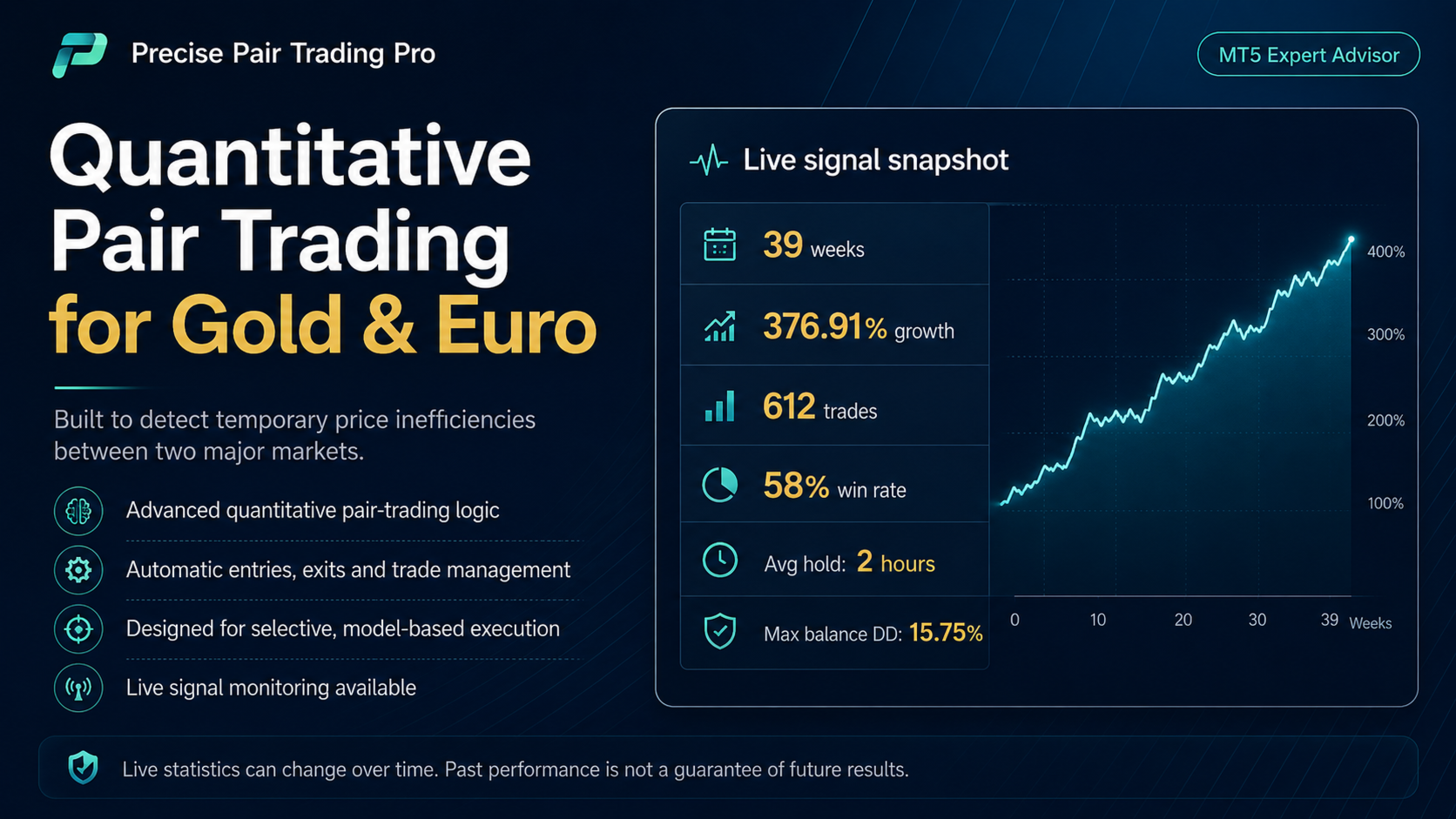
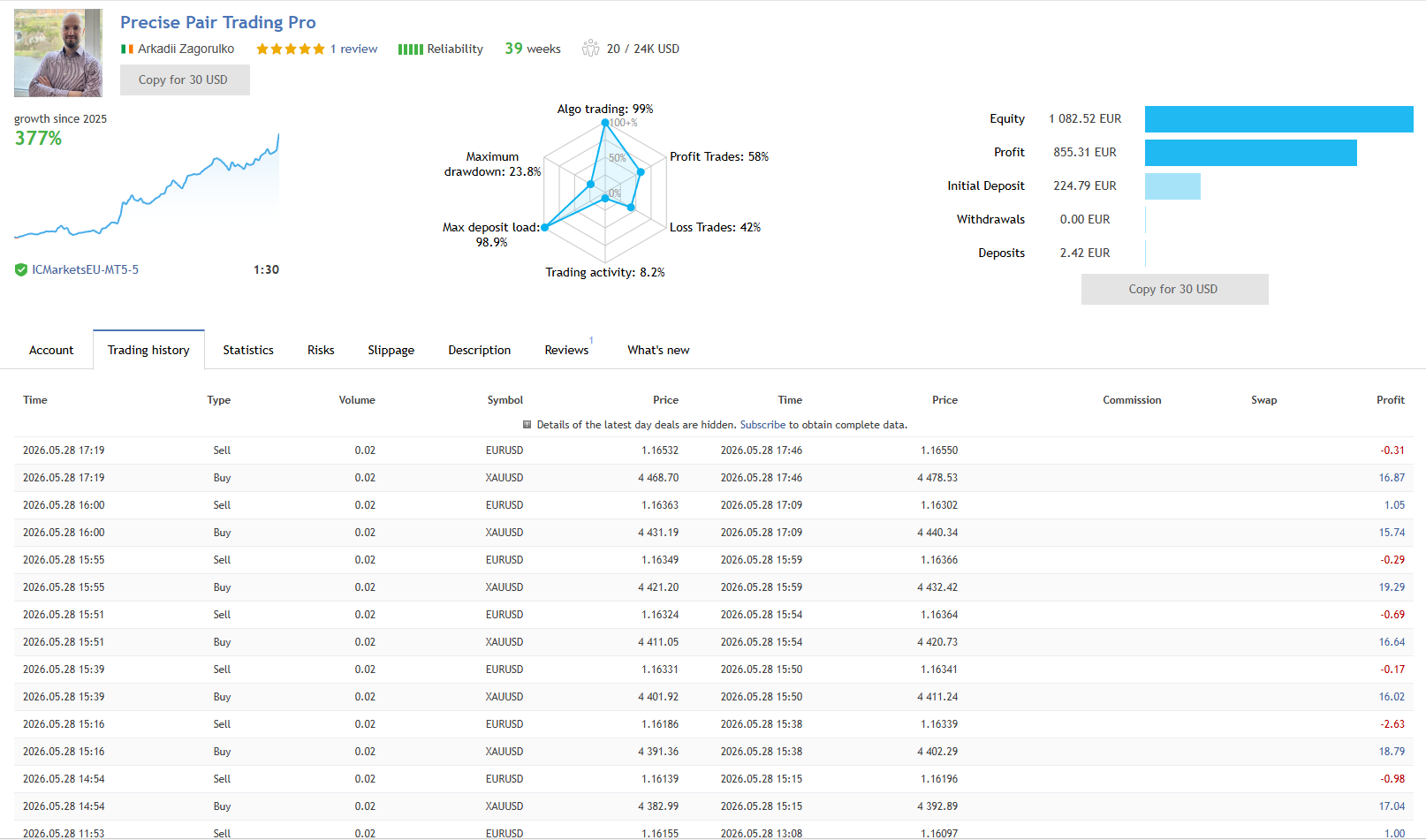
Released in August 2025 by Arkadii Zagorulko, the EA has been quietly accumulating a nine-month, real-money live signal on IC Markets EU. The headline number is striking — roughly +377% in 39 weeks — and unlike most marketplace EAs that publish a signal, this one has done its trading at EU-regulated 1:30 leverage, on a recognisable broker, with the kind of trade pattern that actually matches its stated strategy. That’s worth taking seriously.
This review covers what pair trading actually means on this pair, what the live signal does and doesn’t prove, the two honest caveats the developer himself flags (deposit load and annual recalibration), how it compares to the typical gold robot, and our verdict.
⚠️ Looking for a Precise Pair Trading Pro “free download”? Don’t.
Every MQL5 marketplace EA ships with built-in DRM. There is no working cracked file in existence — so a “free” copy is always one of two things:
- malware, or
- bait for a Telegram payment scam where you pay and get nothing.
The only safe routes are the MQL5 marketplace or a reputable reseller. CheaperForex offers it at a significant discount versus the marketplace price — see the product page here.
The Developer: Arkadii Zagorulko
Arkadii Zagorulko is an Irish-based developer with a multi-year presence on the MQL5 platform and a catalogue of around a dozen products spanning Expert Advisors, indicators and utilities. His public developer rating sits comfortably above 4.8 stars across more than a thousand reviews on his profile — which, while it covers his whole product range rather than this EA alone, is the kind of long-tail credibility that’s worth more than a launch-week flurry of five-stars.
His writing on the listing reads as someone who understands statistical strategy rather than someone selling a black box. He’s explicit about how the system works, what it needs, and crucially what it requires of the user — including the honest note that the strategy needs light annual recalibration. Developers who flag their own caveats up front are a better starting point than developers who don’t.
How Pair Trading Actually Works on This Pair
Pair trading has a long institutional history — it’s the foundation of much of the statistical-arbitrage industry. The basic idea is straightforward. Take two markets that normally move in a related way. Model their typical relationship. When they drift unusually far apart, open positions on both sides expecting the relationship to revert. The edge isn’t in predicting which way Gold or the Euro will go — it’s in betting on the convergence between them after a temporary dislocation.
The interesting choice here is the pair itself. XAUUSD and EURUSD aren’t a textbook tight-correlation pair like two airline stocks would be — they’re broadly related through the US dollar, but with their own drivers. That looser relationship is actually the point: when the pair drifts on noise rather than on a real fundamental shift, the model can fade the dislocation. The selective trading activity on the live signal (only around 8% of the time the EA is actually in trades) suggests it’s not firing on every wobble — it’s waiting for moments that meet its statistical threshold.
What it isn’t, and what the developer is openly explicit about: there is no grid, no martingale, no averaging ladder. Positions open from signal conditions and close from signal conditions, with automatic stops and management throughout. That distinction matters because the “no grid / no martingale” claim is one of the most-abused phrases in this category. Reading the listing and watching the live trade history, it appears to hold up here — trades are paired hedged positions, not stacked recovery layers.
The Live Signal — A Genuinely Strong Track Record
This is the section where most gold-EA reviews start hedging. With Precise Pair Trading Pro, we don’t have to — the signal is among the more credible we’ve examined this year, for reasons that matter beyond the headline number.
The broker is recognisable and regulated. IC Markets EU is a top-tier ECN broker, not the obscure or B-book venues we routinely have to flag elsewhere. That alone changes the trust calculus.
The leverage is 1:30 — EU-regulated. This matters more than it sounds. Strong returns on 1:1000 leverage at a less-known broker can be replicated with any aggressive strategy on a small account. Strong returns at 1:30 under EU rules are far harder to manufacture; they have to come from genuine trade quality. A +377% result at 1:30 is a different category of evidence to a +377% result at 1:1000.
Nine months and 612 trades is a meaningful sample. Not enough to call it proven through every market regime, but well past the “lucky first month” phase. The strategy has traded through different gold environments, different EURUSD environments, and the relationship-driven movements between them.
The trade pattern matches the stated strategy. Looking at the live history, trades open in paired buy/sell positions on EURUSD and XAUUSD simultaneously and close within roughly two hours on average. That’s exactly what pair trading looks like — it’s not, for example, a directional gold scalper dressed up in pair-trading marketing.
The win rate is 58%, not 90%. This is a positive signal, oddly enough. Pair-trading strategies don’t usually have spectacular hit rates because the edge comes from the size of the reversion, not from the frequency of being right. A 58% win rate with a positive return profile is far more believable — and harder to engineer — than the 90%+ rates we routinely see on cherry-picked young signals.
What Early Buyers Are Saying

The early marketplace reviews echo what the live signal shows. The first buyer to weigh in publicly described the EA as performing well over the first week, with a mix of take-profits and stop-losses producing an overall profit, and characterised the trading behaviour as “controlled and steady” — which is exactly the right language for a strategy that’s designed to be selective and reversion-driven rather than aggressive.
Two things are worth noting about this sentiment honestly. The review sample is still small — direct buyer feedback is thin and the strategy works best evaluated over months, not weeks. And early reviews on any product tend to be from buyers who haven’t yet seen a deep drawdown. That doesn’t make them unreliable, just incomplete. The live signal’s 600+ trades remain the more robust evidence; the early buyer feedback is a useful, consistent companion to it.
The Two Honest Caveats — And Why They Matter
No EA is free of trade-offs, and this one has two specific ones worth understanding before you commit real money. Neither is disqualifying; both shape how you should use the system.
1. Deposit load is high on the live signal.
The signal account runs at deposit load near 99% — which means the strategy uses essentially all available margin while positions are open. That’s how it produced the +377% on a small starting balance at 1:30 leverage. It’s also why the maximum drawdown reads in the 23-24% range despite the win rate.
The honest implication: if you size positions the way the signal does, you should expect equity swings comparable to what the signal produced. Conservative sizing — smaller lots, lower percentage of account at risk per pair — reduces both the return and the drawdown proportionally. Most buyers should run more conservative than the signal, at least for the first few months, until they’ve seen how the strategy behaves on their own broker.
2. The strategy requires light annual recalibration.
This one is unusual because the developer himself volunteered it on the listing rather than burying it. Pair trading is statistical by nature: the spread relationship between Gold and the Euro changes over time as their respective drivers evolve. A model calibrated to 2023’s relationship won’t behave identically in 2026’s.
The developer’s stated requirement is light optimisation once a year using the most recent 12 months of data. That’s not “re-engineer the system” — it’s recalibrating spread and beta parameters to current conditions, which is exactly what a statistical strategy should do. It is, however, a real difference from a set-and-forget trend-follower. If you want zero maintenance for 12 months at a stretch, this isn’t that EA. If you’re willing to spend a session each year refreshing parameters (the dev’s listing implies it’s straightforward), the trade-off is reasonable — and arguably a positive, since it’s why the strategy stays relevant rather than degrading silently.
How to Test This One Sensibly
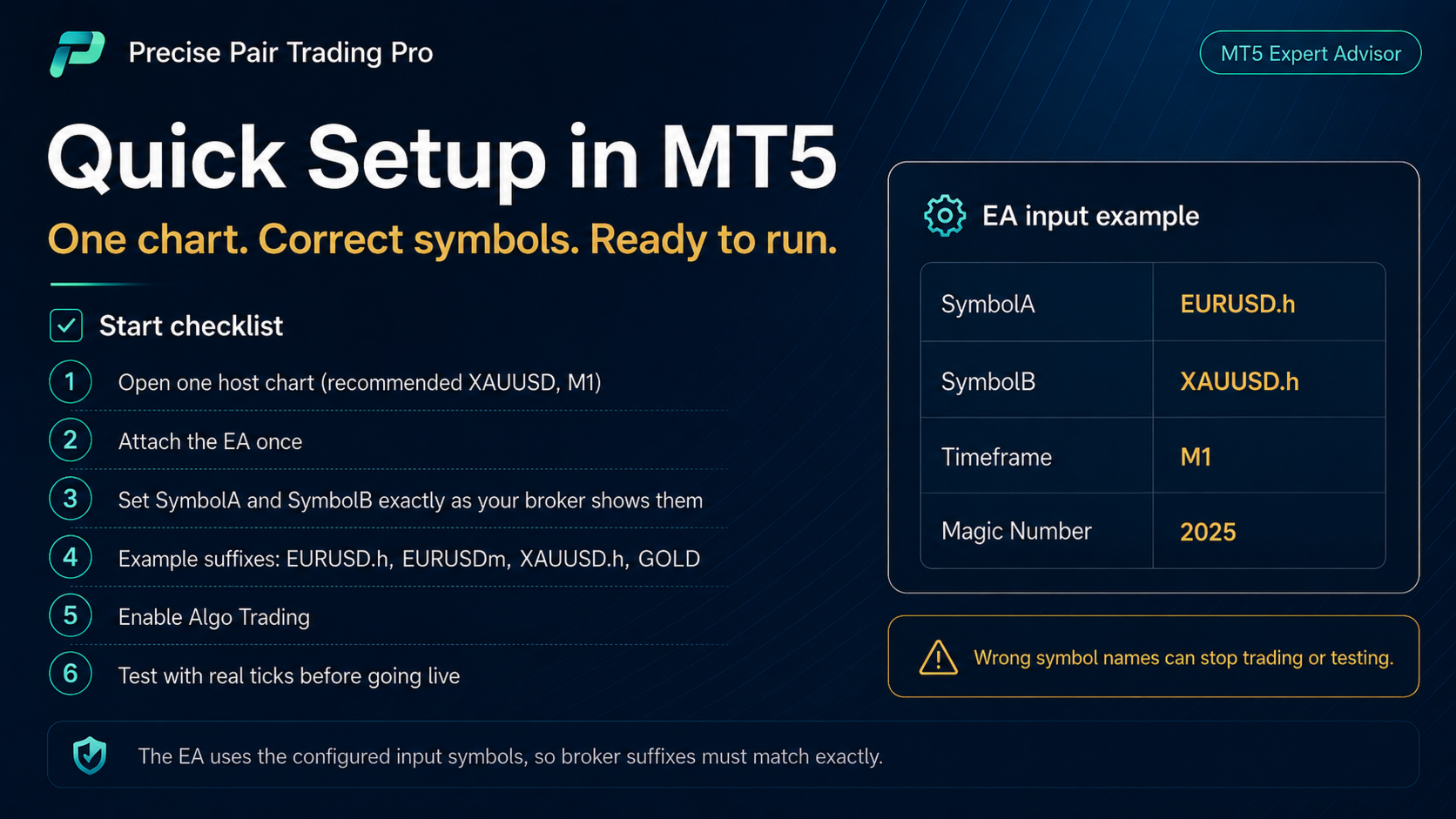
For an EA that lives or dies on broker-specific spread quality and pair behaviour, the testing path matters more than usual.
Start on your broker’s demo, not someone else’s. The strategy reads spreads on both XAUUSD and EURUSD from your broker’s feed. The signal’s results on IC Markets EU may or may not translate to a different broker’s environment. Demo it on the specific account type you intend to run live.
Get the symbol inputs right. The single most common failure mode for this kind of EA isn’t strategy-related — it’s a wrong broker suffix. If your broker’s gold is XAUUSD.h or your EURUSD is EURUSDm, those go into the EA’s inputs verbatim. Wrong names and the EA either won’t trade or will misread spreads.
Backtest with real ticks. The developer specifically calls this out — and for a pair-trading strategy reading two symbols in parallel, it’s not optional. Generic OHLC backtests won’t reflect the spread behaviour the strategy depends on.
Start with sub-signal sizing. Use lot sizes that produce a meaningfully lower deposit load than the live signal — half of it is a reasonable place to start. Watch how trades behave for a few weeks before sizing up. The strategy doesn’t trade often (~8% activity on the signal), so you’ll need patience to build a meaningful sample.
Plan the annual recalibration into your calendar. Mark it as a recurring task. The strategy is designed to be refreshed; treating it as set-and-forget is the user-error pattern most likely to degrade results.
Who Precise Pair Trading Pro Is For
It’s a good fit if you:
- Want a quantitative, statistical strategy rather than another directional gold robot
- Value a long, real-money live signal at EU-regulated leverage on a top-tier broker
- Appreciate a developer who flags caveats openly rather than hiding them
- Are comfortable starting more conservative than the signal and validating before scaling
- Will run the annual recalibration the strategy needs to stay aligned with current markets
Look elsewhere if you:
- Want a true set-and-forget system that never needs touching
- Trade only on MT4 — this is MT5 only
- Want to mirror the signal exactly without thinking about deposit load
- Can’t tolerate the floating drawdown that pair-trading reversion strategies generate while positions are open
Our Verdict
We rate Precise Pair Trading Pro 4.5 out of 5.
The strengths here are unusual for the gold-EA category. The strategy is genuinely quantitative — pair trading is a real institutional approach, not a marketing veneer. The live signal is the kind that lifts a product above its peers: top-tier broker, EU-regulated leverage, nine months, 600+ trades, and a trade pattern that actually matches the stated strategy. No grid, no martingale, no averaging — and looking at the live history, it appears genuinely to hold up. The developer has a long-running catalogue and a strong overall reputation across his other products.
The half-point we hold back reflects the two honest caveats above. The live signal’s near-99% deposit load means the headline +377% comes with real equity swings that conservative buyers should size away from. And the requirement for light annual recalibration, while unusually honest of the developer to flag, does mean this isn’t a system you can install and ignore indefinitely. Neither is a flaw — they’re features of how the strategy actually works — but they’re worth weighing.
For traders who want something different from the directional gold systems that dominate this category, who can run sensible position sizing, and who don’t mind a brief annual maintenance pass, Precise Pair Trading Pro is a credible buy. Validate it on your own broker, start conservative, and let the live trades — not the headline — set your expectations. And because the EA installs as a standalone file with no activation limits, buying it cheaper through CheaperForex is the sensible way to put it through its paces.
How to Get Precise Pair Trading Pro Safely
Two legitimate sources, and only two.
The MQL5 marketplace — direct from Arkadii Zagorulko’s developer page. Here is the official MT5 listing.
CheaperForex — the same EA at a significant discount, delivered as a standalone file with no activation limits. Here is the product page.
Anywhere else offering it free or via a Telegram seller is a trap — there’s no working cracked file, only malware or pay-and-vanish scams.
Frequently Asked Questions
Is Precise Pair Trading Pro legit, or a scam?
Legitimate. It’s a published MQL5 marketplace product from a developer with a multi-year catalogue and a strong overall reputation, backed by a real-money live signal on IC Markets EU at EU-regulated leverage. The scams in this space are the “free download” sites and Telegram sellers offering cracked copies that can’t exist. Buy from MQL5 or a reputable reseller.
How seriously should I take the live signal?
Quite seriously, with one caveat. The 39-week record on a top-tier broker at 1:30 leverage is a meaningfully better evidence profile than most marketplace EAs offer — short results at high leverage on obscure brokers are common, long results at low leverage on regulated brokers are not. The caveat is that the signal runs at very high deposit load, which is what drives both the return and the drawdown.
What does “pair trading” mean in plain English?
Trading two related markets together. The EA opens hedged positions on Gold and the Euro when their statistical relationship drifts outside its normal range, and closes them when the relationship reverts. The profit comes from the reversion, not from picking the direction of Gold or the Euro individually.
Why is the win rate only 58%?
Because pair trading isn’t a hit-rate strategy. The edge comes from the size of the average reversion versus the size of trades that don’t revert, not from being right more often. A 58% win rate with the live return profile is far more believable — and far harder to fake — than the 90%+ rates you see on cherry-picked young signals.
What’s the deal with the annual recalibration?
The strategy is statistical. The relationship between Gold and the Euro evolves over time as their respective drivers shift, so the model needs occasional re-tuning to the most recent 12 months of data to stay aligned. The developer flags this openly. It’s a brief once-a-year maintenance task, not a redesign — but it’s a real difference from a set-and-forget trend-follower.
How aggressive is the deposit load really?
The live signal runs near 99% deposit load, which means it’s using essentially all available margin while positions are open. That’s how the headline percentage was produced. Conservative buyers should run smaller lot sizes than the signal — half is a reasonable starting point — and accept proportionally lower returns and lower drawdowns. Don’t simply mirror the signal’s sizing without thinking.
What broker and account should I use?
A broker offering both XAUUSD and EURUSD with reasonable spreads on each, ideally ECN or RAW Spread. IC Markets is the reference; similar tier brokers should work comparably. The critical setup detail is matching the EA’s input symbols to your broker’s exact naming — including any suffixes like .h, m, or different gold symbols like GOLD.
Why buy from CheaperForex instead of MQL5?
The product is identical — same standalone file, same updates from the developer. You pay significantly less because we operate on a lower-margin reseller model. For a strategy you’re going to demo first and validate before scaling, paying less to test it is the practical move — you cap the cost of finding out whether the system suits your account.