
Osloma Gold EA MT5 Review: An Honest Look at This Market-Structure XAUUSD Grid System (2026)
Last updated: June 2026
Most gold grids are sold as if “grid” is a dirty word that needs hiding. Osloma Gold doesn’t bother — it tells you exactly what it is on the listing: a structured four-level grid system, market-structure based, XAUUSD only. It pairs that honesty with a specific design choice most of its competitors don’t make: a predefined hard stop-loss applied to every basket, and a flat lot structure across the four grid levels rather than the exponential multiplication that blows up most grid accounts.
That combination — bounded basket loss + no lot escalation — is genuinely uncommon in this category, and it’s what makes Osloma Gold worth a careful look rather than dismissing as another grid. Released in May 2026 by Uttam Kumar Nandeibam, the EA already has a public MQL5 live signal running since February 2026 on IC Markets and an early stack of positive reviews on the listing.
This review covers what Osloma Gold actually does, how the four-level basket structure works in practice, what the live signal and backtest show (and don’t), how to read the equity curve honestly, the settings that matter most, who it suits and who it doesn’t, and our verdict.
⚠️ Looking for an Osloma Gold “free download”? Don’t.
Every MQL5 marketplace EA ships with built-in DRM. There is no working cracked file in existence — so a “free” copy is always one of two things:
- malware, or
- bait for a Telegram payment scam where you pay and get nothing.
The only safe routes are the MQL5 marketplace or a reputable reseller. CheaperForex offers it at a significant discount versus the marketplace price — see the product page here.
The Developer: Uttam Kumar Nandeibam

Uttam Kumar Nandeibam publishes under the Osloma Fx brand on MQL5 and Osloma Gold is the flagship Gold product. The developer is reasonably new to the marketplace catalogue but maintains an active product channel and a public discussion group where users compare configurations.
Reading the listing and the way the product is described, two things stand out. First, the developer is openly straightforward about what the system is — a grid — rather than dressing it up as a “smart” or “AI” anything. That kind of honesty about category is rare and worth crediting. Second, the documentation around inputs and risk is unusually detailed for a relatively new seller: a full input guide explaining what every setting does, including the specific risk-per-basket calculation and the autolot equity-based sizing model. That level of documentation suggests someone who understands the system genuinely needs the user to size it correctly, not just to install and hope.
How the Four-Level Grid Actually Works
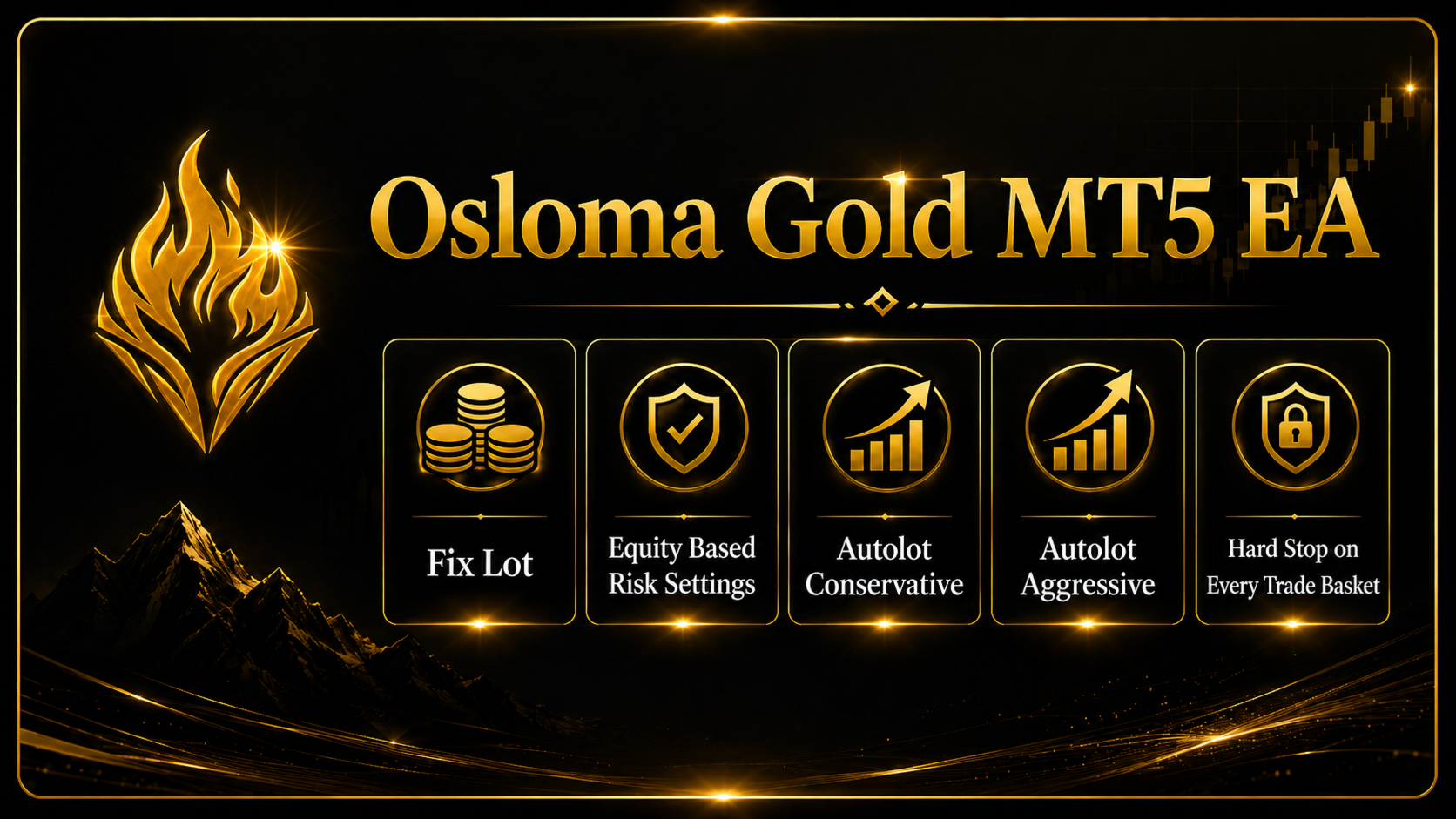
Start with the entry logic. Osloma Gold runs multi-timeframe analysis on gold to identify pullback entries during momentum continuation — the spots where price has retraced into a structural zone but the dominant move is still intact. This isn’t novel by itself; plenty of EAs claim similar logic. What matters is what happens after the initial entry.
When price moves further against the position, Osloma Gold opens additional positions at calculated grid intervals. The basket can grow to a maximum of four trades total per signal set — three additional grid levels beyond the initial entry. Crucially, lot sizes stay flat across the four levels rather than multiplying. If you’ve set a fixed lot of 0.01, your four-level worst-case basket is 0.01 + 0.01 + 0.01 + 0.01 = 0.04 lots total — not the 0.01 + 0.02 + 0.04 + 0.08 = 0.15 lots that an exponential martingale would have you holding.
This is what the developer means by “no martingale.” Lots don’t escalate. That single design choice removes the worst single failure mode in this category — the runaway position size that turns a deep drawdown into an instant blow-up.
The second design choice is the per-basket hard stop-loss. Every basket is wrapped in a predefined maximum loss (the developer’s default suggestion is $100-$150 per 0.01 basket). If the basket’s floating loss hits that threshold, the system closes it — taking a controlled, defined loss rather than letting it spiral. Combined with the cooldown setting that pauses new trades after a max-basket stop hits, the worst-case loss profile is bounded rather than open-ended.
The honest counterpoint: it is still a grid, and floating drawdown while baskets are open is part of normal operation. The hard SL caps the worst case; sensible sizing manages the everyday case. If you’ve never sat through a grid drawdown without intervening, this is the design lesson to internalise before going live.
The Settings That Actually Matter
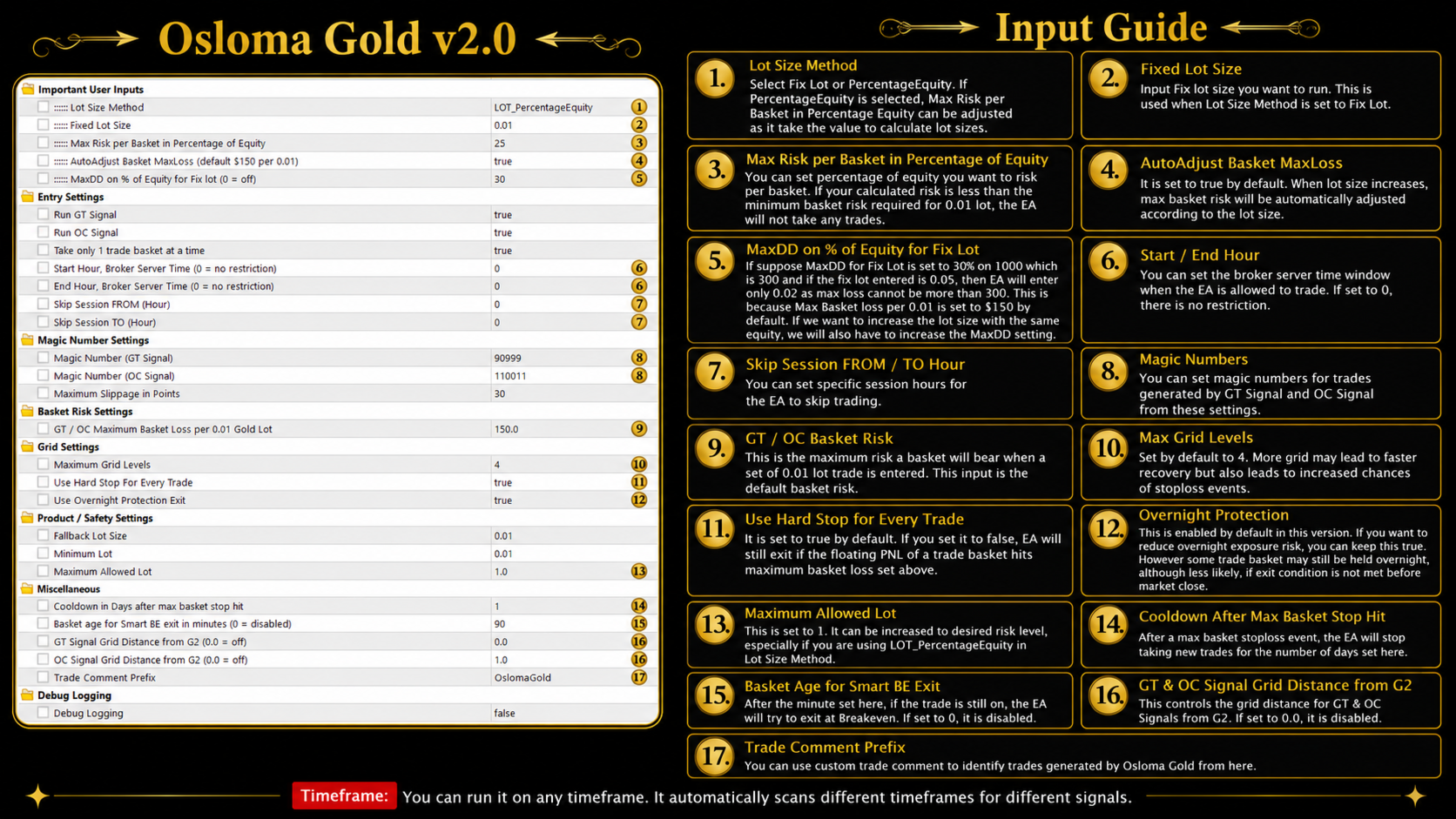
The configuration surface is wide, but only a handful of settings carry real weight. These are the ones to think about before the EA touches a live account.
Lot Size Method. Choose between Fix Lot (a static lot size you control) or PercentageEquity (autolot that scales lot size to account equity). New buyers should start with Fix Lot at 0.01 until they’ve watched the EA behave on their own broker. Move to PercentageEquity only after you’ve calibrated what the system actually does on your account.
Max Risk per Basket. The single most important setting in the whole input list. This caps the worst-case loss the system will accept on any one basket. The developer’s default of $100-$150 per 0.01 basket is sensible; halve it if you want a more conservative profile. Whatever you choose, this number is the answer to “what’s the worst that can happen on one trade sequence.”
Max Grid Levels. Defaults to 4. Reducing this to 3 or 2 makes the EA more conservative — fewer additions during adverse runs, smaller floating drawdown, but also less recovery capacity. Increasing it makes the system more aggressive and increases the floating drawdown ceiling. Most buyers should leave this at 4 and adjust risk through the basket-loss setting instead.
Cooldown after max basket stop. When the hard SL triggers on a basket, this setting pauses new entries for the configured number of days. The default of 1 day is reasonable; longer cooldowns are more conservative.
GT and OC magic numbers. Osloma Gold has two independent entry signal sets. You can run one or both. Running both increases trade frequency but also stacks margin demand if both fire near-simultaneously. Single-signal mode is the conservative starting point.
Use Hard Stop For Every Trade. Defaults to true. Leave it true. Disabling this removes the basket-level safety net that distinguishes Osloma Gold from open-ended grids.
The Live Signal — Read the Curve Honestly
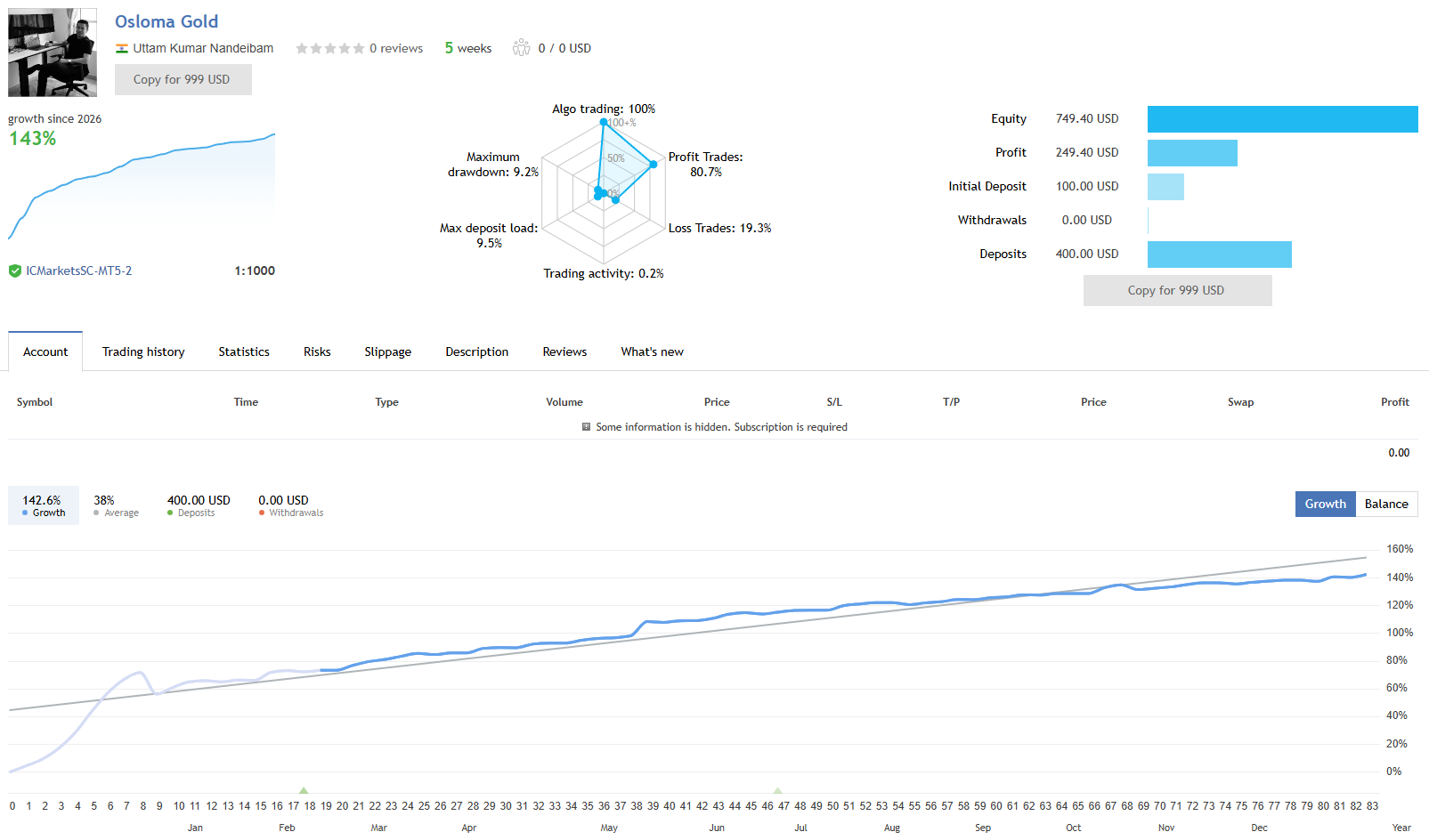
The headline numbers are strong: ~+143% growth, 80.7% profit trades, ~9.2% maximum drawdown, 0.2% trading activity (i.e. it’s selective rather than constantly in the market), on IC Markets as a real-money account. You can verify it yourself.
A few things are worth pulling out before treating those numbers as a guarantee.
The early portion of the curve is back-filled. Look closely at the growth chart and the lighter section at the start shows imported pre-tracking history, before the genuinely MQL5-tracked portion (the darker line) takes over. This pattern is common on new signals and isn’t dishonest by itself — the developer is showing how the system performed on their account before they enabled public signal tracking. But it means you should weight the tracked tail more heavily than the back-fill when judging behaviour. Fortunately, the tracked tail here looks clean and steady, which is the right signal.
17 weeks is encouraging, not proven. Four months of live data through one gold environment is a positive start, not a long-term track record. It hasn’t been tested through a sustained hostile period for grid systems, and the worst drawdown the live signal will eventually produce is almost certainly worse than the 9.2% on the chart today. That’s not pessimism; it’s what “young signal” means.
9.2% is balance drawdown. A grid system’s true risk picture is equity drawdown — which includes the floating losses on baskets that are still open. Balance drawdown only counts what’s been realised at trade close. The backtest reports 11.67% equity drawdown against 0.82% balance drawdown, which gives you a clearer sense of the gap. Plan around the equity figure, not the balance one.
The 1:1000 leverage is what makes the percentage growth possible. A real-money account at 1:1000 with a small base will produce dramatic percentage moves in both directions. The strategy’s quality is in the trade pattern and the basket discipline, not in the headline percentage. On a more conservative-leverage account (EU 1:30, for example) the same strategy will produce a more modest result on the same trades.
The 0.98 LR Backtest — Strong But Read Carefully
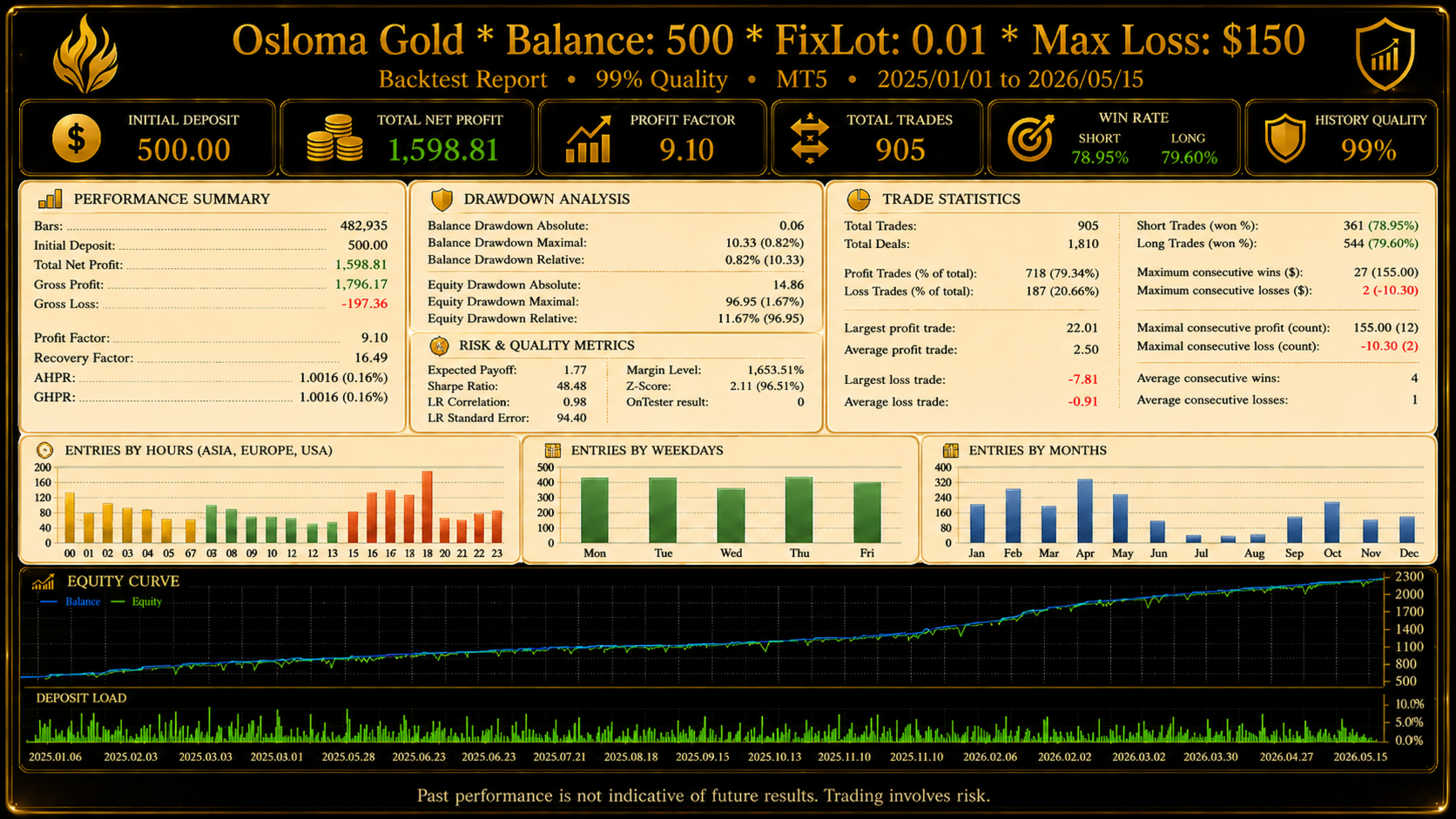
The backtest covers January 2025 to May 2026 at 99% history quality. The headline metrics are unusually strong: a profit factor of 9.10, a 78.95% short win rate and 79.60% long win rate, 905 trades, and an LR correlation of 0.98 against the linear regression — meaning the equity curve climbs in near-mathematically-straight fashion across the period.
A 0.98 LR is genuine evidence that the strategy’s profitability isn’t concentrated in one favourable stretch. It’s particularly notable because the test period covers multiple gold regimes (2025 bull moves and 2026 corrections), so the linearity isn’t an artefact of testing only in a friendly environment.
Two important caveats keep this in proportion.
17 months is short for a backtest. The standard for “robust” usually runs 5-10 years of data across multiple market regimes. 17 months is enough to be useful but not enough to call it proven across history. Treat the LR as encouraging structural evidence, not a long-term forecast.
The equity drawdown matters more than the balance figure. 0.82% balance drawdown is the eye-catching number, but for a grid system the equity drawdown (11.67% in this backtest) is the figure that describes how the account actually feels during adverse stretches — because it includes the floating losses on baskets that are still open. Size your account expectations to the 11.67%, not the 0.82%.
None of that diminishes the strength of the result. It just frames it for what it is: a robust 17-month test of a market-structure-based grid with hard SL discipline, supported by a clean tracked tail on the live signal.
What Buyers Are Saying
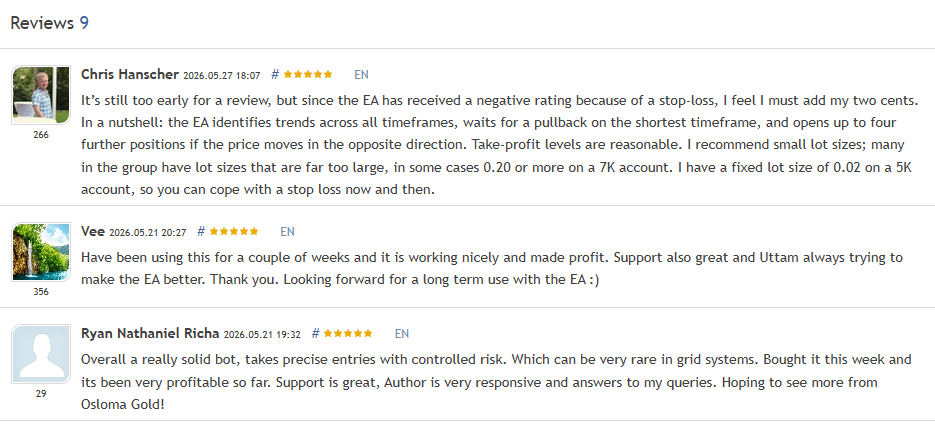
Early buyer sentiment lines up with the strategy’s design. The standout review describes the system in concrete operational terms: “identifies trends across all timeframes, waits for a pullback on the shortest timeframe, and opens up to four further positions if the price moves in the opposite direction. Take-profit levels are reasonable. I recommend small lot sizes.”
That review is unusually useful because it confirms how the EA actually behaves on a real account — and the lot-size advice is the right instinct. Buyers running 0.20+ lots on a 7K account, as that reviewer noted other users had been, are setting themselves up for a deep drawdown that the hard SL alone won’t save them from. The system’s protections are real but they’re not a substitute for sensible sizing.
Other early reviews describe Osloma Gold as “a really solid bot” with “precise entries” and “controlled risk” — which is the right language for a grid that’s actually trying to manage exposure rather than just dressing martingale in nicer marketing.
As always, weight these as early impressions, not long-term verdicts. The product is young enough that the multi-month review base hasn’t built yet.
Who Osloma Gold Is For
It’s a good fit if you:
- Want a Gold-only system from a developer who’s honest about what category the EA actually belongs to
- Understand grid mechanics and can sit through floating drawdown without manually closing baskets
- Value the hard SL per basket and the no-lot-multiplication design as real risk controls
- Will start at conservative risk-per-basket settings and let live behaviour on your own broker guide you
- Run on an ECN/RAW broker with reasonable XAUUSD spreads
Look elsewhere if you:
- Are uncomfortable with grid systems and floating drawdown in any form
- Need a multi-year proven live track record before buying — this signal is 17 weeks old
- Want to mirror the signal’s 1:1000 leverage on a small account without thinking about sizing
- Trade only on MT4 — this is MT5 only
- Run prop-firm challenges where grid trading is typically prohibited
Our Verdict
We rate Osloma Gold 4.5 out of 5.
The strengths are real and they’re things you can verify yourself rather than take on faith. The system is honest about being a grid rather than dressing it up. The hard stop-loss on every basket is a meaningful design choice that bounds the worst-case loss instead of leaving it open-ended. The flat lot structure across the four grid levels removes the runaway-position-size failure mode that ruins most grid accounts. The live signal’s tracked portion looks clean and steady. The backtest produces a 0.98 LR across a multi-regime 17-month period, and the developer documents the inputs to a level that suggests they expect users to actually configure the system rather than install-and-pray.
The half-point we hold back covers the things that are genuinely true for a system this young. 17 weeks of live data hasn’t been stress-tested through a sustained hostile gold period. The live signal’s headline percentage rides on aggressive leverage that most buyers shouldn’t replicate. The early reviews are positive but the long-tail review base hasn’t built yet. And it is still a grid — the design is disciplined, but the category’s floating-drawdown psychology will eat any buyer who can’t sit through it.
For Gold traders who understand grid mechanics, respect the floating-drawdown reality, run conservative risk on a reputable ECN broker, and treat the live signal as a strong-but-young indicator rather than a forward guarantee, Osloma Gold is one of the more honestly-designed gold grids on the marketplace. Buying it cheaper through CheaperForex is the sensible way to test a relatively new system — you cap the cost of finding out how it behaves on your own account.
How to Get Osloma Gold Safely
Two legitimate sources, and only two.
The MQL5 marketplace — direct from Uttam Kumar Nandeibam’s developer page. Here is the official MT5 listing.
CheaperForex — the same EA at a significant discount versus the marketplace price. Here is the product page.
Anywhere else offering it free or via a Telegram seller is a trap — there’s no working cracked file, only malware or pay-and-vanish scams.
Frequently Asked Questions
Is Osloma Gold legit, or a scam?
Legitimate — it’s a published MQL5 marketplace product with a public real-money live signal on IC Markets and a growing review base. The scams in this space are the “free download” sites and Telegram sellers offering cracked copies that can’t exist. Buy from MQL5 or a reputable reseller.
Isn’t this just another grid system in disguise?
It is openly a grid system — the developer doesn’t hide that. What distinguishes it from most marketplace grids is two specific design choices: a hard stop-loss on every basket (so worst-case per-sequence loss is bounded), and a flat lot structure across the four grid levels (no exponential multiplication). Both are real, and both meaningfully change the risk profile versus open-ended or martingale-style grids.
How seriously should I take the live signal?
The tracked tail is clean and the 9.2% drawdown is reasonable for the category — that’s encouraging real-money evidence. But the signal is only 17 weeks old, the early portion of the curve is back-filled, and the headline percentage rides on 1:1000 leverage. Read it as a promising start, not a settled track record, and don’t extrapolate the percentage to your own (probably more conservative) leverage setup.
Does the 0.98 LR backtest really mean what it sounds like?
It means the 17-month equity curve climbs in near-mathematically-linear fashion across multiple gold regimes — strong evidence the strategy isn’t curve-fit to one favourable stretch. But 17 months is shorter than the multi-year tests that usually qualify as “robust,” and the equity drawdown (11.67%) matters more than the eye-catching balance drawdown (0.82%) for a grid.
What’s the real risk picture?
Two layers. The hard SL per basket bounds the worst single-sequence loss. Floating drawdown while baskets are open is normal operation and not bounded — it’s managed by sizing. Your basket-loss setting, lot size, and account size are what actually determine the equity-drawdown experience. Conservative defaults reduce both returns and drawdowns proportionally.
What settings should I start with?
Fixed lot at 0.01 with the developer’s recommended $100-$150 max basket loss, single signal (one magic number) rather than both, and 4 grid levels with the hard stop enabled. Watch live behaviour on your own broker for several weeks before adjusting. Don’t reach for autolot or both signals on day one.
What broker and account should I use?
A reputable ECN or RAW broker offering XAUUSD with reasonable spreads. Hedging is recommended but not required by default. Match leverage to your jurisdiction — the live signal’s 1:1000 is what produces the eye-catching percentage but most buyers shouldn’t replicate it without thinking about sizing.
Why buy from CheaperForex instead of MQL5?
The product is identical — same EA, same updates from the developer. You pay significantly less because of how the reseller economics work. For a system you’re going to demo first and validate before scaling, paying less to test it is the practical move — you cap the cost of finding out whether the system suits your account.