
Last updated: June 2026
ZenQ Flow AI EA launched on the MQL5 marketplace in May 2026 — a XAUUSD-focused trading console and Expert Advisor from Russian developer Valentina Zhuchkova that pairs an automated trading engine with an integrated AI Assistant powered through OpenAI’s GPT-4o-mini API. It’s a sister product to her earlier release, Nexorion Initium Novum (which we covered in our Nexorion editorial review), and a substantially more sophisticated build — full 5-page Trading Console, multi-symbol watchlist, 13 analytics tabs, live AI analysis layer.
View product details and current pricing.
The architecture is the strongest part of the case. The Trading Console exposes a feature-dense professional-style interface on the chart, the AI Assistant integrates an external large language model in a way most marketplace EAs don’t even attempt, and the developer’s catalogue is starting to mature (her MQL5 profile now sits at 5.0 across 8 reviews, up from the debut state at the time of the Nexorion release). On paper, this is one of the more genuinely interesting XAUUSD products listed in 2026.
The evidence on this specific product, though, has three specific flags significant enough to hold the editorial rating to 3.5 out of 5. The live signal shows 100% profit trades and 0% loss trades at 11 weeks, which is a young-signal artefact that won’t hold long-term. Both backtest modes carry an LR correlation of 0.99 — the same too-clean signature we flag elsewhere as optimised-against-history. And both backtest modes contain a recurring outlier single-trade loss that’s five-to-fifteen times the typical loss size. This review covers all three openly, alongside what the architecture genuinely does well.
⚠️ Looking for a ZenQ Flow AI “free download”? Don’t.
Every MQL5 marketplace EA ships with built-in DRM. There is no working cracked file in existence — so a “free” copy is always one of two things:
- malware, or
- bait for a Telegram payment scam where you pay and get nothing.
The only safe routes are the MQL5 marketplace or a reputable reseller. CheaperForex offers ZenQ Flow AI at a significant discount versus the marketplace price — Get ZenQ Flow AI EA MT5 at CheaperForex.
The Developer: Valentina Zhuchkova

Valentina Zhuchkova is a Russian algorithmic trading developer publishing on MQL5. At the time of our Nexorion Initium Novum review she was a debut seller with limited published track record. Since then her catalogue has matured — she now has two products listed (Nexorion + ZenQ Flow AI), two live signals running publicly, and her MQL5 profile rating sits at 5.0 across 8 reviews. That’s still a small sample, but it’s a credible direction of travel rather than a stagnant or declining profile.
What ZenQ Flow AI demonstrates as a build is that Valentina isn’t just iterating on the same product. The Trading Console architecture, the multi-page modular interface, the AI Assistant integration through OpenAI’s API — these are substantively more ambitious engineering than Nexorion’s more conventional automated-EA design. Whether you read that as a developer growing into harder problems or as a feature-stacking exercise that adds complexity faster than it adds reliability is part of what this review is going to examine.
The Trading Console
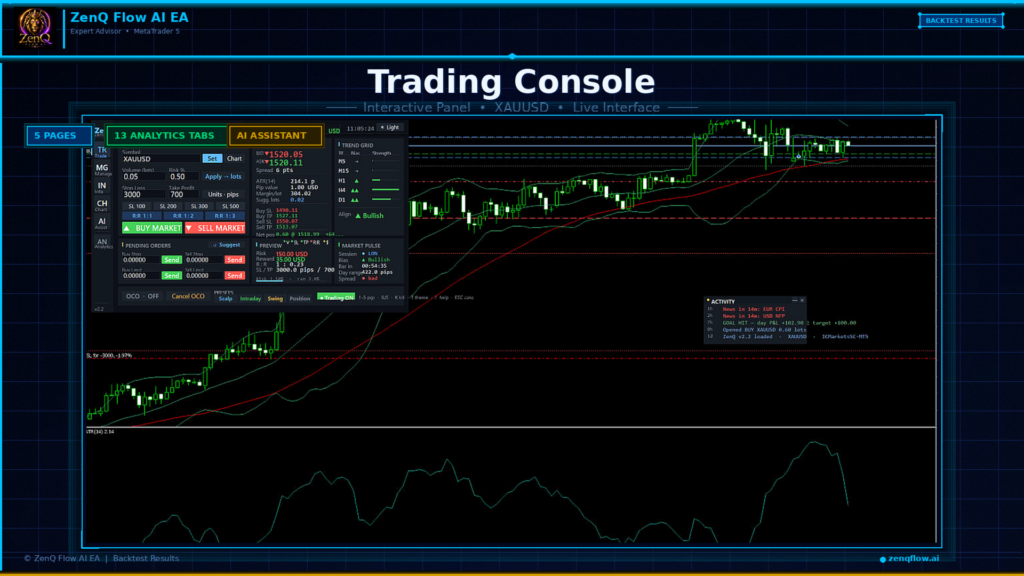
Most marketplace EAs run invisibly. They attach to a chart, do their work in the background, and offer no interactive surface beyond a small status panel in a corner. ZenQ Flow AI takes the opposite approach — it exposes a full interactive trading interface on the chart with five distinct pages: Trade (one-click buy/sell with lot sizing, risk percentage, SL/TP presets, and RR ratio buttons), Manage (position oversight, partial close, SL-to-break-even), Info (instrument metadata, spread, session timing, pip calculator), Chart (multi-timeframe view with SMA 20/50 and Bollinger overlays plus price alerts), AI Assist (the GPT-4o-mini integration), and Analytics (13 tabs covering correlation, news, calendar, performance, sessions, and more).
What that buys you in practice is genuine operational depth. The Trend Grid panel reads M5, M15, H1, and D1 bias simultaneously and produces an aggregate alignment signal. The Market Pulse panel ties session, bias, day-bar position, day-range, and spread into a single context readout. The Activity Log threads recent trades through upcoming news events so you can see why the EA paused or took a position relative to scheduled releases. Pending order controls include OCO (one-cancels-other) logic with separate buy-stop, sell-stop, buy-limit, and sell-limit configurations.
This isn’t a quickstart product. Configuring the Trading Console takes more thought than attaching a typical scalper, and the analytics tabs reward time spent learning what each tab actually shows. For traders who want to use the EA as a fully algorithmic system and ignore the panel, the core automated trading engine runs independently — but you’d be leaving a lot of the product’s value on the table.
The AI Assistant — How It Actually Works
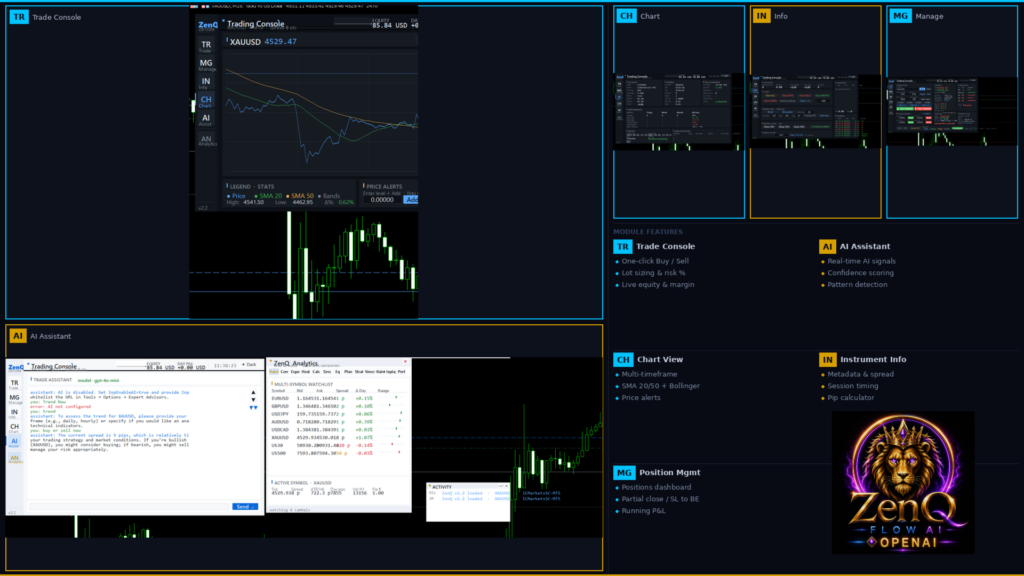
This is the architectural feature that most distinguishes ZenQ Flow AI from anything else on the marketplace. The AI Assistant uses MetaTrader 5’s WebRequest API to call OpenAI’s GPT-4o-mini model in real time, sending the model your current market context and getting back analytical commentary — trend interpretation, multi-timeframe alignment reads, spread analysis, suggested trade direction. The model responses appear directly inside the on-chart Trading Console.
The mechanics, briefly. Setup requires whitelisting https://api.openai.com/ in MT5’s WebRequest settings (Tools → Options → Expert Advisors), then adding your own OpenAI API key to the EA’s input parameters. The EA handles the API calls; you pay OpenAI’s usage rates directly for the tokens consumed (GPT-4o-mini is one of OpenAI’s cheaper models, so cost per query is small — typically fractions of a cent per analysis request). The AI Assistant is optional: turn it off and the core automated trading engine runs without it.
Two honest observations about this feature.
First, it’s a genuinely interesting integration. Most “AI” labelling on trading products is a marketing word attached to an indicator stack. ZenQ Flow AI is actually calling a real large language model and incorporating its output. That’s a category difference, not a degree difference.
Second, treat the AI Assistant’s output as analytical commentary, not as trade signals. GPT-4o-mini is not a trading-specialised model — it’s a general-purpose LLM with broad knowledge that includes financial concepts. Its analyses can be useful as a sanity check or as a second opinion on what you’re seeing, but they will not be more reliable than your own analysis on questions the model has limited training data for. Don’t outsource trade decisions to it; use it as one input among several.
The Live Signal — 100% Win Rate Needs Honest Framing
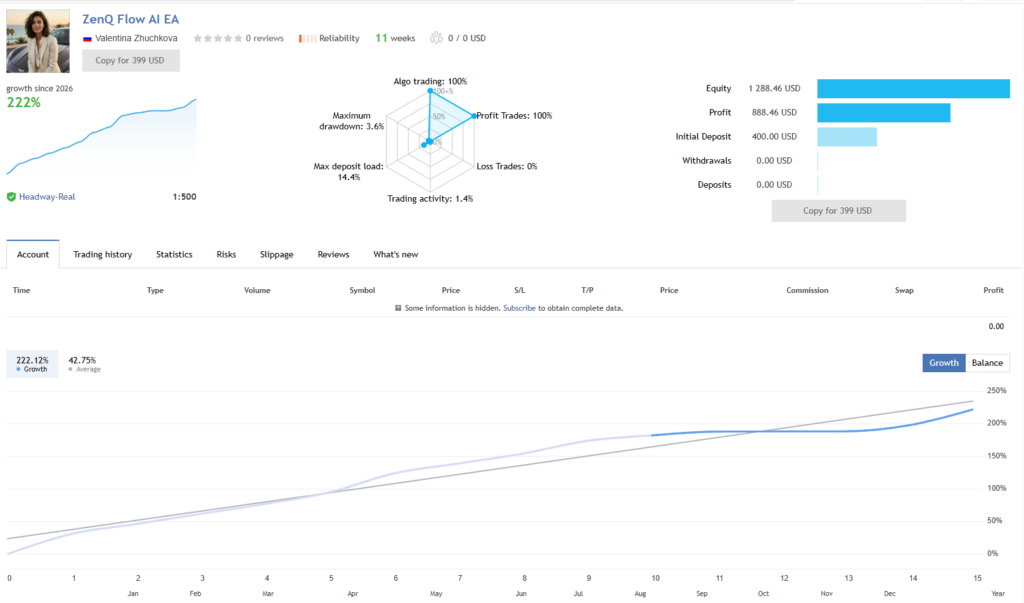
The live signal is published, real money, on the Headway broker at 1:500 leverage from a $400 starting deposit. Eleven weeks in, it shows roughly +222% growth, 100% profit trades (0% loss trades), 3.6% maximum drawdown, 14.4% max deposit load, and 1.4% trading activity. The growth chart climbs steadily over the displayed period.
The 100% profit trades figure is the single most important number on this signal to understand correctly.
It is mathematically possible for a trading system to win every trade it closes over a short live period — particularly if the system trades infrequently (1.4% activity is low), has a wide stop loss that’s rarely hit, or uses a “let winners run and close manually” approach where the system has discretion over when to close. None of these are evidence of forward-looking sustainability. A 100% win rate at eleven weeks of live trading does not predict a high win rate over twelve or twenty-four months — what it usually means is that the strategy hasn’t yet encountered the market conditions that will produce losing trades, or that some loss-realisation mechanism hasn’t yet triggered.
The backtest, by contrast, shows a 93-94% win rate across both modes. That’s the more realistic forward expectation for this strategy. Plan around the backtest win rate, not the live signal’s 100% figure. The honest reading of the live signal: the system is genuinely placing real trades on a real account and producing real returns, with the operational behaviour aligning with the backtest design (low trading activity, tight per-trade drawdown). But the headline numbers are amplified by the small starting balance, the high leverage, and the early-stage timing.
The 3.6% maximum drawdown figure is similarly young. Both backtest modes show meaningfully higher equity drawdown — 18.84% on High Risk over a single year, and a 70% equity drawdown relative figure on the Moderate mode that’s worth understanding (we cover the backtest separately below). Size your account around the higher-mode backtest figures, not the live signal’s tight early sample.
The Backtests — Two Modes, Two Periods, One Recurring Outlier
ZenQ Flow AI ships two configurable risk modes (Moderate and High Risk), and the developer provides separate backtest reports for each. The two backtests cover different time windows, which is itself worth flagging — the High Risk backtest covers 2025-2026 (just over a year), while the Moderate backtest covers 2020-2026 (six years). Showing a single configuration tested over the full available window would be cleaner methodology. As provided, you’re comparing different risk settings against different market regimes, which limits what you can conclude about either mode in isolation.
High Risk Mode (2025-2026)
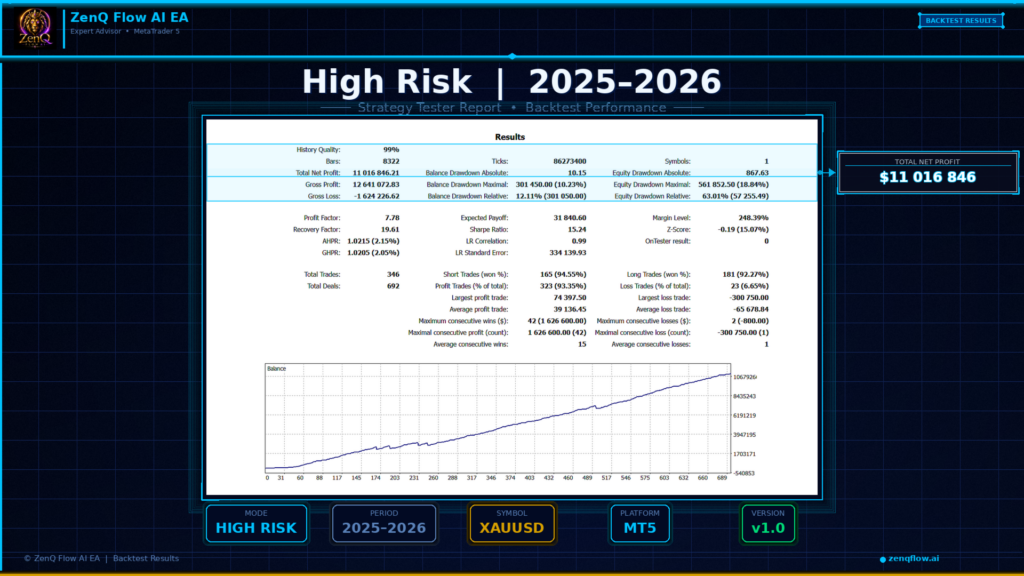
High Risk produces 346 trades over roughly a year of real-tick data at 99% history quality. Profit factor 7.78, win rate 93.35%, balance drawdown 10.23%, equity drawdown 18.84%, equity drawdown relative 63.01%, LR correlation 0.99.
Three honest readings.
The LR 0.99 is the curve-fit signature we flag elsewhere. A 0.99 linear regression correlation means the equity curve is near-mathematically straight across the full test window. Real strategies don’t trade XAUUSD like that — there’s always meaningful variance from regime to regime, news event to news event, month to month. Robust strategies typically land between 0.85 and 0.98 LR. A 0.99 tells you the strategy was optimised against the historical dataset rather than evidencing a forward-looking edge. The backtest is useful for confirming the strategy executes on real ticks; it’s not a forecast.
The equity drawdown relative figure is 63.01%. That’s the maximum percentage drawdown at any equity-pulse moment during the test, which is materially higher than the 18.84% absolute equity drawdown figure (and over five times the 10.23% balance drawdown). The two are calculated differently — the absolute figure references peak-to-trough; the relative figure references concurrent equity exposure during open positions. A 63% relative equity drawdown means at some point during the test, open positions were exposing roughly two-thirds of the account’s then-current equity to potential loss. Worth understanding before sizing.
The largest single loss was $300,750. Maximum consecutive losses is just 2 (-$800) — which sounds reassuring until you read the “maximal consecutive loss (count)” line, which shows a single loss of -$300,750. One trade in 346 lost roughly three hundred thousand dollars on the test, against an average loss of $65,678. That’s a single loss roughly 4-5x the typical loss size. This isn’t a series-of-small-losses pattern — it’s an occasional very-large-loss pattern. We’ll see the same loss appear in the Moderate mode below, which is the most important detail in this backtest.
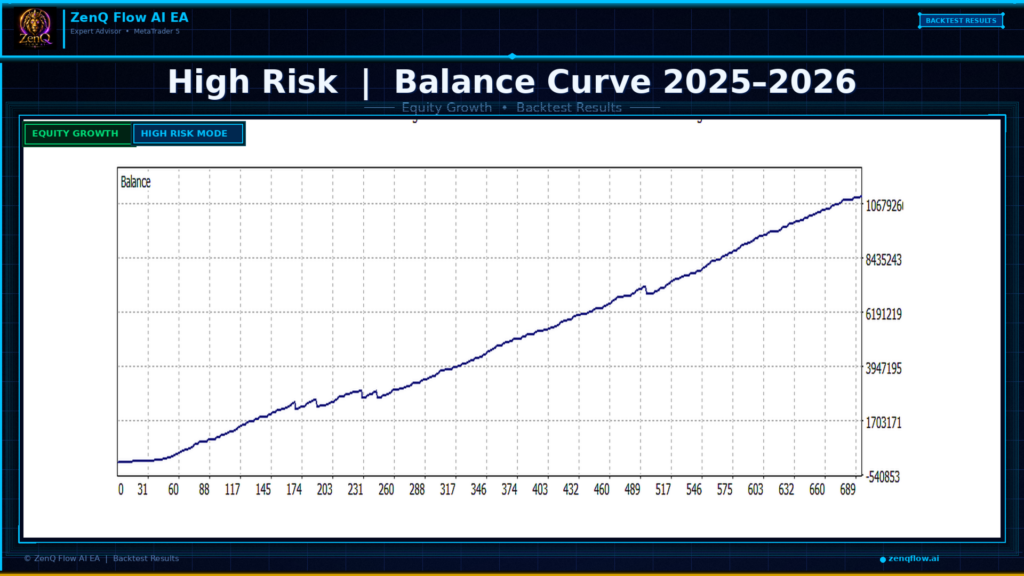
The balance curve close-up makes the LR 0.99 issue visually apparent — the equity climbs in a near-perfectly straight line with only small ripples where the outlier loss and a handful of other significant trades occurred. That smoothness is what optimised backtests look like; live trading does not.
Moderate Mode (2020-2026)
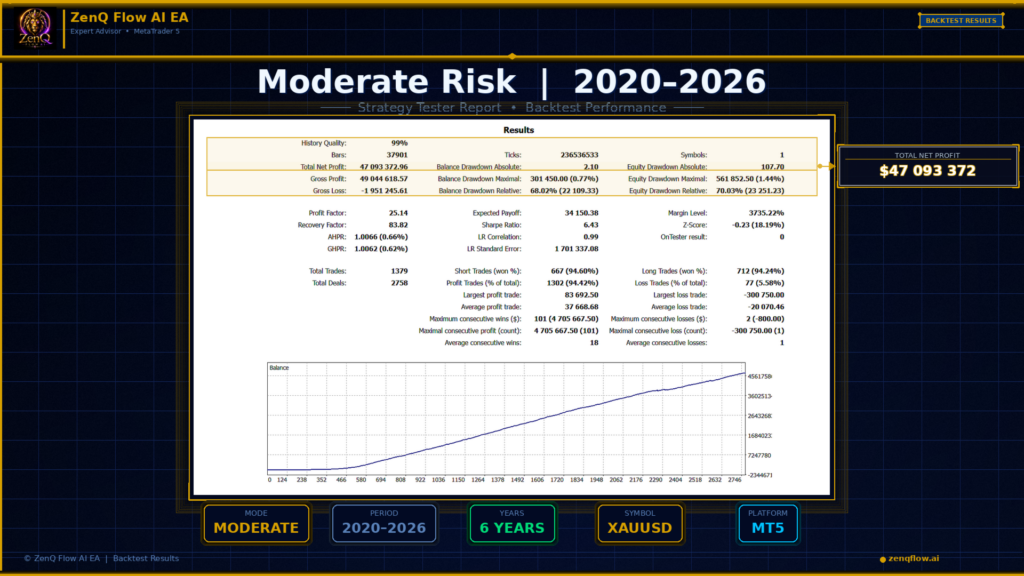
Moderate mode produces 1,379 trades across six years of real-tick data at 99% history quality. Headline numbers look more conservative on lot sizing — balance drawdown 0.77%, equity drawdown absolute 1.44%, but the equity drawdown relative figure is 70.03%. Profit factor 25.14 (which is unrealistically high in the same way TwisterPro’s 20.93 is — backtest PFs of that magnitude consistently compress in live conditions), win rate 94.42%, LR correlation 0.99 again.
The most important detail in this report, however, isn’t in the headline metrics. It’s the same -$300,750 largest single loss appearing in the Moderate mode backtest that appeared in the High Risk backtest. The same single-trade outlier loss across two different risk modes over two different test windows suggests this is a recurring strategy pattern — an event the system occasionally hits where a position runs against it in a way that triggers a large single-trade loss. Over the six-year Moderate window, 1 trade in 1,379 hit this magnitude. Average loss is $20,070; this outlier is roughly 15x the typical loss.
The 70% equity drawdown relative figure is the same kind of measure as in High Risk and tells you the same story — at peak exposure during the test, open positions were exposing seventy percent of then-current account equity. The “max consecutive losses: 2” line, which the developer’s marketing materials lean on as a comfort figure, is technically true but materially misleading when one of those losses can be -$300,750.
The Moderate compounding-mode result shows a multi-million-dollar profit projection over six years from a thousand-dollar starting balance. As with similar projections on other products (Zerqon’s nine-figure compounding result, TwisterPro’s $2.57M from $10K), this is the standard tester-mode compounding artefact — it assumes the strategy compounds indefinitely without sustained drawdown. Real accounts cannot do this. Disregard the headline number; the underlying win rate and outlier loss are the data points that actually matter.
What Early Buyers Are Saying
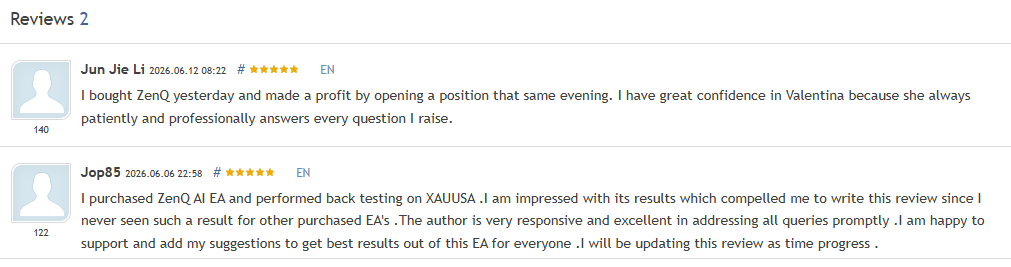
Two reviews on the listing at the time of writing, both five stars. One reviewer purchased ZenQ and reported a profitable position opened the evening of purchase — useful operational data point that the system places real trades, but a single-day single-trade sample. The second reviewer ran backtests on XAUUSD and described the results as more impressive than other purchased EAs they’ve reviewed, with intent to update the review as live experience accumulates — also operationally useful, but the backtest impressions reflect the same too-clean LR 0.99 pattern we’ve covered above.
Weight these as encouraging first impressions rather than verdicts. The review base will mature meaningfully over the next six to twelve months as buyers run the system through more market conditions and the live signal samples beyond its current young state.
Comparison to Nexorion Initium Novum
For traders considering Valentina’s catalogue, the practical question is: ZenQ Flow AI or Nexorion Initium Novum?
Nexorion is the more conventional XAUUSD automated EA — set it up, let it run, evaluate the live behaviour. The architecture is simpler, the configuration burden is lighter, the editorial concerns we covered in the Nexorion review are smaller in magnitude (we rated it 4/5). If you want a hands-off automated XAUUSD EA from Valentina with the same risk caveats applied at a more standard level, Nexorion is the simpler choice.
ZenQ Flow AI is the more ambitious build — Trading Console, AI Assistant, multi-symbol analytics. The setup burden is heavier, the editorial concerns sit at the more skeptical 3.5/5 level we cover in this review, and the operational reward is a much richer trading interface. If you want to use the AI Assistant feature, you’ll also want an OpenAI API account configured. ZenQ is the right choice if you’re attracted specifically to the AI integration or want the interactive console rather than a pure background EA.
Both products share the same dev. If you’re new to Valentina’s work entirely, our recommendation is to start with Nexorion at conservative sizing on demo, confirm the dev’s products behave as designed on your broker, and only consider adding ZenQ Flow AI once you have a feel for the underlying approach. Buying both at launch is more concentration into a single developer than is necessary while validating.
Who ZenQ Flow AI Is For
It might be a fit if you:
- Want the AI Assistant integration specifically — most marketplace EAs don’t offer real external LLM hooks, and ZenQ does
- Value an interactive Trading Console on the chart over a pure background EA
- Are willing to maintain an OpenAI API key to enable the AI Assistant feature
- Will run Moderate mode at conservative sizing on demo or your smallest live account, treating the first six to twelve months as evaluation
- Can plan around the realistic outlier-loss pattern visible in both backtest modes rather than the live signal’s tight early sample
Look elsewhere or wait if you:
- Read the 100% live win rate as a forward-looking forecast — it isn’t
- Need an established developer with a multi-year unblemished catalogue — Valentina is two products in
- Aren’t comfortable with the LR 0.99 backtest signature (which indicates optimised-against-history rather than forward-looking validation)
- Want a simpler hands-off automated EA — Nexorion is the more conventional choice
- Trade only on MT4 — this is MT5 only (the AI Assistant requires WebRequest API)
- Would rather wait six to twelve months for the live signal and the review base to mature before committing
Our Verdict
We rate ZenQ Flow AI EA 3.5 out of 5.
The architecture earns the upper half of the score. The Trading Console is a feature-dense interactive interface that genuinely distinguishes this product from background-running EAs. The AI Assistant integration through OpenAI’s GPT-4o-mini is a real working feature, not marketing language. The multi-symbol watchlist, the 13 analytics tabs, the Trend Grid and Market Pulse modules, the OCO pending order controls — every part of the panel earns its place. Valentina’s catalogue is maturing in the right direction with a second more-ambitious product and an improving profile rating.
The half-point we hold back, and the reason this rating doesn’t reach 4 out of 5, captures three specific evidence-level concerns. The 100% live win rate at 11 weeks is a young-signal artefact that will not hold long-term — and the difference between the live 100% and the backtest 93-94% is the size of the surprise you should be planning for. The LR 0.99 backtest correlation across both modes carries the optimised-against-history signature, telling you the backtest is useful for confirming the system executes on real ticks but not for forecasting forward returns. And the recurring -$300,750 single-trade loss in both backtest modes — 4-5x the average loss in High Risk and 15x the average loss in Moderate — tells you the strategy occasionally takes a single very-large-loss event that the “max 2 consecutive losses” marketing framing obscures.
Our practical position: if you’re attracted to the AI Assistant and the Trading Console specifically, this is a genuinely interesting product worth testing at conservative sizing. Run Moderate mode (not High Risk) while validating, start on demo or your smallest live account, plan around the backtest’s 18%+ equity drawdown rather than the live signal’s 3.6%, and understand that one trade in every several hundred to thousand on the backtest realised a very-large-loss event. Buying through CheaperForex at a significant discount is the practical way to test a product in this category — you cap the cost of finding out whether the architecture suits your account.
If you’d rather take a simpler position on Valentina’s catalogue, our review of Nexorion Initium Novum covers her more conventional release.
How to Get ZenQ Flow AI Safely
Two legitimate sources, and only two.
CheaperForex — the same EA at a significant discount versus the marketplace price. Get ZenQ Flow AI EA MT5 at CheaperForex. Our editorial view above applies; the discount applies regardless.
The MQL5 marketplace — direct from Valentina Zhuchkova’s developer page. Here is the official MT5 listing.
Anywhere else offering it free or via a Telegram seller is a trap — there’s no working cracked file, only malware or pay-and-vanish scams.
Frequently Asked Questions
How does the AI Assistant actually work — is it really AI?
Yes, in the meaningful sense. The AI Assistant uses MetaTrader 5’s WebRequest API to call OpenAI’s GPT-4o-mini model directly with your current market context, then displays the model’s analytical response inside the on-chart console. That’s a real LLM integration, not a label attached to an indicator stack. The trade-off is that GPT-4o-mini is a general-purpose model rather than a trading-specialised one — useful for analytical sanity checks, not for outsourcing trade decisions.
Do I need an OpenAI subscription separately?
You need an OpenAI account with API access and a small balance (or pay-as-you-go billing enabled). GPT-4o-mini is one of OpenAI’s cheaper models, and each AI Assistant query consumes a small number of tokens — typical cost per analysis is fractions of a cent. The EA itself doesn’t bundle the API access; you provide your own key.
How seriously should I take the 100% live win rate?
Not as a forward-looking forecast. A 100% win rate at 11 weeks of live trading is a young-signal artefact — common across newly-launched EAs that subsequently underperform once they encounter the market conditions that produce losses. The realistic forward expectation is closer to the backtest’s 93-94%, with the difference representing the magnitude of surprise to plan for.
What’s the realistic drawdown on a real account?
Plan around the High Risk backtest’s 18.84% equity drawdown rather than the live signal’s 3.6%, even if you run Moderate mode (which shows lower absolute but a higher 70% relative equity drawdown figure that’s worth understanding). The live worst case will move closer to the higher-mode backtest figures over time as the system samples more difficult market periods.
What about the -$300,750 outlier loss in the backtests?
This is the most important single detail in the backtest evidence. The same single-trade outlier loss appears in both backtest modes — 4-5x the average loss in High Risk and 15x the average loss in Moderate. It’s a recurring strategy pattern, not a one-off test glitch. The “max 2 consecutive losses” line that the marketing materials emphasise is technically true but materially incomplete when one of those losses can be this large.
What about the LR correlation of 0.99 across both backtests?
A 0.99 linear regression correlation means the equity curve is near-mathematically straight across the full test window. Real strategies don’t trade like that. Robust live strategies typically land between 0.85 and 0.98. A 0.99 indicates the strategy was optimised against the historical dataset — useful for confirming the strategy executes on real ticks, not predictive of live returns.
Is ZenQ Flow AI better than Nexorion Initium Novum?
Different products by the same developer. ZenQ Flow AI has a substantially more sophisticated architecture (Trading Console, AI Assistant, multi-symbol analytics). Nexorion is a more conventional hands-off automated EA. We rated Nexorion 4/5 and ZenQ Flow AI 3.5/5 — the half-point gap reflects ZenQ’s specific evidence-level concerns rather than an architecture comparison. Read both reviews and choose based on whether you want the AI integration and interactive console specifically.
If I buy it, how should I run it?
Run Moderate mode at conservative sizing on demo or your smallest live account. Start with the developer’s default settings rather than overlay risk multipliers. Plan capital around 18-20% potential drawdown rather than the live signal’s 3.6%, and understand that the strategy occasionally takes a single very-large-loss event. Treat the first six to twelve months as evaluation rather than scaling. Don’t extrapolate the 100% live win rate forward.