
September 2026 update: GoldWave Ultra is now separately listed. For a fresh look at the shared signal and new buyer feedback, read our GoldWave Ultra MT5 review or view Ultra features and pricing. The original review below contains its earlier dated observations.
Last updated: April 2026
Scroll through any EA listing on MQL5 and you’ll see the same visual: a backtest equity curve rising smoothly from bottom-left to top-right, $10,000 becoming millions over five or six years. It’s the industry’s default sales document. Developers optimise it, screenshot it, and stick it at the top of the page because it converts.
View product details and current pricing.
Shengzu Zhong, the developer behind Goldwave EA, has a different approach. He puts the following sentence on his own product listing, directly discouraging prospective buyers from trusting his own backtest: “I do not consider highly optimized backtests as proof of system reliability. Real, long-term live trading performance provides far more meaningful reference.” Then adds: “When backtests look perfectly identical to live results, that often deserves extra caution.”
In an industry where everyone else is polishing backtests to sell more copies, that’s an unusually honest starting point. And it’s structurally significant for this particular EA because Goldwave genuinely can’t be backtested properly — two of its core features don’t work in the MT5 Strategy Tester at all.
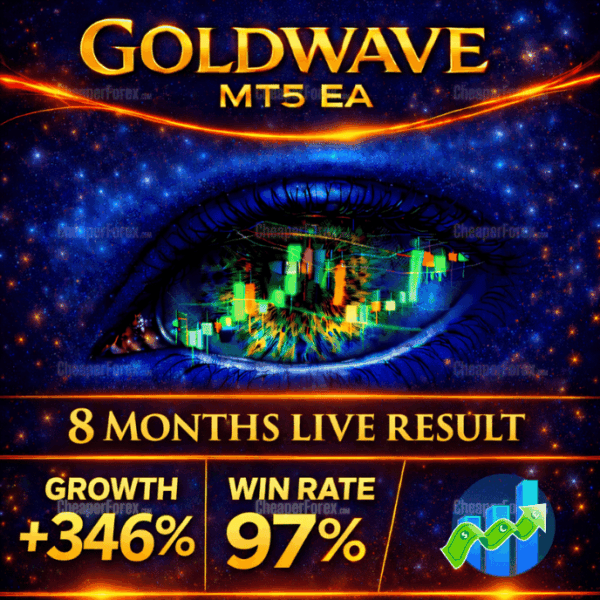
What you can evaluate: 8 months of verified live trading on IC Markets. 329% growth. 97% win rate across 135 trades. 10.54 profit factor. One position at a time, no grid, no martingale. This guide covers the live data, the download process for Goldwave, and whether the developer’s “ignore the backtest” pitch holds up to scrutiny.
The Two Features That Break Backtesting
Goldwave’s headline design decision is genuine fidelity to live conditions, and two specific technical choices make that explicit:
A WebRequest-based news filter. The EA connects to a live economic calendar server and blocks trading during high-impact events — NFP, FOMC, CPI releases, rate decisions, the moments when Gold can spike $30 in seconds. MT5’s Strategy Tester doesn’t support WebRequest. Any backtest runs with the news filter permanently inactive, which means the backtest takes trades the live EA would refuse. Backtest and live EA are literally running different logic.
AI-assisted adaptive logic. Real-time volatility assessment, momentum clustering, trend persistence analysis — these pull from live data streams unavailable in historical testing. Strategy Tester simulates the market as a replay of closed bar data; Goldwave’s live logic uses inputs the replay can’t provide.
Every other Gold EA developer hides this kind of limitation. Zhong writes it into the product copy and points you at the 8-month live signal instead. He’s betting his sales on live transparency rather than backtest polish, which is either a clever marketing angle or a genuine philosophical position depending on how cynically you read it. The live data suggests the latter.
329% Live, 97% Win Rate — The Numbers That Matter
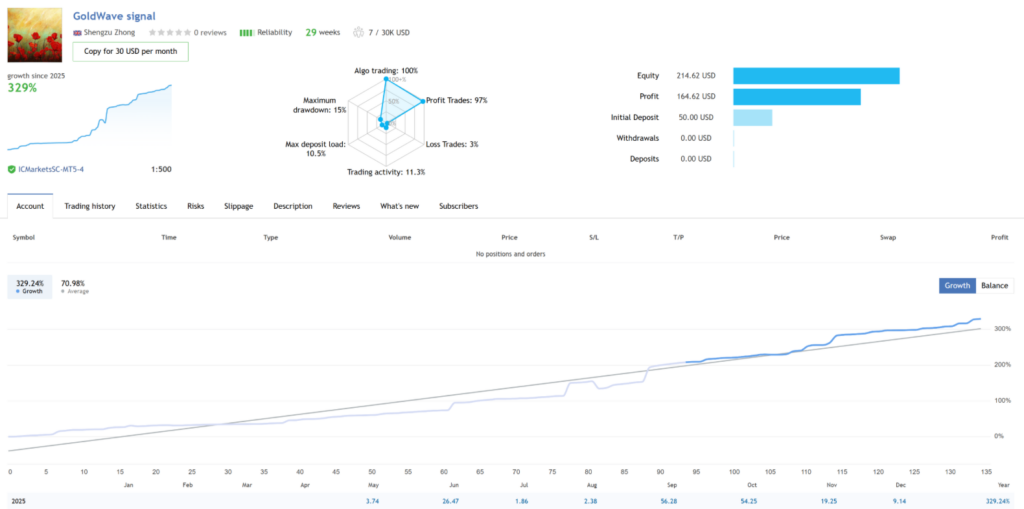
The verified MQL5 signal started with a $50 deposit on IC Markets at 1:500 leverage and has run publicly since then. Key numbers:
329% total growth. 131 winning trades out of 135 closed. A 97% win rate that has held through tariff shocks, rate decisions, inflation surprises, and Gold moving from $2,600 to $3,000+. The Gold market of the last 8 months has been one of the more volatile periods in the metal’s history; Goldwave’s selectivity logic has survived it.
10.54 profit factor. Winning trades generate over 10 times more gross profit than losing trades cost in gross loss. Anything above 2.0 is strong; above 5.0 is exceptional. 10.54 in live trading is a number most EAs don’t reach even in curve-fit backtests.
Maximum 58 consecutive winning trades. Maximum 1 consecutive losing trade. Goldwave has never had two consecutive losses in 8 months of live operation. This will change eventually — statistical normalisation catches every system eventually — but the current streak is the signature of extreme entry selectivity.
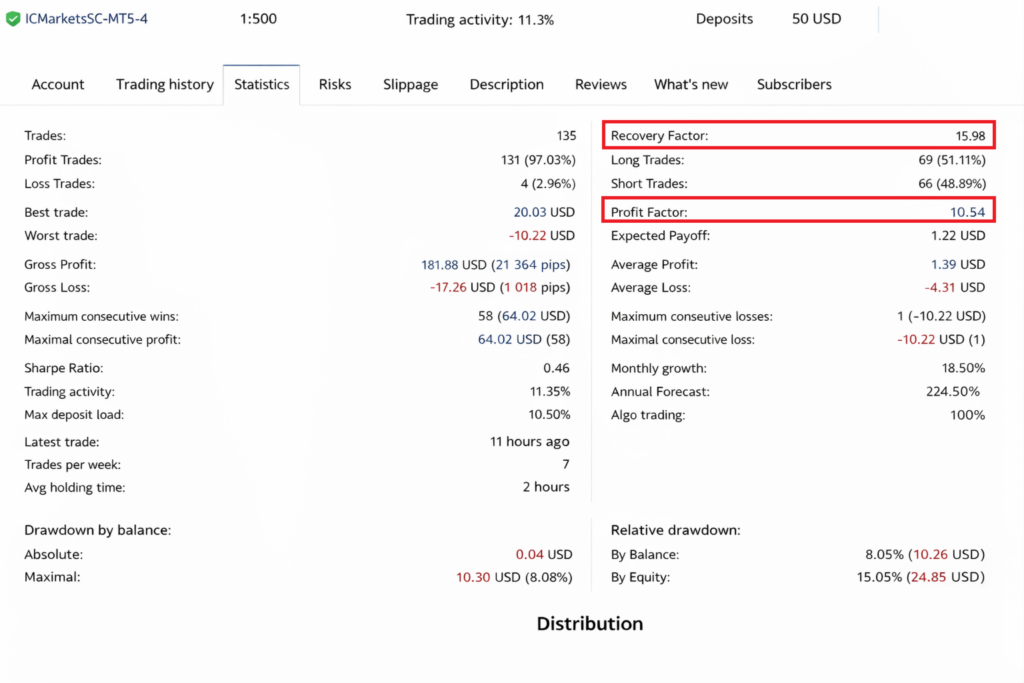
What the screenshots don’t show: the psychological texture. Goldwave trades about 7 times per week. Each trade lasts roughly 2 hours. The EA is out of the market 89% of the time, waiting. You will log in and see nothing happening. For hours. Sometimes days. This is the EA working correctly — selectivity is the mechanism producing the 97% win rate. Traders who expect constant action will find Goldwave frustrating.
Account Size Changes the Story
Honest context on the 329% figure: the signal account started at $50. Percentage returns on $50 accounts are magnified by scale that doesn’t transfer to larger balances. A 329% gain turned $50 into $214.50 over 8 months — impressive in percentage terms, modest in dollar terms.
Scale matters for two reasons. First, execution friction. On a $50 account, a single trade’s slippage is trivial. On $10,000 or $50,000, the same strategy fills at different prices because position size affects how orders interact with the order book. The percentage returns may differ. Second, psychology. A 15% equity drawdown on $50 is $7.50 — annoying but emotionally manageable. The same 15% on $20,000 is $3,000, which trades differently in your head even though the percentage is identical.
Goldwave’s signal proves the logic works. It doesn’t guarantee identical percentage returns at your account size, and it doesn’t guarantee your tolerance for drawdowns will match the demonstration account’s.
The 15% Equity Drawdown vs the 8% Balance Drawdown
Two drawdown numbers appear in the signal stats, and the gap between them is the most important thing to understand before buying Goldwave.
Balance drawdown: 8.08%. This counts only closed losing trades. At its worst point over 8 months, Goldwave’s realised losses pulled the account down 8% from peak. Most EAs would promote that figure — it’s genuinely controlled.
Equity drawdown: 15%. This includes floating (unrealised) losses from open positions. At the worst moment, an open trade was underwater by an additional 7% on top of closed losses before it recovered and closed in profit.
The gap tells you something specific about the strategy: Goldwave sometimes holds losing trades through significant floating drawdown rather than cutting them at the first sign of adversity. The 97% win rate validates the approach — most of those underwater trades recover — but you need to be psychologically prepared for open positions to show red, sometimes significantly, before turning green. If you check floating P&L every hour, those moments will feel worse than the percentages suggest.
What Goldwave Does Before Every Trade
Goldwave’s entry logic runs a checklist. If any single item fails, no trade. This is why trading activity sits at 11.3% — the EA is refusing most setups that look acceptable on the surface.
Trend genuineness. Multi-timeframe confluence cross-validates trend structure from M15 up to H4. A trend visible only on M15 doesn’t qualify. Gold false breakouts get filtered before they become positions.
Volatility classification. The system assesses current Gold volatility state — normal range, expanded range, chaotic. During abnormal volatility (often coinciding with news cycles), Goldwave scales back or stops trading entirely. The WebRequest news filter provides a hard block around scheduled events.
Momentum persistence. Even with a valid trend and acceptable volatility, the system assesses whether momentum has staying power or is about to reverse. Weak persistence means no trade regardless of other confirmations.
Risk management after entry is adaptive rather than fixed. Dynamic stop losses adjust to current volatility — wider during high-range periods, tighter during compression. Take profits use logic-based exit rules that often trigger well before the maximum SL would be reached. The 2-hour average hold time reflects this active management rather than position-and-forget trades.
Active Development and Recent Refinements
Goldwave launched in December 2025. The EA has seen continuous refinement since then — multiple version updates in the first months of availability, driven by buyer feedback and developer observation of live behaviour.
The notable milestones: a dedicated Prop Firm Rule Filter was added, opening Goldwave up to FTMO, MyForexFunds, The5ers and similar challenge accounts. Subsequent point releases refined the WebRequest news filter reliability (a persistent target of iteration because economic calendar APIs change format), improved multi-timeframe confluence edge cases, and broadened broker symbol compatibility for varied XAUUSD naming conventions.
The developer announces releases in the product comments. Update frequency should slow as the product matures, but the active development pattern is a strong signal of ongoing support rather than launch-and-abandon behaviour.
Who Shengzu Zhong Is, and Why It Matters
Shengzu Zhong brings 16+ years of trading experience to Goldwave. His MQL5 portfolio includes EAs, signal indicators, divergence detection systems, and copy trading utilities — a range that suggests technical depth across algorithmic trading rather than a single-product operation. He’s also the developer behind AXIO Gold EA, his more recent Gold scalper that follows the same disciplined philosophy.
The philosophy he states publicly distinguishes him from the typical MQL5 vendor. He explicitly rejects “short-term explosions, parameter stacking, or overfitted strategies.” His stated goal is “logically stable, risk-controlled trading systems that can adapt to different market environments” — and when a developer frames their ambition as beating bank interest rates rather than doubling accounts monthly, you’re dealing with someone who has watched enough accounts blow up to know what sustainable automated trading actually looks like.
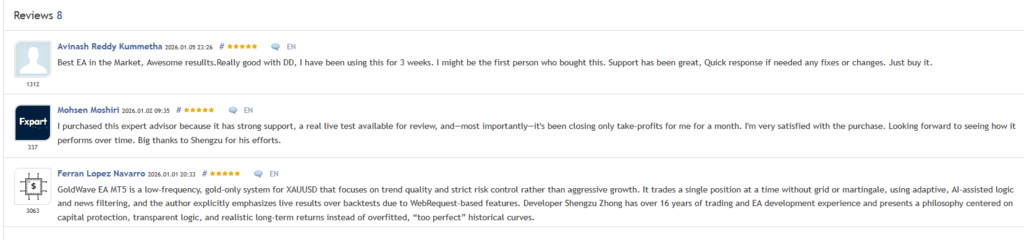
Current engagement: 41 MQL5 reviews averaging 4.72★. 170+ comments on the product page. Forty-five purchases per month since launch. Reviewer feedback clusters around three themes — drawdown control, win rate consistency, and responsive support. One reviewer called it “the best EA in the Market” after three weeks. Another reported a full month of take-profits only. The review sample is substantial and uniformly positive.
Where to Get Goldwave (And Where Not To)
Two legitimate sources. That’s it.
MQL5 Marketplace at $799. The official developer listing. Instant activation through MQL5’s licensing, direct support from Zhong in the product comments, full price.
CheaperForex at roughly 50% off. Authorised reseller pricing with the same official activation, same .ex5 file, free lifetime updates, plus a 7-day money-back guarantee before activation and 20% extra discount for crypto payments. View Goldwave at CheaperForex.
Anywhere else advertising “Goldwave EA free download” or heavily discounted pricing is running one of the standard scams: malware bundled in a decoy file, Telegram funnel to “VIP signals” upsells, or broker affiliate redirect. Marketplace DRM means cracked Goldwave files don’t exist — what those sites distribute isn’t Goldwave, it’s whatever the scammer found useful to hide inside a file named Goldwave.ex5. Ignore them.
Setup Essentials (Without the 9-Step Novel)
Buy through MQL5 or CheaperForex. If via CheaperForex, we activate remotely on your terminal in about 2 minutes via UltraViewer or AnyDesk. The EA appears in your MT5 Navigator under Expert Advisors → Market automatically — no file copying, no Experts folder paste, that’s not how marketplace EAs work.
Open a Gold chart. Your broker’s symbol might be XAUUSD, XAUUSD.r, XAUUSDm, GOLD, or something else — Goldwave adapts. Set the timeframe to M1. Click the Algo Trading button in the MT5 toolbar (must be green). Drag Goldwave from the Navigator onto the chart.
Before you close the settings dialog, do one Goldwave-specific thing: enable WebRequest for the news filter URLs. Go to Tools → Options → Expert Advisors, tick “Allow WebRequest for listed URL,” and paste the URLs included with your activation. Without this step, the news filter is inactive and the EA will trade through NFP and FOMC — which it’s not supposed to do. This is the most common Goldwave setup mistake.
Load the appropriate preset. Three presets are included with your activation: Default (matches the live signal, aggressive), Conservative (reduced risk per trade, tighter filters), and Prop Firm (configured for challenge accounts with daily loss limits and drawdown caps). Pick based on your account type and risk tolerance, click Load in the settings dialog, select the .set file, click OK.
A smiley face in the top-right of the chart confirms the EA is live and will begin placing trades when its selectivity criteria align. Sad face means Algo Trading isn’t enabled or there’s a license issue.
Broker and Account Requirements
The live signal runs on IC Markets RAW Spread at 1:500 leverage. Any reputable ECN broker with low Gold spreads will work, but IC Markets gives you execution closest to the published signal. Tight spreads matter more for Goldwave than for grid EAs because the edge includes precise entry timing — wide spreads erode it.
Either hedge or netting accounts work. This is unusual among Gold EAs — most require hedging specifically. Because Goldwave only opens one position at a time, it’s compatible with netting-only accounts including many prop firms, most European regulated brokers, and US brokers operating under NFA rules.
Leverage minimum 1:100, 1:500 recommended. Higher leverage doesn’t increase risk directly (position sizes are calibrated by the EA); it provides margin headroom that avoids edge-case margin warnings during adverse moves.
A VPS is strongly recommended though not strictly mandatory — the one-position architecture makes Goldwave less VPS-dependent than grid systems. Two reasons to run one anyway: the WebRequest news filter needs continuous uptime to catch scheduled events, and the multi-timeframe logic updates throughout the trading day. A forex VPS at $13–25/month solves both.
Prop Firm Compatibility
Goldwave is one of the few Gold EAs genuinely suited to prop firm challenges. The one-position-at-a-time design, controlled drawdown, and fixed stop-loss per trade align with challenge rules that ban grid trading and impose strict drawdown limits.
The Prop Firm preset is calibrated for FTMO-style rules: daily loss limits, maximum drawdown thresholds, restricted lot sizing. Running Goldwave on a $10k–$200k challenge account is a standard use case the developer explicitly supports.
Match deposit size to challenge size. For personal accounts outside prop firms, $500 is the practical minimum for the Default preset, $1,000+ is comfortable. $5,000+ if running Conservative and prioritising capital preservation over aggressive returns. The $50 signal start is a public demonstration, not a realistic starting balance for most trading contexts.
Goldwave vs Gold Grid EAs — Different Answers to Different Questions
Most Gold EAs in the premium price bracket use grid trading — Quantum Queen, Quantum Athena, and many others. Goldwave is fundamentally different. The choice between them isn’t about which is better — it’s about which answers a question you’re actually asking.
Grid systems bet on Gold’s tendency to mean-revert. They accumulate positions during adverse moves, profit when price reverts, produce high returns with deep floating drawdowns, and require traders who can sit through significant unrealised losses without intervening. They don’t suit prop firm challenges. They reward patience with outlier returns.
Goldwave bets on selectivity. One position at a time, defined stop-loss per trade, bounded maximum exposure per trade, rare trading activity. Lower peak returns than grid systems at aggressive settings, but defined risk per position and psychological predictability. Suits prop firms, suits traders who need to know their worst-case exposure on any given trade, suits accounts where capital preservation matters more than percentage returns.
Neither mechanic is the “right” answer universally. Some traders diversify by running one account on each — grid for peak returns, single-position for bounded risk. Running both on separate accounts gives genuine strategy diversification; running both on the same account just doubles your Gold exposure without meaningful hedge.
Goldwave vs AXIO Gold — Same Developer, Different Rhythm
If you’re choosing between Goldwave and Shengzu Zhong’s newer AXIO Gold EA, both come from the same developer with the same disciplined philosophy. The differences are in operational rhythm and signal length:
Goldwave has 8 months of live data, 41 reviews, and an established 4.72★ track record. Trades roughly 7 times per week with 2-hour average holds. The longer signal duration is its primary trust differentiator — you’re evaluating proven live behaviour across multiple Gold market regimes.
AXIO has 6 months of live data, fewer reviews because it’s newer, and a slightly different selectivity profile. Both follow the same one-position, no-grid, live-results-over-backtests approach. Some buyers run both on separate accounts to diversify entry timing within the same disciplined philosophy.
Questions Worth Asking
If the backtest doesn’t work, what evidence am I actually evaluating?
8 months of verified live MQL5 signal data on IC Markets, showing 135 trades, a 97% win rate, 10.54 profit factor, and real equity growth on a public account. That’s harder to fabricate than a backtest and reflects actual execution including slippage, spread variation, and news events the WebRequest filter caught. The developer’s 16+ years of experience and consistent product philosophy add context.
Can the 97% win rate continue?
Eventually, no — statistical normalisation catches every strategy. Over short samples win rates can be anomalously high or low. What matters is the mechanism producing the rate. Goldwave’s selectivity (11.3% trading activity) is the mechanism; as long as Gold continues producing the kind of multi-timeframe trend setups the EA waits for, the rate should remain high even as it drifts down from 97%. A settled long-term rate in the 75–85% range is more realistic.
What’s the real worst-case scenario I should plan for?
A sustained Gold regime where multi-timeframe trends fail to align and the EA stays flat for weeks — that’s the scenario where Goldwave underperforms without losing money, which frustrates impatient users. The drawdown risk is bounded per trade by the hard stop loss; the frequency risk is unbounded. You should be comfortable with an EA that might do very little for extended periods if current Gold conditions don’t suit its criteria.
Why enable WebRequest specifically for Goldwave?
The news filter is one of Goldwave’s defining features. Without WebRequest enabled, the EA trades through NFP, FOMC, CPI releases — exactly the events that produce the slippage and adverse fills that wreck EA performance. The required URLs are included with your activation; pasting them into Tools → Options → Expert Advisors takes 30 seconds and is the most important single setup step.
Is Goldwave really suitable for prop firms?
Yes, and the Prop Firm preset is built for it. One position at a time means maximum exposure per trade is always bounded. The selective entry logic produces few enough trades to stay well within daily loss limits. Controlled drawdown keeps you clear of maximum drawdown thresholds. The 97% win rate is specifically valuable for challenge accounts where drawdown rules are unforgiving.
What happens if the WebRequest URL changes?
Goldwave’s news filter depends on a specific endpoint for its calendar data. If that endpoint changes, the filter breaks until Zhong updates it. This has happened during prior updates and been fixed quickly. Running on a VPS with auto-updates enabled ensures you get fixes as they ship.
Should I buy now or wait for a newer version?
Buy now. You’re paying for lifetime access to the product line, not a specific version, and future updates are free for legitimate buyers.
Verdict
Goldwave is what you get when a developer with 16 years of trading experience decides to let live performance speak for itself. The refusal to lean on backtests, the transparency about WebRequest breaking historical testing, the explicit framing of “logically stable” as the goal rather than “monthly percentage extremes” — these aren’t marketing positions. They’re the words of someone who has seen what actually works long-term.
The 8 months of live data validates the philosophy. 329% growth, 97% win rate, 10.54 profit factor, never two consecutive losses — these are live numbers on a public IC Markets account, through tariff shocks and rate decisions and Gold’s most volatile stretch in years. One position at a time. No grid. No martingale.
The honest caveats: the signal account is tiny ($50), the equity drawdown (15%) is nearly double the balance drawdown (8%) so floating losses feel worse than realised losses suggest, the EA trades rarely enough to frustrate action-seeking users, and backtesting is genuinely broken by the WebRequest and adaptive-logic features. At 8 months live, Goldwave is established but not yet long-term proven — another 12 months of data would make the case airtight.
We rate Goldwave 4 out of 5. The live performance is outstanding. The developer’s transparency is genuine. The risk architecture is clean. The half-star held back reflects the small signal account, the inability to independently backtest, and the need for more live data through different Gold regimes. For traders who value verifiable live evidence over polished backtests — and for prop firm challengers who need single-position mechanics — Goldwave is one of the strongest Gold EA cases on MQL5 right now.
Get Goldwave at CheaperForex →