
Last updated: June 2026
The most-abused phrases in the gold-EA market are “no martingale, no grid, no averaging.” Most products advertise it. Most products don’t actually behave that way once you run them. Lizard is one of the rare cases where the architecture, the backtest pattern and the live trade history all line up with the claim. It is a XAUUSD-only multi-strategy swing breakout system from Marco Scherer — nine independent strategies running in parallel across M1 to D1, pending stop orders triggered only on real breakouts, defined stop loss and take profit on every trade, and a built-in daily drawdown limit specifically for prop firm compliance.
View product details and current pricing.
That architecture alone makes Lizard worth a careful look. The 17-month backtest shows ~120% return at 85% win rate with a 5-6% maximum drawdown, and the four-week real-money live signal on VTMarkets is tracking a closely matching 84% win rate. The honest caveats are that the live signal is young, the live drawdown is already three times the backtest figure (a small-account amplification effect that’s worth understanding), the backtest period covers a single 17-month gold environment rather than multi-year history, and one or two of the headline backtest metrics need to be read with care. This review goes through all of it.
⚠️ Looking for a Lizard “free download”? Don’t.
Every MQL5 marketplace EA ships with built-in DRM. There is no working cracked file in existence — so a “free” copy is always one of two things:
- malware, or
- bait for a Telegram payment scam where you pay and get nothing.
The only safe routes are the MQL5 marketplace or a reputable reseller. CheaperForex offers it at a significant discount versus the marketplace price — Get Lizard EA MT5 at CheaperForex.
🚀 Ready to Buy Lizard EA MT5?
$279.96 with crypto · $349.95 by card
Official version · Instant download · Free lifetime updates · 7-day money-back guarantee
The Developer: Marco Scherer

Marco Scherer is a Switzerland-based MQL5 developer publishing under the “masthetics” account. Lizard isn’t his only product, but it’s the one currently drawing the most attention — 52 purchases per month, regular point-release updates (the product is already on version 1.50 within weeks of launch), and an early review base that’s substantive rather than thin.
A reasonable way to evaluate any newer developer is to read what their existing customers actually say beyond the star ratings, and the Lizard reviews are unusually informative. The recurring themes — regular updates that respond to community feedback, a defined breakout strategy at an accessible price, a developer who engages with users — point to active product stewardship rather than a fire-and-forget launch. That doesn’t guarantee future performance, but it’s the kind of operational posture that distinguishes hobby developers from people building a real product over time.
How the 9-Strategy Breakout Architecture Works
The mechanic is conceptually simple, which is part of why it works. Lizard continuously scans the XAUUSD chart for significant swing-high and swing-low structure across multiple timeframes. When a valid structure forms, the EA places a pending buy stop or sell stop order at a calibrated distance from the level — not at the level itself, which is where most breakout systems get faked out. The order triggers only if price actually breaks through the level with momentum.
That single design choice is what separates a genuine breakout strategy from a price-touch system. A lot of EAs marketed as “breakout” actually fire on price reaching a level (which then frequently reverses). Lizard’s pending-stop-order approach requires real continuation through the level — the order can only execute on a directional move, not on a wick or a probe. It filters out exactly the price patterns that destroy weak breakout systems.
Beneath this single description sits the actual engine: nine independent strategies running in parallel. Each operates on its own internal timeframe (from M1 short-term intraday setups through to D1 multi-day swings), with its own stop loss logic, take profit logic, trailing system, magic number, and risk weighting. Strategies activate automatically based on account balance and the selected frequency mode, and each is calibrated against its own historical performance window.
This is genuine diversification within a single instrument. A short-term M1 strategy and a multi-day D1 strategy aren’t capturing the same edge — they’re capturing different kinds of moves under different market conditions. When gold is range-bound and the short-term setups fail, the longer-term strategies are often quiet. When gold trends, the short-term strategies catch the directional moves while the longer ones ride the continuation. It’s a sensible way to build robustness into a single-pair EA without leaving the pair behind.
The exit side is where most breakout systems quietly fail, so it’s worth detailing what Lizard actually does. Break-even moves the stop loss to entry once a defined profit threshold is reached — locking in zero-risk on a winner. Trailing SL follows price to protect gains as the move extends. Trailing TP dynamically adjusts the take profit when momentum supports it. A magic trail allows step-based SL progression as the position matures. And a virtual SL runs in software independently of the broker — useful when broker-side SL handling is suspect, which it sometimes is. Stack those together and you have a defined-risk system that manages every position actively rather than just opening and closing on signal.
The Risk Architecture — Where Most EAs Lie
Most gold EAs claim “no martingale, no grid” and then quietly enable some form of recovery mode that adds positions during drawdown. Lizard doesn’t. The listing is explicit about it, and the trade pattern on both the backtest and the live signal confirms it: positions open from the breakout signal, manage through the multi-layered exit system, and close. There’s no basket structure, no lot multiplication, no averaging.
That fundamentally changes the worst-case loss profile. In a martingale or grid system, the worst case is the entire account if a deep adverse move keeps stacking positions until margin runs out. In Lizard, the worst case per trade is the defined stop loss, and the worst case across a losing streak is the sum of those defined losses. The backtest’s largest single loss is around $300 on a $10,000 account (3%), and the maximum consecutive loss across the 17-month test was around $580 (5.8%). Those are bounded numbers — they describe a system whose downside you can actually plan around.
On top of that sit two practical risk filters that genuinely matter. The NFP filter automatically pauses trading before and after Non-Farm Payrolls releases — the single most reliable EA-destroyer in the gold calendar. Market-close protection automatically removes pending orders before the daily close window, so the EA isn’t left holding stops over the weekend gap. Neither is glamorous; both are exactly the kind of small disciplines that separate a tested product from a tester-fitted one.
And then there’s the prop firm DD limit. Lizard ships with a built-in maximum daily drawdown input designed for challenge-account compliance. This isn’t a marketing label — it’s an actual configurable risk ceiling. Combined with the no-grid architecture (which is the standard reason most EAs fail prop firm rules), it makes Lizard one of the few marketplace gold EAs that’s genuinely suitable for prop firm work.
The 17-Month Backtest — Strong, With One Honest Note
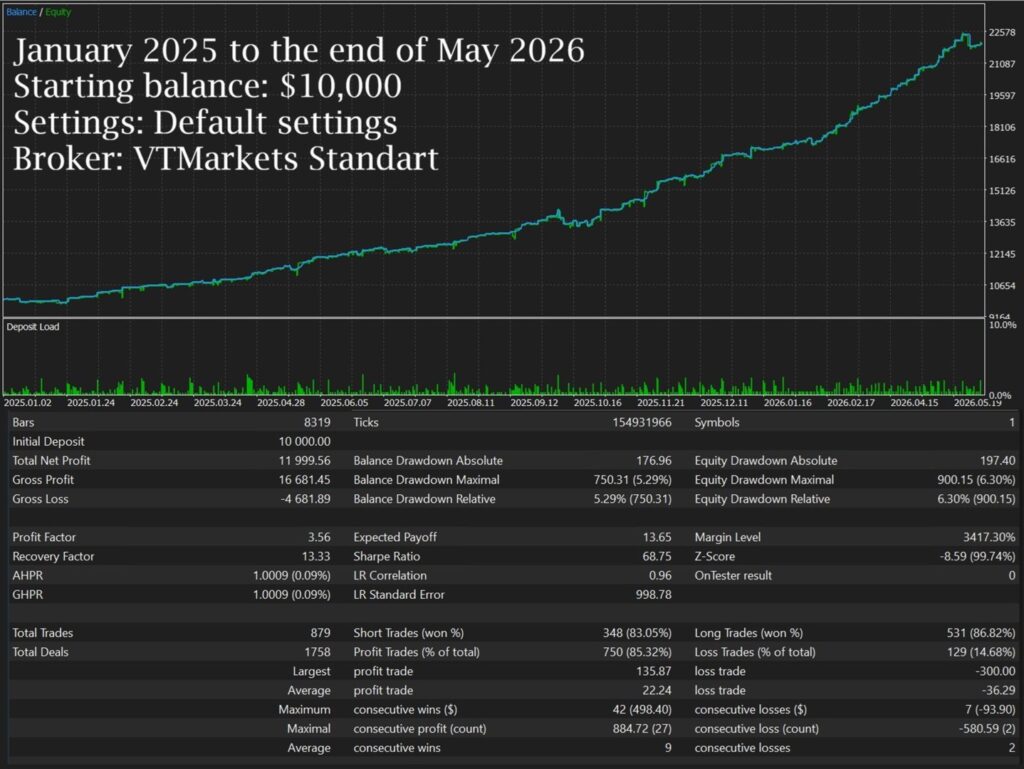
The backtest covers January 2025 through the end of May 2026 — roughly 17 months — on real-tick data from VTMarkets at default settings with a $10,000 starting balance. The headline result is a ~120% net return at an 85.32% win rate across 879 trades, with a 5.29% balance drawdown and a 6.30% equity drawdown. The profit factor lands at 3.56, the recovery factor at 13.33, and the LR correlation at 0.96.
A few things are worth pulling out, because they hold up under scrutiny in a way that not every gold-EA backtest does.
The LR correlation is 0.96, not 1.00. An LR of 0.96 is what a real strategy looks like — strong linearity in returns, but with the small natural variance you’d expect from genuine trading. An LR of exactly 1.00 (which we’ve seen on other recent gold EAs) is the giveaway sign of a curve-fitted backtest. Lizard’s 0.96 is in the credible range.
The trade pattern matches a real breakout system. 879 trades over 17 months works out to about 50 trades per month — meaningful frequency but not the constant-trade signature of a scalper or grid system. The average winning trade ($22.24) is roughly comparable to the average losing trade ($36.29), with the edge coming from frequency (85% win rate) rather than asymmetric payoffs. That’s an honest profile for a breakout strategy, and it’s hard to fake without the underlying logic actually behaving that way.
The drawdown numbers describe a real strategy. 5.29% balance and 6.30% equity drawdown across 17 months tells you the worst floating loss during the test never got dramatic. That’s consistent with the defined-SL architecture and the absence of grid/martingale — losses get realised and the system moves on rather than letting unrealised drawdown accumulate.
The one honest qualification: the Sharpe ratio of 68.75 is unrealistically high and shouldn’t be read at face value. Real strategies, even excellent ones, rarely exceed Sharpe ratios of 3-5. A Sharpe of 68 is what gets produced when MT5’s tester calculates Sharpe across the relatively short and consistent return distribution of a high-win-rate strategy — it’s a mathematical artefact of the calculation method, not a forecast of risk-adjusted excellence. Ignore it. The genuinely useful metrics are the profit factor (3.56), the win rate (85%), and the drawdown figures.
One more contextual note: the backtest covers 17 months of fairly trending gold behaviour. It hasn’t been tested across a sustained range-bound gold market or a flat consolidation period, both of which historically punish breakout strategies. A breakout system’s hardest market isn’t a crash or a rally — it’s a chopper that fakes out direction repeatedly. The next year will tell us more about how Lizard handles those conditions.
The Live Signal — Read the DD Honestly
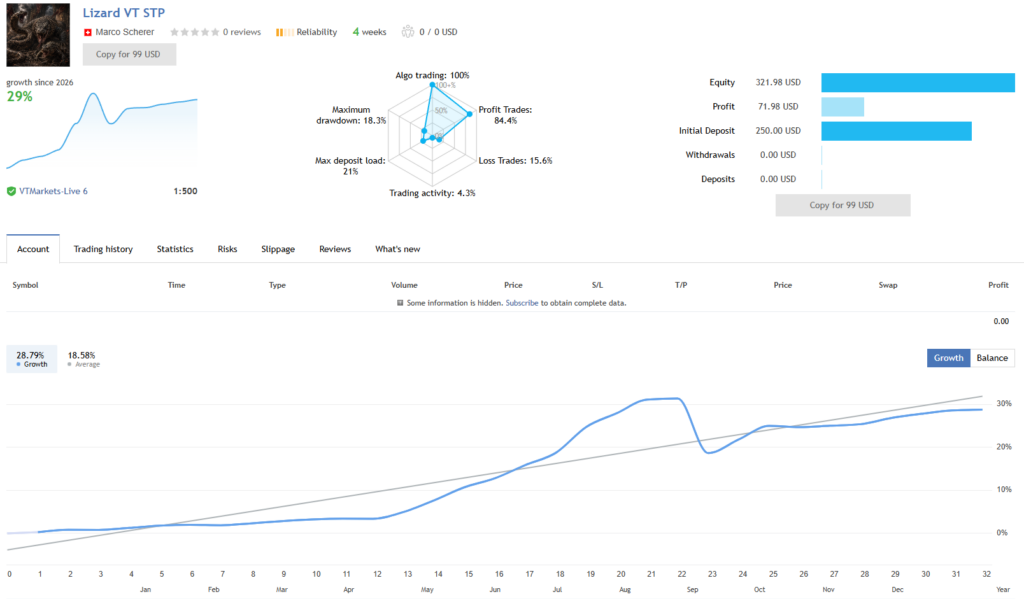
The live signal is the more important evidence, even though it’s young — backtest results can be tuned, real-money trading can’t. The signal has been running on VTMarkets for ~4 weeks at the time of writing, on a $250 deposit (the developer’s published minimum), and shows ~29% growth at an 84.4% win rate.
The single most useful data point on this signal is the alignment between live and backtest win rates. The backtest produced 85.32% winning trades. The live account is producing 84.4%. That kind of close alignment between simulated and real-money behaviour is what you want to see — it means the strategy is genuinely doing the same thing in live conditions that it does in the tester, and the small gap (the kind of gap that real-world slippage and spread would cause) is in the expected direction and magnitude.
The honest qualification is the drawdown. The backtest’s 6.30% equity drawdown is the comforting number. The live signal’s 18.3% maximum drawdown is the realistic one — and it’s the figure most buyers should size their accounts around.
Why the gap? Partly because $250 is a small account, and small accounts produce larger percentage moves on the same dollar drawdowns. A single losing streak that’s barely visible on a $10,000 backtest account can look dramatic on a $250 live account. Partly because four weeks of live trading doesn’t sample anywhere near as much variance as 17 months of backtest data — the live worst case so far is just the worst single stretch in a very short period. And partly because real broker conditions (variable spread on news, occasional slippage) always introduce some friction the backtest doesn’t account for.
The practical implication: plan around 15-20% drawdown, not 6%. Size your account accordingly. If 20% of your starting balance would cause you to intervene with the EA mid-trade, your account is too small or your frequency mode is too aggressive.
What Buyers Are Saying

The early reviews are unusually informative — substantive descriptions of real usage rather than the generic “EA did great” comments common at launch. Three themes recur and they’re worth weighing.
The breakout-at-a-fair-price positioning lands with buyers. Multiple reviewers specifically call out Lizard as a credible breakout EA at an accessible price point — which is a useful market signal. The fair-price framing matters because the gold EA category is otherwise dominated by $500-$2000 systems that promise transformational returns; an established breakout strategy at the lower end of the range is a distinct proposition.
Patience and not manually intervening is flagged repeatedly. One review put it plainly: “be patient, which is the most difficult, and don’t trade manually to lose the benefits of the robot.” That’s the right user-side discipline for any defined-SL strategy with multi-day swings — and it’s exactly the kind of advice buyers should internalise before going live. Closing positions manually during drawdown is how most traders sabotage strategies that would otherwise work.
The “replacing famous gold EAs” framing. One reviewer references using Lizard as a replacement for previously-popular gold EAs. Take that with appropriate weight — it’s one buyer’s opinion, not a category verdict — but it does suggest Lizard is competing for a slot in serious traders’ EA portfolios rather than just impulse purchases.
As always, weight these as encouraging early impressions rather than long-term verdicts. The review base will mature over the coming months, and the picture may shift up or down once buyers have run the system through different gold conditions.
Who Lizard Is For
It’s a strong fit if you:
- Want a XAUUSD breakout system with genuine no-grid, no-martingale architecture
- Value diversification through multiple parallel strategies on a single instrument
- Need a gold EA that’s actually configured for prop firm challenges (built-in daily DD limit)
- Can size your account around realistic 15-20% drawdown rather than the backtest’s 6%
- Run a stable VPS and can leave the system alone through floating drawdowns
- Trade gold and have been looking for a defined-risk alternative to the grid-and-martingale category
Look elsewhere if you:
- Need a multi-year proven live track record before buying — this signal is 4 weeks old
- Want a set-and-forget system you can run on aggressive frequency modes on day one
- Can’t tolerate the 15-20% drawdowns realistic of any genuine breakout strategy
- Manually intervene on open positions — this strategy needs to be left alone
- Trade only on MT4 — this is MT5 only
Our Verdict
We rate Lizard 4.5 out of 5.
The strengths here are unusually solid for a young gold EA. The strategy is genuinely a breakout system — not marketing-as-strategy — with nine independent strategies providing real internal diversification across timeframes. The risk architecture is defined-loss throughout, with no grid, no martingale, no averaging, and proper filters (NFP, market-close, dynamic price scaling, smart time filter, virtual SL). The prop firm DD limit is a real built-in feature, not a sticker. The 17-month backtest shows credible behaviour with an LR of 0.96 — meaningfully better than the curve-fitted “1.00” you’ll see on lesser products. And the live signal’s win rate aligns closely with the backtest, which is the alignment that actually matters when judging whether a strategy works.
The half-point reflects what’s genuinely true for a product this young. The live signal is only four weeks old and hasn’t seen a sustained adverse gold environment — the realistic live drawdown sits closer to 18% than 6%, and that gap matters for sizing. The backtest covers 17 months rather than multiple years, and breakout strategies historically have their hardest time in range-bound gold rather than the trending environments in the test window. The Sharpe ratio metric needs to be discounted as a tester artefact. None of these are disqualifying — they’re the standard “young product” caveats — but they’re worth weighing.
For Gold traders who want a defined-risk breakout system, who can size around realistic drawdowns, who appreciate active product stewardship from a responsive developer, and who specifically want a prop-firm-compatible gold EA, Lizard is one of the most credibly-built launches of 2026. Validating on demo first, starting at a conservative frequency mode, and treating the first months as observation rather than scaling is the sensible path. And buying it through CheaperForex at a significant discount is the practical way to test a young strategy — you cap the cost of finding out how the system behaves on your own account.
How to Get Lizard Safely
Two legitimate sources, and only two.
CheaperForex — the same EA at a significant discount versus the marketplace price. Get Lizard EA MT5 at CheaperForex.
The MQL5 marketplace — direct from Marco Scherer’s developer page. Here is the official MT5 listing.
Anywhere else offering it free or via a Telegram seller is a trap — there’s no working cracked file, only malware or pay-and-vanish scams.
Frequently Asked Questions
Is Lizard legit, or a scam?
Legitimate. It’s a published MQL5 marketplace product from an established Swiss-based developer with active updates (already at v1.50 within weeks of launch), a real-money public live signal on VTMarkets, and a substantive early review base. The scams in this space are the “free download” sites and Telegram sellers offering cracked copies that can’t exist. Buy from MQL5 or a reputable reseller.
Is it really not martingale or grid?
Yes, and the trade pattern confirms it. Positions open from the breakout signal, manage through the multi-layered exit system, and close. There’s no basket structure, no lot multiplication, no averaging. The backtest’s largest single loss is around 3% of the starting account; the worst losing streak across 17 months is around 5.8%. Those are the bounded numbers of a defined-SL system, not a grid.
Why is the live drawdown so much higher than the backtest?
Three factors. The live account is small ($250), which amplifies percentage moves on the same dollar drawdowns. Four weeks of live trading samples far less variance than 17 months of backtest data, so the live worst case is just the worst of a short period. And real broker conditions introduce friction the backtest doesn’t fully model. Plan around 15-20% drawdown on real accounts, not the backtest’s 6%.
Should I trust the 85% backtest win rate?
The win rate itself is credible because the live account is producing 84.4% — that close alignment means the strategy is genuinely doing the same thing live as in testing. Where you should apply more caution is the Sharpe ratio (68.75 is a tester artefact, not a real forecast) and the assumption that the strategy will perform identically in market environments not present in the backtest window.
Does it really work for prop firm challenges?
Yes. The EA includes a built-in maximum daily drawdown input specifically for prop firm compliance, and the no-grid / no-martingale architecture removes the standard reason most EAs fail prop firm rules. Match the daily DD setting to your specific firm’s requirements before going live, and validate behaviour on demo first.
What frequency mode should I start with?
Auto or Conservative for new buyers, not Extreme. Frequency mode directly affects both return and drawdown — Extreme produces larger swings on both sides of the ledger. Run Conservative for a few weeks on demo or a small live account, observe the behaviour, and step up only after you’ve calibrated what the system actually does on your broker.
What broker and leverage should I use?
A hedging account on a reputable ECN or RAW broker with reasonable XAUUSD spreads. The developer’s live signal runs on VTMarkets at 1:500, but matching IC Markets, FP Markets, or similar tier-one ECN brokers should produce comparable behaviour. The minimum recommended leverage is 1:100; match to your jurisdiction’s availability.
Why buy from CheaperForex instead of MQL5?
The product is identical — same EA, free lifetime updates. You pay significantly less. For a young product you’re going to demo first and validate before scaling, paying less to test it is the practical move — you cap the cost of finding out whether the strategy suits your account.