
Official MT5 version · Gold EA
Lizard EA MT5
Latest version
We’re rated Excellent on Trustpilot · 4.6/5 (opens in a new tab)There is no martingale, no grid, no averaging — every trade carries a defined stop loss and take profit. The architecture includes an NFP filter (auto-pauses around news releases), market-close protection, a built-in prop firm daily drawdown limit, and a multi-layered exit system (break-even, trailing SL, trailing TP, magic trail, virtual SL). A public MQL5 live signal sits alongside the listing on VTMarkets.
- ✅ 9-strategy XAUUSD swing breakout architecture — independent strategies across M1 to D1 timeframes, each with its own SL/TP/trailing logic and risk weighting
- ✅ No grid, no martingale, no averaging — SL and TP on every trade, NFP filter, market-close protection, multi-layered exit system
- ✅ Prop firm compatible + public live signal — built-in daily DD limit for challenge accounts, real-money MQL5 monitoring on VTMarkets
9-strategy XAUUSD breakout engine. No grid, NFP filter, prop firm DD limit, public live signal.
 MT5Save 50%
What you receive
- Lizard.ex5Expert Advisor for MetaTrader 5Latest version
- Setup guide.pdfOfficial step-by-step install guide
Delivered instantly to your account after payment
Regular priceRegular price was $699.00
$349.95 with card
Visa, Mastercard, Apple Pay and Google Pay accepted.
Card payments add bank fees, sales taxes and other charges.
- Latest version
- Instant downloadYour file is provided immediately after payment. In very rare cases we manually review an order first, then send your download straight after. If you don’t receive your file, you can request a full refund.
- Free lifetime updatesAll updates are free. They’re provided on a best-availability basis: we get new versions as fast as we can, led by customer demand, but we don’t guarantee them immediately. If you need every update the moment it’s released, our service may not be the best fit for you.
- 7-day money-backRefunds only cover an EA that fails to attach to your chart because of errors we can replicate. We don’t cover changing your mind or not liking the EA. All brokers are different, and results are never promised because markets are constantly changing.
- Unlimited activationsUse it on as many MT5 accounts and computers as you want, live or demo. There are no restrictions on how you use it.
What you receive
- Lizard.ex5Expert Advisor for MetaTrader 5Latest version
- Setup guide.pdfOfficial step-by-step install guide
Delivered instantly to your account after payment
Source code (.mq5) available at checkout.


28,000+ tradersServed since 2019
Orders over $300 include 3 months of PrismAlgo freeThe highly recommended cloud-connected EA, on all 28 Forex pairs for one MT5 account. Added to your cart automatically. View PrismAlgo
Official versionsInstant downloadFree lifetime updatesExtra 20% off with cryptoReal people on support28,000+ tradersTrading since 2019Rated Excellent on Trustpilot
Product description
About Lizard EA MT5
Quick Summary:
Lizard for MT5 by Marco Scherer is a XAUUSD-only Expert Advisor built around a multi-strategy swing breakout system. The architecture runs nine independent strategies in parallel — each with its own entry timeframe (M1 to D1), stop loss, take profit, trailing logic and risk weighting. Entries are taken only when a real breakout triggers a pending stop order placed at calibrated distance from a swing-high or swing-low structure. The system uses no martingale, no grid, no averaging, with a defined stop loss and take profit on every trade. A real-money MQL5 live signal published by the developer has been running since May 2026.
Official MQL5 Listing:
Lizard — MQL5 Marketplace
Developer’s Live Signal:
Lizard VT STP — MQL5 live signal (VTMarkets)

Why Lizard
- Gold specialist — built exclusively for XAUUSD on a multi-strategy architecture
- 9 independent breakout strategies — running in parallel across M1 to D1 timeframes, each individually optimised with its own SL, TP, trailing logic and risk weighting
- Real-breakout entry logic — pending stop orders trigger only on confirmed momentum, filtering price-touch fakeouts
- No martingale, no grid, no averaging — explicitly excluded from the design; every trade carries defined SL and TP
- Multi-layered exit system — break-even, trailing SL, trailing TP, magic trail (step-based SL progression), and a virtual SL that closes positions in software independently of the broker
- NFP filter — automatically pauses trading before and after Non-Farm Payrolls releases
- Market-close protection — pending orders removed before the daily market close window
- Prop firm compatible — built-in maximum daily drawdown input for challenge-account compliance
- Dynamic price scaling — entry offsets, stop losses and take profits scale proportionally with the current gold price
- Smart time filter — kill-hours blocked per strategy based on historical GMT performance analysis
- Public MQL5 live signal — real-money monitoring on VTMarkets at the developer’s published minimum balance
How Lizard Works
Lizard continuously scans the XAUUSD chart for significant swing highs and swing lows across multiple timeframes. When a valid structure forms, the EA places a pending buy stop or sell stop order at a calibrated distance from the level. The order triggers only if price actually breaks out through that level with confirmed momentum — not on a price touch, which is a common entry weakness in less-disciplined breakout systems.
Beneath this single description sits the actual engine: nine independent strategies running in parallel. Each has its own internal timeframe (from M1 short-term intraday setups through to D1 multi-day swings), its own stop loss and take profit logic, its own trailing system, its own magic number, and its own risk weighting. Strategies activate automatically based on account balance and the selected frequency mode. This is what allows the EA to operate across different gold market conditions rather than being tuned for a single regime.
The exit side is where most breakout EAs fall apart, and Lizard’s multi-layered approach addresses that directly. Break-even moves the stop loss to entry once profit hits a defined threshold. Trailing SL follows price to protect gains. Trailing TP dynamically adjusts the take profit. A magic trail allows step-based SL progression. And a virtual SL runs in software independently of the broker — useful when broker-side SL handling is suspect. Combined with the NFP filter and market-close protection, the system is built to manage risk continuously rather than just opening and closing positions.
Live Signal & Backtest Snapshot
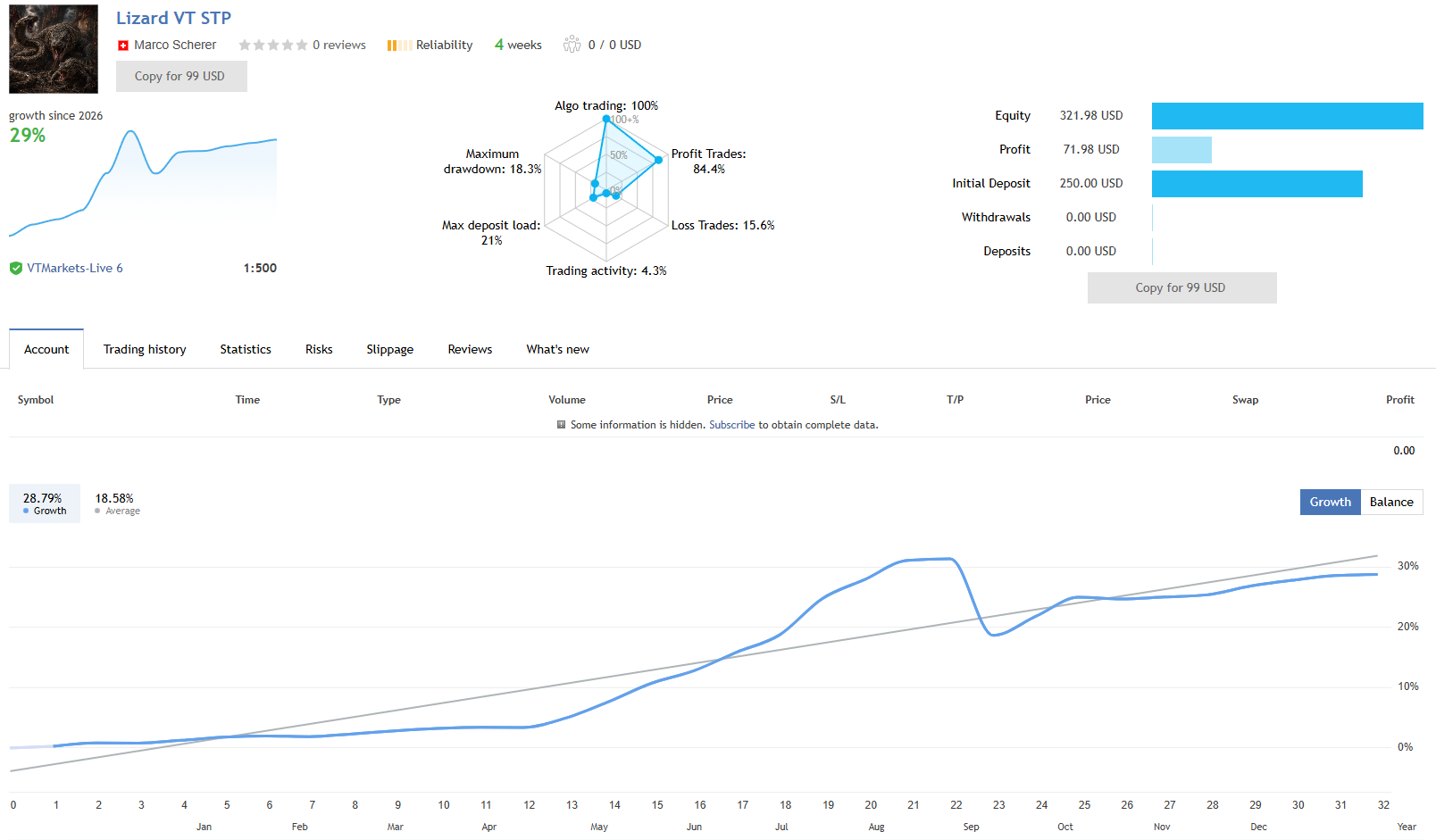
- Live signal: VTMarkets, real money, ~4 weeks tracked at the time of writing
- Live growth: ~+29% from a $250 starting deposit (the developer’s published minimum)
- Live win rate: 84.4% — closely matching the backtest’s 85% (an important alignment signal)
- Live maximum drawdown: 18.3% — higher than the backtest’s 6.30%, partly a small-account amplification effect
- Backtest period: January 2025 – May 2026 (~17 months), real-tick data, default settings
- Backtest result: Profit factor 3.56, 85.32% win rate across 879 trades, 5.29% balance / 6.30% equity drawdown, LR correlation 0.96
The live signal is encouraging — particularly the win-rate alignment with the backtest — but it’s only four weeks old, and the realistic live drawdown will sit closer to the 18% on the live account than the 6% on the backtest. Our full review explains why and what to size around.
EA Setup at a Glance
- Platform: MetaTrader 5
- Instrument: XAUUSD only (Gold)
- Host chart timeframe: H1 (the nine strategies run their own internal timeframes M1-D1)
- Strategy: Multi-strategy swing breakout — pending stop orders, real-breakout filter, no grid or martingale
- Account: Hedging account, ECN or Raw Spread preferred
- Leverage: 1:500 used on live signal; 1:100 minimum recommended
- Minimum deposit: $250 (the developer’s published minimum, also the live signal balance)
- VPS: Strongly recommended low-latency VPS for continuous operation
- Frequency modes: Auto, Extreme Conservative, Conservative, Moderate, Intense, Extreme, Manual
What You Receive
- Lizard for MT5 — available file
- Developer’s recommended settings and presets, where supplied
Risk Disclaimer
Trading XAUUSD involves significant volatility (NFP, CPI, FOMC, geopolitical events) and a breakout strategy can produce consecutive losses when gold consolidates or fakes out against the breakout direction. The developer’s live signal is young at the time of writing, and the realistic live drawdown experienced on real accounts will likely sit closer to the live signal’s 18% than the backtest’s 6%. The frequency mode you select directly affects both return and drawdown — Extreme mode is not appropriate for new buyers. Match risk settings to your account size, give the account meaningful headroom, test on demo on your intended broker first, and never deploy capital you cannot afford to lose. Past performance — backtest or live — does not guarantee future results.
Full Review & Analysis
📖 Read our complete Lizard EA review →
An honest editorial breakdown: how the 9-strategy breakout architecture actually works, the live signal examined including the live-vs-backtest drawdown gap, the realistic Sharpe interpretation, the frequency-mode settings that matter most, the prop firm question, and our verdict.
Standalone MT5 file. Follow the delivery instructions supplied with your order. Free lifetime updates are included, added as soon as we receive them. You never pay twice. Free remote installation is available if you need it.
Every order
What’s included with Lizard
- Instant downloadReady after checkout and kept in your account
- Free lifetime updatesAdded as soon as we receive them, every version kept in your account
- Unlimited activationsUnlimited live and demo accounts
- Free remote installationOptional: a one-time install over AnyDesk, with settings advice and custom presets
- 7-day money-back guaranteeIf the EA fails to attach to your chart because of errors we can replicate, you get a full refund.
Product FAQs
Lizard EA MT5 FAQs
Real people on support, by Telegram or our contact form.
What is Lizard EA?
A XAUUSD-only Expert Advisor for MetaTrader 5 by Marco Scherer. It runs nine independent swing breakout strategies in parallel — each with its own entry timeframe (M1 to D1), stop loss, take profit, trailing logic and risk weighting. Pending stop orders are placed at calibrated distance from swing-high and swing-low structure, and only a real breakout triggers entry. No martingale, no grid, no averaging — every trade has SL and TP.
What broker and account type do I need?
A hedging account on a broker offering XAUUSD with reasonable spreads — ECN or Raw Spread is preferred. The developer’s live signal runs on VTMarkets at 1:500 leverage; minimum recommended leverage is 1:100. Match leverage to your jurisdiction’s availability.
What deposit should I start with?
The developer’s minimum recommended balance is $250 — and the live signal runs at exactly that. More headroom is sensible if you want lower percentage swings and want to use multiple strategies at higher activity modes. Start conservative on frequency mode and step up only after you’ve watched live behaviour on your own broker.
What chart timeframe should I attach it to?
The H1 chart is the developer’s recommended host. The nine strategies run their own internal timeframes (M1 to D1) regardless of the chart you attach the EA to, so the host chart is essentially the EA’s home — not where its trading signals come from.
Does it work on prop firm accounts?
Yes — the EA includes a built-in maximum daily drawdown input specifically for prop firm compliance. There is no grid or martingale anywhere in the system (which most firms ban), and the multi-layered exit system maintains defined risk per trade. Match the daily DD setting to your specific firm’s rules.
Does it work on MT4?
No. Lizard is built for MetaTrader 5 only.
Do I need a VPS?
A low-latency VPS is strongly recommended. Lizard manages pending orders, multiple trailing systems and a virtual SL layer continuously, so an unstable home connection can leave trades mismanaged. A stable 24/5 VPS is the right setup.
Why buy from CheaperForex instead of the MQL5 marketplace?
This is the same EA supplied as a standalone file, with free lifetime updates. You simply pay significantly less. Our full review covers both the strengths and the honest caveats (young live signal, single-broker testing) before you buy.
- Excellent on Trustpilot 4.6 out of 5 from 120 reviews (opens in a new tab)
- 28,000+ traders since 2019
- 1,530+ official EAs
- Card or crypto payments
Related EAs
Traders also explore
Premium expert advisors at vault-low prices, with your crypto price on every card.
 MT5Save 55%
 MT5Save 53%
 MT5Save 50%
 MT5Save 50%
Ready when you are
Lizard EA MT5 for $279.96 with crypto
Regular price was $699.00 · $349.95 with card · instant download · free lifetime updates

Lizard EA MT5$279.96with crypto$349.95 with card