
Last updated: June 2026
Spider Gold EA is a XAUUSD H1 Expert Advisor from Indonesian developer Muhammad Zahran Rahmadi Putra — and the sister product to his earlier release Mosquito EA (which we covered favourably in our Mosquito editorial review at 4.5/5). Spider Gold uses the same on-chart panel architecture and the same defined-risk-per-trade design philosophy, but applies a different strategy approach to the same XAUUSD H1 timeframe.
View product details and current pricing.
This review lands at 4 out of 5 — a half-point below the Mosquito rating — for specific evidence-level reasons we cover in detail below. The architecture and the LR 0.95 backtest correlation are if anything even better than Mosquito’s (0.91), and the 15-week live signal is a meaningfully longer real-money track record than Mosquito’s 7 weeks. But the live signal carries active deposit-and-withdrawal management that makes the headline growth figure harder to read at face value, the backtest-to-live win rate gap is wider than Mosquito’s (94.5% backtest vs 85.7% live), and the average loss is meaningfully larger than the average win in dollar terms (with the high win rate compensating mathematically). The product is genuinely sound; the evidence interpretation requires more care.
⚠️ Looking for a Spider Gold EA “free download”? Don’t.
Every legitimate marketplace EA ships with built-in DRM or licensing. There is no working cracked file in existence — so a “free” copy is always one of two things:
- malware, or
- bait for a Telegram payment scam where you pay and get nothing.
The only safe routes are the MQL5 marketplace or a reputable reseller. CheaperForex offers Spider Gold EA at a significant discount versus the marketplace price — Get Spider Gold EA MT5 at CheaperForex.
The Developer: Muhammad Zahran Rahmadi Putra

Muhammad Zahran Rahmadi Putra publishes from Indonesia and currently maintains two XAUUSD H1 products on MQL5. Spider Gold is the longer-running of the two — 15 weeks of live signal history at the time of writing versus 7 weeks for the Mosquito EA sister product. Both share the same operational architecture (the on-chart panel design, the configurable risk percentage and lot size approach, the news event integration) but apply different underlying entry logic, which produces different trade frequency, different win rate, and different trade-size distributions.
For traders evaluating the developer rather than the individual product, the catalogue itself is a useful signal: two related but distinct products with different strategy approaches on the same instrument and timeframe suggests a developer building a sustained presence rather than testing a single launch. Both products carry public live signals on real money — also a useful signal.
The Architecture (Same as Mosquito)
Spider Gold’s operational architecture is identical to Mosquito EA: defined risk per trade with configurable risk percentage and lot size inputs, an on-chart panel displaying live spread and active settings, and a high-impact news event readout listing upcoming releases. What differs between the two products is the underlying entry logic — Spider Gold takes positions on different signals than Mosquito does, which produces different trade frequency, different win rate, and different trade-size distributions in the backtest.
The visible operational settings on the published live signal are Risk% in the 3-5 range with Lotsize 0.01 — slightly more aggressive default sizing than Mosquito’s 2.0% default, which is consistent with Spider Gold’s higher backtest win rate cushioning a slightly larger per-trade risk allocation.
10 Consecutive Wins Since Launch
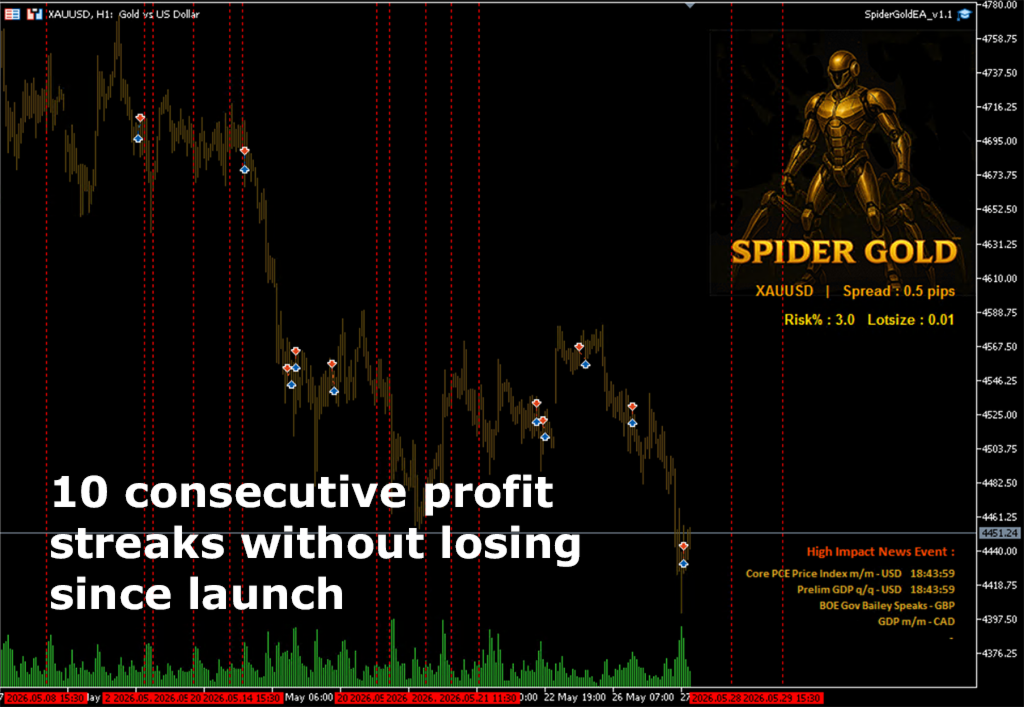
Spider Gold has produced 10 consecutive winning trades since launch — observable directly on the developer’s live MQL5 signal chart. The screenshot above captures the chart with the operational panel visible: XAUUSD pair, spread 0.5 pips, Risk% 3.0, Lotsize 0.01, and the high-impact news readout listing upcoming Core PCE, GDP, BOE, and CAD GDP events.
How to read this honestly. A 10-trade winning streak is encouraging early evidence, but it’s not a forecast. The backtest shows 16 losing trades out of 293 (5.46% loss rate) — that’s the realistic forward expectation. What the streak does tell you is that the defined-risk architecture is currently producing its design behaviour in real market conditions, which is operationally important confirmation. The sister Mosquito product has produced 25 consecutive wins since its later launch by comparison, but Spider Gold’s broader 15-week live history (covered next) is the more substantive evidence on long-term behaviour.
The Live Signal — 15 Weeks With Active Capital Management
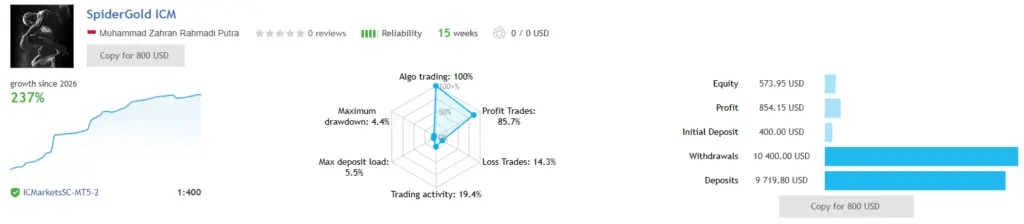
Spider Gold’s public live signal has 15 weeks of tracked history — a meaningfully longer real-money window than the 7-to-8 weeks typical for newly-launched gold EAs, and notably longer than the developer’s own Mosquito EA signal. The account runs at IC Markets SC MT5 with 1:400 leverage. Real money, publicly auditable.
The headline numbers: 237% growth, 85.7% profit trades, 14.3% loss trades, 4.4% maximum drawdown, 5.5% max deposit load, 19.4% trading activity. Encouraging on every metric.
The deposit-withdrawal context — read this carefully. The signal page shows a $400 initial deposit. It also shows cumulative deposits of $9,719.80 and cumulative withdrawals of $10,400.00 across the 15-week period. Current equity sits at $573.95 with cumulative profit of $854.15. What’s happening here is that the account has been actively managed — the developer is adding capital periodically, taking withdrawals periodically, and the equity figure represents what’s currently in the account rather than an unbroken compounded growth curve.
This makes the live signal genuinely more complex to interpret than a typical set-and-forget signal where the only cash flow is the initial deposit. Three honest readings.
The cumulative trading profit is the cleanest single figure. $854.15 of trading profit across 15 weeks is the actual capital the strategy has produced. Read this rather than the 237% headline if you want a clear absolute number.
The 237% growth percentage is technically accurate but contextually amplified. MQL5 calculates growth against the initial deposit; the more aggressive the withdrawal pattern, the higher this percentage climbs even when the cumulative profit remains modest. The 237% figure tells you the strategy is profitable but doesn’t tell you what to expect on a static account.
The operational metrics are the most useful forward signals. 85.7% profit trades, 4.4% max drawdown, and 19.4% trading activity are independent of the cash flow management and tell you about the strategy’s actual trading behaviour. These metrics are credible and consistent with the backtest profile (covered next).
One related observation: the live profit-trade rate (85.7%) is meaningfully lower than the backtest win rate (94.54%). On Mosquito, the live and backtest win rates are tight (89.2% vs 86.81%). Spider Gold’s gap is wider, which suggests the live conditions are producing more losing trades than the backtest predicted. That’s not unusual for the transition from backtest to live, but it’s worth being explicit about — the realistic forward expectation is probably closer to the live 85% than the backtest 94%.
The Backtest — LR 0.95, With One Honest Caveat
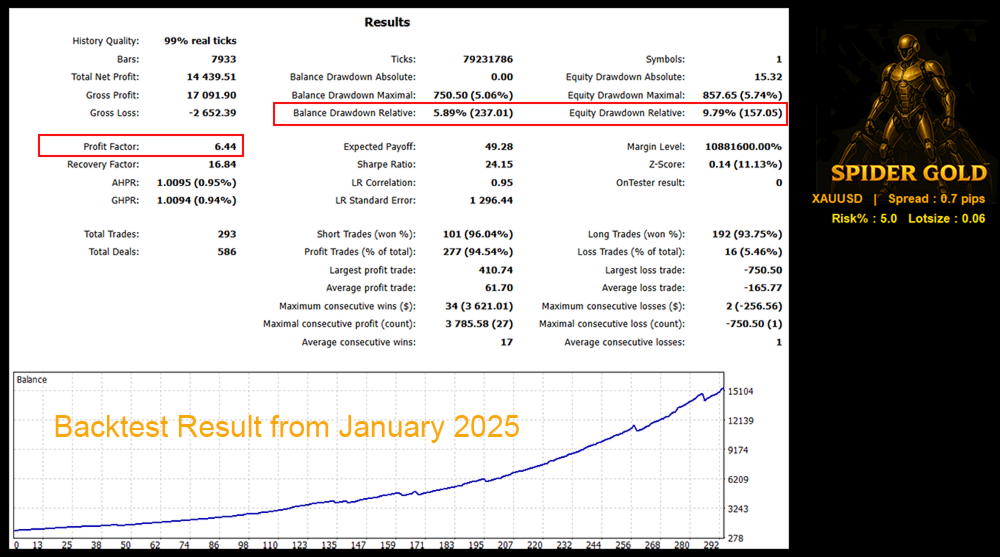
The backtest covers January 2025 onwards on real-tick data at 99% history quality across 79 million ticks. 293 trades, 94.54% profit trades, profit factor 6.44, equity drawdown 9.79%, balance drawdown 5.89%. LR correlation 0.95.
Four honest readings.
The LR 0.95 is genuinely credible. This is even better than Mosquito’s 0.91 — both sit in the 0.85-0.98 range that robust live strategies typically produce, well clear of the suspiciously-clean 0.99/1.00 territory we flag elsewhere. The backtest equity curve in the screenshot shows visible natural variance with an accelerating shape in the second half (consistent with compounding from a small starting balance), which is the shape of real trading rather than optimised-perfect-line curve-fitting.
The consecutive-loss bounds tell you about the architecture. 2 losses in a row is the maximum across 293 backtest trades, with the average sitting at 1. That bounded loss profile — combined with the absence of giant outlier losses that would signal a hidden grid or recovery layer — is the trade signature of a system genuinely operating with defined risk per trade. Whatever Spider Gold’s entry logic actually computes, the exit logic is doing what the developer claims it does.
The average win vs average loss asymmetry deserves explicit framing. Average win is $61.70; average loss is $165.77. The average loss is roughly 2.7x the average win in dollar terms. Mathematically, the 94.5% win rate compensates — 94.5% × $61.70 minus 5.46% × $165.77 equals roughly +$49 expected value per trade — but this is a different profile from Mosquito where the average win and loss were closer in magnitude. What this means in practice: position sizing discipline matters more here than on Mosquito. If the win rate drops below the backtest figure (as it has on the live signal — 85.7% vs 94.5%), the expected value compresses more quickly than it would on a system with symmetric trade sizes. The math still works at 85% win rate, but the buffer is narrower.
The Sharpe 24.15 is a tester artefact. Same flag as on every recent build with a high backtest win rate — real trading strategies rarely exceed Sharpe ratios of 3-5. The figure is what MT5’s tester produces on the consistent return distribution of a high-win-rate strategy; ignore it as a forecast. The useful metrics are the profit factor (6.44), win rate (94.5%), drawdown figures (~5.9-9.8%), and the consecutive-loss bounds.
What Early Buyers Are Saying
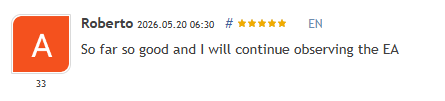
The product has one published MQL5 review at the time of writing — a five-star comment from Roberto noting “So far so good and I will continue observing the EA.” That’s an honest framing from a real buyer rather than an effusive endorsement, and the “continue observing” language reflects the appropriately patient stance toward a young product. Useful operational confirmation that the EA is being used by paying buyers, but a single review covering an early evaluation period is far too thin to support meaningful conclusions about the product. The review base will mature over the coming months as more buyers run the system through different market conditions.
Spider Gold vs Mosquito — Which Should You Buy?
For traders evaluating the developer’s catalogue, the practical question is whether to buy Spider Gold, Mosquito EA, or both. Honest comparison.
Mosquito EA (rated 4.5/5 in our editorial review) has tighter backtest-to-live alignment — the win rates match (89% live vs 87% backtest), and the simple set-and-forget live signal is easier to read at face value. The trade-size distribution is more symmetric, which makes position sizing more forgiving. The half-point we hold back reflects the shorter 7-week live window.
Spider Gold (rated 4/5 here) has the longer 15-week live history and the slightly better LR correlation in backtest. The half-point we hold back reflects the deposit-withdrawal complexity that makes the headline live growth figure harder to interpret cleanly, the wider gap between backtest and live win rates (94.5% backtest vs 85.7% live), and the asymmetric average win vs average loss profile that demands more position-sizing discipline.
For most buyers new to the developer’s work, we’d suggest starting with Mosquito EA at conservative sizing on demo to validate the dev’s approach generally, then considering Spider Gold as an addition once you have a feel for the underlying architecture. Buying both at launch is more concentration into a single developer than is necessary while validating — though both products being at significant discount through CheaperForex makes the cost of evaluation modest.
Who Spider Gold EA Is For
It might be a fit if you:
- Want a XAUUSD H1 system with a longer (15-week) real-money live track record than typical newly-launched gold EAs
- Are comfortable reading the live signal in deposit-withdrawal context rather than anchoring on the 237% headline growth figure
- Can plan around the asymmetric trade-size distribution (average wins smaller than average losses, compensated by high win rate)
- Want to validate the developer’s approach via this product specifically, rather than starting with Mosquito EA
- Run on IC Markets or similar ECN broker — the developer’s live signal demonstrates execution on that environment
Look elsewhere or wait if you:
- Read the 237% live growth figure as a forward-looking expectation rather than a deposit-context-amplified percentage
- Are uncomfortable with the wider backtest-to-live win rate gap (94.5% vs 85.7%) and would rather see closer alignment
- Prefer the simpler set-and-forget live signal of the sister Mosquito EA
- Need a multi-month live track record beyond the current 15-week window
- Trade only on MT4 — this is MT5 only
Our Verdict
We rate Spider Gold EA 4 out of 5.
The architecture is genuinely sound — the LR 0.95 backtest correlation sits squarely in the credible range, the trade-level discipline (max 2 consecutive losses across 293 trades) is consistent with the developer’s design claims, and the 15-week live history is meaningfully longer than typical newly-launched gold EAs. The sister Mosquito EA’s success in achieving tight backtest-to-live alignment is encouraging context for trusting this developer’s general approach.
The half-point we hold back captures the honest interpretation difficulties on this specific product. The live signal’s active deposit-and-withdrawal management means the 237% headline growth figure is technically accurate but contextually amplified — the cleanest single piece of trading performance evidence is the $854 cumulative profit, not the percentage. The backtest-to-live win rate gap (94.5% to 85.7%) is wider than ideal — the realistic forward expectation should anchor closer to the live figure than the backtest. And the asymmetric trade-size distribution (average loss 2.7x average win) means position sizing matters more here than on the sister Mosquito product.
Practical recommendation: if you want to buy it, buy it conservatively. Start at smaller risk percentage than the developer’s published 3-5% range while validating on your own broker, plan capital around the backtest’s 9.8% equity drawdown rather than the live signal’s 4.4%, and treat the first six months as evaluation rather than scaling. If you’d rather start with the simpler-to-interpret Mosquito EA first, that’s our practical recommendation for most buyers new to the developer’s catalogue.
How to Get Spider Gold EA Safely
Two legitimate sources, and only two.
CheaperForex — the same EA at a significant discount versus the marketplace price. Get Spider Gold EA MT5 at CheaperForex.
The MQL5 marketplace — direct from Muhammad Zahran Rahmadi Putra’s developer page. Here is the official MT5 listing.
Anywhere else offering it free or via a Telegram seller is a trap — there’s no working cracked file, only malware or pay-and-vanish scams.
Frequently Asked Questions
Is Spider Gold EA legit, or a scam?
Legitimate. A published MQL5 marketplace product with a real-money public live signal on IC Markets running for 15 weeks, a credible backtest at 99% real-tick history quality, and an early review base on the listing. The scams in this space are the “free download” sites and Telegram sellers offering cracked copies that can’t exist. Buy from MQL5 or a reputable reseller.
How should I read the 237% live growth figure?
As technically accurate but contextually amplified. MQL5 calculates growth against the initial $400 deposit, and the account has had substantial deposits ($9,719) and withdrawals ($10,400) flowing through it across the 15 weeks. The cleanest single piece of trading evidence is the cumulative trading profit (~$854). Use that for absolute return reading, and the operational metrics (85.7% profit trades, 4.4% max drawdown) for behavioural expectations.
Why is the backtest win rate (94.5%) higher than the live rate (85.7%)?
That’s a normal divergence between historical-data testing and live trading — real conditions produce edge cases and execution effects the backtest didn’t model. The honest read is that 85.7% is closer to a realistic forward expectation than 94.5%. The math still works at 85% win rate given the trade-size distribution, but the buffer is narrower.
What about the asymmetric average win vs average loss?
Average win is $61.70 and average loss is $165.77 in backtest — losses are roughly 2.7x larger than wins individually. The high win rate compensates mathematically (94.5% × $61.70 minus 5.46% × $165.77 is positive expected value), but position sizing discipline matters more here than on a system with symmetric trade sizes. If win rate drops, expected value compresses faster.
How does it compare to Mosquito EA?
Same developer, different strategy approaches. Mosquito (rated 4.5/5) has tighter backtest-to-live alignment, simpler live signal interpretation, and more symmetric trade sizes. Spider Gold (rated 4/5 here) has the longer 15-week live track record and slightly better LR backtest, but more interpretation complexity. Our Mosquito review covers that product in detail.
What’s the realistic drawdown on a real account?
Plan around the backtest’s 9.79% equity drawdown rather than the live signal’s 4.4%. The live worst case will move closer to the backtest figure over time as the system encounters more difficult market conditions. On a small account, percentage moves are amplified.
What risk settings should I start with?
The developer’s published live signal runs with Risk% 3.0 and Lotsize 0.01 at points (with backtest results shown at Risk% 5.0 and Lotsize 0.06). Start at the lower end of that range or below while validating on your own broker. Position sizing discipline matters on this product specifically given the asymmetric trade-size distribution — step up gradually only after live behaviour on your own account is validated.
Why buy from CheaperForex instead of MQL5?
The product is identical — same EA, same developer, same strategy. You pay significantly less. For a product with a credible 15-week live track record and a sound backtest, paying less to test it on demo and validate before scaling is the practical approach.