
Last updated: June 2026
Sentinel MT5 EA is a multi-pair grid Expert Advisor from Italian developer Luca Barone, trading EURCHF, CADCHF, and EURCAD on MetaTrader 5 with a measured recovery system. The product has been live since 2025 with a public MQL5 signal that’s now 37 weeks deep — substantially longer than the typical young products we cover. Luca Barone also publishes a separate, transparently-marketed high-risk product, Sentinel KMZ EA MT5, which is the aggressive Gold flipper for buyers who want that approach.
View product details and current pricing.
This review lands at 4.5 out of 5 — matching our Mosquito EA rating from a different developer — for one specific reason that other recent products have failed on: the live signal compounding is clean. Initial deposit €500, additional deposits €1.65 across 37 weeks (effectively zero), withdrawals €605 (the developer taking profit along the way rather than recycling capital to inflate the headline). The 499% growth figure is honest compounded performance from a small starting balance, not the deposit-amplified percentage we’ve had to flag on other products in this session.
That doesn’t change what Sentinel architecturally is, which is a grid-and-recovery system — a category that carries inherent structural risks any honest review needs to flag. The Ultra Risk backtest mode (63.4% monthly gain, 56.65% equity drawdown) is marketing-illustration rather than recommended live settings. The live drawdown (18.7%) is meaningfully higher than the Medium Risk backtest’s 14.09%, which suggests real conditions are tougher than the backtest sample. And the three primary trading pairs share currency exposure that a tail event could correlate. This review covers all of that alongside the genuinely positive case.
⚠️ Looking for a Sentinel MT5 EA “free download”? Don’t.
Every legitimate marketplace EA ships with built-in DRM or licensing. There is no working cracked file in existence — so a “free” copy is always one of two things:
- malware, or
- bait for a Telegram payment scam where you pay and get nothing.
The only safe routes are the MQL5 marketplace or a reputable reseller. CheaperForex offers Sentinel MT5 EA at a significant discount versus the marketplace price — Get Sentinel MT5 EA at CheaperForex.
The Developer: Luca Barone

Luca Barone publishes from Italy and currently maintains two clearly-differentiated MetaTrader 5 products on MQL5. Sentinel MT5 (this product) is the measured multi-pair grid for buyers who want compounding growth with bounded drawdown. Sentinel KMZ EA MT5 is the high-risk Gold flipper — marketed openly as the aggressive option rather than dressed up to look safer than it is.
That transparency in product positioning is worth weighing as a developer-level trust signal. Many EA marketers blur risk profile by claiming everything is “safe” and “low risk” regardless of what’s under the hood. Luca’s catalogue tells you which product is which — and the live LUBOTFX signal demonstrates the measured product’s behaviour over 37 weeks of real-money operation.
The Architecture — Grid With Measured Recovery
Sentinel MT5 is, structurally, a grid system with two recovery phases (Recovery_1 and Recovery_2 in the documentation). This is an architectural category that needs honest framing because it works differently from defined-risk-per-trade systems we’ve covered elsewhere in our recent reviews of Mosquito EA and Spider Gold EA.
How a grid system works. Rather than placing one trade with a stop loss and take profit, a grid opens multiple positions at different price levels. When price moves against the initial trade, the system adds positions at progressively worse levels (the “grid”), with the recovery logic adjusting take-profit targets so that when price eventually retraces, the basket of positions closes in net profit even if the initial entry never reached its original TP. The Recovery_1 and Recovery_2 phases are progressive adjustments to take-profit logic as the basket grows.
What that means for your account. Grid systems carry floating drawdown that can be significantly larger than realised drawdown. A grid that’s down 20% on paper isn’t down 20% closed — it’s down 20% on positions that the system expects to recover. When recovery works, you barely notice the drawdown. When recovery fails (during strong sustained directional moves), the entire basket can be closed at a loss equal to the floating drawdown at that point.
What “measured” means here. Multiple reviewers describe Sentinel’s grid as deliberately conservative — “The grid logic is measured, it doesn’t pile into a deep grid just to chase a recovery” (mariusztre), “Solid Grid system… Risk is tuneable to what you are feeling comfortable with” (Michael Arthur Schorr). Reviewer Lucian Crismaru describes watching the recovery phases work on a real account: “Even when the price went against the initial trade, the EA used the Recovery_1 and Recovery_2 phases to move the Take Profit and closed the whole basket in profit.” That’s the design behaviour working as intended on a real account, captured by an actual buyer.
37 Weeks Clean Compounding
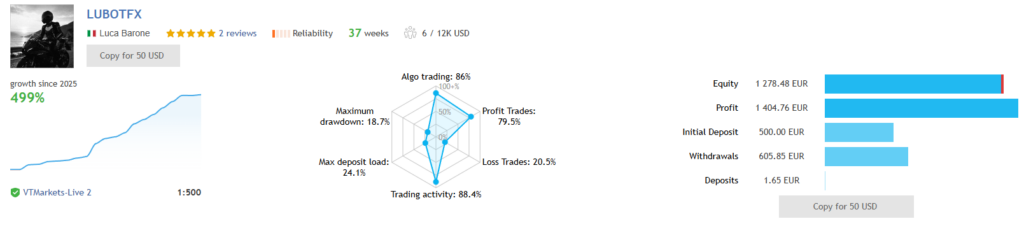
The LUBOTFX live signal is what makes this review land at 4.5 rather than the 4.0 we gave Spider Gold EA from a different developer with otherwise similar architecture-quality signals. The reason is specific and worth being explicit about: the cash flow on this signal is clean.
Signal details: VTMarkets Live 2 broker, 1:500 leverage, 37 weeks of tracked history. The account opened on a €500 initial deposit, has received exactly €1.65 in additional deposits across the entire 37 weeks (functionally zero), and shows €605.85 in withdrawals — Luca taking profit along the way rather than recycling withdrawn funds back as fresh deposits to amplify the growth percentage. Current equity sits at €1,278.48 with cumulative profit of €1,404.76.
What that means for reading the 499% headline: this is genuine compounded performance on a small starting balance over 37 weeks. It’s not the deposit-context-amplified percentage we had to walk through carefully on Spider Gold’s 237% figure. You can take Sentinel’s 499% essentially at face value as the compounded return on the original €500 (with the caveat that long-term compounded returns on a small starting balance are mathematically amplified compared to what the same strategy would produce on a €50,000 account).
Operational metrics confirm the architectural intent. 79.5% profit trades, 20.5% loss trades (a realistic distribution, not the suspicious 100% live win rates we flag elsewhere). 18.7% maximum drawdown — meaningfully higher than the Medium Risk backtest’s 14.09% equity DD, which is worth noting: the live environment is tougher than the backtest sample, and buyers should plan for live DD figures somewhere in the 18-20% range rather than the backtest figures. Trading activity 88.4% reflects the grid system’s continuous open positions across multiple pairs. Algo trading 86% — not a perfect 100%, suggesting the dev has manually adjusted or closed some positions during the tracking period.
The Three Risk Modes — Read Honestly
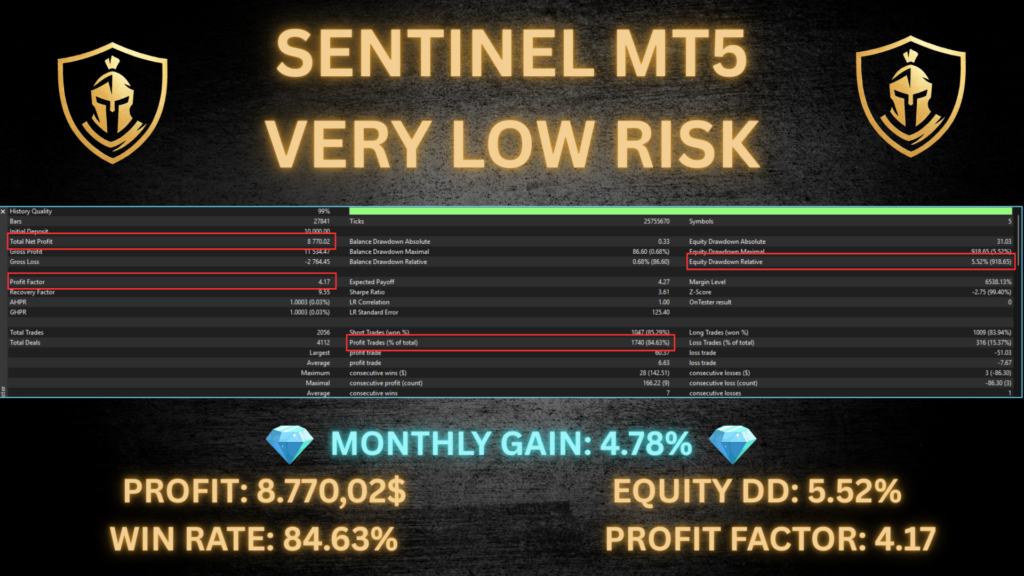
Very Low Risk is the mode most buyers should start with. ~4.78% monthly gain target, 5.52% equity drawdown, profit factor 4.17, Sharpe 3.61. The headline numbers are modest — that’s the point. Reviewer Lucian Crismaru reports running this mode (0.01 lot per 2000 units) for 8 days with 0.07% realised drawdown and 1.23% net profit, which is exactly the “steady growth without the stress” pattern the mode is designed to produce. For buyers who want to evaluate the architecture without exposing significant capital to the inherent grid risks, this is the entry point.
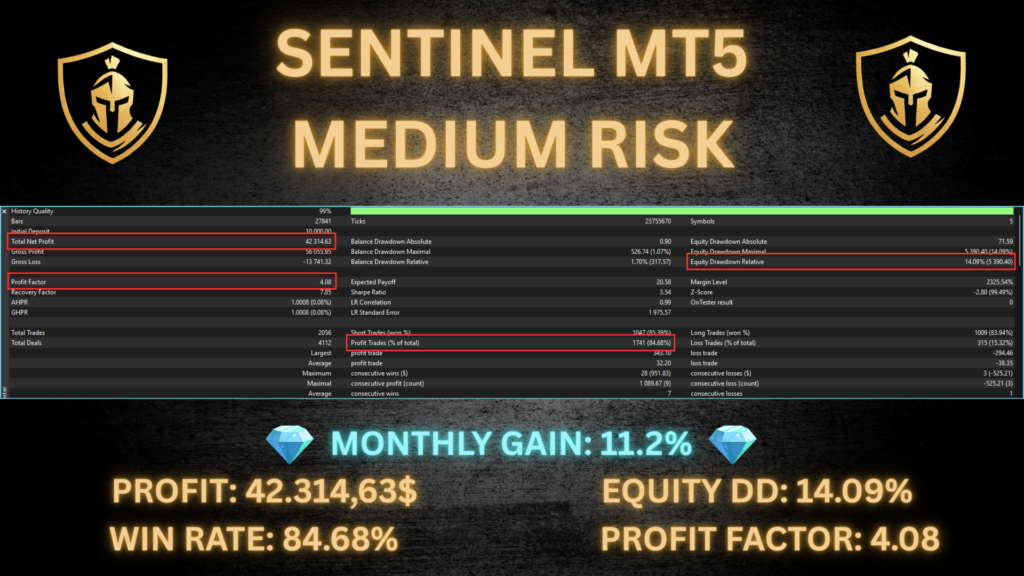
Medium Risk targets ~11.2% monthly gain with 14.09% equity drawdown, profit factor 4.08, Sharpe 3.54. This is the mode the live signal sits closest to in risk profile, and the realistic read on its forward expectation is that live drawdown will land somewhere between the 14.09% backtest figure and the 18.7% live figure — call it the 14-20% planning range. Don’t graduate to Medium until live behaviour on Very Low is validated on your own broker over at least a month.
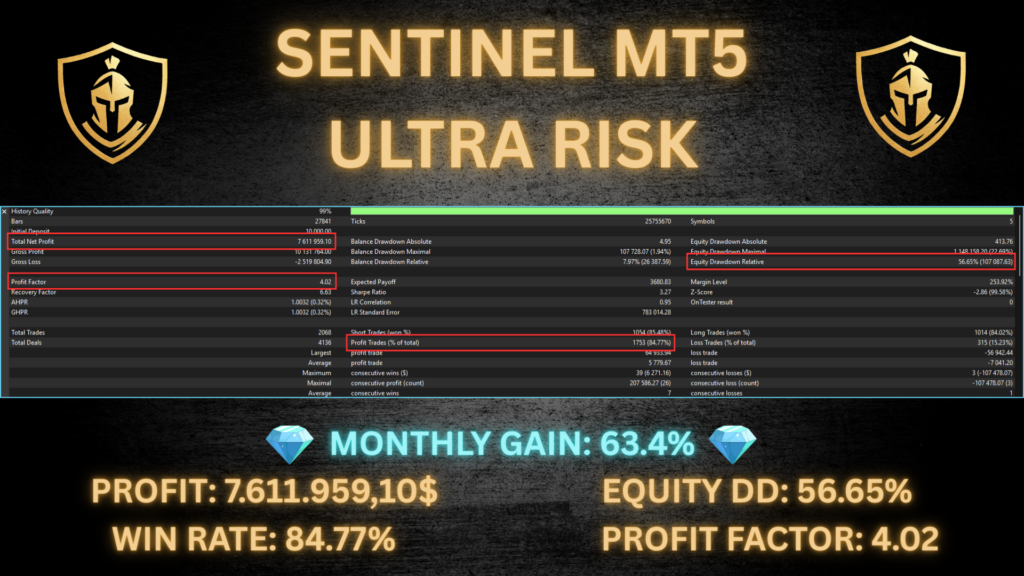
Ultra Risk shows ~63.4% monthly gain with 56.65% equity drawdown and a backtest profit of $7.6M compounded from $10,000. Standard framing applies here: the multi-million compounded projection is a marketing illustration of what aggressive sizing produces on a backtest, not a recommended live setting. A 56% drawdown on a grid system means floating losses across multiple pairs simultaneously during adverse moves — most accounts won’t survive that emotionally even if they survive it mechanically. Read Ultra Risk as “this is what the same strategy looks like at maximum aggression” rather than “this is what you should run.”
One honest framing on the backtest LR correlations. Very Low Risk shows LR 1.00, Medium shows 0.99, Ultra shows 0.95. On a defined-risk-per-trade system, LR figures of 0.99-1.00 would be the curve-fit signature we flag elsewhere. On a grid system, smoother equity curves are an expected architectural feature — losses are floated until baskets close in net profit, which produces visually cleaner curves than per-trade systems. That makes traditional LR-based curve-fit detection less informative on grids generally. The real test is whether live performance tracks the backtest’s behaviour profile over a meaningful period — which is where the 37-week LUBOTFX signal earns its position as the primary evidence.
What Buyers Are Saying
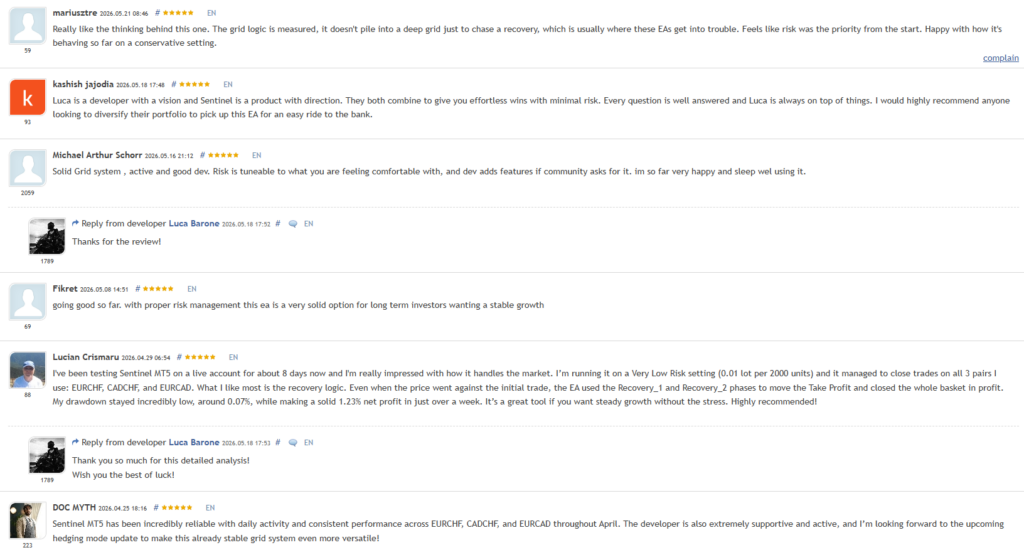
The MQL5 listing has accumulated a substantive review base over the months Sentinel has been on the market, and the comments contain operationally useful observations rather than generic five-star praise.
One reviewer (mariusztre) captures the architectural appraisal well: “The grid logic is measured, it doesn’t pile into a deep grid just to chase a recovery, which is usually where these EAs get into trouble. Feels like risk was the priority from the start. Happy with how it’s behaving so far on a conservative setting.” That’s a buyer who understands grid systems describing what they see in this one — useful confirmation that the developer’s measured-grid framing is accurate.
Lucian Crismaru’s review captures a recovery sequence in action: “Even when the price went against the initial trade, the EA used the Recovery_1 and Recovery_2 phases to move the Take Profit and closed the whole basket in profit. My drawdown stayed incredibly low, around 0.07%, while making a solid 1.23% net profit in just over a week.” Running at the Very Low Risk setting (0.01 lot per 2000 units) on EURCHF, CADCHF, and EURCAD. That’s the system doing exactly what it’s designed to do, captured by an actual user.
Fikret notes: “going good so far. with proper risk management this ea is a very solid option for long term investors wanting a stable growth.” DOC MYTH reports consistent performance across the three pairs across April. Multiple reviewers reference the upcoming hedging mode update, which suggests an active development roadmap rather than a fire-and-forget release.
Weight these as substantive early-to-mid-term buyer feedback that aligns with what the live signal demonstrates. The review base is mature enough to be informative without being so deep that survivorship bias becomes a concern.
Sentinel MT5 vs Sentinel KMZ — Which Should You Buy?
Luca Barone’s catalogue gives buyers a clear choice. The two products are positioned as opposite ends of the same developer’s risk spectrum, marketed transparently rather than blurred together.
Sentinel MT5 (this product) is the measured multi-pair grid — designed for buyers who want compounding growth with bounded drawdown across EUR/CHF/CAD currency crosses. The 37-week live track record demonstrates the architecture working through extended live conditions. Risk modes from Very Low (~5% DD) through Medium (~14% DD) cover the range of conservative-to-moderate exposures most buyers should consider.
Sentinel KMZ EA MT5 is the high-risk Gold flipper — marketed openly as the aggressive option. Different instrument (Gold), different architectural approach, fundamentally different risk profile. Buyers attracted to KMZ should approach it as a small-allocation high-risk component of a broader portfolio rather than a core position.
For most buyers new to Luca’s work, we’d recommend starting with Sentinel MT5 on Very Low Risk to evaluate the developer’s approach generally. If you also want the high-risk Gold exposure, KMZ is the dev’s transparent option for that. The two products complement rather than compete — they target different account allocations and different risk appetites.
Who Sentinel MT5 EA Is For
It might be a fit if you:
- Want a multi-pair EUR/CHF/CAD grid system with a 37-week clean-compounding live track record
- Understand that grid-and-recovery systems carry floating drawdown larger than realised drawdown, and plan capital around that
- Will actually run the Very Low or Medium risk modes rather than chasing the Ultra Risk illustrative numbers
- Are comfortable with the live drawdown landing in the 14-20% range rather than just the backtest 5.5-14% figures
- Want a developer with transparent product positioning (the measured multi-pair Sentinel and the aggressive Sentinel KMZ as separate clearly-marketed products)
Look elsewhere or wait if you:
- Don’t want a grid-and-recovery architecture and prefer defined-risk-per-trade systems (consider Mosquito EA or Spider Gold EA as alternatives)
- Plan to run the Ultra Risk mode in real conditions — the 56.65% drawdown is the kind of figure that ends accounts
- Have concentrated exposure to CHF, EUR, or CAD already and don’t want to amplify it across three correlated pairs
- Want a system that won’t take any losses — every system takes losses, and grid systems specifically can take large basket losses during adverse runs
- Trade only on MT4 — this is MT5 only
Our Verdict
We rate Sentinel MT5 EA 4.5 out of 5.
The architecture earns the upper half of the score with one specific differentiator that pushed it above similar recent products: the live signal compounding is clean. €500 starting deposit, €1.65 in additional deposits across 37 weeks, and €605 in withdrawals representing profit-taking rather than capital recycling. The 499% headline growth figure is what the strategy actually produced on the original €500 — not the deposit-context-amplified percentage we had to walk through carefully on similar grid and recovery systems elsewhere. Combined with realistic backtest Sharpe ratios across all modes (3.27-3.61), substantive buyer reviews that capture the architecture working as designed, and a developer who positions his catalogue with honest risk-tier transparency (Sentinel MT5 measured / Sentinel KMZ aggressive), the evidence quality is genuinely better than what we typically see on grid systems.
The half-point we hold back captures the honest grid-system caveats. Grid-and-recovery architectures carry floating drawdown that can be substantially larger than realised drawdown, and a system that has worked through one market regime can still face the regime change that tests its recovery limits in ways the 37-week sample didn’t include. The live drawdown (18.7%) is meaningfully larger than the Medium backtest (14.09%) — live conditions are tougher than the backtest sample. The three primary pairs share currency exposure that a tail event could correlate. And the Ultra Risk mode’s 56.65% drawdown is the kind of figure that becomes an account-ending event if a buyer mistakes it for “achievable” rather than “illustrative.”
Practical recommendation: if you want to buy it, buy it conservatively. Start on Very Low Risk to validate live behaviour on your own broker, plan capital around a 14-20% drawdown range rather than the backtest figures, treat the first 2-3 months as evaluation, and only consider stepping up to Medium after you’ve watched the recovery phases handle a few uncomfortable moves on your actual account. Never run Ultra Risk in real conditions regardless of what the backtest projection suggests. Buying through CheaperForex at significant discount versus the marketplace makes the cost of evaluation modest.
How to Get Sentinel MT5 EA Safely
Two legitimate sources, and only two.
CheaperForex — the same EA at a significant discount versus the marketplace price. Get Sentinel MT5 EA at CheaperForex.
The MQL5 marketplace — direct from Luca Barone’s developer page. Here is the official MT5 listing.
Anywhere else offering it free or via a Telegram seller is a trap — there’s no working cracked file, only malware or pay-and-vanish scams.
Frequently Asked Questions
Is Sentinel MT5 EA legit, or a scam?
Legitimate. A published MQL5 marketplace product with a 37-week real-money public live signal on VTMarkets showing clean compounding, a substantive verified review base with operationally-useful observations from real buyers, and a transparent developer who maintains separate clearly-positioned products for different risk appetites. The scams are the “free download” sites and Telegram sellers offering cracked copies that cannot exist.
How should I read the three backtest risk modes against live expectations?
Treat Very Low Risk and Medium Risk as the actual operational range — Very Low for evaluation and Medium for moderate exposure after live validation. Treat Ultra Risk as illustration of what aggressive sizing produces, not as a live setting. Plan live drawdown for the 14-20% range based on the live signal’s 18.7% figure, not the backtest’s 14.09% Medium mode.
What does “Recovery_1 and Recovery_2” actually mean for my account?
These are progressive recovery phases the grid uses to close losing baskets in net profit. When price moves against the initial trade, the system adds positions at progressively worse levels and the recovery logic adjusts take-profit targets so the whole basket closes profitably when price retraces. When recovery works (the common case), you barely notice the drawdown. When recovery fails (during sustained strong directional moves), the floating loss can be closed at a meaningful realised loss. The 37-week live signal shows recovery working consistently, but this is a structural risk all grid systems share.
Why is the live drawdown (18.7%) higher than the Medium backtest (14.09%)?
Live conditions are reliably tougher than backtest samples. Real spreads vary, real execution introduces slippage, and the live sample includes market periods the backtest didn’t model. Reading the live figure as the more realistic forward expectation than the backtest figure is the honest approach. Plan capital around the live range.
How does the deposit/withdrawal pattern compare to other products?
Clean. The live signal opened on €500, has received only €1.65 in additional deposits across 37 weeks (functionally zero), and shows €605 in withdrawals — profit-taking rather than capital recycling to inflate headlines. This is meaningfully different from products where active deposit-and-withdrawal flows complicate the headline growth interpretation. The 499% growth figure is genuine compounded performance.
How does it compare to Sentinel KMZ EA?
Same developer, fundamentally different products. Sentinel MT5 is the measured multi-pair grid on EUR/CHF/CAD crosses. Sentinel KMZ EA MT5 is the high-risk Gold flipper, marketed openly as the aggressive option. Choose based on which risk profile you actually want; the dev’s transparency makes this an informed choice rather than a guess.
What position sizing should I start with?
The developer’s Very Low Risk mode is the starting point most buyers should choose. Reviewer Lucian Crismaru reports running 0.01 lot per 2000 units of account equity, which produced 0.07% realised drawdown and 1.23% net profit over 8 days of evaluation. Stepping up from there should be incremental and only after live behaviour on your own broker is confirmed across at least a month of real trading conditions.
Why is it cheaper at CheaperForex?
The product is identical — same EA, same developer, same strategy. You pay significantly less. For a product with a 37-week clean-compounding live track record, paying less to validate on your own broker is the practical approach.