Last updated: April 2026
Most Gold EAs are designed to find reasons to trade. They scan for setups, generate signals, and fire orders — the more they trade, the more opportunities they capture. That’s the theory. In practice, it’s also how most Gold EAs eventually blow accounts — overtrading in conditions that look right but aren’t.
TwisterPro Scalper is designed to find reasons not to trade. Every potential entry must pass through five independent validation layers, and any single failed layer kills the trade. The EA watches Gold on M15 around the clock but only fires when all five checks agree — roughly once or twice a week on Mode 1. The rest of the time, it sits there doing nothing.
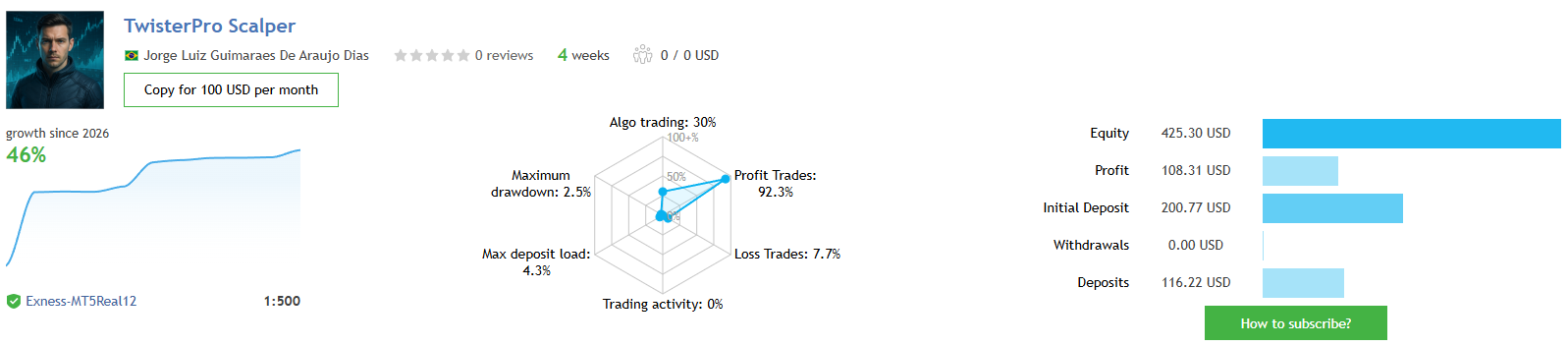
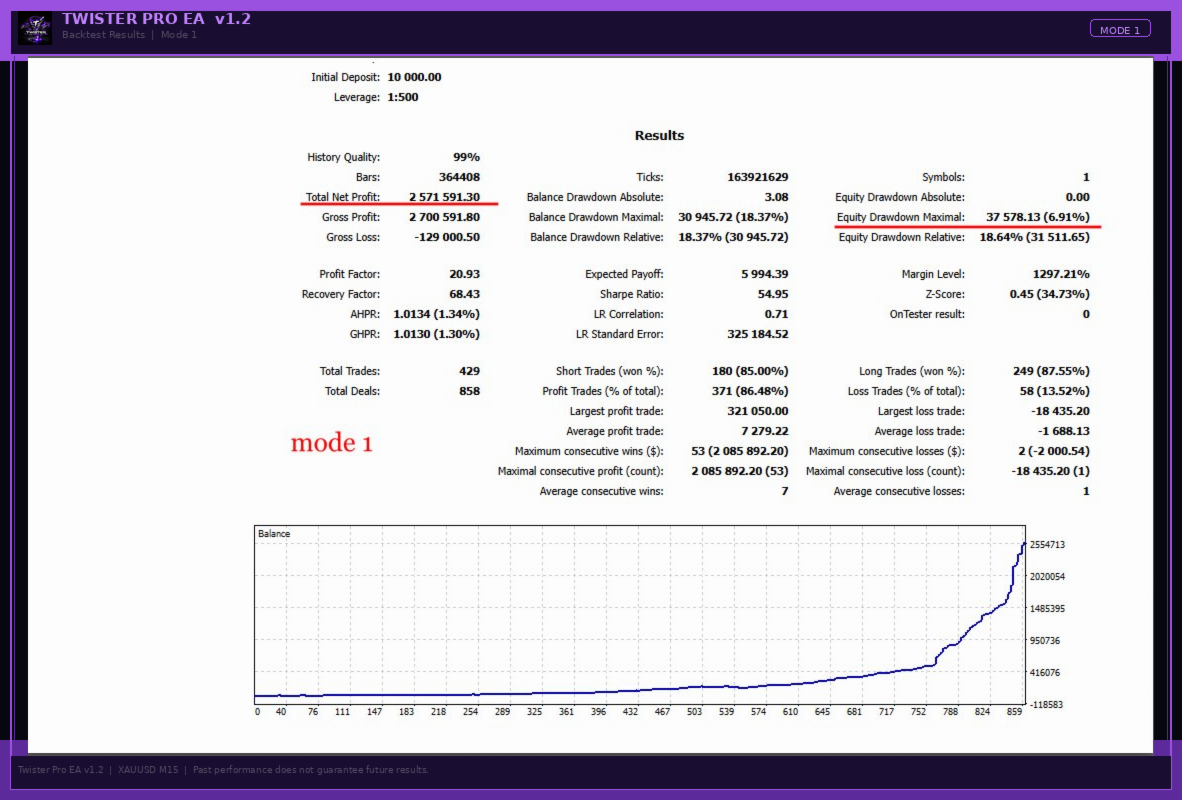
The result of that refusal: a striking backtest profile with a high profit factor, a maximum of just two consecutive losses across 429 trades, and a live signal showing 46% growth in its first four weeks with 92.3% winning trades and 2.5% maximum drawdown. This review looks at whether the bet on selectivity is genuinely paying off — or whether the headline metrics are a small-sample artefact dressed up as a strategy.
⚠️ Looking for a TwisterPro Scalper “free download”? Don’t.
Every MQL5 marketplace EA ships with built-in DRM. There is no working cracked file in existence — so a “free” copy is always one of two things:
- malware, or
- bait for a Telegram payment scam where you pay and get nothing.
The only safe routes are the MQL5 marketplace or a reputable reseller. CheaperForex offers it at a significant discount versus the marketplace price — see the product page here.
The Developer: Jorge Luiz Guimaraes De Araujo Dias

Jorge Luiz Guimaraes De Araujo Dias is a Brazilian developer publishing on MQL5. TwisterPro Scalper is his primary product, and the listing reads as notably technical and specific — discussing validation layers, assertiveness modes, and the risk architecture in detail rather than relying on vague “AI” or “neural network” claims. That’s a useful first signal. Developers who can explain what their product actually does, in concrete operational terms, tend to be ones who built it deliberately rather than fitted it to a backtest.
What’s less established is the longer-term track record. The product is relatively new to the marketplace at the time of writing, so there isn’t yet the multi-year buyer feedback or live history that would let you triangulate the developer’s broader reliability. The current evaluation has to be on the product’s own architecture, its backtest evidence, and the early live signal — which is what the rest of this review covers.
The Logic of Saying No
The 5-layer validation system is the entire thesis of this EA. Understanding what it does explains both the striking backtest metrics and why the EA trades so infrequently.
Before every potential entry, TwisterPro runs five independent checks. The developer doesn’t disclose the specific layers (proprietary), but the observable behaviour tells the story: the EA watches Gold continuously on M15 and rejects the vast majority of what it sees. Across 429 backtest trades over a multi-year period, that’s roughly 1-2 trades per week. For an EA attached to a chart 24/5, that’s a lot of sitting still.
Each layer has veto power. If layer 1 passes but layer 3 fails, the trade is killed. If four layers agree but the fifth doesn’t, no trade. This isn’t a scoring system where four out of five is “good enough.” It’s unanimous or nothing.
The numbers validate the design philosophy. When TwisterPro does trade, it wins around 86% of the time in backtesting and 92% in early live. When it loses, the average loss is meaningfully smaller than the average win. And it almost never loses twice in a row — maximum 2 consecutive losses in the entire 429-trade backtest, with an average of one. That last metric is the one that matters most for the psychology of trading the EA: you’re almost never sitting through a losing streak.
The Live Signal — Four Weeks Is Not a Track Record

The verified MQL5 live signal started on a $200 Exness account at 1:500 leverage and produced 46% growth in its first month. Three honest things to weigh.
92.3% live win rate actually exceeds the 86% backtest. Small-sample caveat applies — four weeks isn’t enough to draw definitive conclusions — but the early alignment between live and backtest behaviour is a healthy sign that the strategy logic isn’t curve-fitted. When live patterns track the backtest in behaviour (win rate, trade frequency, drawdown character) rather than just headline returns, it suggests the underlying edge is real rather than a fit to past data.
2.5% maximum drawdown is too low to extrapolate. For a Gold scalper producing 46% monthly growth, a 2.5% peak-to-trough drawdown is remarkably tight — and the 4.3% max deposit load confirms conservative position sizing. But this is a four-week sample. The realistic live drawdown will move closer to the backtest’s 18%+ equity figure as the system encounters more difficult market periods. Plan around the higher number.
Four weeks on a low-frequency strategy is barely 5-10 actual live trades. Mode 1 averages 1-2 trades per week. Whatever the headline numbers say, the live signal so far covers a tiny fraction of the trade volume needed to validate the strategy statistically. Read it as an encouraging start, not as proven behaviour. Three to six months of live data is the minimum threshold for treating the results as established.
The Backtest — Read the Headline Metrics Honestly

The Mode 1 backtest produces metrics that look almost too good on first read: profit factor in the 20s, Sharpe ratio in the 50s, 86.48% win rate across 429 trades. Three honest readings, in order of importance.
The maximum-2-consecutive-losses metric is the genuine standout. Across 429 trades over a multi-year period, the EA never lost more than twice in a row, with an average consecutive-loss streak of one. This is the figure that tells you something real about the strategy’s design: the 5-layer validation isn’t optimised primarily to maximise wins — it’s optimised to prevent losing streaks. For traders who have been through the psychological damage of watching an EA lose 5, 7, 10 trades in a row, this is the metric that matters most.
The headline profit factor will compress in live conditions. A backtest PF in the 20s is extraordinary — most high-performing EAs sit between 2 and 5. Real-world execution costs (variable spread on news, slippage, edge cases the backtest didn’t encounter) consistently compress backtest PFs in live trading. A live PF of 5-10 would still be exceptional and is a more realistic expectation. Don’t anchor on the headline number as what to expect from your account.
The Sharpe figure is a tester artefact. Real trading strategies, even excellent ones, rarely exceed Sharpe ratios of 3-5. The 50+ figure that appears on this backtest is what MT5’s tester produces when it calculates Sharpe across the short and consistent return distribution of an extreme-win-rate strategy with low trade frequency. It’s a mathematical quirk of the calculation method, not a forecast of risk-adjusted excellence. The useful metrics are the win rate, the average win versus average loss ratio, the consecutive-loss figures, and the equity drawdown — all of which support a “real but more modest than headline” interpretation.
One more contextual note worth flagging: 429 trades across multi-year data is a relatively small sample. The extreme selectivity that produces such high profit factor and win rate also means fewer data points to evaluate the strategy against. A less selective EA with five thousand trades and a PF of 3.0 might actually be more statistically robust, even though the headline number is less impressive.
What Early Buyers Are Saying

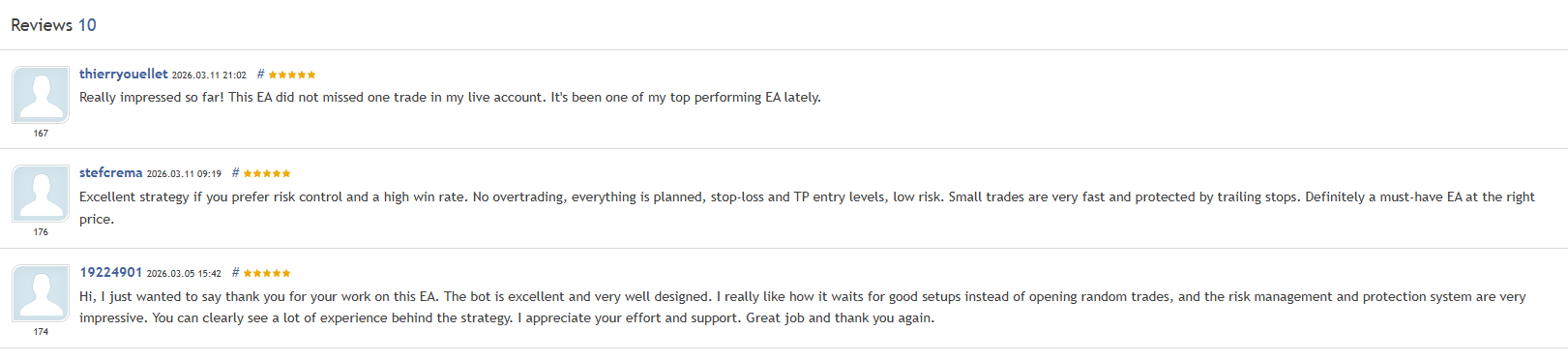
The early review base on the MQL5 listing is unanimously positive — and importantly, the substantive themes line up with the strategy’s design rather than reading as generic praise.
One buyer reported the EA didn’t miss a single trade on their live account and called it one of their top performing systems. Another specifically praised the risk control and high win rate, noting the absence of overtrading and the defined SL/TP on every position. A third described the EA as “excellent and very well designed” and highlighted that it “waits for good setups instead of opening random trades” — that an MQL5 buyer would specifically praise an EA for not trading is exactly the kind of feedback that validates the design philosophy.
Weight these as encouraging early impressions rather than long-term verdicts. The review base will mature over the coming months, and a fuller picture will emerge once buyers have run the system through different gold conditions.
The RAW Spread Requirement
One operational detail worth being explicit about: the developer states a RAW spread account is essential, not recommended. That word matters. A standard account with marked-up spreads will erode the tight M15 scalping margins the EA is built around — and may cause premature stop-loss hits as the system tries to exit positions on movements that should have been within tolerance.
Use Exness Raw, IC Markets Raw, Vantage, Fusion Markets, or a similar zero-markup ECN account. Equally important: set the Broker Type input correctly for your broker’s Gold pricing format (“Default” for 2-decimal pricing, “Exness” for 3-decimal). The wrong setting produces incorrect SL/TP distances and trailing stop behaviour.
Budget for a RAW account alongside the EA purchase. If you’re currently on a standard account, this matters enough to be worth switching before going live.
Where It Could Fall Short
Four weeks of live data isn’t enough. The backtest is impressive. The early signal is promising. But we’ve seen EAs look spectacular for their first month and then hit conditions that break them. The 5-layer validation should provide some protection against this, but “should” isn’t “proven.” Give it three to six months before treating the live results as established.
It’s slow. One to two trades per week on Mode 1. If you’re checking your EA every day expecting activity, TwisterPro will frustrate you. Long stretches of nothing followed by a burst of precision — that’s the rhythm. You need to be psychologically comfortable with an EA that earns its returns through inaction.
The headline PF will compress live. 20-plus in backtesting could easily normalise to 5-10 in live conditions once you factor in real execution, wider spreads during volatility, and edge cases the backtest didn’t encounter. Even at 5.0 live it would be exceptional — but don’t anchor on the backtest figure as what to expect from your account.
Small sample. 429 trades across multi-year data is a low-frequency strategy’s tradeoff: high selectivity means fewer data points to evaluate the strategy against. Read the backtest as a directional signal of the design’s effectiveness rather than a precise forecast.
Who TwisterPro Is For
It’s a fit if you:
- Value precision over frequency — a system that takes 1-2 trades a week and wins most of them
- Want the lowest possible exposure to losing streaks (max 2 consecutive losses in the backtest)
- Have access to a RAW spread account (Exness Raw, IC Markets Raw, Vantage, Fusion Markets, similar)
- Can leave the EA alone for days at a time without manually intervening
- Are comfortable evaluating a young live signal as a starting point rather than proof
Look elsewhere or wait if you:
- Need a multi-month proven live track record before buying — this signal is four weeks old
- Want frequent trading activity to monitor — Mode 1 averages 1-2 trades per week
- Trade only on a standard markup account and won’t switch to RAW — the EA’s edge depends on tight spreads
- Trade only on MT4 — this is MT5 only
- Anchor on the backtest’s headline numbers and would be disappointed by realistic live compression
Our Verdict
We rate TwisterPro Scalper 4 out of 5.
The architecture is the strongest part of the case. The 5-layer validation system is a real, observable design — not a marketing label — and the trade pattern in both the backtest and early live signal is consistent with what the developer describes: 1-2 trades per week, high win rate, very rare consecutive losses, defined SL and TP on every position, no martingale or grid recovery. The maximum-2-consecutive-losses metric across 429 trades is genuinely the standout finding, because it tells you the design is built primarily to prevent losing streaks rather than maximise wins.
The half-point we hold back reflects what’s honestly true for a young product. Four weeks of live data is not a track record. The headline backtest profit factor and Sharpe ratio will compress meaningfully in live conditions — the realistic forward expectation is a strong but more modest profile, not the headline figures. 429 trades across multi-year data is a smaller sample than ideal. And the developer doesn’t yet have the multi-year published track record that would let you lean on broader catalogue credibility.
The practical recommendation: if you have a RAW spread account and you’re comfortable with a low-frequency system, this is one of the more thoughtfully-designed Gold EAs available right now. Start at conservative sizing on demo or a small live account, run Mode 1 (the recommended configuration), and treat the first three to six months as evaluation rather than scaling. If the signal maintains its behaviour through that window, the rating goes up. Buying it through CheaperForex at a significant discount is the practical way to test a young system — you cap the cost of finding out how it behaves on your account.
How to Get TwisterPro Safely
Two legitimate sources, and only two.
The MQL5 marketplace — direct from Jorge Luiz Guimaraes De Araujo Dias’s developer page. Here is the official MT5 listing.
CheaperForex — the same EA at a significant discount versus the marketplace price. Here is the product page.
Anywhere else offering it free or via a Telegram seller is a trap — there’s no working cracked file, only malware or pay-and-vanish scams.
Frequently Asked Questions
Is TwisterPro Scalper legit, or a scam?
Legitimate. It’s a published MQL5 marketplace product with a public real-money live signal on Exness and an early review base accumulating from buyers. The scams in this space are the “free download” sites and Telegram sellers offering cracked copies that can’t exist. Buy from MQL5 or a reputable reseller.
Is a 20-plus profit factor realistic for live trading?
Almost certainly not at that exact level. Backtest PFs consistently compress in live conditions due to slippage, spread variations, and edge cases the test didn’t model. A live PF of 5-10 would still be exceptional and is a more realistic expectation. The early live signal is producing results consistent with a very high PF, but the sample is too small to calculate meaningfully.
What’s the difference between Mode 1 and Mode 2?
Mode 1 is the highest-assertiveness setting — fewest trades, strictest validation, and the mode the developer recommends. Mode 2 relaxes one of the validation criteria slightly for higher trade frequency, at the cost of some selectivity. The public live signal and the headline backtest both run Mode 1. Most buyers should start with Mode 1.
Why does it trade so rarely?
The 5-layer validation requires unanimous agreement before entry. Any single layer can veto a trade. This filters out the vast majority of potential setups — only the highest-conviction opportunities pass all five checks. The result is 1-2 trades per week on Mode 1, but with a backtest win rate above 86% and only two consecutive losses across the entire test.
How seriously should I take the 2.5% live drawdown figure?
As a four-week snapshot, not a forward forecast. The realistic live worst case will move closer to the backtest’s 18%+ equity drawdown over time as the system encounters more difficult market conditions. Size your account around the 15-20% figure rather than the early signal number.
Is TwisterPro prop firm compatible?
The architecture is prop-firm friendly: defined SL/TP on every trade, no grid, no martingale, low trade frequency (less exposure time), and tight live drawdown so far. Verify your specific firm’s rules on EA trading and on M15 scalping before committing capital, and size around the realistic 15-20% drawdown rather than the headline 2.5%.
Do I really need a RAW spread account?
Yes. The developer is explicit that RAW spread is essential, not recommended, and the EA’s M15 scalping margins are tight enough that markup spreads will erode the edge meaningfully. Use Exness Raw, IC Markets Raw, Vantage, Fusion Markets, or a similar zero-markup ECN account. Also set the Broker Type input correctly for your broker’s Gold pricing format.
Why buy from CheaperForex instead of MQL5?
The product is identical — same EA, same future updates from the developer. You pay significantly less. For a young product you’re going to demo and validate before scaling, paying less to test it is the practical move — you cap the cost of finding out whether the strategy suits your account.