Last updated: May 2026
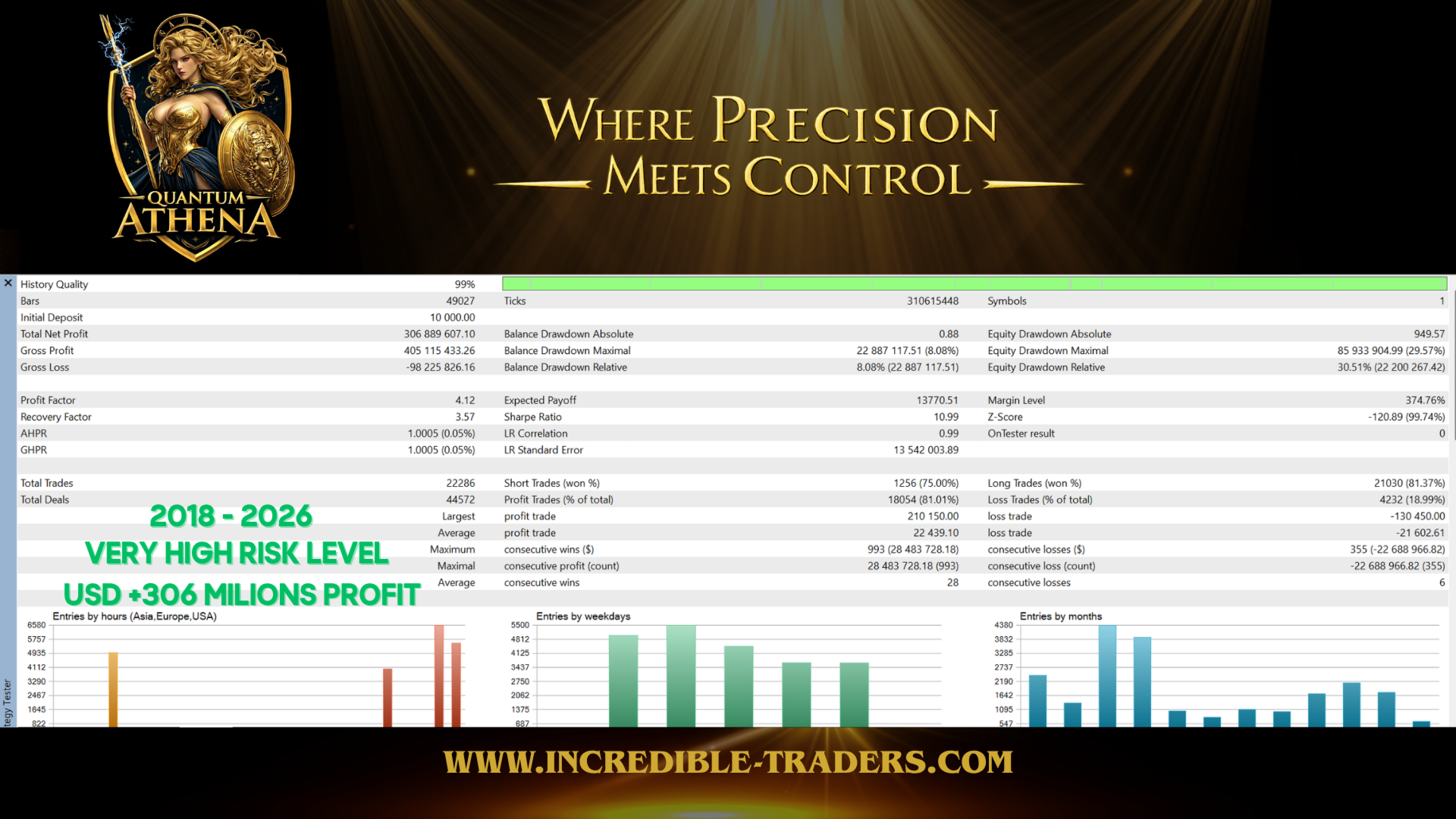
There’s one number on Quantum Athena’s eight-year backtest worth pausing over: a Linear Regression correlation of 0.99. Out of a maximum of 1.0. Across 22,286 simulated trades and eight years of XAUUSD data, the equity curve climbs in something that mathematics will accept as a straight line.
That’s the kind of result you should always look at twice — backtests, even good ones, are easier to engineer than live performance. So this review does what every honest review of a new EA should: takes the impressive headline seriously, but pulls it apart to see what’s actually inside.
Quantum Athena was published in April 2026 by Bogdan Ion Puscasu, the developer behind the wider Quantum series. It’s positioned as the lighter, current-conditions sibling of Quantum Queen — same grid architecture, less feature-layered, at a lower entry price. Below, we’ll cover what it actually does, how the backtest and live signal stand up to scrutiny, the broker question worth raising, what grid trading actually feels like on a real account, how it fits next to Queen and Valkyrie, and our verdict.
⚠️ Looking for a Quantum Athena “free download”? Don’t.
Every MQL5 marketplace EA ships with built-in DRM. There is no working cracked file in existence — so a “free” copy is always one of two things:
- malware, or
- bait for a Telegram payment scam where you pay and get nothing.
The only safe routes are the MQL5 marketplace or a reputable reseller. CheaperForex offers it at a significant discount versus the marketplace price — see the product page here.
The Developer: Bogdan Ion Puscasu

This is the part that genuinely matters for a young product like Athena. Bogdan Ion Puscasu has one of the largest established catalogues on the MQL5 marketplace — Quantum Emperor, Quantum Queen, Quantum King, Quantum StarMan, Quantum Baron, and Quantum Valkyrie sit alongside Athena, and between them carry a combined review count and rating well above what most marketplace developers can show.
That matters because Athena itself is too new to judge on its own user reviews — it launched in April 2026 and direct buyer feedback hasn’t yet accumulated. What you’re really buying into is the track record of the catalogue. The credibility transfer isn’t blanket — a new product can still underperform — but it’s a meaningfully different starting position from buying a debut release by an unknown seller, where you have nothing but the marketing to go on.
Treat Bogdan’s record as the floor of trust for Athena. Then judge the EA’s own data on its merits, which is what the next sections do.
How the Grid Actually Works
Athena is a structured grid system on XAUUSD. The mechanic is straightforward enough that it’s worth being plain about it, because it tells you what you can and can’t expect.
The EA opens an initial Gold position. If price moves against the entry, additional positions are added at calculated intervals, building a progressively better average entry. When price reverts — which Gold statistically tends to do — the whole basket closes profitably as the average crosses back through. Most of the time this resolves quickly, which is why the trade-level win rate looks high. Occasionally, price extends against the grid for longer, and floating drawdown builds while the system waits for the reversion.
That last sentence is the most important one in this review. Grid trading isn’t a high-win-rate strategy that occasionally has a bad day. It’s a system that’s structurally designed to sit through adverse runs and let mean reversion do its work. The high win rate isn’t the edge — it’s a side-effect of the closing mechanic. The actual edge is statistical: most adverse runs end before margin does.
To Athena’s credit, the developer has been explicit that there is no martingale-style lot multiplication, and that the grid is “managed” rather than open-ended. That’s a real distinction from the blow-up-prone grid EAs that flood the marketplace. But “managed grid” still means floating drawdown, and you need to be honest with yourself about whether you can sit through that without intervening.
The 0.99 LR Backtest — Examined Critically

Headline numbers from the developer’s eight-year XAUUSD backtest: a 4.12 profit factor, a Sharpe ratio of 10.99, an 81% win rate across 22,286 trades, and the much-quoted 0.99 Linear Regression correlation. By every standard backtest metric, this is exceptional.
The 0.99 LR is the one that gets repeated most, so let’s be precise about what it does and doesn’t mean. LR correlation measures how closely the equity curve fits a straight line. 0.99 means the climb is near-mathematically linear across the test — not lumpy, not concentrated in a few favourable stretches. As evidence that the strategy didn’t accidentally curve-fit to one stretch of Gold’s history, it’s genuinely impressive.
Now the caveats, because every backtest has them and pretending otherwise is dishonest.
A backtest is a simulation, not a record. An eight-year tester run reflects how the strategy would have behaved on historical Gold data under tester-grade execution assumptions. Real fills, spreads, slippage, and broker quirks always differ from the simulation. A Sharpe of 10.99 in a tester translates to a far lower Sharpe live — that’s not a flaw of this EA specifically, it’s a flaw of every backtest.
The headline dollar figure is compounding noise. Backtest “net profit” on a Very High Risk grid over eight years can be any number you want it to be, depending on the starting balance and risk level chosen. That number tells you almost nothing about expected return; the ratios (profit factor, Sharpe) are more honest.
The drawdown figures shown in the tester are best-case. An 8% balance drawdown on Very High Risk looks reassuring — but the equity drawdown is much higher (close to 30%), and equity is what matters because it includes floating losses while the grid is open. Read the equity number, not the balance one.
The 0.99 LR is a strong piece of evidence. It is not proof. Take it as a sign the underlying logic is structurally robust across history, then look at what’s happening on real money — which is the next section.
The Live Signal — And the Broker Question

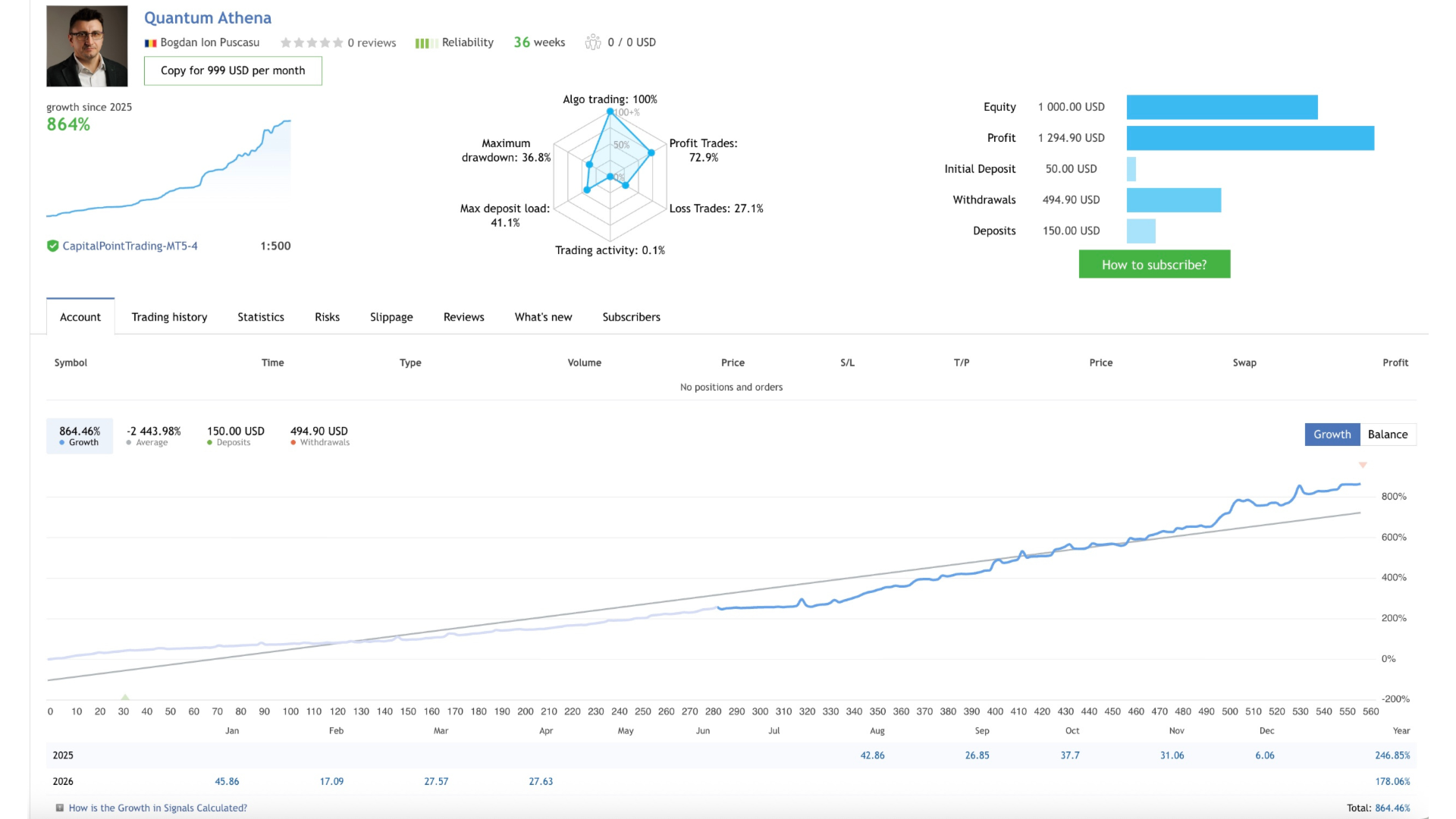
The live signal is the more important evidence, because backtests can be polished and live trading can’t. Several things on it work in Athena’s favour: it’s been running since August 2025 (long enough to span multiple Gold regimes), every month has been profitable, and the developer has actually withdrawn profits — withdrawals matter, because they prove the money is real and not just paper equity.
Three honest caveats balance the picture.
The broker is Capital Point Trading. This is the biggest reservation we have. Capital Point Trading isn’t a top-tier ECN broker — it’s a smaller, less-known house, and a system’s headline numbers on a venue like that aren’t guaranteed to translate to a more transparent, tighter-execution broker. We’d want to see the signal replicated on something like IC Markets, Pepperstone, or FP Markets before treating the return profile as broker-independent. The advice is straightforward: don’t run Athena where the signal runs. Run it on a reputable ECN/RAW broker you’d trust with your own money on any other system, and expect a more modest version of the signal’s behaviour.
The signal uses an aggressive risk setting. The headline return reflects a Very High Risk configuration, which the developer flags openly. The drawdown that came with it (in the mid-30s percent at the worst point) is the price tag attached. Most buyers shouldn’t run that setting on a real account — start conservative, see how it behaves on your broker, and only step up once it’s earned it. The lower risk levels exist precisely for this.
It’s a young live signal in an unusual stretch of Gold. Roughly nine months of live data through a generally favourable Gold environment is a positive start, but it hasn’t yet been tested across a sustained hostile period for the strategy. A future drawdown could be worse than anything on the chart so far — that’s not pessimism, it’s what “young signal” means.
The Grid Drawdown Reality You Need to Hear
This section exists because grid trading punishes the same buyer behaviour over and over: people see floating drawdown, panic, close the positions manually, and lock in the loss the grid would have closed for profit.
If you can’t watch a meaningful chunk of your equity sit in floating drawdown without touching it, Athena is not for you. That isn’t a criticism of Athena — it’s the price of how grid systems produce their returns. The basket needs to remain intact to close on reversion. If you close it early, you destroy the recovery mechanism.
The honest test before you buy: imagine your account 25% down on floating drawdown, with the EA open and waiting. Can you leave it alone? If yes, the strategy fits your temperament. If you’d close it, look at Quantum Valkyrie instead — same developer, fixed stop loss and take profit on every trade, no grid mechanics, defined risk per position.
Conservative risk settings reduce both the returns and the drawdowns proportionally — they don’t eliminate floating drawdown, but they shrink it to something more buyers can sit through. Start there.
Athena vs Queen vs Valkyrie
If you’re choosing inside Bogdan’s Gold range, the three relevant products are different products, not different prices for the same thing.
Quantum Queen is the full-featured Gold-grid flagship. It carries the longest live track record, the most user reviews, and the broadest set of configuration options. It’s the right choice if you want the established Quantum Gold system with the most public data behind it.
Quantum Athena (this product) is the lighter, current-conditions sibling. Same grid engine, fewer feature layers, lower entry price. It’s the right choice if you want into the Quantum Gold ecosystem at a cheaper level, or if you already own Queen and want a related variant running on a separate account.
Quantum Valkyrie is the non-grid alternative. Fixed stop loss and take profit per trade, no floating drawdown of the grid type, suitable for prop-firm challenges where grid trading is prohibited. It’s the right choice if grid mechanics aren’t compatible with your temperament or your account constraints.
Athena and Queen aren’t redundant — buyers who own both typically run them on separate accounts. Athena and Valkyrie aren’t competing products either: they’re solving the same Gold problem with different risk shapes.
Who Quantum Athena Is For
It’s a good fit if you:
- Want a Gold-only system from a developer with an established catalogue rather than a debut seller
- Understand grid mechanics and can sit through floating drawdown without intervening
- Will run it on your own reputable ECN/RAW broker — not blindly mirror the signal’s broker
- Start at a conservative risk setting and validate before scaling
- Already own Quantum Queen and want a complementary sibling on a separate account
Look elsewhere if you:
- Can’t tolerate floating drawdown — try Quantum Valkyrie from the same developer instead
- Want the longest possible live track record before committing — Queen has more public history
- Run prop-firm challenges where grid trading is typically prohibited
- Trade only on MT4 — this is MT5 only
Our Verdict
We rate Quantum Athena 4.5 out of 5.
The strengths are real. It comes from a developer with one of the largest established catalogues on the MQL5 marketplace, which is the right starting credibility for a new product. The strategy is a managed grid with no martingale-style lot multiplication. The eight-year backtest produces unusually linear results that suggest a structurally robust strategy across history. And the live signal is real money, with monthly profitability and actual withdrawals — which is more than most new EAs offer.
The half-point we hold back reflects three things, all worth knowing before buying. The live signal runs on Capital Point Trading rather than a top-tier ECN broker we’d be confident extrapolates to other venues. The aggressive risk setting on the signal produced drawdowns most buyers shouldn’t replicate — and Athena’s quieter risk levels haven’t yet built their own equivalent track record. And, for all the catalogue credibility, the product itself is still young enough that the live history is short.
If you understand grid mechanics, accept the floating-drawdown nature of the strategy, run it conservatively on your own reputable ECN broker, and treat the live signal as a promising signal rather than a forward guarantee, Athena is a credible buy. And because it’s a new product still proving itself, paying significantly less for it through CheaperForex is the sensible way to take the position — you cap the cost of finding out how it behaves on your account, and the EA, the licence, and the updates are identical to the marketplace product.
How to Get Quantum Athena Safely
Two legitimate sources, and only two.
The MQL5 marketplace — direct from Bogdan Ion Puscasu’s developer page. Here is the official MT5 listing.
CheaperForex — the same EA, the same MQL5 activation, at a significant discount versus the marketplace price. Here is the product page.
Anywhere else offering it free, or via a Telegram seller undercutting both sources, is a trap. A marketplace EA can’t be cracked, so those files are malware or pay-and-vanish scams.
Frequently Asked Questions
Is Quantum Athena legit, or a scam?
Legitimate — it’s a published MQL5 marketplace product from one of the largest established developers on the platform, with a public real-money live signal. The scams in this space are the “free download” sites and Telegram sellers offering cracked copies that can’t exist. Buy from MQL5 or a reputable reseller and you’re fine.
Does the 0.99 LR backtest really mean what it sounds like?
It means the eight-year equity curve is statistically near-linear across the test period — strong evidence that the strategy isn’t curve-fit to one favourable stretch. It is not, by itself, proof that future returns will look the same. Read it as a structural quality signal, not a forecast.
How seriously should I take the live signal?
Seriously, but with three honest caveats: it runs on Capital Point Trading rather than a top-tier ECN broker, it uses an aggressive Very High Risk setting that most buyers shouldn’t replicate, and roughly nine months of live data hasn’t yet been tested across a sustained hostile period. The withdrawals on the signal are a real positive — they prove the profits are real money, not paper equity.
What broker should I actually run it on?
A reputable ECN or RAW broker that you’d trust with any other system — IC Markets, Pepperstone, FP Markets, or similar. We’d specifically recommend against simply mirroring the signal’s broker without thinking, since results on a less-known broker don’t guarantee results on a top-tier ECN.
What’s the realistic drawdown on a real account?
Depends entirely on your risk level. The signal’s aggressive setting produced floating drawdowns in the mid-30s of percent at the worst point. Conservative settings reduce both the return and the drawdown proportionally. Plan around the equity drawdown (which includes floating losses), not the balance drawdown.
Should I get Athena or Quantum Queen?
Queen is the full-featured Gold-grid flagship with the longest public live history; Athena is the lighter sibling at a lower entry price using the same engine, with less feature surface. Existing Queen owners often run both on separate accounts. New Quantum buyers can use Athena as a cheaper way into the ecosystem. They’re complementary rather than substitutes.
What if I can’t handle the grid drawdown psychologically?
Look at Quantum Valkyrie from the same developer — fixed stop loss and take profit on every trade, no grid mechanics, defined per-trade risk. It’s also the right choice for prop-firm challenges where grid trading is typically prohibited.
Why is the CheaperForex price so much lower than MQL5?
Bulk licence volume. We buy MQL5 marketplace licences in volume and pass the wholesale discount on — the EA, the licence, the future updates, and the standard MQL5 support channel are identical to a direct marketplace purchase. The price is lower simply because the unit cost to us is lower.