
Last updated: May 2026
Waka Waka is one of the longest-running grid systems on the MQL5 marketplace. First launched in 2018 and continuously developed through to version 4.59 (February 2026), it’s the EA that established Valeriia Mishchenko as one of MQL5’s most active grid developers. The premise is straightforward: AUDCAD, AUDNZD, and NZDCAD are commodity-driven currency crosses that share strong mean-reversion tendencies. Apply Bollinger Bands to identify volatility extremes, RSI to confirm sufficient momentum for a reversal, and a controlled grid to manage positions when the initial entry moves against you — and you have a strategy that aligns with how these specific pairs actually behave.
View product details and current pricing.
The track record is unusually transparent. Nearly 100 combined MQL5 reviews across the MT4 (48 reviews at 4.25★) and MT5 (44 reviews at 4.13★) versions. A verified live signal on MQL5 Signals tracked for 402 weeks — over 7 years of public broker-confirmed trade data. Over 20,000 demo downloads of the MT5 version alone. Continuous version iteration through version 4.59 with active developer engagement on the comments section. By the standards of the MQL5 marketplace where most products fade within 6-12 months of launch, Waka Waka’s longevity is remarkable.
The honest concerns are equally well-documented. The same verified live signal that shows a 74.39% win rate across 5,156 trades also shows a 72.42% maximum equity drawdown. Multiple users have documented severe drawdown events in their reviews, including some who reported account wipes on higher-risk preset configurations. MQL5’s automated system flags the signal with a “large drawdown may occur again” warning. The developer herself addresses these events publicly rather than hiding them. This review covers what Waka Waka actually does, what the data really shows, and whether the strategy is appropriate for your specific risk profile — on either MT4 or MT5.
⚠️ Searching for Waka Waka EA free download? Waka Waka is an MQL5 marketplace product with built-in DRM. Cracked .ex4 / .ex5 files do not exist for marketplace EAs — sites offering “free downloads” deliver malware or non-functional files leading to Telegram payment scams. The EA also requires WebRequest access to external news and time servers for full functionality, which cracked copies cannot maintain. CheaperForex offers Waka Waka at a significant discount with the full unlocked file — MT4 version here | MT5 version here.
Why Grid Trading Actually Makes Sense on AUD/NZD Crosses
Most grid systems fail because they’re applied to the wrong markets. Grid strategies depend fundamentally on mean reversion — the assumption that price will eventually move back toward its average rather than continuing indefinitely in one direction. On strongly trending pairs like GBPJPY or trending instruments like Gold during a clear bull cycle, grids accumulate losses faster than they can resolve them, and accounts get destroyed.
AUDCAD, AUDNZD, and NZDCAD are different. Australia, New Zealand, and Canada all run commodity-export-driven economies with broadly similar central bank policies and similar exposure to global commodity demand cycles. When AUD strengthens against the USD on commodity news, NZD and CAD typically strengthen at correlated rates. The cross pairs between these currencies therefore tend to range rather than trend over multi-month timeframes — exactly the conditions where grid strategies have a structural edge.
This is the foundational insight that gives Waka Waka a legitimate strategic basis rather than just being another grid-on-anything product. The developer didn’t choose these three pairs arbitrarily — they were specifically selected because their mean-reversion character matches what grid mechanics require to work. When users on the MQL5 reviews praise the EA for “consistent monthly returns” and “stable profits,” they’re seeing the strategy working in the market conditions it was designed for. When other users report severe drawdowns during 2023-2024, they’re seeing what happens when even these range-bound pairs experience unusual trending periods that extend beyond historical norms.
MT4 vs MT5 — Which Version Should You Buy?
Waka Waka is available for both MetaTrader 4 and MetaTrader 5. They’re separate products on the MQL5 marketplace, each with its own review history. The trading logic is identical between platforms — same Bollinger Bands entry signals, same RSI filtering, same grid mechanics, same weighted take-profit, same maximum drawdown safety net.
The MT4 version offers:
- 48 verified MQL5 reviews at 4.25★ — slightly higher average rating
- Mature platform with broader broker support across legacy MT4 brokers
- Compatibility with the wider MQL4 EA ecosystem if you run other MT4 products
- Lower system resource usage on older hardware/VPS configurations
- Published earlier (2021) with longer accumulated marketplace presence
The MT5 version offers:
- 44 verified MQL5 reviews at 4.13★ with 20,891 demo downloads
- Faster execution speed and lower latency on the modern platform
- Superior backtesting infrastructure (multi-currency, depth-of-market)
- Native multi-currency hedging support
- Better integration with modern broker MT5 infrastructure
The combined picture: 92+ verified buyer reviews across both platforms. The slight rating difference (4.25★ MT4 vs 4.13★ MT5) reflects the older MT4 listing accumulating positive reviews over a longer period when the strategy was performing strongly, while the MT5 reviews include more recent buyer feedback from periods that have included the documented drawdown events.
Our recommendation:
- Choose MT5 if you’re starting fresh, your broker offers competitive MT5 conditions, you want native platform performance, or you plan to backtest extensively before live deployment.
- Choose MT4 if you’re already running other MT4 EAs you want to keep alongside, your preferred broker only offers MT4, or you specifically prefer the MT4 ecosystem.
Both versions trade exactly the same way and produce equivalent live results. Choose based on your broker setup and platform ecosystem fit, not on the assumption one platform is inherently superior for this specific strategy.
How Waka Waka Trades — The Strategy in Detail
Entry — Bollinger Bands: Bollinger Bands measure how far current price has moved from its moving average, scaled by volatility. When price touches or breaks beyond the upper or lower band, it indicates the move is statistically extreme relative to recent behaviour. On range-bound pairs like AUD/NZD crosses, these extremes typically resolve through mean reversion. Waka Waka prepares to enter in the opposite direction of the overextension — sell signals at upper band touches, buy signals at lower band touches, anticipating a return toward the centre.
Filter — RSI: Before any trade actually opens, the Relative Strength Index confirms that momentum is consistent with a near-term reversal. The Maximum RSI Value parameter rejects entries where momentum readings suggest the move may still have legs. This filter is what separates Waka Waka from generic Bollinger Band crossover EAs — it prevents the grid from activating during strong trending conditions where mean reversion is less likely to occur promptly.
The Grid Mechanism: When both Bollinger Bands and RSI confirm, Waka Waka opens an initial trade. If price continues against the position, additional grid trades activate at intervals controlled by the Trade Distance setting. Smart Distance mode automatically adjusts spacing based on current market volatility — wider gaps during volatile conditions to avoid grid overload, tighter spacing during calm periods to capture mean reversion more efficiently. Lot multipliers are configurable for the 2nd trade, the 3rd-5th trades, and the 6th-plus trades — letting users tune position sizing escalation to their risk tolerance.
Take-Profit — Weighted: This is one of Waka Waka’s distinguishing features. When weighted TP is enabled, the take-profit target is calculated in dollars rather than pips. The dollar target stays constant regardless of how many grid levels are open. As positions accumulate during deep grids, the equivalent TP in pips decreases — meaning price doesn’t have to recover all the way to the original entry for the basket to close in profit. This significantly improves close probability during deep grid extensions, though it does not eliminate the fundamental drawdown risk of holding multiple losing positions while waiting for reversal.
Safety Net — Maximum Drawdown Percent: The configurable max drawdown threshold triggers automatic closure of all open positions if floating drawdown exceeds the user’s defined limit. This is the hard stop against catastrophic grid extension — at the cost of locking in significant losses if breached. Users on conservative settings often configure this between 30-50%; more aggressive deployments push it higher but accept correspondingly higher account-wipe risk.
The 402-Week Live Signal — The Full Picture
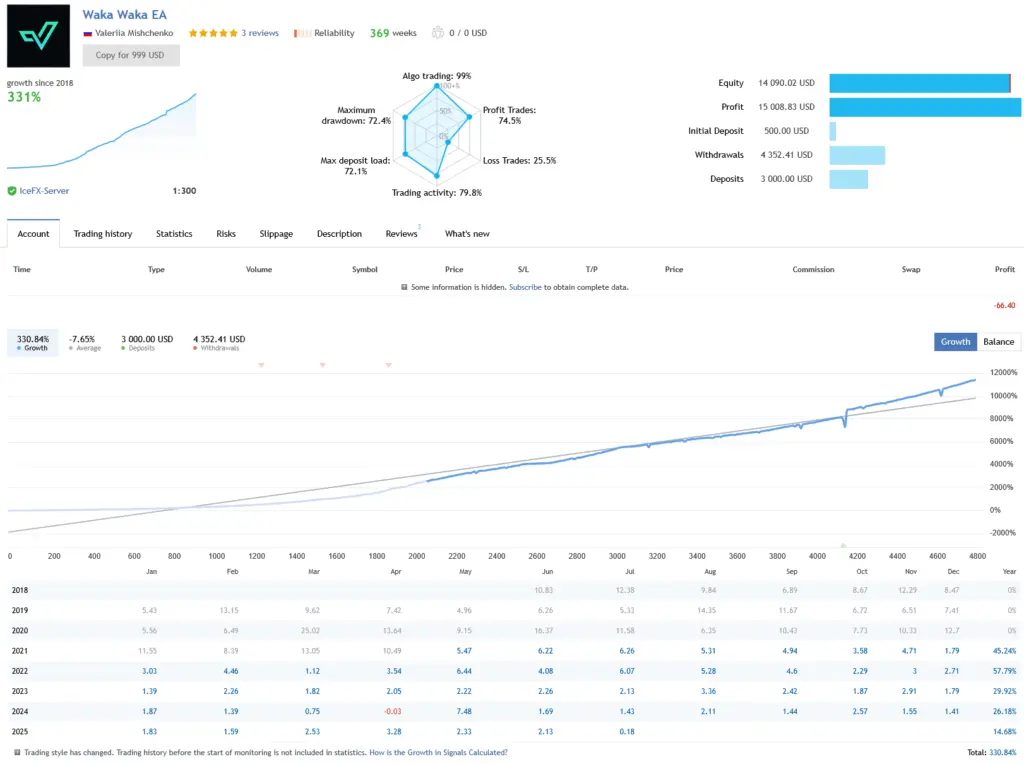
The Waka Waka EA verified live signal (#995287) is one of the longest-running grid signals on MQL5 Signals — 402 weeks of public, broker-confirmed trade data on IC Markets at 1:300 leverage:
The strong numbers:
- Total Trades: 5,156
- Win Rate: 74.39%
- Trades Per Week: 15
- Trading Activity: 79.83%
- Average Holding Time: 1 day
- Maximum Consecutive Wins: 31
- Initial Deposit: $500 with $3,000 in additional deposits over time
- Total Profit: $15,897
- Withdrawals: $4,352 in realised profits already withdrawn
- Current Balance: $15,045
The numbers that demand attention:
- Maximum Drawdown by Balance: 13.88%
- Maximum Drawdown by Equity: 72.42%
- MQL5 Warning Active: “A large drawdown may occur again”
- Maximum Consecutive Losses: 7 trades
Reading the drawdown numbers correctly:
The 13.88% balance drawdown sounds reasonable. The 72.42% equity drawdown is the number that matters. The difference is the difference between realised losses (balance drawdown) and unrealised floating losses (equity drawdown) — and for a grid system, the unrealised losses while waiting for mean reversion is where the real risk lives. During the worst period of the signal’s history, someone watching the account in real-time would have seen the equity column drop to approximately 28% of its peak. The position eventually resolved and the strategy recovered — but a human watching that drawdown happen in real-time would have experienced very serious psychological pressure to liquidate, and that pressure is exactly when traders make decisions that turn temporary drawdowns into permanent losses.
How users have actually responded to the drawdown events:
This is publicly documented in the MQL5 review history. During the major drawdown period in 2023-2024, multiple users posted reviews describing their experiences:
Fanilo Andriamihari Raveloson — March 2024 (1-star)
“Warning: It uses grid + martingale logic. Many customers already lost their accounts and it happens recently (March 2024) for some customers. Historical drawdown of 50% has been reached recently on the developer account. Don’t be misleaded by official signal performance. Do not expect the same return as it involves taking suicidal level of risk that the developer herself does not take anymore. If you dare to trade this EA only use the minimum risk settings.”
M Arul James — February 2023 with later update
“USE THIS EA ONLY WITH LOW RISK SETTINGS. This is the #1 EA what I have in my collection. It never ended a day with loss till now. Update: Account with High risk was washed out (AUDCAD from 2023-06-12 to 2023-06-23). Account with Significant risk was washed out. Account with Low risk was still running with 52% DD.”
These reviews are real and they matter. The story they tell is consistent: users on low-risk settings survived the 2023-2024 drawdown period with significant but recoverable losses. Users on higher-risk preset configurations experienced full account loss within weeks. The developer’s published guidance to use low-risk settings isn’t conservative marketing — it’s the difference between a difficult drawdown to ride out and a wiped account.
How the developer has responded:
Valeriia Mishchenko responds personally to negative reviews on the MQL5 listing rather than ignoring them. Her responses consistently emphasise that proper Money Management and Risk Management settings make full account loss “nearly impossible.” She acknowledges that she added 30% capital to her own signal account during the worst drawdown period to avoid full equity wipeout — a transparent admission that became a frequent criticism. The developer engagement is unusually direct for the MQL5 marketplace where most developers ignore criticism. Whether you find her responses adequate depends on whether you accept that grid strategies fundamentally require active risk management rather than set-and-forget deployment.
Multi-Currency Backtest Performance
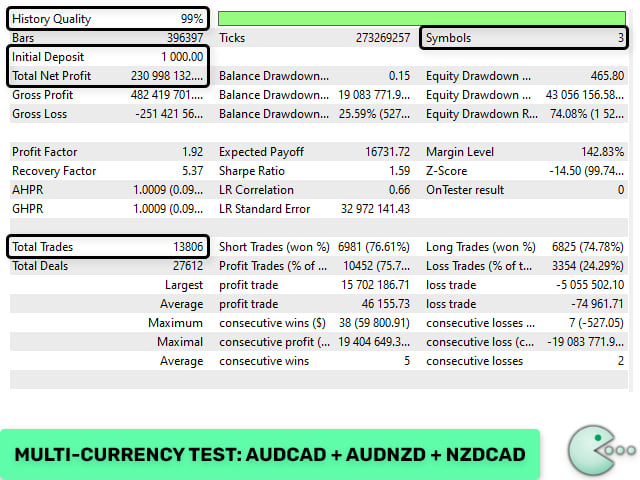
The developer’s published backtest covers 15 years of historical data across all three supported pairs:
- Period: 2006-2021 (15 years)
- Pairs: AUDCAD + AUDNZD + NZDCAD combined
- Total Net Profit: $230,998,132 (variable-lot compounding from initial capital)
- Profit Factor: 1.92
How to interpret these numbers responsibly:
The $230M figure is the result of variable-lot compounding over 15 years. The starting account compounds aggressively as profits accumulate, scaling position sizes proportionally. Real-world deployment with conservative lot sizing and periodic withdrawals produces dramatically smaller absolute dollar returns. The verified live signal’s $15,897 profit on $3,500 total deposits over 7 years is a far more meaningful forward expectation than the backtest’s nine-figure result.
The 1.92 profit factor is the more meaningful metric — it tells us that across 15 years of backtested data, total profits were roughly twice total losses. This is consistent with grid trading performance patterns: many small wins from successful mean-reversion closures, occasional larger losses when grids extend deeply, and overall net positive expectancy when the strategy is applied to its target market conditions. Profit factor consistency between backtest (1.92) and live performance is what gives the strategy genuine credibility — overfit backtests typically show profit factors of 3+ that don’t survive live deployment.
What 92+ MQL5 Reviewers Actually Report
Combined across the MT4 and MT5 versions, Waka Waka has accumulated 92+ verified MQL5 reviews. The 4.25★ on MT4 (48 reviews) and 4.13★ on MT5 (44 reviews) are realistic, honest ratings — neither is a perfect 5.0, and the patterns of positive and negative reviews tell a consistent story about who succeeds and who fails with this EA.
Recurring themes in positive reviews:
- Consistent monthly returns for patient users on low-risk settings — multiple reviewers report 2-4% monthly returns over 6+ month deployment periods
- Backtest performance closely matches live trading — repeatedly cited as a sign of genuine strategy design rather than overfitting
- Exceptional developer support and engagement — Valeriia personally responds to MQL5 comments and provides risk management guidance
- One-chart setup makes deployment minimal — no per-pair configuration, no .set files to manage
- Transparency about grid mechanics — the developer doesn’t pretend it’s “not a grid” or hide the position accumulation logic
Recurring themes in negative reviews:
- Higher-risk preset configurations have produced documented account wipes — specifically during the 2023-2024 AUD/NZD trending periods
- The 70%+ drawdown events are real and severe — users on medium risk have reported 52% equity drawdowns; users on higher risk have reported full account loss
- Performance has been less consistent in 2024-2025 compared to the 2021-2022 strong period — some reviewers report deteriorated returns
- The “grid + martingale” criticism is fair — while the developer markets it differently, the underlying mechanics do involve adding to losing positions with increasing lot sizes
One particularly substantive positive review from a long-term user:
Casper — April 2023 (5-star)
“I have tried several EAs, but none remotely compares to this. After much consideration and backtesting, I chipped in and bought it. This EA can be a life changer if you use it correctly. It definitely has for me since I no longer have to worry about the ups and downs in the stock market and the volatility that comes with most investments. Here I have a stable and steady income. It is a grid-based EA, but since it is made cleverly and has many security measures built into it, I don’t consider it riskier than other EAs.”
And a representative critical review:
saroq — Updated March 2024
“For all of the updates it is a simple and inflexible grid martingale system. The touted Machine Learning achieves nothing towards making this EA safer. To give my accounts some measure of safety I can only run the Waka Waka EA on low risk. On this risk setting my drawdown is about 20%. The annual returns that my low risk settings will generate for the year is a pitiful 8.1%.”
Both reviews are honest and both deserve to be taken seriously. They describe genuinely different deployment experiences, and the difference comes down to risk settings, capital allocation, market conditions during the specific deployment window, and individual tolerance for drawdown. The strategy works for some users and fails for others — that’s the honest summary, and any review that pretends otherwise is misleading.
The Developer: Valeriia Mishchenko’s Full Portfolio
Valeriia Mishchenko has been developing algorithmic trading systems for over a decade and is one of the most active developers on the MQL5 marketplace. Waka Waka is her longest-running product — first launched in 2018, published on MQL5 in 2021, and continuously developed through to version 4.59 in February 2026. Four years of active maintenance and version iteration on the marketplace, with 92+ verified buyer reviews across both platforms.
The developer engagement is unusually direct. She responds personally to MQL5 review comments — both positive and negative — and addresses risk management criticism head-on rather than ignoring it. When users have posted concerns about drawdown events, her responses have acknowledged the events and emphasised that proper Money Management and Risk Management settings are essential. She has publicly disclosed adding capital to her own live signal during severe drawdown periods — a transparency choice that became a criticism in itself but represents the kind of honest disclosure most EA developers avoid.
What distinguishes Valeriia from most MQL5 developers is the focused, coherent nature of her portfolio. Instead of releasing dozens of throwaway products, she has built a small lineup of EAs that each target a distinct market or strategy variation — and continues to actively maintain all of them. Here’s the full lineup, available through CheaperForex on both MT4 and MT5:
🛡️ Sentinel AI EA (Newest Release)
Available for both MT4 and MT5. The newest addition to the Valeriia Mishchenko portfolio. AI-filtered grid system for EURUSD and GBPUSD on M5 timeframe, designed to identify trend reversals and exploit market inefficiencies with greater accuracy than traditional grid systems. The standout claim: a verified live signal showing no losing months since August 2019 with approximately 2.04% monthly gain. Built on the same grid foundations as Waka Waka but with significantly more selective entry filtering — Sentinel AI pauses trading entirely during high-risk market phases, which is why it sometimes goes weeks without taking trades. If you like the Waka Waka methodology but want stricter entry discipline, this is the natural evolution.
🤖 Perceptrader AI
Available for both MT4 and MT5. The direct AI-enhanced evolution of Waka Waka. Trades 6 pairs (NZDUSD, USDCAD, AUDNZD, AUDCAD, NZDCAD, GBPCHF) on M5 timeframe with a 48-month verified live track record. Uses a Perceptron neural network to filter entries before the grid activates — addressing the core weakness of grid systems by avoiding setups where mean reversion is unlikely. Live signal stats: ~318% growth, ~17.9% max drawdown, ~65.7% win rate, ~55% trading activity. Significantly lower drawdown profile than Waka Waka because the AI filter reduces the frequency of deep grid extensions. If the 72% Waka Waka drawdown concerns you, Perceptrader AI is the upgrade path.
⛏️ Golden Pickaxe
Available for both MT4 and MT5. The mean-reversion grid system specifically built for XAUUSD (Gold). Same grid principles as Waka Waka but applied to Gold, which has very different market characteristics. Five predefined set files cover different risk profiles. Note: Gold’s strongly trending behaviour in 2024-2025 caused significant drawdowns on Golden Pickaxe (the developer issued a spread filter overhaul update in early 2026 to address Gold market structure changes). If you want grid exposure to Gold rather than AUD/NZD crosses, this is the dedicated product — but be aware Gold trends harder than commodity crosses, so risk management is even more critical.
🌙 Night Hunter Pro
Available for both MT4 and MT5. The non-grid alternative in Valeriia’s portfolio. Advanced scalping system that identifies safe entry points during calm market periods (typically overnight hours when major sessions are closed). Different methodology to Waka Waka entirely — uses pending orders with strict stop-losses on every trade rather than grid accumulation. Lower drawdown profile by design, prop-firm friendly, FIFO compatible. If you specifically want to avoid grid mechanics but stay with the same developer, this is the product.
🌇 Evening Scalper Pro
Available for MT4. Mean-reversion strategy on cross pairs during the American trading session (19:00-23:00 server time). High profit targets on each trade, no holding through the rollover window (0:00-1:00). Different time-of-day window than Night Hunter Pro, different methodology than Waka Waka. Useful for portfolio diversification if you want non-overlapping trading hours.
📰 News Catcher Pro
Available for both MT4 and MT5. Mean-reversion strategy that exploits intraday seasonal volatility patterns caused by high-impact news events. Trades GBPUSD, EURUSD, and EURGBP on M5 timeframe. Does NOT trade frequently — it enters the market shortly before specific high-impact news events occur. FIFO compatible. Different again from the other portfolio products — useful as a low-frequency add-on rather than a primary system.
The strategy’s 4+ year continuous update history through to version 4.59 demonstrates that Waka Waka is an actively maintained product rather than a launch-and-fade marketplace listing. The MQL5 marketplace contains many EAs that received heavy marketing at launch and then went silent within months as the developer moved to new products. Valeriia Mishchenko’s continued iteration across her entire portfolio — including Waka Waka — suggests she is genuinely engaged with her products and users.
Who Should Buy Waka Waka
Buy Waka Waka if you:
- Specifically want to trade AUD/NZD commodity cross pairs and understand the mean-reversion thesis
- Have at least $1,000 with 1:100 leverage or $6,000+ with 1:30 leverage
- Use hedging-enabled MT4 or MT5 accounts (required for the grid mechanics)
- Are psychologically and financially prepared for 50%+ equity drawdown periods
- Plan to use low-risk preset configurations consistently rather than chasing higher returns
- Can deploy a 24/5 VPS for continuous operation
- Want a strategy with 7+ years of verified public live signal history
- Are willing to demo-test for 4-8 weeks minimum before live deployment
Consider these alternatives from the same developer if you:
- Cannot tolerate 50%+ equity drawdown periods — try Perceptrader AI with its AI entry filtering (~17.9% historical max DD) or Sentinel AI with stricter entry discipline
- Want a non-grid strategy — Night Hunter Pro uses pending orders with strict stop-losses instead
- Trade primarily Gold — Golden Pickaxe applies the grid methodology specifically to XAUUSD
- Want session-specific trading — Evening Scalper Pro trades only during the American session
- Want event-driven trading — News Catcher Pro trades around high-impact news events
Where to Download Waka Waka Legitimately
Two sources, and only two:
MQL5 Marketplace — direct purchase from Valeriia Mishchenko’s developer page. MT4 listing | MT5 listing. Activation count limited.
CheaperForex — significant discount on the MQL5 price with the full unlocked file delivered. Same EA, free lifetime updates, plus a 7-day money-back guarantee before activation and an extra 20% discount for crypto payments. MT4 version | MT5 version.
Anywhere else claiming to offer Waka Waka — for free, at suspiciously discounted prices, via Telegram payment scams, via cracked .ex4/.ex5 files — should be treated as fraudulent. The MQL5 DRM cannot be cracked, and the EA’s WebRequest-based news and time server access cannot function in cracked copies.
Installation and Setup Notes
Step 1: Delivery. If you bought from MQL5, the EA appears automatically in your MT4/MT5 Navigator under Market. If you bought from CheaperForex, you receive the full unlocked .ex4 or .ex5 file directly — copy it into your platform’s MQL4/Experts (or MQL5/Experts) folder, restart the terminal, and the EA appears in your Navigator under Expert Advisors.
Step 2: Open an AUDCAD M15 chart. This is the only chart Waka Waka needs — it trades AUDCAD, AUDNZD, and NZDCAD automatically from this single chart attachment.
Step 3: Verify your account type. Waka Waka requires a hedging-enabled account. On MT5 specifically, check that your account is “Hedging” rather than “Netting” — netting accounts cannot run the EA. Most ECN brokers offer hedging by default; ask broker support if uncertain.
Step 4: Add required URLs to your terminal’s allowed list. The EA needs WebRequest access to external news and time servers. In MT4/MT5, navigate to Tools → Options → Expert Advisors → Allow WebRequest for listed URLs, and add the server URLs provided in the developer’s installation guide. Without this, the news filter and time detection features won’t function correctly.
Step 5: Configure Money Management. Use the lowest-risk preset for initial deployment, particularly if your starting balance is under $6,000. The risk presets are clearly labelled in the EA’s input parameters. Don’t be tempted by the higher-risk options until you have months of profitable live history providing cushion against future drawdowns.
Step 6: Set the Maximum Drawdown Percent safety net. Configure this at a level you can actually tolerate — typically 30-50% for conservative deployments. If breached, the EA will close all positions and lock in significant losses, but it prevents catastrophic full account wipeout during extreme adverse periods.
Step 7: Enable AutoTrading. Click the AutoTrading button in the platform toolbar so it turns green. A smiley face icon appears in the top-right of the chart when the EA is running correctly.
Frequently Asked Questions
Where can I download Waka Waka legitimately?
Two sources only: MQL5 marketplace at the official developer page (with activation count limits), or CheaperForex at a significant discount with the full unlocked file and a 7-day money-back guarantee. The MT4 version and MT5 version are sold as separate products on both platforms.
Does Waka Waka really use martingale?
Waka Waka uses a controlled grid that shares characteristics with martingale in that position sizes can escalate as the grid deepens. However, it’s not unlimited martingale — grid levels are capped by the Maximum Trades setting, lot multipliers are configurable rather than fixed doubling, and the Maximum Drawdown Percent setting can auto-close all positions as a hard safety net. The “grid + martingale” criticism in some reviews is technically accurate but the developer is transparent about the mechanics rather than hiding them.
What does the live signal really show?
402 weeks tracked on MQL5 Signals running on IC Markets at 1:300 leverage. 5,156 trades with 74.39% win rate. $15,897 profit from $3,500 total deposits with $4,352 already withdrawn. Critically: 72.42% maximum equity drawdown — the worst grid extension period in the signal’s 7-year history. MQL5’s automated warning flags that “a large drawdown may occur again.”
What’s the difference between MT4 and MT5 versions?
Strategy is identical between platforms — same Bollinger Bands + RSI logic, same grid mechanics, same weighted TP, same safety net. The MT4 version has 48 reviews at 4.25★ with longer marketplace history. The MT5 version has 44 reviews at 4.13★ with 20,891 demo downloads and faster native execution. Choose based on your broker setup and platform preference.
How does Waka Waka compare to Perceptrader AI?
Perceptrader AI is the AI-enhanced evolution of Waka Waka. It trades 6 pairs instead of 3, on M5 instead of M15, and adds a Perceptron neural network that filters trades before the grid activates — significantly reducing drawdown frequency (~17.9% max DD historical vs Waka Waka’s 72%). Waka Waka is the proven original with more verified reviews and longer track record; Perceptrader AI is the modernised version with better drawdown control. If the 72% historical drawdown on Waka Waka concerns you, Perceptrader AI is worth serious consideration.
How does Waka Waka compare to Sentinel AI?
Sentinel AI is the newest product in Valeriia’s portfolio — trades EURUSD and GBPUSD on M5 with much stricter entry filtering than Waka Waka. The standout claim is no losing months since August 2019 with approximately 2.04% monthly gain. Sentinel AI sometimes goes weeks without trading because its filters pause activity during high-risk market phases, which is deliberate design rather than malfunction. If you want grid methodology with much more selective entry discipline, Sentinel AI is the natural choice.
Is Waka Waka prop firm compatible?
Use with extreme caution. The Maximum Drawdown Percent setting can be configured to match prop firm rules, but the verified live signal’s 72% historical equity drawdown is well outside typical prop firm parameters (8-10% total DD, 4-5% daily DD). The strategy can pass prop firm challenges with very conservative settings, but breach risk during deeper grid extensions is significant. Consider strategies with more predictable drawdown profiles for funded account deployment — Night Hunter Pro is the prop-firm-friendly option from the same developer.
What risk setting should I use?
Always start with the lowest-risk preset. The developer’s published guidance, backed by 7+ years of verified live signal data, strongly recommends low-risk configuration — especially for accounts under $6,000 with 1:30 leverage. Users who deployed Waka Waka on higher-risk preset configurations during the 2023-2024 adverse market window experienced documented account wipes. The low-risk preset has produced 50%+ drawdowns even on users who survived; the higher-risk presets have produced full account loss.
What broker and account type do I need?
A hedging-enabled MT4 or MT5 account is required — the EA cannot operate on non-hedging account types. ECN/Raw spread broker recommended (though the EA is documented as not particularly sensitive to spread). The verified live signal runs on IC Markets at 1:300 leverage. Minimum deposit $1,000 at 1:100 leverage or $6,000+ at 1:30 leverage.
Why only these three pairs?
AUDCAD, AUDNZD, and NZDCAD were specifically chosen because they’re range-bound commodity currency crosses. Australia, New Zealand, and Canada share similar export-driven economies, which means their currencies tend to move in correlation. The cross pairs therefore mean-revert rather than trend over multi-month timeframes — the structural condition that gives grid strategies their edge. Deploying Waka Waka on other pairs without similar mean-reversion character would significantly increase failure risk.
The Verdict — Honest Grid Trading for AUD/NZD Crosses
Waka Waka has earned its position as one of the longest-running grid systems on MQL5 through a combination of strategic soundness, transparent developer engagement, and continued version iteration over 4+ years on the marketplace. The 92+ verified buyer reviews across both MT4 and MT5 platforms, the 402-week verified live signal showing 74.39% win rate across 5,156 trades, and the ongoing developer responses to user feedback all represent genuine strengths that distinguish this product from the typical MQL5 launch-and-fade pattern.
The honest concerns are equally real and equally important. The 72.42% historical equity drawdown on the verified live signal is severe — it represents a period where account equity dropped to roughly 28% of its peak before recovery. Multiple users have documented account wipes on higher-risk preset configurations. The “grid + martingale” criticism in some reviews is technically accurate. The strategy’s annualised returns on low-risk settings (8-10% in some user reports) are modest compensation for the drawdown risk profile.
We rate Waka Waka 4.5 out of 5. The strong rating reflects the genuinely impressive 7+ year live track record, the strategic logic of applying grid mechanics specifically to mean-reverting AUD/NZD crosses, the transparency and accessibility of the developer’s communication, the simplicity of the one-chart setup, the active version maintenance through to version 4.59, and the meaningful position Waka Waka holds as the foundation of an entire portfolio of follow-on products (Perceptrader AI, Sentinel AI, Golden Pickaxe, Night Hunter Pro, Evening Scalper Pro, News Catcher Pro) — most marketplace EAs never spawn a successor, let alone six. The half-point held back reflects the substantial 72% drawdown risk that’s structurally inherent to the strategy, the documented user account wipes on higher-risk configurations, and the prop firm incompatibility despite the maximum drawdown safety setting. For grid traders who specifically want AUD/NZD exposure, understand the risk profile, can capitalise appropriately, and will commit to low-risk preset deployment — Waka Waka is a credible long-term holding and the original that started the entire Valeriia Mishchenko lineup.