
Last updated: June 2026
Cortex Aurex EA is a XAUUSD H1 Expert Advisor from Ukrainian developer Vladimir Mametov. It trades Gold on the H1 timeframe with a documented dual-exit architecture: trailing profit logic for winning positions, and M1 opposite-signal detection to close losing positions when the lower timeframe confirms a reversal. The product launched in mid-2026 with a public MQL5 live signal running on RoboForex-ECN at 1:500 leverage.
View product details and current pricing.
This review lands at 4.5 out of 5 — a positive lean for one specific reason that’s increasingly rare on new marketplace products: the developer has documented his architecture openly. Most marketplace EAs hide behind generic claims (“AI-powered”, “smart recovery”, “advanced risk management”) that tell you nothing about what the system actually does. Cortex Aurex publishes a strategy engine diagram showing the input-to-execution flow, a trade management logic diagram showing the dual-exit design, and a parameter inputs screenshot showing the configurable defaults. That transparency makes the product evaluable rather than a black box — buyers can form an informed mental model of what they’re running before they commit capital.
The half-point we hold back captures the honest caveats. Cortex Aurex uses M1 opposite-signal detection rather than a static stop loss for losing positions, which is a deliberate architectural choice with real implications during fast adverse market moves. The 6-week live signal is encouraging early evidence but not yet a multi-month track record. The published live growth figure is amplified by additional deposits during the tracking period — the cleaner number for forward expectations is the cumulative profit relative to total capital deployed. And the multi-year backtest’s hockey-stick compounded curve is best read as illustrative of the strategy’s behaviour profile rather than a forecast.
⚠️ Looking for a Cortex Aurex EA “free download”? Don’t.
Every legitimate marketplace EA ships with built-in DRM or licensing. There is no working cracked file in existence — so a “free” copy is always one of two things:
- malware, or
- bait for a Telegram payment scam where you pay and get nothing.
The only safe routes are the MQL5 marketplace or a reputable reseller. CheaperForex offers Cortex Aurex EA at a significant discount versus the marketplace price — Get Cortex Aurex EA MT5 at CheaperForex.
The Developer: Vladimir Mametov

Vladimir Mametov publishes from Ukraine and currently maintains Cortex Aurex as a fresh release on MQL5. The product launched in mid-2026, so the developer’s MQL5 profile at the time of writing is still maturing — the value of evaluating Vladimir specifically comes more from the product-level documentation he’s published than from years of catalogue history.
What’s worth noting at the developer level: the documentation quality on Cortex Aurex is unusually high for a marketplace EA. The architectural diagrams (strategy engine, trade management logic) are clearer and more honest about what the system actually does than what most marketplace product pages provide. That’s a useful trust signal even before the live signal evidence base matures — a developer who’s willing to publish architectural detail rather than hide behind marketing claims is committing to a specific design that buyers can evaluate.
The Strategy Engine
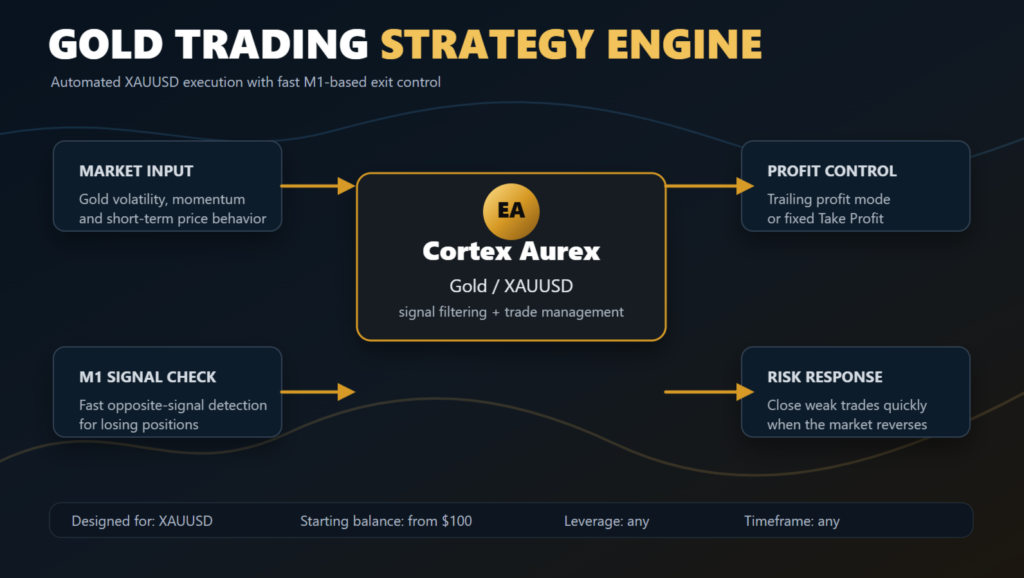
The strategy engine diagram lays out four documented components.
Market Input — the strategy reads gold volatility, momentum, and short-term price behaviour on the H1 timeframe. The specific entry rules aren’t published, but the inputs the system consumes are documented.
Cortex Aurex EA — the central decision logic that filters market inputs into trade signals and manages open positions. This is the “what triggers an entry” component.
M1 Signal Check — running in parallel with the main strategy, an M1-timeframe check monitors for opposite-direction signals against existing open positions. When a losing position has an M1 opposite signal confirmed, the EA closes it. This is the dynamic exit mechanism that replaces a traditional static SL.
Profit Control / Risk Response — two distinct exit paths. Winning positions are managed by trailing profit logic (or optionally fixed take-profit if configured); losing positions are exited via the M1 opposite-signal mechanism described above. The diagram describes the design goal as “close weak trades quickly when the market reverses” — a defensible philosophy if the M1 opposite-signal detection is reliable.
Designed for XAUUSD specifically with a starting balance documented from $100. Any leverage, any timeframe (though H1 is the chart timeframe with M1 used internally for exit timing).
The Trade Management Logic
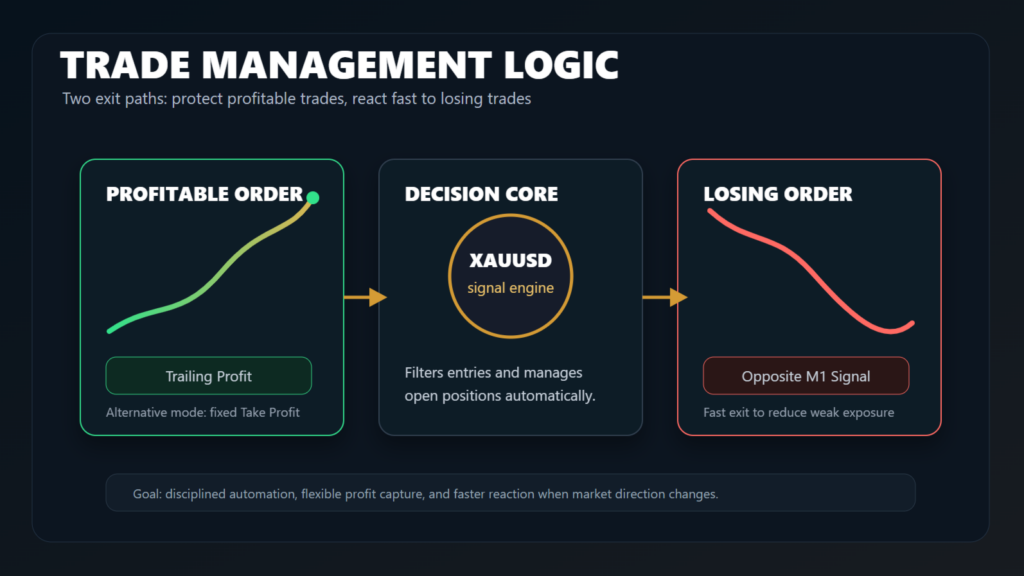
The trade management diagram is where the architectural philosophy becomes explicit. The system handles winning and losing positions through fundamentally different mechanisms:
Profitable orders are managed by trailing profit logic — the trailing activates after a defined profit threshold (450 points by default) and steps along with price as it moves further into profit. The alternative configuration uses fixed Take Profit instead. The design intent here is to let winners run while still locking in profit on retracements.
Losing orders are handled by the M1 opposite-signal mechanism. Rather than using a price-based stop loss, the EA monitors the M1 timeframe for opposite-direction confirmation against any losing position. When the M1 reverses against the position, the EA closes it quickly. The diagram’s description: “fast exit to reduce weak exposure.”
Stated goal: “disciplined automation, flexible profit capture, and faster reaction when market direction changes.”
This is an honest design framing. Cortex Aurex isn’t claiming to be a perfect or magical system; it’s claiming to use M1 timing signals to manage exits dynamically rather than statically. Whether that approach holds up in your particular market conditions and broker execution is what demo and live evaluation will tell you. Our position: the philosophy is defensible and the documentation is honest, but no-static-SL architectures specifically carry risk during gap moves and news spikes — see the dedicated section below.
The Configurable Inputs
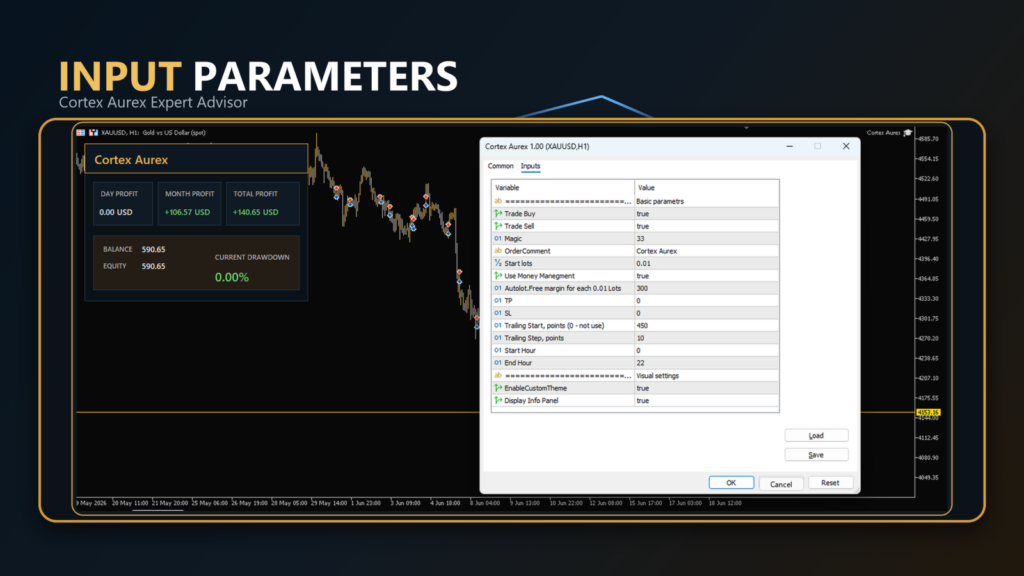
The inputs screenshot gives the clearest picture of the EA’s operational defaults. The relevant parameters and what they mean:
- Trade Buy / Trade Sell: Both enabled by default — the EA trades both directions
- Magic 33: The EA’s order identification number for multi-EA setups
- Start lots 0.01: Base lot size when money management is disabled
- Use Money Management: true / Autolot $300 per 0.01 lots: Position sizing scales with free margin — every $300 of free margin adds 0.01 lots to the trade size. On a $1,000 account this means starting trades at around 0.03 lots
- TP 0 / SL 0: No fixed take-profit and no fixed stop-loss by default. Both are disabled in favour of the dynamic exit logic — trailing for profit, M1 opposite-signal for loss
- Trailing Start 450 / Trailing Step 10: Trailing activates after 450 points of profit, then steps every 10 points as price moves further in your favour
- Start Hour 0 / End Hour 22: Trades any time from 00:00 to 22:00 server time (avoids the final hour of the day)
- EnableCustomTheme / Display Info Panel: Visual settings for the on-chart panel
The on-chart info panel visible in the screenshot displays Day Profit, Month Profit, and Total Profit at the top, with Balance, Equity, and Current Drawdown below — useful operational state visible continuously without needing to dig into Terminal tabs.
The No-Static-SL Question
The most important architectural detail buyers need to understand is the absence of a fixed stop loss. SL is set to 0 in the developer’s defaults, which disables price-based static stop loss entirely. Losing positions are closed when M1 opposite-signal detection triggers — not when price hits a predetermined level.
This is a deliberate design choice, not an oversight. The philosophical argument for M1-based dynamic exits over static SLs has some merit: static stops can be hit by spread spikes during low-liquidity periods and re-entry timing becomes a manual headache; M1 opposite-signal exits are more contextually responsive to actual market reversal. The trade-off is that the M1 signal needs to actually trigger for the exit to occur.
Where this matters: during fast adverse moves — price gaps over weekends, news spike events (NFP, FOMC), geopolitical shocks — the M1 opposite signal may not trigger promptly while price moves significantly against the position. Without a static SL providing a hard cap, losses on such moves can extend further than they would on a system with fixed stops in place.
The 6-week live signal hasn’t yet sampled the extreme events where this would matter most. The architectural choice is defensible for typical market conditions but carries specific tail risk during exceptional moves. Buyers comfortable with this trade-off can proceed; buyers who prefer the certainty of static stops should either configure SL manually (the input is exposed) or look at systems with built-in static SL as a core feature.
Practical recommendation: if you run Cortex Aurex live, consider setting a manual conservative SL value in the inputs rather than leaving it at 0. The architecture’s M1 opposite-signal logic will still handle normal exits; a manually-configured SL provides the catastrophic-event backstop the default 0 lacks. This is the cleanest way to keep the dual-exit architecture’s benefits while addressing the gap-and-spike concern.
The Live Signal — Read the Deposits
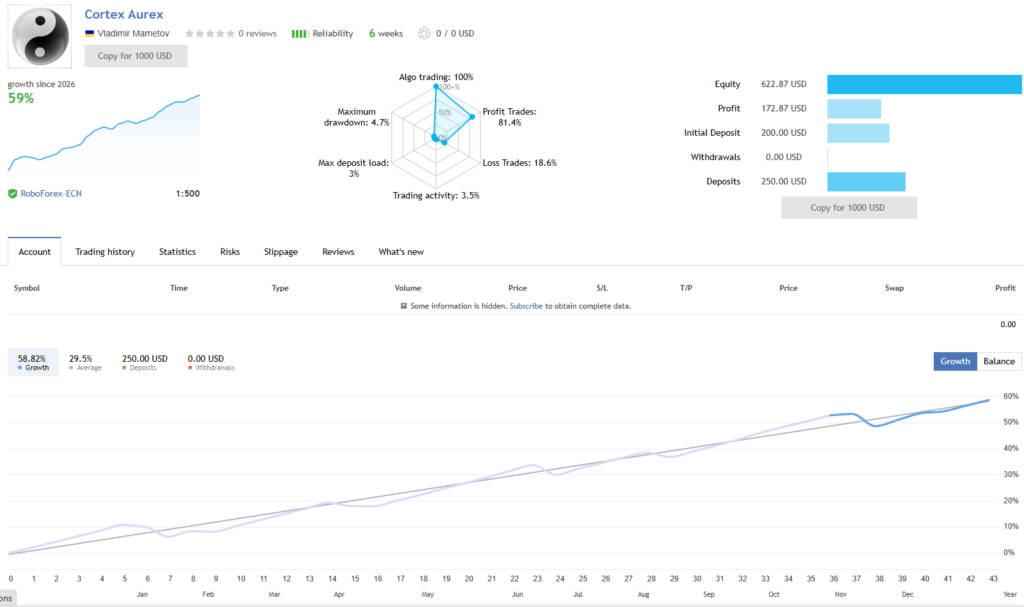
The public live signal is real money on RoboForex-ECN at 1:500 leverage. Six weeks of tracked history at the time of writing.
The headline numbers: 59% growth, 81.4% profit trades, 18.6% loss trades, 4.7% maximum drawdown, 3% max deposit load, 3.5% trading activity.
The deposit context. The signal opened on a $200 initial deposit. Cumulative deposits during the 6-week tracking period show $250 in additional capital added beyond the initial — bringing total deposits to $450. Current equity sits at $622.87 with cumulative profit of $172.87. The 59% headline growth figure is calculated against the original $200; the cleaner read on actual absolute return is $172.87 cumulative profit against $450 total capital deployed, which works out to roughly 38% absolute.
Neither figure is misleading exactly, but the 38% figure is the one to anchor expectations on for forward-looking purposes. The 59% headline is amplified by the way MQL5 calculates growth percentages against initial deposits when additional capital flows in.
The genuinely positive operational metrics. The 18.6% loss-trade rate is the meaningful signal here — real strategies take losses, and a young live signal showing realistic loss distribution is healthier evidence than the suspicious 100% live win rates we’ve flagged on other recent products. The 4.7% max drawdown on the young sample is encouraging but will almost certainly converge upward as the system encounters more challenging conditions. The 3.5% trading activity confirms selective entry behaviour consistent with the H1 timeframe approach.
What the 6-week sample doesn’t tell us yet. Whether the M1 opposite-signal exit logic holds up during high-volatility news events. Whether the trailing profit start at 450 points is well-calibrated for varying gold volatility regimes. Whether the absence of static SL produces unacceptable tail losses during gap moves. These are questions the live signal will start answering over the coming months as it samples more of gold’s volatility distribution.
The Backtest
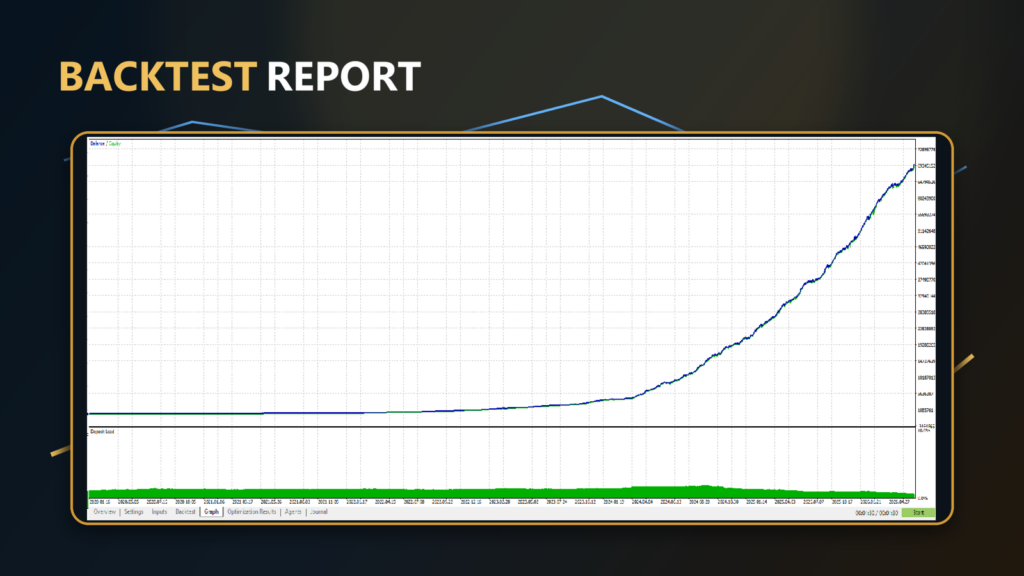
The backtest covers approximately January 2020 to April 2026 — a multi-year window that includes pandemic-era gold volatility, the 2022 rate-hike regime, and gold’s 2024-2026 rally. The equity curve shows the characteristic hockey-stick shape of a compounded backtest on a high-win-rate strategy: relatively flat for the first couple of years, then accelerating into exponential growth as the position sizing scales with the growing account balance.
Standard framing applies here. The compounded equity projection is illustrative of how the strategy’s win rate and trade-size distribution would compound if rerun forward from a small starting balance — it’s not a forecast of forward returns. The shape is a feature of compounding mathematics, not a unique strength of this specific strategy. A 38% absolute return per year compounded for six years produces the same hockey-stick shape on any equity curve.
What’s more useful than the multi-million projection is the underlying behavioural profile the backtest implies: the strategy ran consistently across multiple market regimes (pandemic crash, recovery, rate-hike volatility, recent gold rally) without breaking. The deposit-load bars at the bottom of the chart show very low margin usage throughout — consistent with the autolot’s conservative 0.01-lot-per-$300-margin sizing. That’s the kind of operational discipline that survives across regimes; the absolute return projection is the marketing presentation of it.
What Early Buyers Are Saying

One verified MQL5 review at the time of writing — five stars from elena864 (June 2026): “Excellent advisor for gold.” A brief positive first impression rather than a detailed operational breakdown. Weight this as encouraging early feedback rather than substantive buyer evidence — the review base will mature over the coming months as more buyers run the system. Single-review evidence bases are far too thin to anchor purchase decisions on by themselves, which is why this review’s editorial focus is on the architectural documentation and the live signal rather than the review count.
Who Cortex Aurex EA Is For
It might be a fit if you:
- Value architectural documentation and want to understand exactly how a system makes exit decisions before deploying live capital
- Understand the trade-offs of M1-based dynamic exits vs static stop losses, and are comfortable with the no-static-SL default (or willing to configure a manual SL backstop)
- Are comfortable being an earlier buyer on a 6-week live signal with the understanding that more evidence will accumulate over coming months
- Want a XAUUSD H1 specialist with selective entry behaviour (3.5% trading activity) rather than a high-frequency system
- Can read live signal headlines in deposit context (the cleaner number is cumulative profit relative to total deposits, not the percentage)
Look elsewhere or wait if you:
- Require a static price-based stop loss as a core feature and aren’t willing to configure one manually
- Want a multi-month or multi-year live track record before buying — this signal is six weeks old
- Need a deep review base for purchase confidence — there’s currently one published review
- Trade only on MT4 — this is MT5 only
- Would rather wait six months for the live signal to mature through more market regimes before evaluating
Our Verdict
We rate Cortex Aurex EA 4.5 out of 5.
The architecture earns the upper half of the score with one specific differentiator that’s increasingly rare on marketplace EAs: the developer has documented the design openly rather than hiding behind generic marketing language. The strategy engine diagram, the trade management logic diagram, and the inputs screenshot give buyers a clear mental model of what they’re running before they commit capital. The 6-week live signal shows realistic loss-trade distribution (18.6%) consistent with a system that’s behaving as designed rather than producing the suspicious 100% live win rates we’ve flagged elsewhere. The on-chart info panel surfaces operational state continuously. The autolot logic with $300-margin-per-0.01-lot defaults is conservative enough that small accounts can evaluate the system without being over-leveraged.
The half-point we hold back captures the honest caveats. The no-static-SL architecture is a deliberate choice with real implications during fast adverse market moves — buyers should either accept that risk profile knowingly or configure a manual SL backstop. The 6-week live signal sample is encouraging early evidence but not yet a multi-month track record across multiple market regimes. The headline 59% live growth figure is amplified by additional deposits during the tracking period (cleaner read: 38% absolute on $450 total capital deployed). The hockey-stick backtest curve is best read as illustration of compounding mathematics, not as forecast.
Practical recommendation: if you want to buy it, buy it conservatively. Start at the developer’s $200 deposit level or below for evaluation on demo, validate live behaviour on your own broker for at least 4-6 weeks before scaling, consider configuring a manual SL value in the inputs (the field is exposed even though the default is 0), and read the architectural documentation carefully before deploying — Cortex Aurex’s M1-opposite-signal design philosophy is worth understanding rather than ignoring. Buying through CheaperForex at significant discount keeps the cost of being an early evaluator modest.
How to Get Cortex Aurex EA Safely
Two legitimate sources, and only two.
CheaperForex — the same EA at a significant discount versus the marketplace price. Get Cortex Aurex EA MT5 at CheaperForex.
The MQL5 marketplace — direct from Vladimir Mametov’s developer page. Here is the official MT5 listing.
Anywhere else offering it free or via a Telegram seller is a trap — there’s no working cracked file, only malware or pay-and-vanish scams.
Frequently Asked Questions
Is Cortex Aurex EA legit, or a scam?
Legitimate. A published MQL5 marketplace product with a real-money public live signal on RoboForex-ECN, openly documented architectural diagrams that most marketplace products don’t provide, and a developer transparent enough about the design to make informed buyer evaluation possible. The scams are the “free download” sites and Telegram sellers offering cracked copies that cannot exist.
Why is there no static stop loss by default?
The developer has chosen a dual-exit architecture: trailing profit for winning trades, M1 opposite-signal detection for losing trades. The default SL=0 disables price-based static stops because the design intends the M1 logic to handle losing exits dynamically. This is a documented choice rather than an oversight — but during fast adverse moves where M1 doesn’t trigger promptly, losses can run further than they would with a static SL. Buyers can configure a manual SL value in the inputs as a backstop while keeping the M1 logic active.
How does the M1 opposite-signal exit actually work?
While the EA is in a losing trade on the H1 timeframe, it monitors the M1 timeframe for opposite-direction signal confirmation. When the M1 confirms a reversal against the losing position’s direction, the EA closes the position quickly to “reduce weak exposure” (the developer’s phrasing). The mechanism is timing-sensitive — slower brokers or unstable VPS connections can introduce execution lag that affects the exit’s effectiveness.
How should I read the 59% live growth figure?
As technically accurate but amplified by additional deposits during the tracking period. The headline is calculated against the $200 initial deposit, but the account received $250 in additional deposits during the 6 weeks of tracking. The cleaner read on actual absolute return is the $172.87 cumulative profit against $450 total capital deployed, which works out to roughly 38% absolute. Anchor expectations on the 38% figure rather than the 59% headline for forward-looking purposes.
Will it work on small accounts?
The developer documents a starting balance from $100, and the autolot defaults to 0.01 lots per $300 of free margin. Small accounts run at minimum lot size for extended periods — this is conservative but means the percentage returns on the smallest accounts are amplified by the small base. The live signal opened on $200; that’s at the lower end of practical operation. Larger accounts give the M1 opposite-signal exit logic more headroom to operate without static SL coverage.
How does it compare to other XAUUSD H1 EAs we’ve reviewed?
Different architectural focus. Mosquito EA and Spider Gold EA are defined-risk-per-trade systems with traditional fixed SL/TP. Cortex Aurex uses dynamic M1-opposite-signal exits without static SL. Both architectural categories have valid use cases; choice depends on whether you prefer the certainty of static stops or the contextual responsiveness of M1-based dynamic exits.
What if the M1 signal doesn’t trigger during a fast adverse move?
Without a static SL backstop, the losing position remains open and the loss can extend further. This is the central tail-risk concern with the default architecture. Mitigation: configure a manual SL value in the EA inputs as a catastrophic-event backstop. The M1 opposite-signal logic continues to handle normal exits; the manual SL only triggers in exceptional adverse moves where M1 doesn’t.
Why is it cheaper at CheaperForex?
The product is identical — same EA, free lifetime updates. You pay significantly less. For a young product with credible architectural documentation, paying less to test it on demo and validate before scaling is the practical approach.