
StormDRAGON MT5 Review: Gold Strategies, Live Signal and Risk
StormDRAGON EA MT5 combines four independently configurable XAUUSD strategies with a fantasy-themed trading dashboard. Three breakout modules can run with stop losses and trailing exits, while a separate pullback module adds optional fixed-lot recovery. Its distinctive appeal is the choice between breakout-only and recovery-enabled trading, with execution diagnostics built into an unusually visual interface. The main consideration is that the live history spans changing strategies and has experienced meaningful floating drawdown.
View StormDRAGON EA MT5 features and pricing

- Developer source link: StormDRAGON on MQL5
- Live signal link: StormDRAGON Vantage account
- Setup and release notes: Developer quick-start guide and comments · Release history
Source-based review checked 16 September 2026. We examined the listing, public quick-start instructions, release notes, customer feedback and linked MQL5 signal. We have not independently traded the EA or reproduced its backtests.
How the four heroes trade
Alfred Charano’s system uses separate trading modules rather than one common entry trigger. The current listing describes three breakout approaches and one pullback/recovery approach. Each can be selected separately, although they all target the same gold market.
- OniSHIN: momentum breakouts, an optional liquidity-sweep mode and configurable trailing management.
- GinRYU: faster breakout entries with tight stops and trailing exits.
- KaguraZEN: gold breakouts with conservative/aggressive entry choices and stop-loss management.
- KyoSHIRO: QuasiModo-style pullbacks with fixed-lot recovery; optional partial closing is available above 0.01 lot.
The listing names M30 for OniSHIN, M15 for GinRYU and KaguraZEN, and H1 for KyoSHIRO. These are internal strategy references: the setup instructions still specify a single H1 attachment chart. Older screenshots should not be used to infer that several chart attachments are required.
Breakout-only versus recovery-enabled settings
SCALP and recovery-enabled configurations are materially different. Adding KyoSHIRO introduces extra positions during adverse movement, even though the recovery lots are fixed. All four strategies still share gold exposure. Stop losses, trailing stops and drawdown settings can reduce exposure but do not guarantee an exact loss limit through gaps or slippage.
The developer’s August quick-start guide puts SCALP at 0.01 lots per breakout hero. HIGH adds KyoSHIRO at 0.01 with the other heroes at 0.03. EXTREME uses larger sizing and can enable partial closing on KyoSHIRO. Those combinations create different position counts, margin use and drawdown behaviour; the performance of one preset cannot establish the performance of the others.
The product listing suggests $500 for MED, while the public quick-start comment gives $750 for MID. Treat that inconsistency as a reason to verify the actual preset and margin requirements, rather than presenting either amount as a safe universal minimum. HIGH is described around $1,000 and EXTREME around $2,000 or more. The developer also mentions a 50% drawdown ceiling: that is a substantial potential loss allowance, not evidence of conservative risk.
Execution tools and the latest practical changes
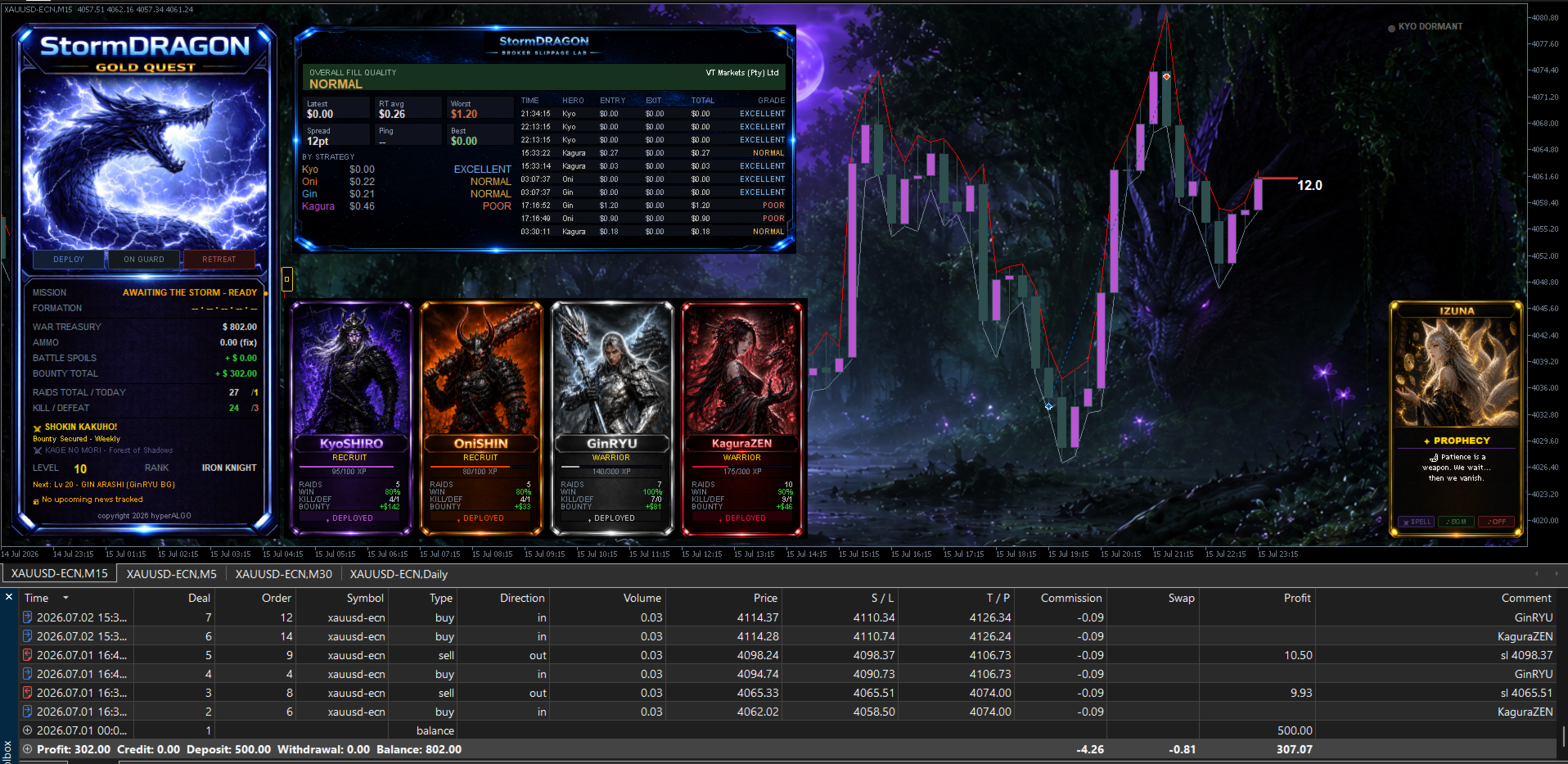
The 31 August release notes added a Broker Slippage Lab with entry/exit costs, per-hero statistics and recent-fill grading. They also describe breakout filtering, manual stop-loss overrides and control of opposite pending orders. The developer recalibrated exits and KaguraZEN’s sessions and swing detection. These are documented changes, not independently demonstrated improvements in profitability.
The latest notes and 13 August comments explicitly favour pending orders for OniSHIN, GinRYU and KaguraZEN, and SCALP rather than the older LOW market-order preset. Pending orders still experience slippage, especially during fast moves. The Slippage Lab can help expose broker differences; it cannot eliminate them.
Vantage live signal: returns and drawdown together
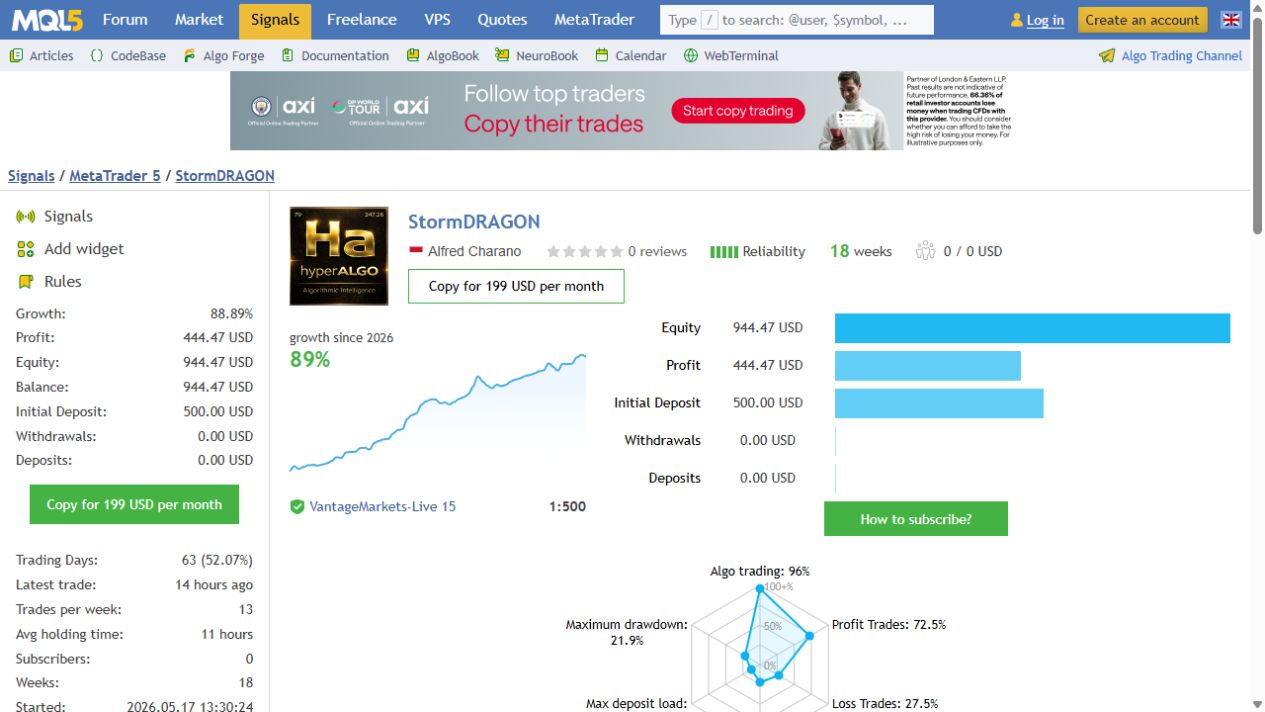
The linked MT5 signal was marked as a real VantageMarkets-Live 15 account with 1:500 leverage. On 16 September 2026 it showed 88.89% growth, $444.47 profit and $944.47 balance/equity from an initial $500, with no additional deposits or withdrawals displayed. It showed 18 weeks of history and a Started timestamp of 17 May 2026; the description dates the first trade to 19 May.
The account had 189 completed trades: 137 winners and 52 losers, a 72.48% win rate and profit factor of 2.15. Average profit was $6.08 versus a $7.46 average loss, so the result depends on winning often enough rather than an unusually large average winner. The longest losing run was five trades, losing $51.39. Average holding time was 11 hours and maximum deposit load was 12.70%.
Relative equity drawdown was 21.89% ($125.66), compared with approximately 7.36% balance drawdown. The difference matters: a balance-only view understates the floating loss seen while positions remain open. The snapshot’s equal balance and equity do not erase that earlier drawdown. MQL5 showed 96% algorithmic trading, rather than a fully automatic history.
Why the account is not a clean test of today’s setup
The distribution includes 170 XAUUSD trades and 19 GBPJPY trades. Gold contributed $406.94 net profit and GBPJPY $37.53. The 9 August release notes explain why: KaguraZEN was rebuilt from a GBPJPY grid module into a gold breakout module. Consequently, all of the 88.89% headline growth cannot be attributed to the current four-gold-strategy architecture.
The signal description also records a June pause, a VPS problem with a manually closed trade, and successive preset and stop-loss changes through July and August. The latest dated settings note describes HIGH with recovery enabled. That mixed history is useful forward evidence, but does not isolate SCALP-only results or prove a single unchanged configuration. MQL5 previously displayed copying-frequency warnings that were later removed; standalone execution can also differ across brokers.
The RPG interface and news controls
The fantasy interface includes hero cards, XP, ranks, battlefield backgrounds and optional sound. These are presentation and monitoring features, not evidence of a trading edge. The current listing says KaguraZEN is active from level zero; visual progression should not be confused with needing to earn access to that trading strategy.
For news filtering, MT5 must allow WebRequest access to the documented economic-calendar feed. The developer warns that trading can continue without news protection if the feed is not permitted. Use low-spread execution conditions and a continuously connected terminal or VPS, and check the selected heroes, sizing and news status before going live.
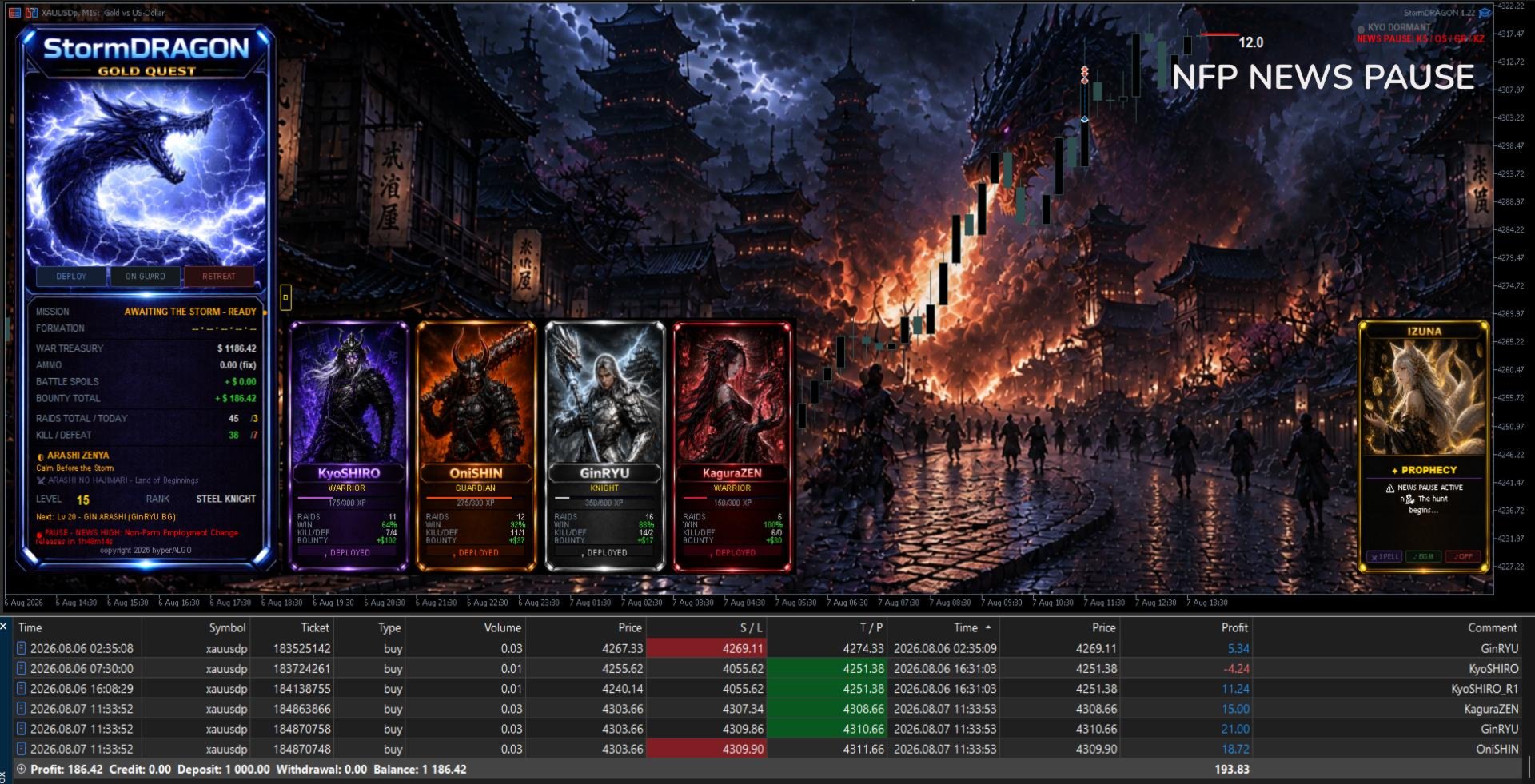
The developer recommends landscape displays, typically 1920×1080 or 1440p, and a chart window no wider than roughly 1920 pixels for the artwork. Ultrawide and portrait displays may not render the background as intended, although the trading functions are stated to remain available. Confirm that all controls and alerts are readable on the intended VPS screen.
Original backtests: useful context, different evidence
The gallery contains two older two-symbol tester summaries, one labelled $1,000 Extreme fixed-lot and another $10,000 fixed-lot. The first shows $7,460.72 net profit, 1,439 trades and 24.86% relative equity drawdown; the second shows $39,693.12 net profit, the same trade count and 14.03% relative equity drawdown. These are simulated outcomes under their own sizing assumptions, not customer returns.
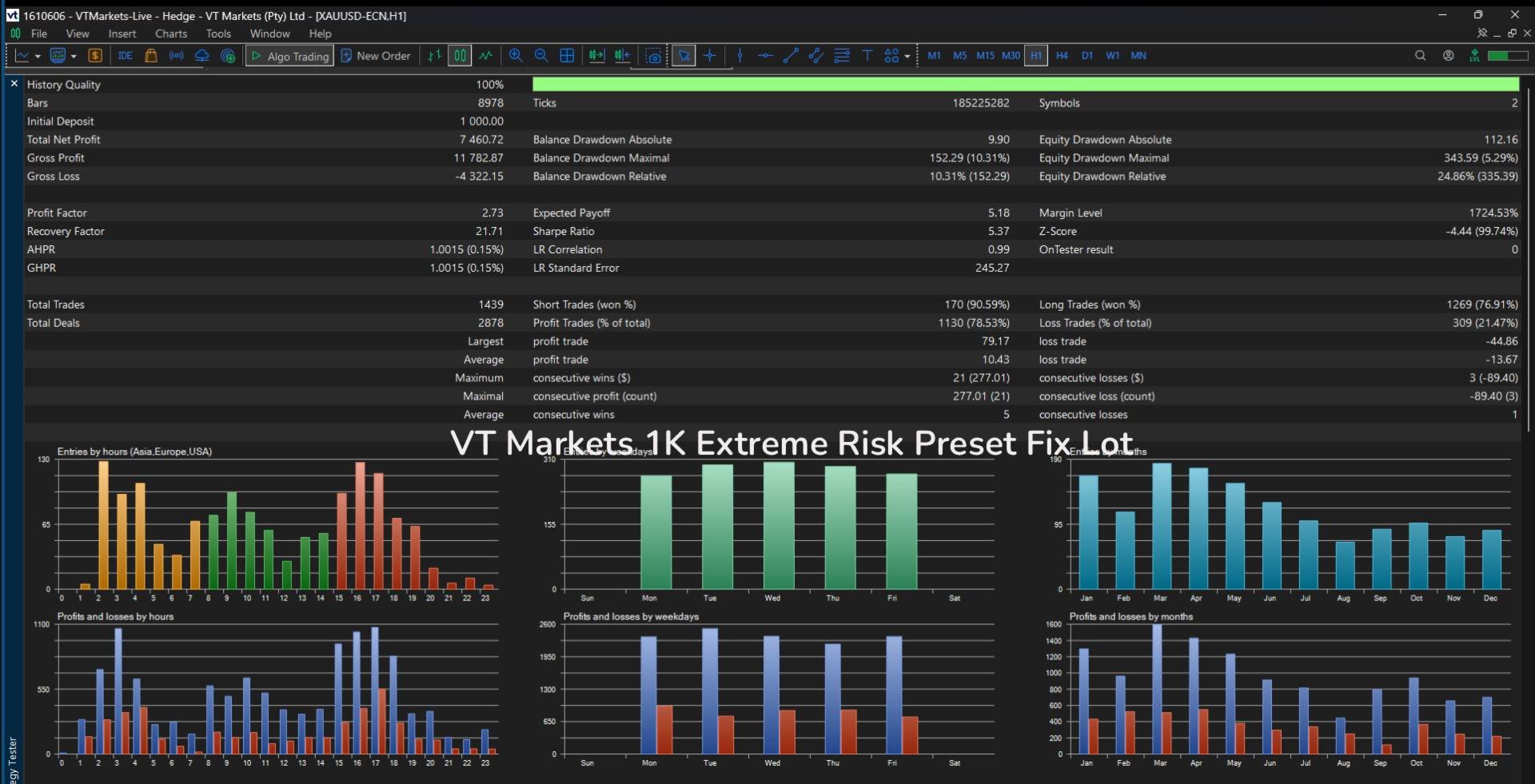
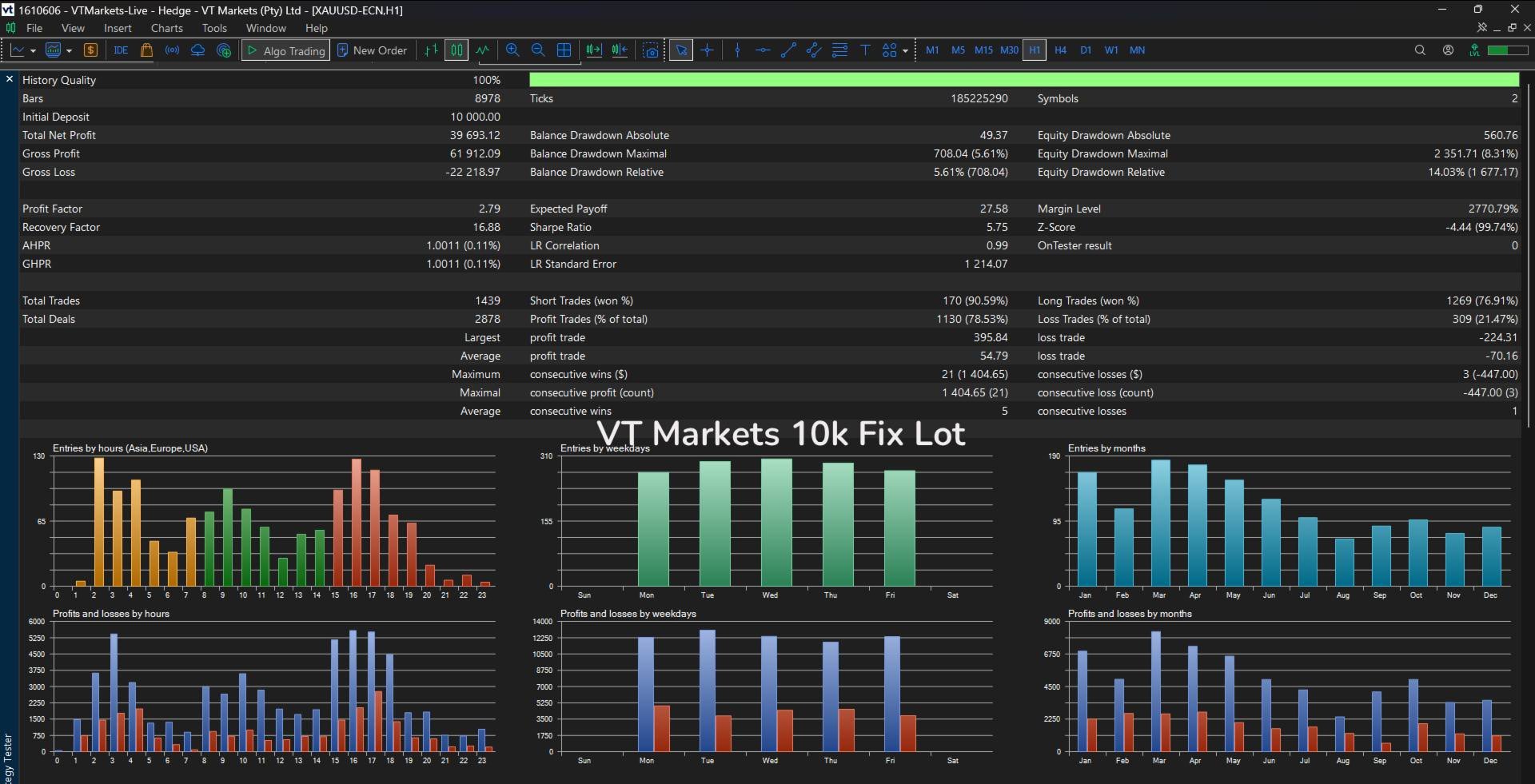
Although the listing describes a January 2025–August 2026 backtest range, these particular summary images do not establish every test parameter or the current gold-only implementation. Their two-symbol structure and older strategy history limit direct comparison with today’s build. A 100% history-quality label does not reproduce real slippage, broker execution or future conditions.
Customer reviews: praise and practical concerns
Five MQL5 reviews were visible at this check. Traderhub’s September update was positive about both breakout and recovery operation, while Mercier Guillaume Patrick praised the work and interface but wanted a longer period before judging it. Marco Scherer also reported positive early trades and a recovered grid sequence. These are individual customer accounts of their experiences, not audited performance records.

The less favourable feedback is important too. SilentGhost reported repeated stop losses and poor results across brokers and settings in early August. Bruno Lec remained interested but described a learning curve, differences between backtests and live execution, and disabling GinRYU after too many stop losses. The developer responded with pending-order guidance and newer settings. The complaints predate the latest release, so they do not prove a current unresolved fault; equally, an update announcement does not prove that every customer’s issue is solved.
July comments also raised incorrect dashboard counts and apparent inclusion of other trades. The developer characterised those reports as display issues; subsequent release notes describe fixes to counters and isolation of the EA’s protection/close-all controls. Verify actual account history and magic-number separation rather than relying solely on game-style dashboard totals.
Setup priorities and assessment
Attach the EA to a single XAUUSD H1 chart; its strategy timeframes are handled internally. The developer’s latest guidance favours the pending-order SCALP preset instead of the older market-order LOW preset. The listed SCALP starting balance is $250 with 0.01-lot entries, but this is a developer setup recommendation, not a guarantee of adequate capital or limited loss.
Start by checking the selected heroes, lot sizing, pending-order mode, news-feed status and maximum exposure. Compare runs with and without recovery on the intended broker. Gold remains the common risk across all four modules, and a colourful dashboard does not diversify the underlying instrument.
StormDRAGON offers unusually visible controls over strategy selection and execution quality, plus a public live account with both winning and losing trades. Its strongest selling points are flexibility and transparency of controls. Its main limitations are the changing signal configuration, material floating drawdown, mixed customer outcomes and sensitivity to spreads and fills.