
Kumiko XR EA MT5 combines separate daytime and overnight XAUUSD strategies on one chart. Its day engine uses wider recovery spacing and H4 trend/momentum filtering; its night engine uses tighter spacing and smaller basket targets, with a session lock preventing the two from starting overlapping baskets. Its appeal is explicit session-based operation and visible ladder controls. Its central trade-off is recovery-grid exposure: the historical return figures come from an in-sample test with the optional equity stop disabled.
View product details and current pricing.

- Official listing: Kumiko XR EA MT5 on MQL5
- Related public account: Kumiko X — different edition; not verified XR results
- Seller profile: Christopher William Hynes
- Update history: Kumiko XR updates
Reviewed against public sources on 16 September 2026. This is an analysis of the developer’s listing, release notes, original test images and related signal, not an independent trading test. The private setup manual was not publicly available.
Day and night engines: what changes between sessions
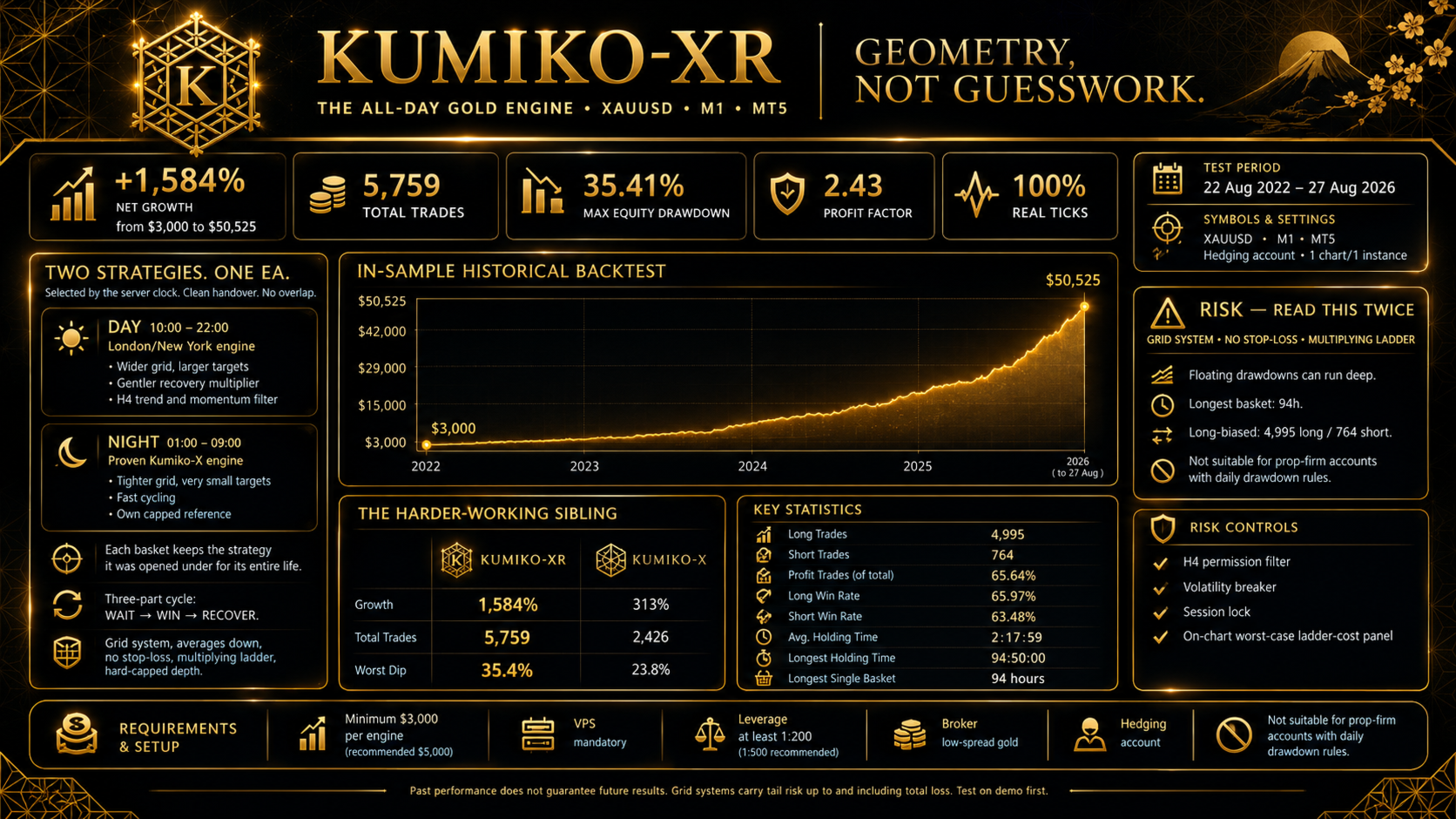
Kumiko XR is the all-day relative of Kumiko X. The daytime engine runs during the published 10:00–22:00 server-time window with wider spacing, larger basket targets and a gentler recovery multiplier. The overnight 01:00–09:00 engine uses tighter spacing and small targets. Server time matters: those hours are not automatically your local time or a fixed UTC schedule.
The day engine uses H4 trend and momentum permission, including withholding buys in a confirmed downtrend. Both engines use a recovery ladder, but each basket retains its own session’s depth, multiplier and exit rules. A basket opened before a handover can stay active afterwards; the session change is not a forced-close instruction. The other engine waits until the existing basket is finished.
The latest update materially changes the risk controls
The default design adds larger positions when price moves against a basket and waits for recovery. A capped number of legs does not cap the money a sustained move can lose. The latest release adds an optional equity stop, off by default, that closes positions and halts trading for the day after a configured decline from the day’s opening balance. Published tests assume that stop is off; enabling it changes the outcome.
The 10 September release also fixes restart adoption: the developer says a recovered night basket previously could inherit the daytime ladder depth and generate a much larger position than intended. The panel’s worst-case ladder calculation was corrected to pair each session’s multiplier with its own depth. These are meaningful operational changes, so the review follows the release notes rather than repeating the older overview unchanged.
The optional stop is measured against the day’s opening balance. It is not the same as a fixed lifetime drawdown limit from the original deposit. Order execution, gaps and slippage can also affect the realised closing level. Backtest figures for the default stop-off configuration cannot be assumed to describe stop-on trading.
Four-year backtest: what is actually shown
The developer reports a continuous StarTrader XAUUSD M1 simulation from 22 August 2022 to 27 August 2026. The displayed $3,000 run ends near $50,525, with $47,524.93 net profit, 5,759 trades and profit factor 2.43. Relative equity drawdown is 35.41%. That is a substantial historical decline despite the much smaller balance-drawdown fields in the report.
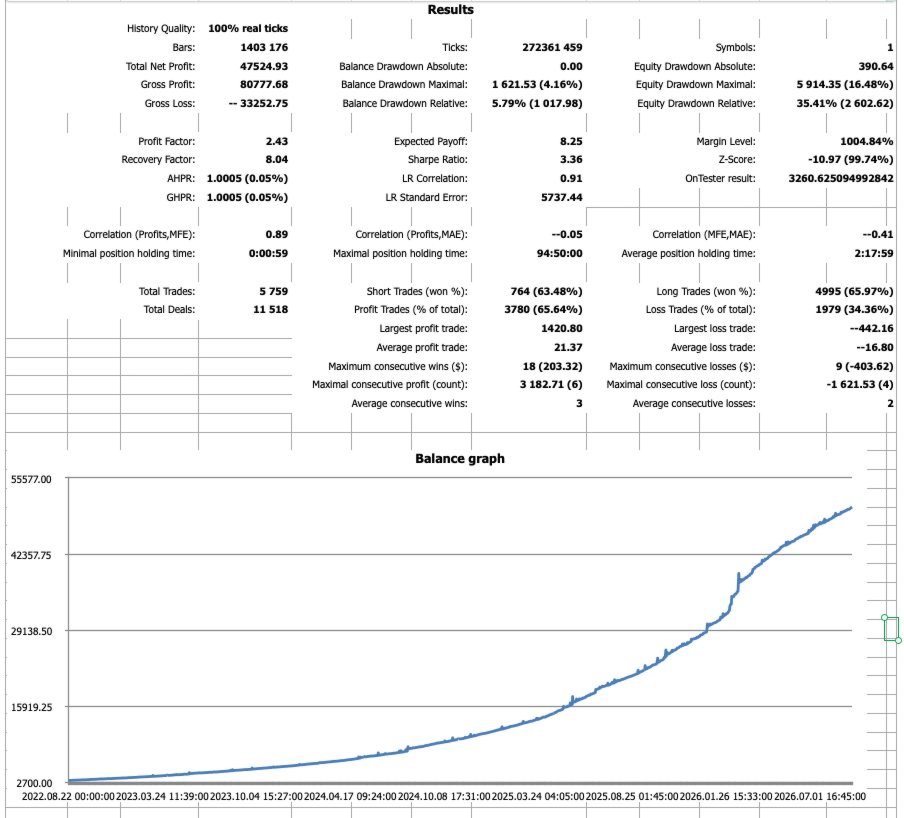
The report contains 4,995 long trades versus 764 shorts, so the tested system is strongly long-biased. Average holding time is approximately 2 hours 18 minutes, while the longest reported position/basket duration approaches 94 hours. Averages hide the time and capital committed to the difficult recovery episodes.
The author explicitly states that settings were selected on the same data used for the test. This makes it in-sample evidence, not an out-of-sample validation. Profitable calendar years and successful alternate start dates are useful stress checks within that history, but they do not remove selection bias or reveal the worst move the future may deliver. No combination of capped depth and a favourable historical margin level makes the default grid immune to account loss.
The seller’s live signal is Kumiko X, not an XR verification
The public seller profile links an MT5 account named Kumiko X. Because the product description distinguishes X’s overnight engine from XR’s two-engine design, the account should be treated as related background only. No separately identified XR live account was verified in the public sources checked for this review.
On 16 September 2026 that JTMarkets-Trade account showed 6.55% growth, $269.33 profit, a $5,200 initial deposit and $2,413.53 withdrawals. Balance and equity were both $3,055.80. It displayed seven weeks of account history, with MQL5 monitoring Started on 11 August. An account-age label is not proof of seven weeks of uninterrupted public monitoring.
There were 152 gold trades, 136 winners and 16 losers, and profit factor 2.18. Relative equity drawdown was 17.32%; relative balance drawdown was 2.07%, while the separate maximal balance field showed $66.44 (1.21%). Average loss of $14.31 exceeded average profit of $3.66. The win rate therefore needs to be read with the size of losses, not alone. Maximum deposit load was 11.17%, algorithmic trading 96%, and the provider described the LOW MEDIUM setting.
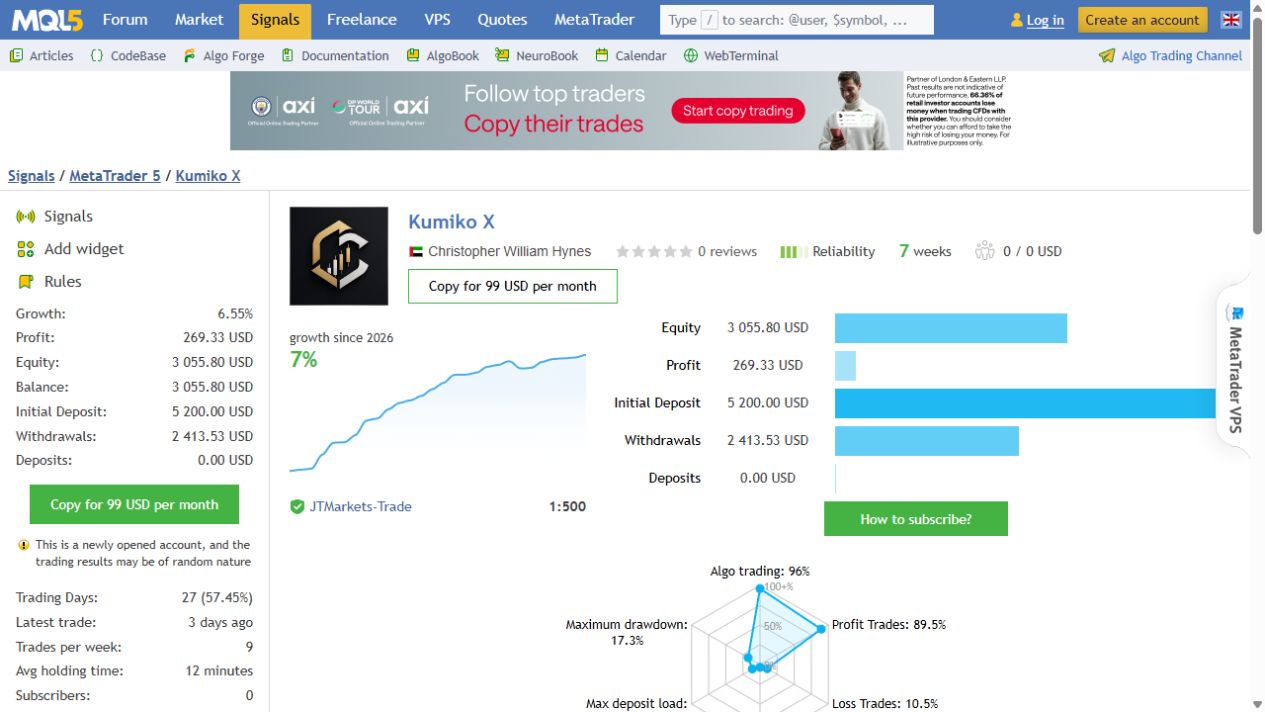
MQL5 marked this as a new account, and the latest trade was three days before the check. These observations are dated, limited evidence for the labelled X account. They do not establish XR returns, identify the additional daytime engine’s contribution or validate every risk tier.
Practical requirements
The documented starting setup is XAUUSD M1, one chart and one instance, on a hedging account with two-decimal gold quotes. The developer specifies at least $3,000 per engine and recommends $5,000, leverage of at least 1:200 with 1:500 preferred, low spreads and uninterrupted VPS operation. These are operating assumptions, not assurances that the account cannot be exhausted.
The release notes say the current EA can attach to other chart timeframes using internal margin safeguards, while M1 behaviour is unchanged. For reproducing the published evidence, use the documented gold M1 setup and the intended broker’s real-tick data. Differences in quote precision, spreads, swaps and contract specification can materially change a grid’s economics.
The on-chart ladder-cost display is useful for understanding sizing before entry. It should not be read as the maximum total money that can be lost after the ladder fills. Open exposure can continue losing value even when no further positions are added. Test interruption/restart handling and the optional equity stop on a demo account before relying on them.
Customer feedback and assessment
No written MQL5 product reviews or customer comments were available at the time of this check. There is therefore no customer review screenshot to present, and the related signal also has no reviews. The developer supplies its setup guide and recommended presets privately; we have not invented instructions from an unavailable manual.
Kumiko XR provides a clear account of how its two sessions differ and publishes the averaging risk rather than hiding it. Its latest restart fix and optional equity stop are important improvements in the documented feature set. The main evidence remains an in-sample simulation; an independently identified XR live record across varied gold regimes would strengthen the case considerably. This is for traders who deliberately accept recovery exposure, not a system to describe as low-risk or prop-challenge ready.
Compare the same developer’s two systems
Kumiko XR focuses on gold with separate day and night engines. Takumi uses EURUSD mean reversion and can maintain several baskets. Both use averaging ladders; trading different symbols does not remove their shared recovery risk.