
Takumi EA MT5 trades EURUSD mean reversion using M5 entry conditions and an H1 trend filter. It manages separate baskets with volatility-based targets, a capped averaging ladder and a partial hedge for deeper baskets. It suits analysis of cost-aware basket exits rather than quick, stop-defined trades. The key consideration is prolonged floating exposure: the developer’s current written test history includes a basket lasting roughly forty days, and the early live signal already shows the difference between balance growth and equity.
View product details and current pricing.

- Official listing: Takumi EA MT5 on MQL5
- Public account: Takumi X developer account
- Seller profile: Christopher William Hynes
Source-based review checked 16 September 2026. We inspected the current listing, original developer graphic, empty customer feedback areas and the Takumi X signal linked from the seller profile. We have not independently traded the software or reproduced the historical tests; the setup manual is provided privately.
Mean reversion, separate baskets and cost-aware exits
Takumi opens against a measured stretch from the rolling M5 mean, subject to an H1 trend filter. The idea is to trade reversion rather than assume every price extension will keep trending. Up to three baskets per side can operate, each with its own slot and target. Multiple nearby entries can therefore be deliberate rather than accidental duplicates.
Targets are based on the basket’s weighted average and scaled to volatility. The developer says a basket must be net positive after costs to meet the normal exit condition. That describes basket-level logic; it is not a promise that every individual trade, or every account, will avoid losses. Correct commission input matters because understated costs can make an apparent profitable target uneconomic.
What the averaging ladder and partial hedge do
Takumi has no per-leg stop loss. It can hold and add to losing baskets for days or weeks, including across weekends. The capped ladder and partial hedge limit aspects of position management, but do not guarantee recovery or prevent total account loss. Judge floating equity, margin and total exposure alongside closed balance; unrealised losses are economically meaningful.
If the market continues against a basket, added legs move the weighted average closer to the prevailing price. That reduces the retracement needed for the combined target but increases exposure. A partial hedge may slow losses when a deep basket faces further extension; it cannot erase existing losses or guarantee eventual recovery. The author describes H1 filtering on both entries and additions and restart adoption for existing baskets.
The current written listing reports a median basket time a little over four hours and a longest basket of 953 hours, approximately forty days. Such holding periods can accumulate swap charges and carry event/weekend risk. The normal net-positive exit rule may keep losing exposure open for a long time; it does not make the floating loss irrelevant.
Historical test claims and inconsistent gallery figures
The written listing describes a StarTrader EURUSD M5 real-tick simulation from 1 January 2023 to 20 August 2026. At the Extreme tier it reports $2,000 growing to $13,810, $11,810 net profit, 9,569 trades, profit factor 1.80 and 21.2% worst equity drawdown. The author says fourteen different starting dates finished profitably and that about 67.6% of baskets closed without needing a second leg.
These settings were selected using the same historical data, so the author correctly calls the test in-sample. Alternate start dates and an inverted-entry comparison are developer checks within that process, not independent forward verification. We have not reproduced the tests or verified their broker costs.
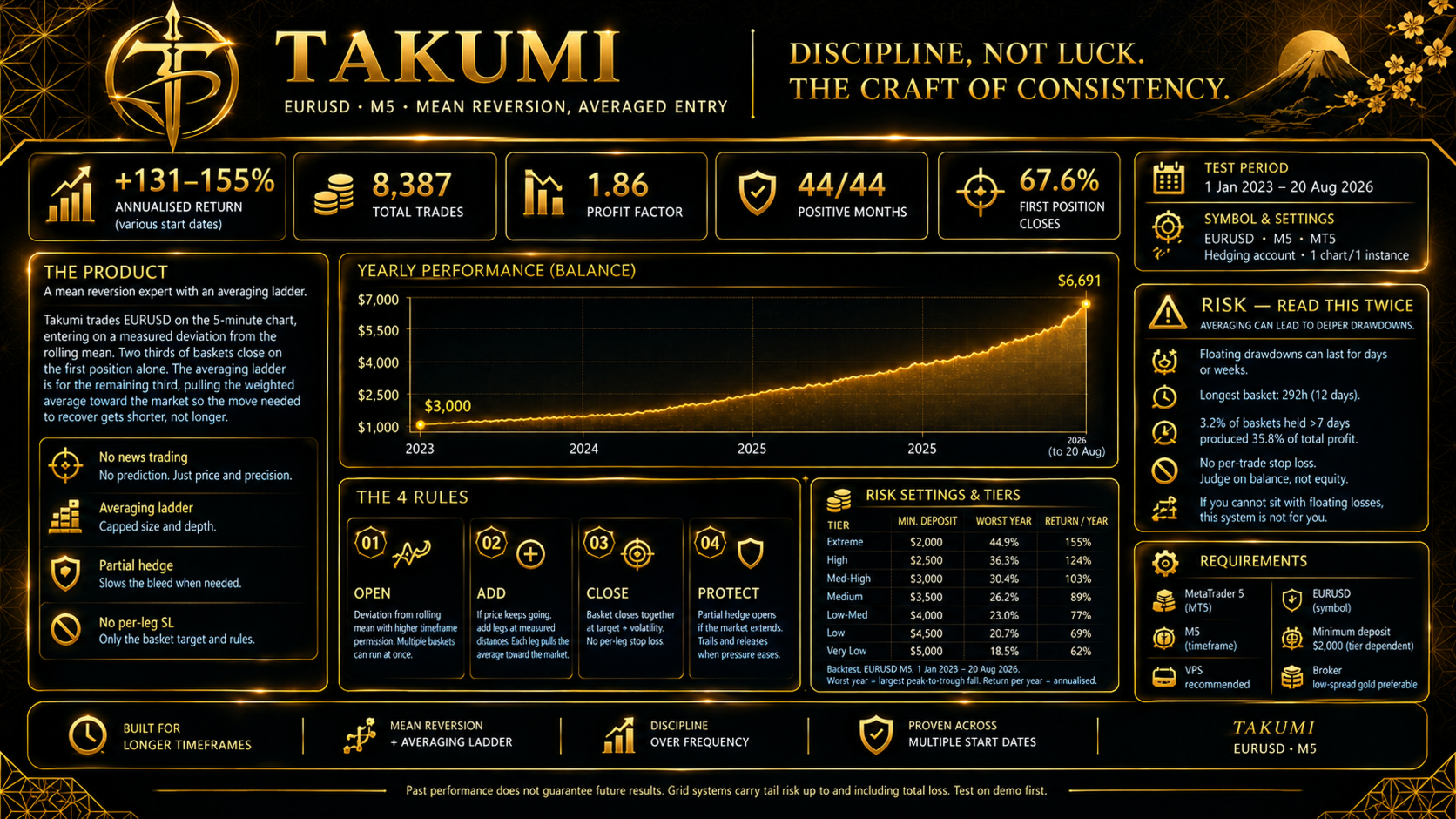
The original gallery graphic shows a different trade count (8,387), profit factor (1.86) and longest basket (292 hours), alongside different return and risk-tier figures. Those numbers cannot be silently combined with the written account. They may refer to another test or configuration, but the public material does not reconcile them. The graphic is retained for its strategy explanation, with this limitation made explicit. Its suggestion to judge balance rather than equity is not a sound way to assess open risk: both must be examined.
Takumi X signal: positive closed growth, negative equity return
The seller’s public Takumi X account is an MT5 real account on JTMarkets-Trade at 1:500. The provider describes the Extreme setting. At the 16 September check it displayed four weeks of history, a 22 August 2026 Started date, an initial $2,000 and no further deposits or withdrawals.
Closed profit was $52.63 and balance was $2,052.63, giving the displayed 2.63% growth. Equity was only $1,945.06. The $107.57 gap represents floating loss at that snapshot; equity was $54.94, or about 2.75%, below the initial deposit. This is why a smoothly rising balance chart must not be treated as the whole result for a recovery system.
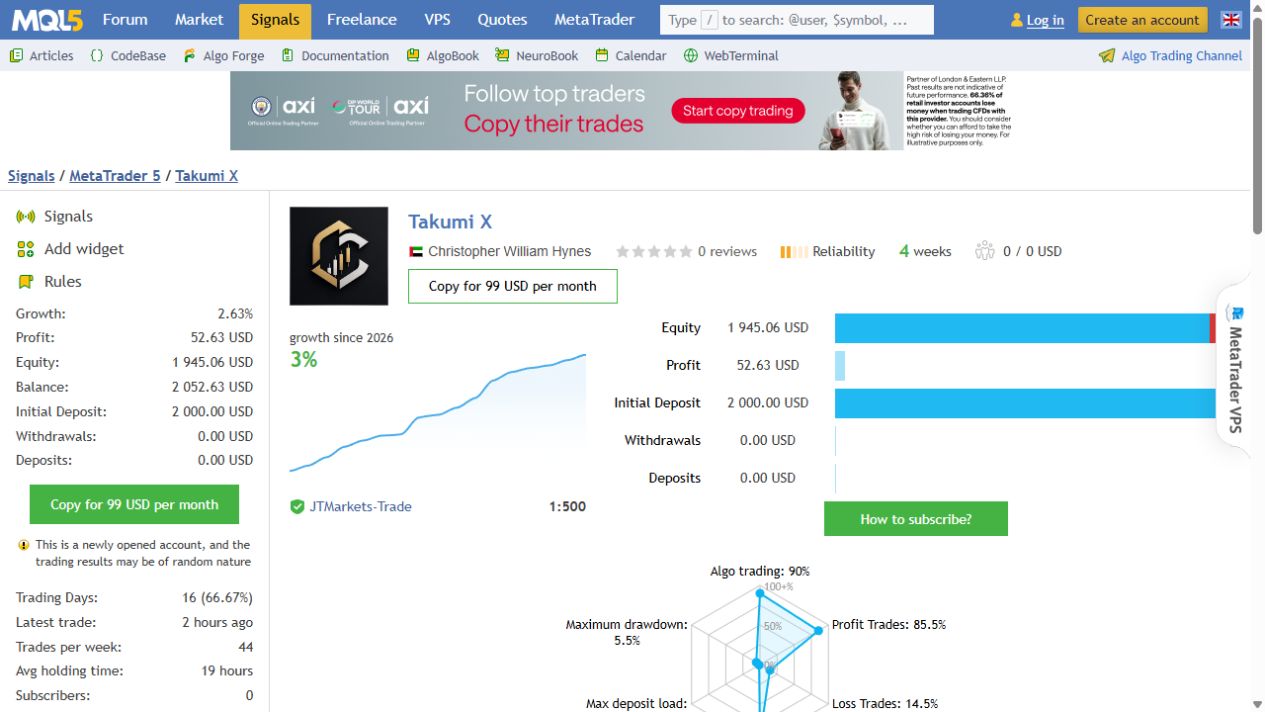
The sample contained 110 EURUSD trades: 94 wins and 16 losses, an 85.45% win rate and profit factor 3.39. Average win was $0.79 versus a $1.38 average loss. Maximum relative equity drawdown was 5.54% ($113.60), compared with 0.30% balance drawdown. Those are distinct measures; the smaller balance number does not describe the open-account risk.
Trading activity was about 90%, average holding time 19 hours, and maximum deposit load 1.31%. MQL5 marked 90% of trading as algorithmic and displayed a new-account warning. Copying-frequency warnings had appeared and been removed during the short history. None of these figures establishes long-term resilience or proves that the current tier can withstand the much longer basket described in the historical test.
Account requirements and sizing
Use EURUSD M5, one chart and one instance, on an MT5 hedging account; the developer says the EA will not start on netting accounts. The stated leverage requirement is 1:500 or higher. The published deposit range runs from $2,000 at Extreme to $5,000 at Very Low, the default tier. Broker commission must be entered correctly for the cost-aware exit calculation. Continuous VPS operation and low spreads are specified.
The risk tier changes how much capital supports each position; it does not convert mean reversion into a different entry strategy or impose a guaranteed maximum loss. High leverage is an operational requirement stated by the author, not protection from loss. Insufficient margin, wider spreads, swaps and incorrect commission input can all alter the basket path.
The developer explicitly excludes prop-firm accounts with daily drawdown rules. Long basket duration and the absence of individual stop losses make that limitation material. Test the intended deposit, tier, costs and restart behaviour rather than choosing a tier from headline return alone.
Customer feedback and assessment
No customer product reviews or comments were visible during this check, and the Takumi X signal had no reviews. No third-party testimonials or star ratings have been invented or imported. The public listing offered a private manual but no separate release-history tab was exposed.
Takumi’s useful features are its independent basket targets, cost-aware exits, trend gating and partial-hedge mechanism. The trade-off is persistent recovery exposure and potentially long holding periods. The short signal is more informative when its floating loss is included, and the inconsistent gallery statistics make fresh reproduction of the intended configuration particularly valuable. It should be evaluated as an averaging system with meaningful tail risk, not a guaranteed stream of positive basket closes.
Compare the same developer’s two systems
Kumiko XR focuses on gold with separate day and night engines. Takumi uses EURUSD mean reversion and can maintain several baskets. Both use averaging ladders; trading different symbols does not remove their shared recovery risk.