
GBP Machine Pro EA MT5 uses a dedicated GBPUSD M5 model with 70 inputs and separate buy/sell decisions for four market regimes. Its most useful distinction is the retained trade plan: the regime at entry determines the stop, target and maximum holding period. The central evidence question is whether the modern GBP model can reproduce its historical behaviour, because the developer’s long test also contains a separate early-data model branch.
View product details and current pricing.

- Official listing: GBP Machine Pro EA MT5 on MQL5
- Public track record: none specific to this EA verified at our check.
- Developer manual: GBP Machine Pro PDF in ZIP archive
Evidence scope: the developer listing, 31-page public manual and original gallery were reviewed on 16 September 2026. This is a document-based assessment; we have not run an independent forward test. CheaperForex sells this EA.
What the 70 GBPUSD features contribute
The manual groups the inputs into returns, candle anatomy, rolling price ranges, distance from means, volatility, tick volume, directional balance, RSI/slopes, time and spread. The point of this design is to describe a market state before selecting a trade. None of those individual inputs, including RSI, should be read as the sole entry trigger.
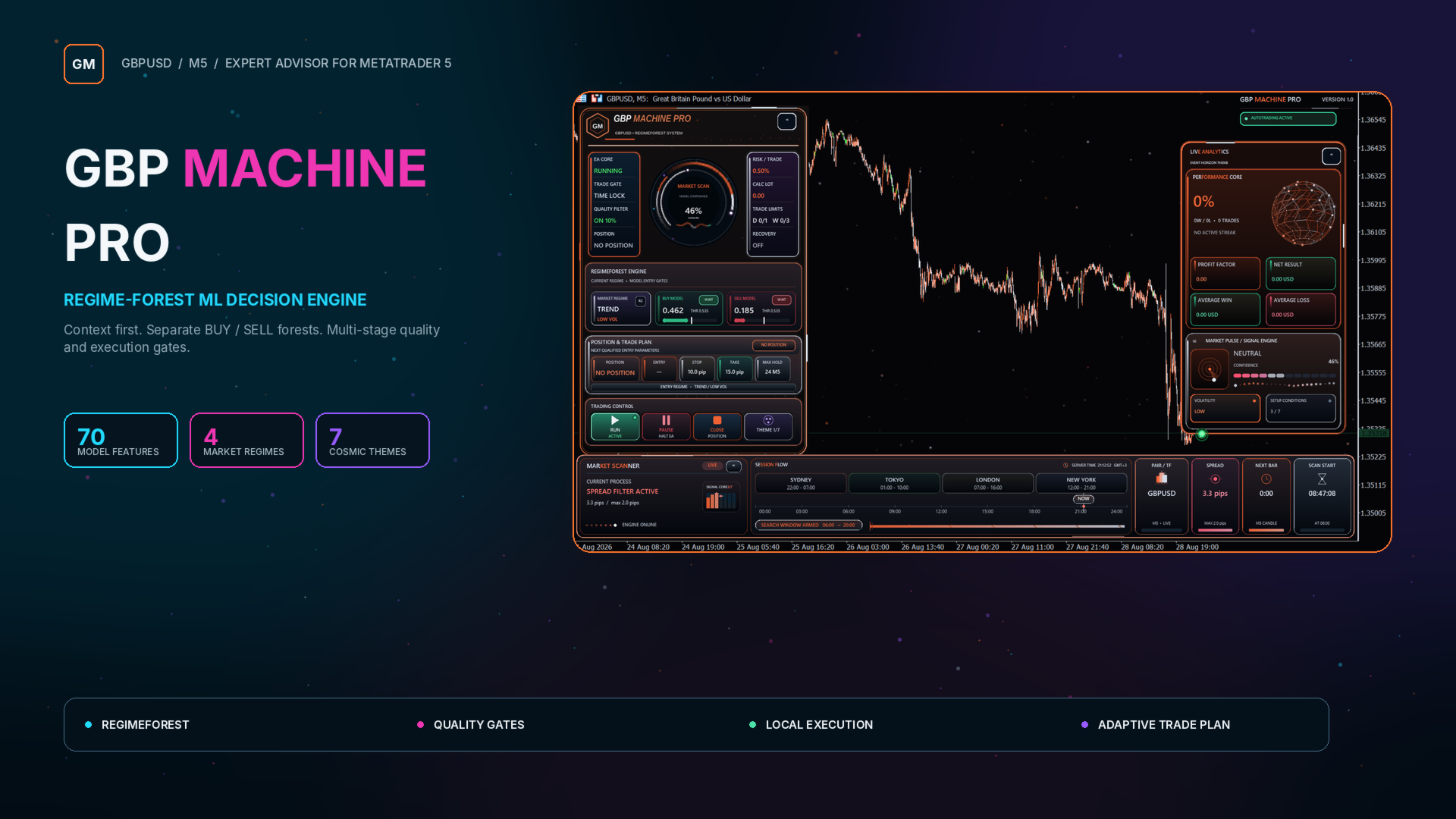
The EA classifies a completed M5 bar as range or trend, each at low or high volatility. Separate buy and sell forests then give eight directional model paths. A proposed trade still has to pass quality and execution checks. Consequently, the panel can display an apparently promising model result without placing an order; the model score is only one part of the decision.
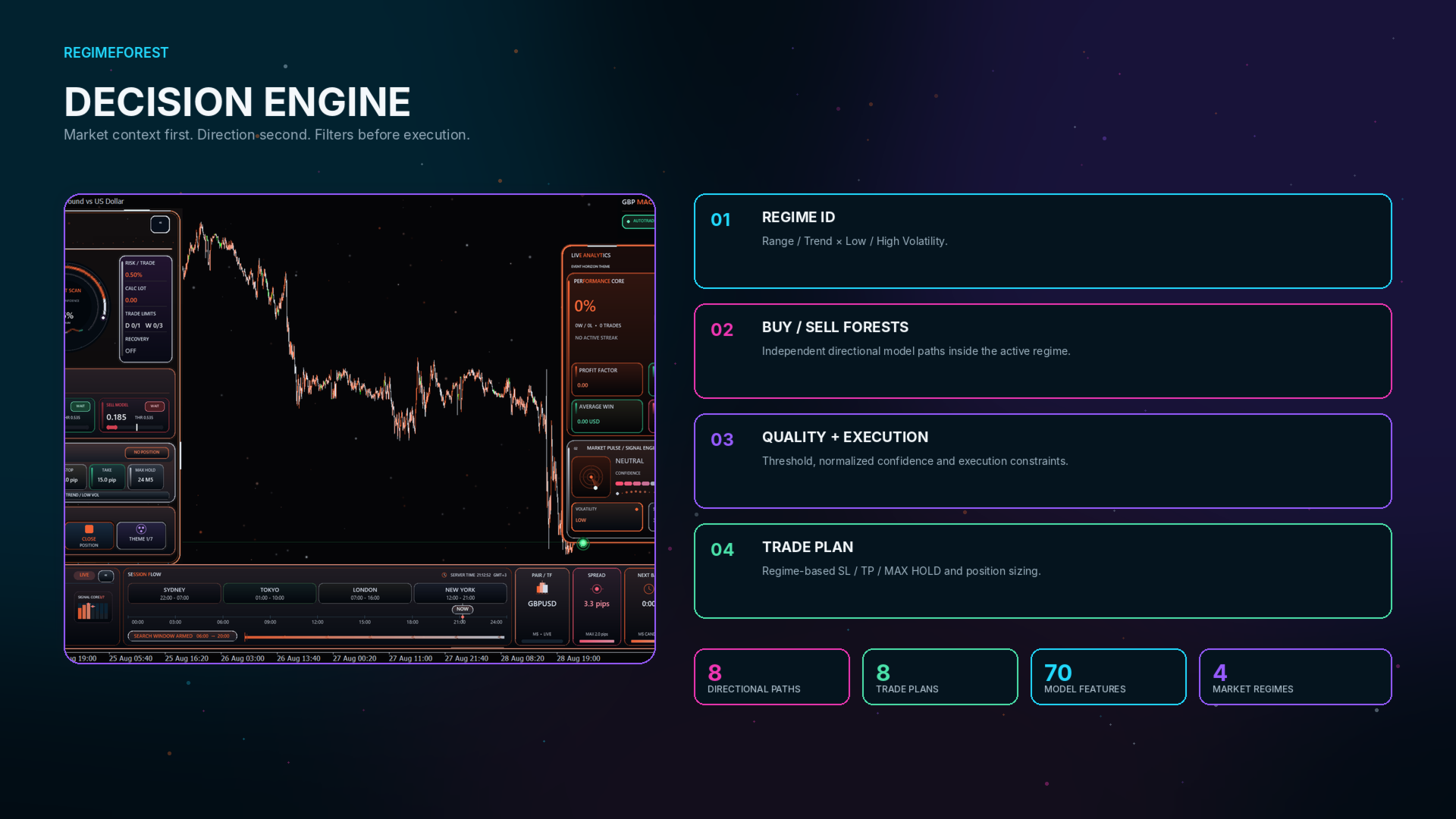
The modern GBP branch has its own confidence check
GBP Machine Pro is not the EUR edition with a currency symbol changed. Its manual describes a different feature builder, GBP forest models and trade-management calibration, including a normalised confidence-edge check in the modern branch. This is a concrete reason to evaluate the GBPUSD model separately. Fewer inputs than EUR’s 115 does not show that it is either less capable or less prone to overfitting.
Training takes place offline and the resulting model is embedded in the EA. During trading, it selects among stored model paths rather than learning an entirely new strategy from the customer’s latest trades. The decision logic therefore does not require a paid cloud-model API. “Adaptive” here refers to choosing a regime-dependent path, not proof of continuous successful retraining.
A trade keeps the plan selected at entry
The stop, target and maximum-hold profile are associated with the entry regime and direction. If the market is later classified differently, the original plan remains attached to the position. That makes the maximum-hold exit important: a trade can be closed after its allotted M5 bars even if neither price target has been reached.
Auto Risk calculates volume using the actual stop distance. Fixed Lot changes the sizing method while retaining the model’s entries and exits. One open position at a time avoids a collection of simultaneous grid orders, but says less about how size might change between trades. The manual’s Recovery status is not fully explained, so the one-position statement should not be extended into an unverified promise about all post-loss sizing.
Why the 2000–2026 test needs to be split conceptually
The strongest caveat in the GBP manual is its explicit division between a historical forest and execution calibration for 2000–2007 and the modern branch from 2008 onward. The early branch does not run in present-day live trading. A continuous curve covering those years therefore combines two historical arrangements; it is not 26 years of one unchanged current executable.
At 0.5% Auto Risk, the published control run reports 2,682 trades, profit factor 13.22, 94.74% winners and 1.62% relative equity drawdown. It separately reports 0.75% relative balance drawdown and 98% history quality. Those are developer test figures, not results independently reproduced here. The history-quality figure concerns the test data report; it does not certify the selection of the model or the absence of overfitting.
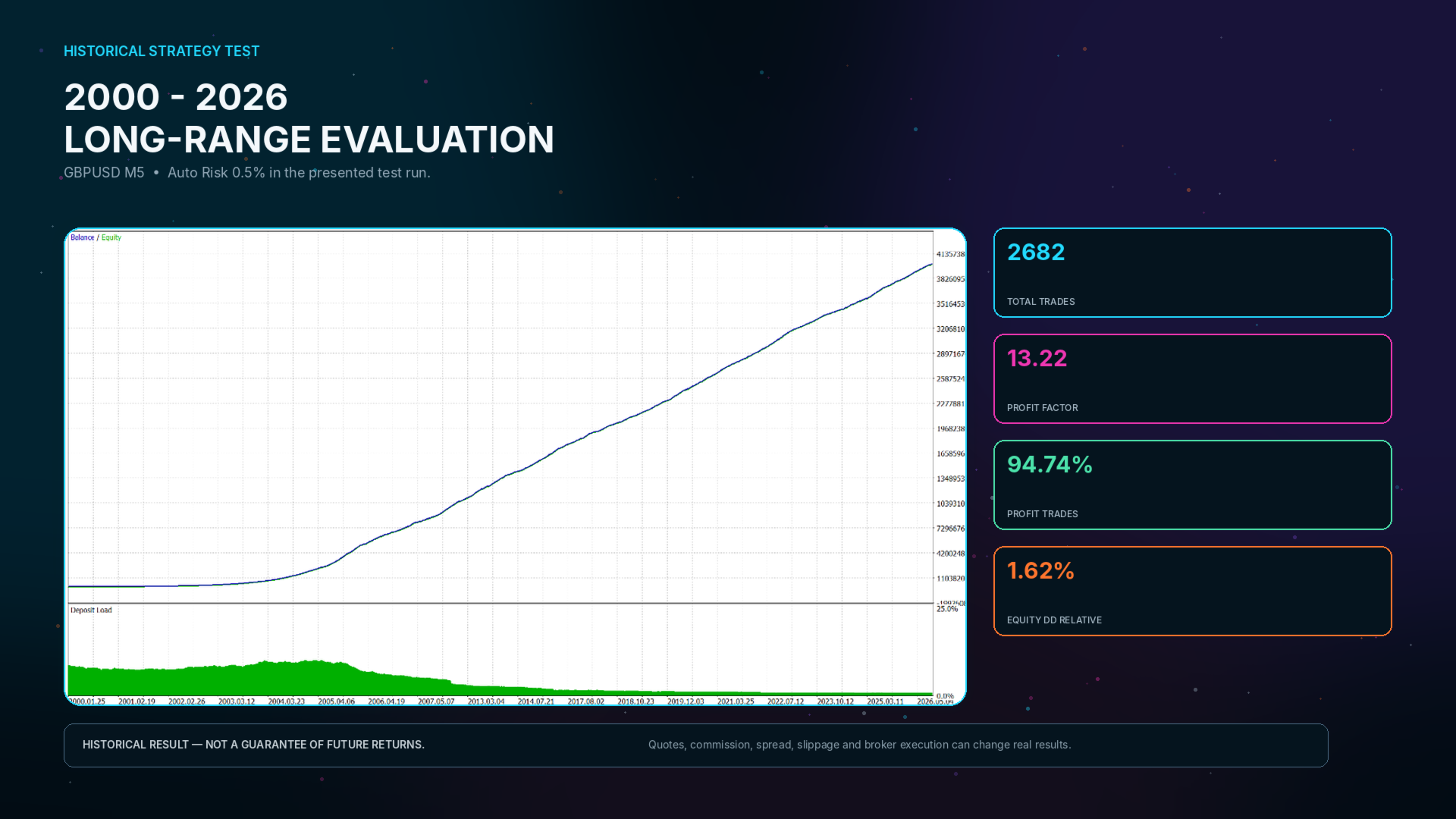
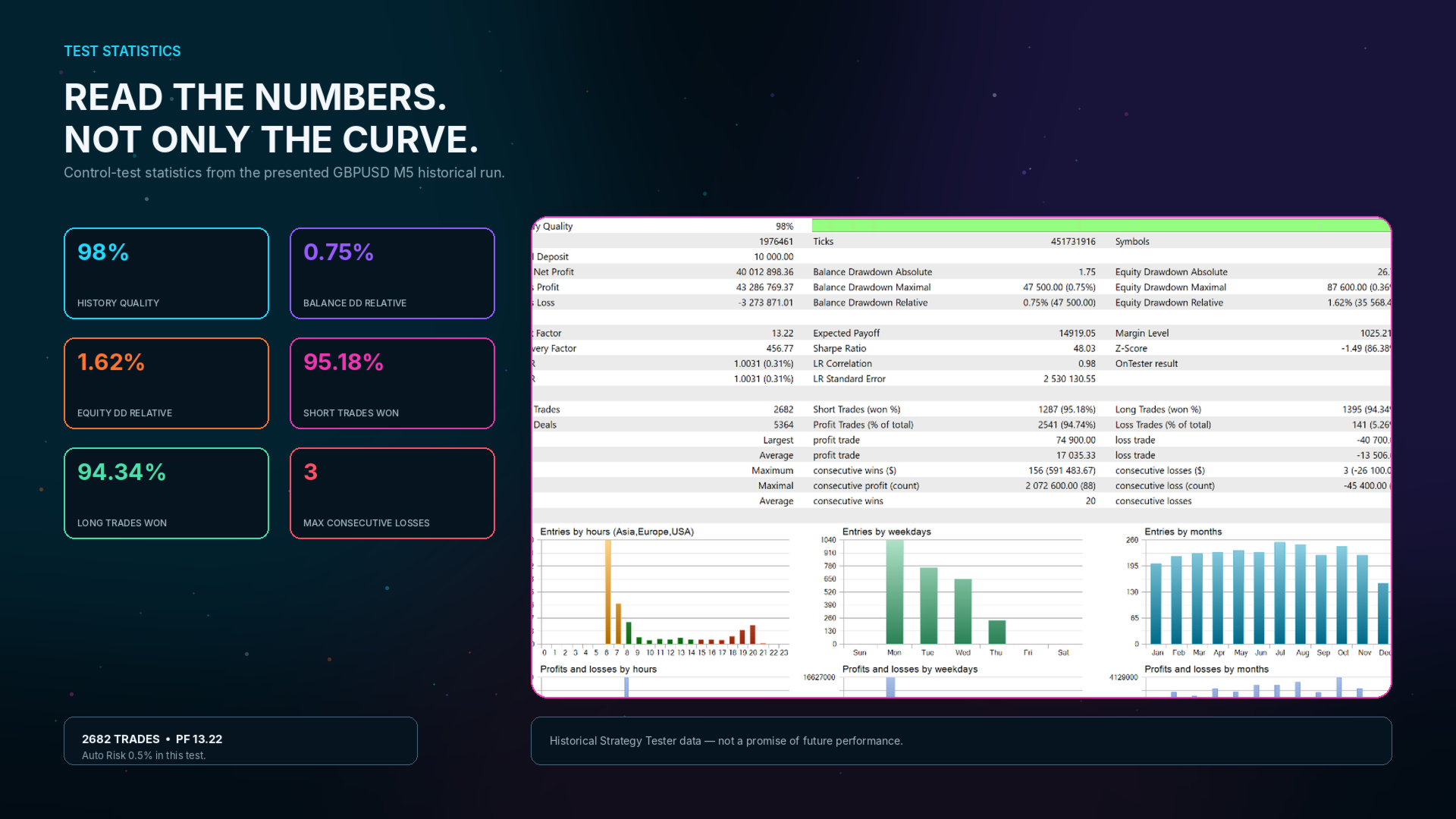
A useful validation request would separate the modern model’s results from the early branch and identify which observations were unavailable during training and model selection. Without that split, a very strong aggregate profit factor leaves the main question unanswered. Testing a different broker feed, costs and later dates would be more informative than treating the longest available curve as automatically the best evidence.
Use the interface to diagnose waiting and exits
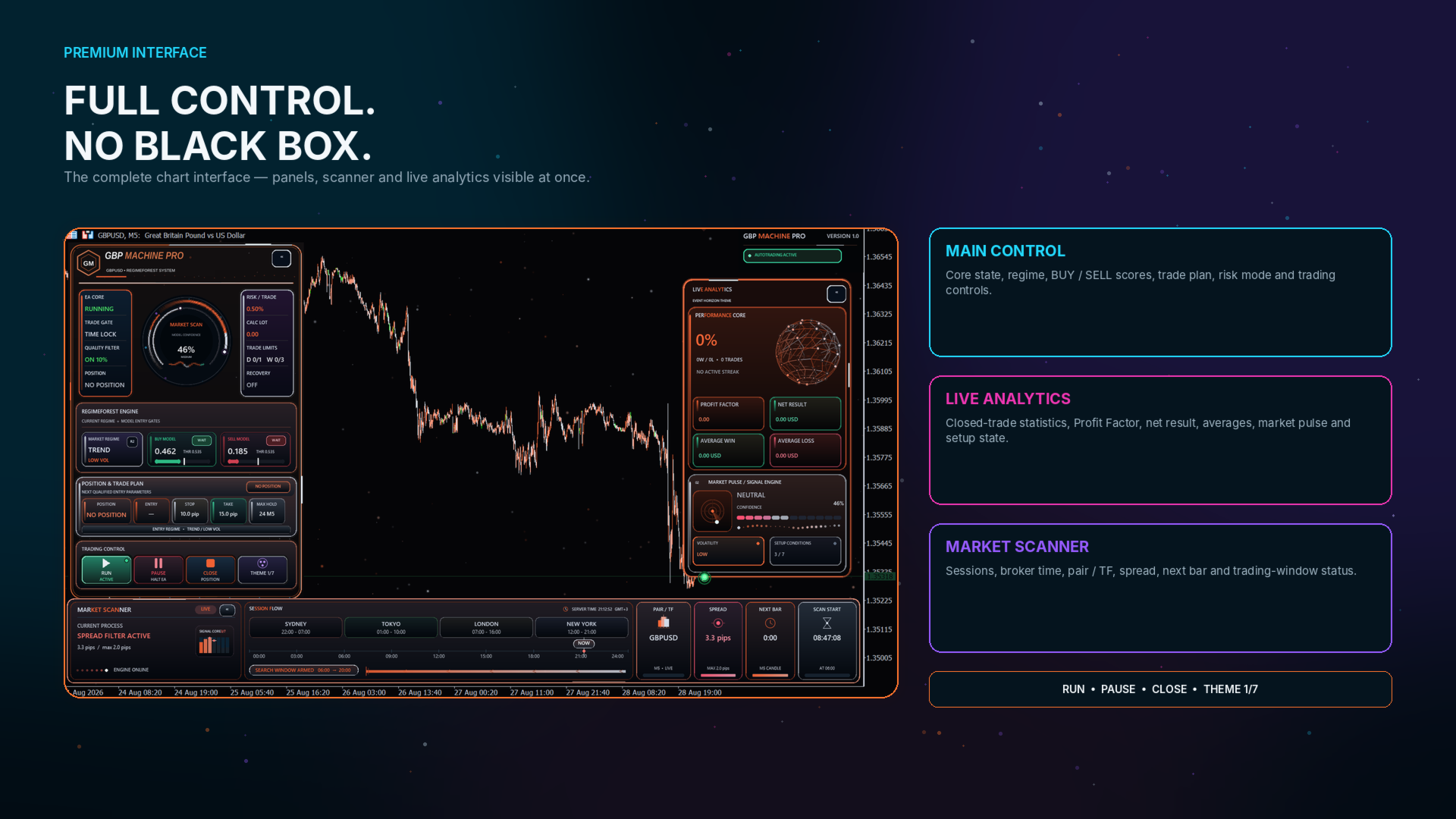
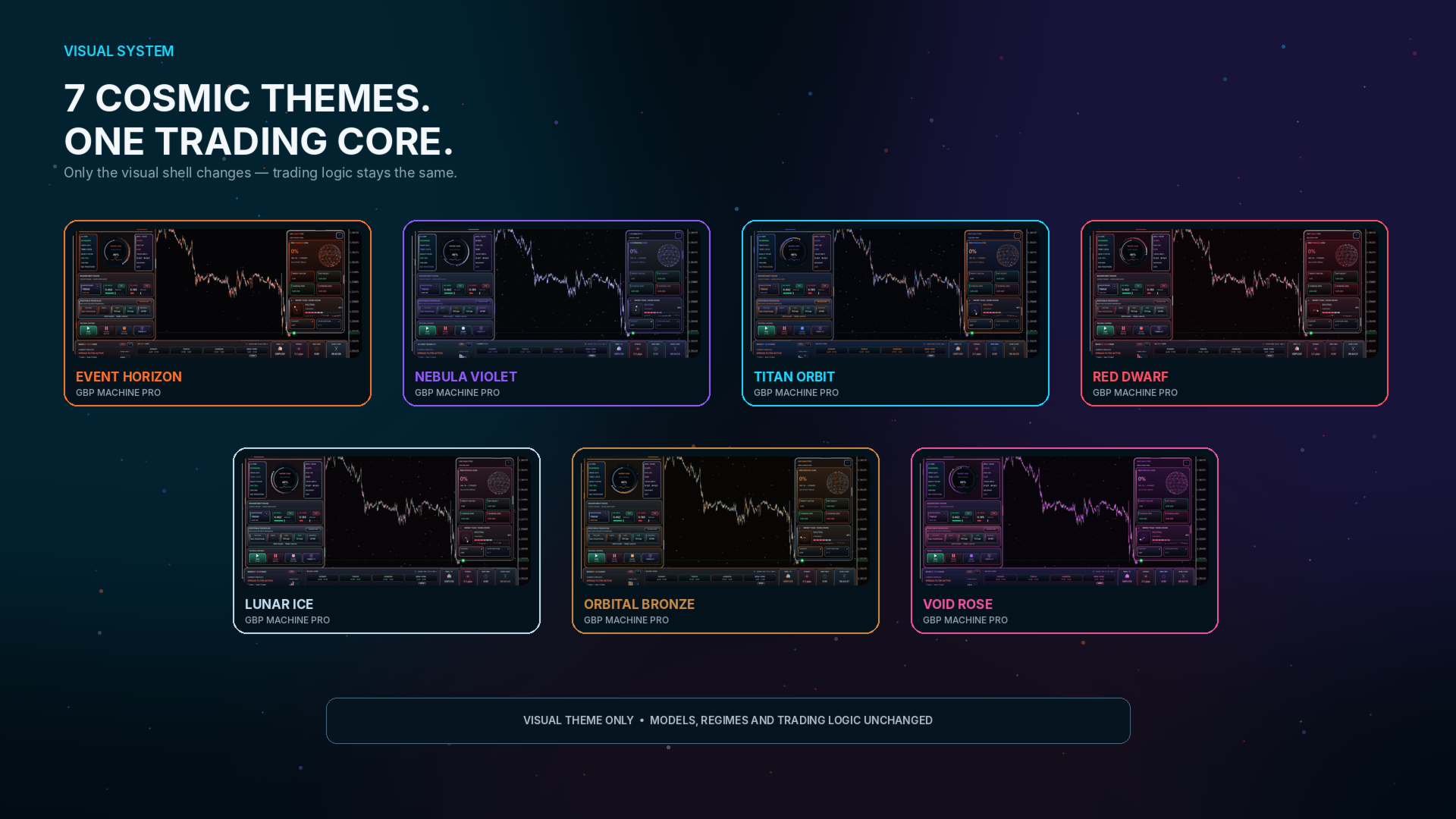
The dashboard brings together the current regime, buy/sell paths, entry gates and retained trade plan. Its closed-trade analytics concern the EA’s Magic Number; a favourable card is not a statement for the entire account. For evaluation, connect a skipped entry or time-based exit to the relevant panel state, rather than judging the system only by whether it traded frequently.
GBPUSD setup: sizing and broker time first
The documented chart is GBPUSD M5. Begin with the strategy defaults and choose Auto Risk or Fixed Lot deliberately; the developer does not ask a new user to optimise every model threshold. Verify the broker’s winter GMT offset and daylight-saving setting against the MT5 server clock. For a broker at UTC+2 in winter and UTC+3 in summer, the stated example keeps the base offset at +2 and handles summer time through DST.
The advertised $100 minimum is an operating starting point, not a loss limit. Minimum lots and volume increments can prevent a small account from expressing an exact risk percentage. A VPS is recommended, and uninterrupted terminal operation matters for the maximum-hold rule and other active management.
Current assessment and missing evidence
No dedicated public GBP Machine Pro signal or written customer reviews were available at the 16 September check. The developer’s Aurum and ORIX accounts belong to other systems and do not validate this model. The listing’s EUR bonus is a developer-direct arrangement requiring contact with the author; these store listings remain separate offers.
GBP Machine Pro is most interesting for a trader who wants to observe how a predefined model changes its decisions across regimes. Its documentation gives more detail than a generic AI label. The purchase decision still depends on obtaining credible modern-branch validation and accepting that the published simulation has not demonstrated a live trading edge.
Other systems from Leonid Arkhipov
The related products below have different markets and model cores. Their results should be assessed separately.