
NASDuck EA MT5 Review: Two-Way Nasdaq Trading System
NASDuck EA MT5 review. NASDuck EA MT5 combines trend-following and counter-trend trading for the Nasdaq 100 CFD. Its FLIGHT and DIVE engines can trade either direction, with separate strategy weights and per-position protection.
Our assessment: A clearly differentiated index product for buyers seeking both trend and reversion entries. Its design is understandable, but this new listing’s evidence is a developer backtest and one early review rather than a verified long-term public signal.
View NASDuck EA MT5 and current pricing

- Developer source link: NASDuck EA MT5 on MQL5
- Live signal link: No dedicated public signal verified at the 16 September 2026 check.
Sources checked 16 September 2026: the developer listing, available release notes, original gallery and linked public evidence. This is a source-based review, not a claim that CheaperForex independently ran this EA.
FLIGHT and DIVE have different failure modes
A trend engine may enter just before a range resumes, while a counter-trend engine may fade a move that continues. Combining them is a plausible portfolio design, but the important empirical question is whether their losses really offset at the selected weights. That requires separate engine results and combined forward observation. Descriptions of opposite market theories cannot establish a statistical relationship by themselves.
What Enhanced Risk changes
The weights allocate exposure rather than retune the entries. Scaling both down reduces the selected participation; switching one off creates a single-engine configuration. This is useful for controlled comparisons because the buyer can change the portfolio mix without optimizing dozens of entry parameters. Nevertheless, a stated risk budget does not ensure an exact realized maximum loss after a market gap or failed execution.
Historical report, with both equity drawdowns
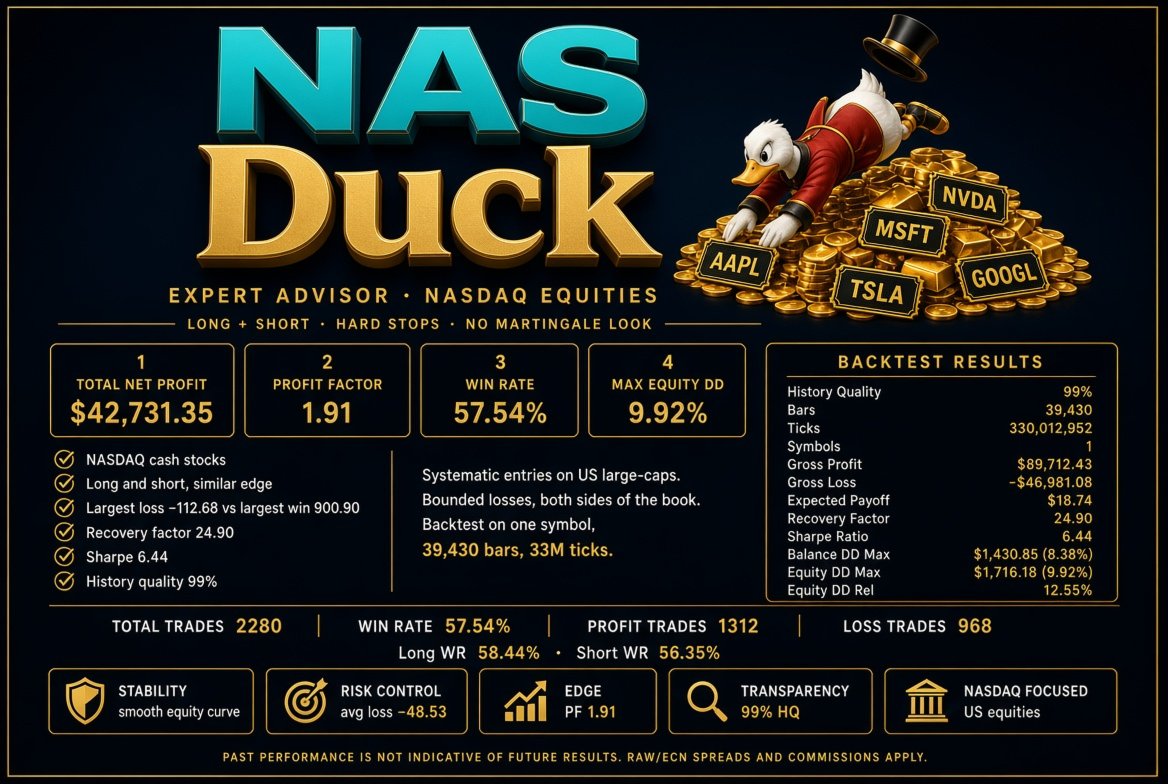
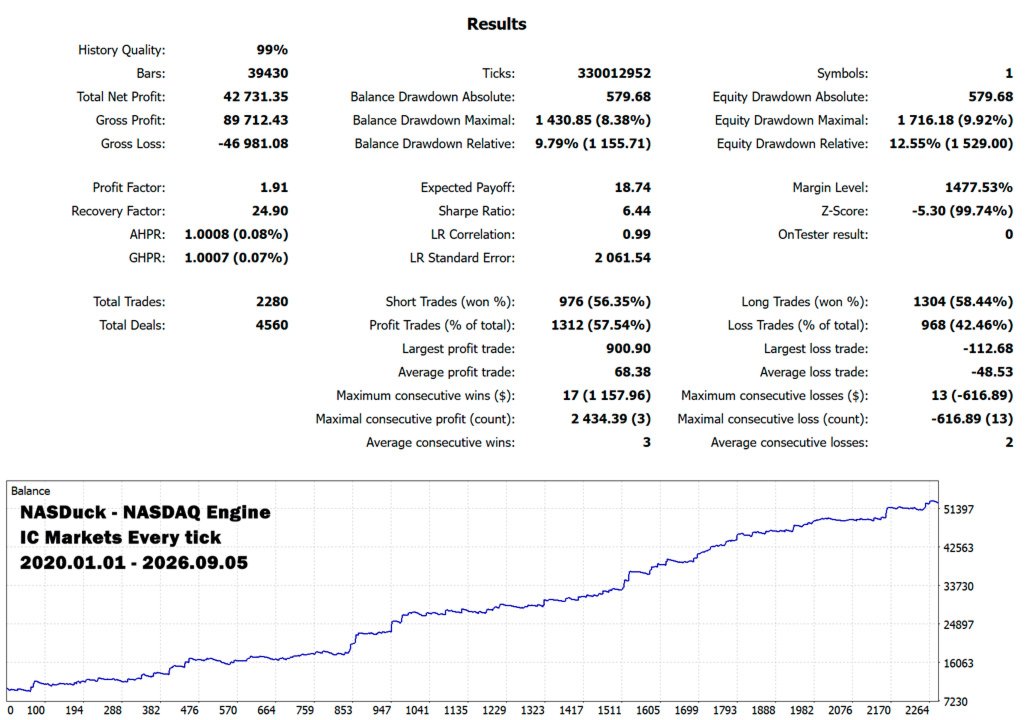
The original 2020–5 September 2026 report shows 2,280 trades, profit factor 1.91 and 57.54% winners. It lists $42,731.35 net profit. The 9.92% maximal equity drawdown highlighted in the promotional graphic is not the only risk figure: relative equity drawdown is 12.55%. The source labels the test as IC Markets every-tick data. That identifies the supplied simulation, not a monitored IC Markets account or a test independently reproduced by CheaperForex.
Evidence is early
The product was published on 6 September 2026. No NASDuck-specific live signal was linked in the listing or verified among the seller’s five public signals at the 16 September check. We do not borrow Stock Trader Pro’s performance simply because it comes from the same developer. The single customer review refers to a profitable day, which is far too little history to assess a two-engine portfolio.
Execution and account fit
Nasdaq CFD contract specifications differ materially between brokers. Check monetary value per point, lot increments, the daily break, spread around the cash open and any overnight costs. A fixed lot copied from another broker may represent a different exposure. Test each engine and then the combined configuration under the same realistic cost assumptions. The one-chart design reduces chart administration but does not remove these contract checks.
Customer feedback and its limits
One review, dated 10 September 2026, praised the EA and reported a profitable day. It is reproduced only as a short attributed excerpt. It gives an early user impression, not evidence of consistent profitability or independently verified account performance.

Original developer images and reports
These original images are retained as source material. Simulations and promotional graphics are distinct from the genuine MQL5 signal captures above. Open an image to inspect its labels and report fields.
Choosing this system
No dedicated public live signal was verified. The available performance illustration is a historical developer test. A clearly differentiated index product for buyers seeking both trend and reversion entries. Its design is understandable, but this new listing’s evidence is a developer backtest and one early review rather than a verified long-term public signal.
More from Ivan Pochta
Compare the different markets and strategy designs; sharing a developer does not mean sharing the same performance.