
Nexus Portfolio EA is Ivan Sadvarii’s MetaTrader 5 system for gold, cash indices and two currency pairs. It runs 18 trading modules with different entry rules and combines their exposure under one account-level risk manager. The strategy mix is the main reason to consider it. Broker session times and order sizes matter when evaluating how much of that portfolio actually trades.
Available from CheaperForex.

How the strategies share one account
The developer describes several distinct setups. The gold Asian-session module looks for a break of the session’s range. Some modules trade moves back toward VWAP, while an index module looks for daily pullbacks. The Pyramid Runner modules can add positions as a trade moves in their favor and use a shared trailing stop for the resulting exposure. Different rules can still create overlapping positions when several instruments respond to the same news or session open. Read the developer’s module details.
The global risk manager can limit combined open risk and how many orders or positions the EA maintains. The listing also describes daily, weekly and monthly thresholds and an optional exit based on basket profit. These controls set rules for the EA’s decisions. Fast moves, gaps and slippage can still affect the price at which a position closes.
Why broker settings affect the portfolio
- Hedging mode
- The documented setup uses an MT5 hedging account. This account mode allows positions on the same instrument to be held separately.
- Symbol mapping
- Index CFDs often use broker-specific names. Check the mapping for gold, both currencies and all five indices. Modules whose instrument is unavailable may be skipped.
- Session alignment
- The schedules assume UTC+2 during winter and UTC+3 during summer. Compare the broker’s server time around clock changes, especially for modules that use a cash-market open.
- Order size and testing
- Stop distance and each symbol’s volume rules affect the calculated lot size. The developer recommends from $5,000 for the default configuration and real-tick backtests with broker history for all instruments being tested.
What changed in version 6.1
The November 25 release lowered the default Calendar Drift notional allocation from 47% to 20% of equity per index and removed separate sizing boosts for US500 and JP225. Notional allocation measures exposure. The developer reports that the entry, exit and emergency-stop rules stayed the same. Developer release notes
What the three live signals show
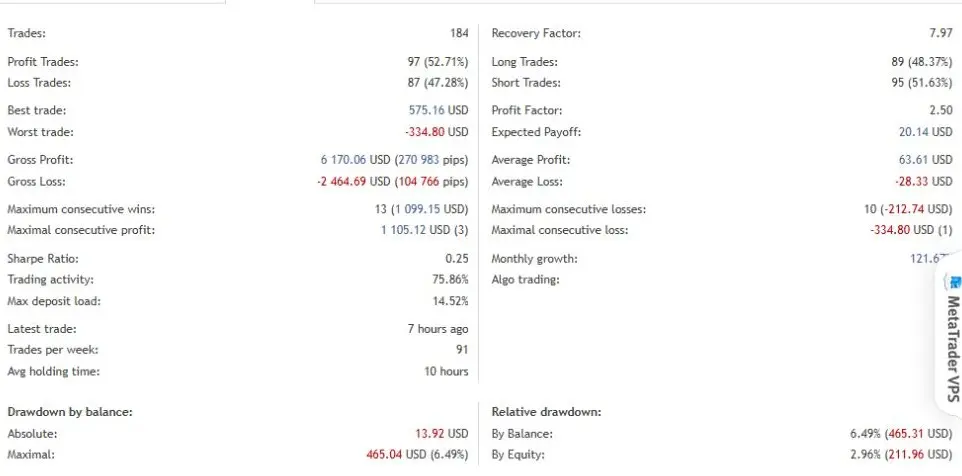
On November 25, 2026, the developer linked three separate RoboForex-ECN accounts running higher risk multipliers than the documented default of 1.0. The published mapping was 5.0 on Nexus Portfolio EA, 4.0 on Nexus Portfolio EA3 and 3.0 on Nexus Portfolio EA2. Each account covered roughly two to three weeks, and MQL5 flagged the short history.
The November 25 capture of the 5.0 account showed 184 trades, with 6.49% relative drawdown by balance and 2.96% by equity. These are account-level records. The algorithmic-trading share reported by MQL5 was about 61% to 64% across the three accounts, so their headline returns include activity beyond what the platform classifies as algorithmic. The higher settings, short histories and account-level mix make direct comparisons with default settings uncertain.
See the product details and current pricing.