
Sentora EA MT5 trades XAUUSD trend pullbacks using two exit targets on MT5 hedging accounts. The split exits are its main appeal for traders who want to take some profit early and trail the remaining position. Netting changes that trade management, and the developer’s public signal has only two weeks of history as of 27 November 2026.
Available from CheaperForex.

How Sentora trades a gold pullback
Developer Gabriel Paul Ange Perrin describes separate long and short trend-pullback engines. The EA skips new entries in a direction when it already has a position open in that direction. In MT5 hedging mode, a qualifying signal can open two positions at the same time with a common initial stop level. The first has the nearer target and can move its stop toward entry. The second aims farther and uses trailing protection. If the account uses MT5 netting, the EA uses one larger position with the nearer profit target and keeps its initial stop in place. Sentora product specifications.
The input for 1% default risk applies per signal. With two equal legs, that targets roughly 0.5% per position before lot rounding. A broker’s minimum trade size can shift the outcome, and overlapping long and short trades can increase account-wide exposure. A dashboard count of satisfied entry conditions shows the strategy’s readiness at that moment. It does not estimate the probability of a winning trade.
Don’t miss thisSee the EA we recommend
The Gold EA we trade ourselves
DowGold for XAU and US30


We have tested thousands of EAs. DowGold is the one we use and recommend, and we rarely say that. We’re also an official reseller.
Publicly tracked real USD MyFXBook accounts. A live cloud, constantly evolving strategy.
See DowGoldWhat the developer’s v1.30 test shows
The published XAUUSD M15 test for version 1.30 runs from 1 January 2020 through 5 November 2026 using historical real-tick data, a modeled $100,000 balance, 1% risk per signal and 10 ms of modeled latency. The developer reports 388 trades, a 1.86 profit factor and 9.87% relative equity drawdown. These are simulated figures from one broker setup. Live execution variation, broker contract terms and lot rounding can change outcomes, and CheaperForex has not independently reproduced the test. Developer’s historical test settings and figures.
Version 1.30, published 23 November 2026, changed trade logic and introduced adjustable equity controls. The default daily stop is 3% below equity at the start of the broker day. The separate peak-equity stop is 17% below an equity high. The developer says small accounts can use wider effective limits, up to 15% daily and 30% from the peak. Inspect the thresholds on your actual account. Platform downtime, gaps and slippage can affect closes, and account rules need a separate check. Version 1.30 release notes.
Sentora’s public signal and marketplace feedback
The developer links a Sentora account on MQL5. On 27 November 2026, its public record showed 2.61% growth and €783.51 profit on an initial €30,000. MQL5 displayed about two weeks of history and four closed XAUUSD trades, with a warning that there were too few trades to evaluate the signal. The account began on 11 November, before v1.30 was released. Its aggregate figures cover both sides of that release date and cannot isolate the current version’s performance. Sentora public signal and trade history.
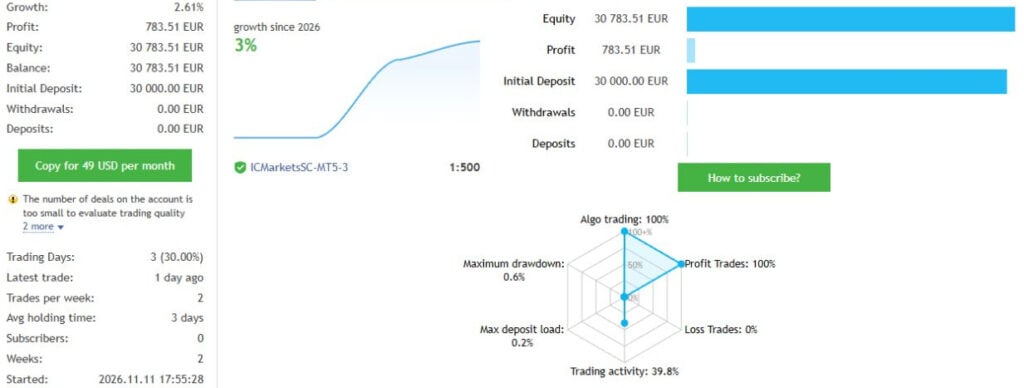
The Sentora marketplace listing showed one customer rating on 26 November 2026 with no written feedback. The rating offers no details about the customer’s broker, settings or experience running the EA. Sentora reviews on MQL5.

Who should look at Sentora?
Sentora’s two exits are most relevant to MT5 hedging users who already trade XAUUSD and want to separate early profit-taking from a longer trailing exit. Before running it live, use your broker’s demo environment to inspect order size, stops and spreads, and check the effective daily and peak-equity thresholds. Give the short public record limited weight in your decision.
See Sentora’s features and current price.