
Last updated: May 2026
Two weeks isn’t enough time to validate a forex EA. It especially isn’t enough time to validate a grid/Martingale-style system, where the dangerous performance scenarios — sustained drawdowns during persistent trends — sometimes don’t materialize for months or years of favourable conditions.
View product details and current pricing.
That’s the honest starting point for this AnE review. The product launched 1 May 2026 from Thi Ngoc Tram Le, a Vietnamese developer with a respectable portfolio including AOT (4.76★ across 108 verified MQL5 reviews). The 2-week live signal shows promising early numbers — 22% growth on $500 deposit, 5.6% maximum drawdown, 78.8% profit trades, IC Markets at 1:1000. The 2018-2026 backtest in HIGH RISK mode produces an eye-watering $32.8 million from a $10,000 starting deposit. Two 5-star MQL5 reviews from verified buyers are already accumulated.
None of that proves AnE will work over the long term. None of it disproves it either. This review covers what we know, what we don’t know, what the grid mechanics mean structurally, and how to think about AnE if you’re considering buying it now versus waiting for more data to accumulate.
⚠️ Searching for AnE EA free download? AnE is an MQL5 marketplace product with built-in DRM. Cracked .ex5 files do not exist for marketplace EAs. Sites offering “free downloads” deliver malware, fake EAs that won’t execute, or funnel you into Telegram VIP signal scams. CheaperForex offers AnE at a significant discount on the official MQL5 price with full activation and a 7-day money-back guarantee.
The Critical Disclosure: AnE Is a Grid/Martingale System
The single most important fact about AnE — the one that should determine whether you read the rest of this review or close the tab — is that AnE explicitly uses grid-based averaging with Martingale-style position management. The developer is transparent about this in both the official MQL5 listing and the PDF user manual that ships with the product.
Grid/Martingale systems work like this:
- Initial entry — The EA opens its first position based on the configured signal logic.
- Adverse movement — If price moves against the initial entry, the EA may open additional positions at strategic intervals to lower the average entry price of the basket.
- Basket profit target — Once the combined profit of all open positions reaches the target threshold, the entire basket closes simultaneously at a weighted-average exit point.
- Circuit breaker fallback — If the configured Max Drawdown Circuit Breaker threshold is reached at any point, all trading stops automatically.
The mechanical advantage of this approach is high win rates — most market movements eventually reverse, and the basket closes profitably when reversion arrives. The structural risk is that some movements don’t reverse quickly. Sustained trends — particularly the kind of one-way moves Gold can produce during geopolitical events, central bank policy shifts, or systemic market stress — leave the grid stacking positions that drift deeper underwater without finding the reversion that closes them in profit.
This is the fundamental trade-off built into the architecture. AnE delivers smooth equity curves most of the time. When it doesn’t, the drawdown is structurally larger than what single-trade EAs produce.
The 2-Week Live Signal — What It Shows and What It Can’t Show Yet
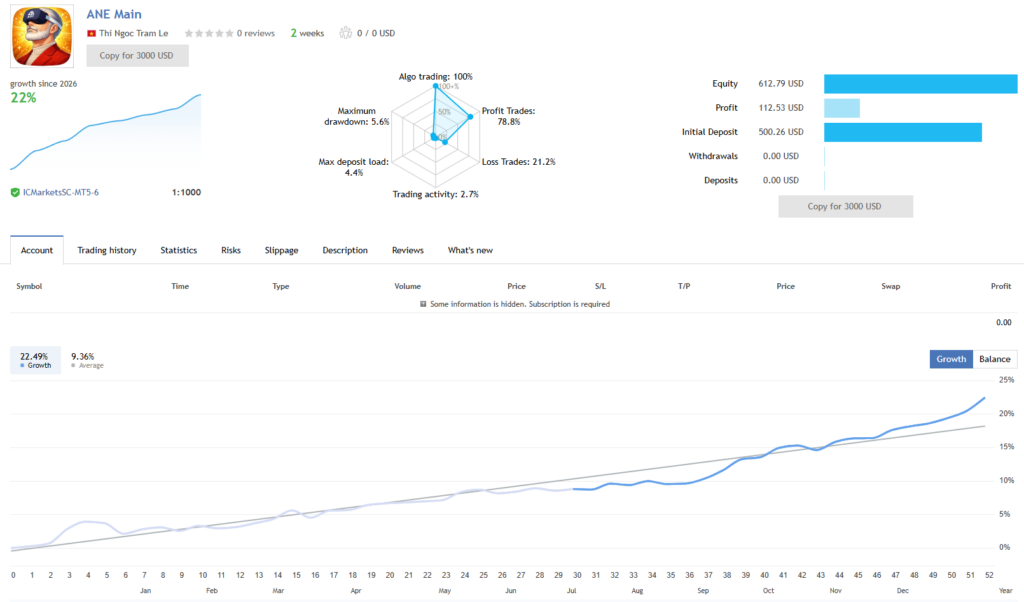
The verified AnE Main live signal has been running 2 weeks at the time of writing. Here’s the data:
- Growth: 22.49%
- Average Growth: 9.36%
- Initial Deposit: $500.26
- Current Equity: $612.79
- Profit: $112.53
- Maximum Drawdown: 5.6%
- Max Deposit Load: 4.4%
- Profit Trades: 78.8%
- Loss Trades: 21.2%
- Trading Activity: 2.7%
- Algo Trading: 100%
- Withdrawals: $0
- Additional Deposits: $0
- Broker: IC Markets (ICMarketsSC-MT5-6 server)
- Leverage: 1:1000
What this validates: The system is real, executes trades on a live account, and the developer is using their own product with skin in the game ($500 of personal capital deployed). The 5.6% maximum drawdown across the 2-week window is genuinely impressive control for a grid system. The 78.8% win rate is consistent with grid/Martingale architectures generally — these systems are designed to produce high win rates because they wait for reversion rather than accepting losses.
What this can’t validate: Whether the system will perform similarly during the next sustained Gold trend. Whether the 5.6% max drawdown will hold up over a 6-month or 12-month window. Whether the 22% growth rate is sustainable or if early signals reflect favourable market conditions that won’t persist. The honest answer to all these questions is “we don’t know yet.”
The 2.7% trading activity figure is worth noting separately — it suggests the EA waits for specific signal conditions rather than over-trading. This is a positive architectural choice for a grid system, but also means longer windows where positions sit open. Whether that’s a benefit or a risk depends on how those open positions perform during adverse market periods.
The 2018-2026 Backtest — How to Read $32.8 Million From $10,000
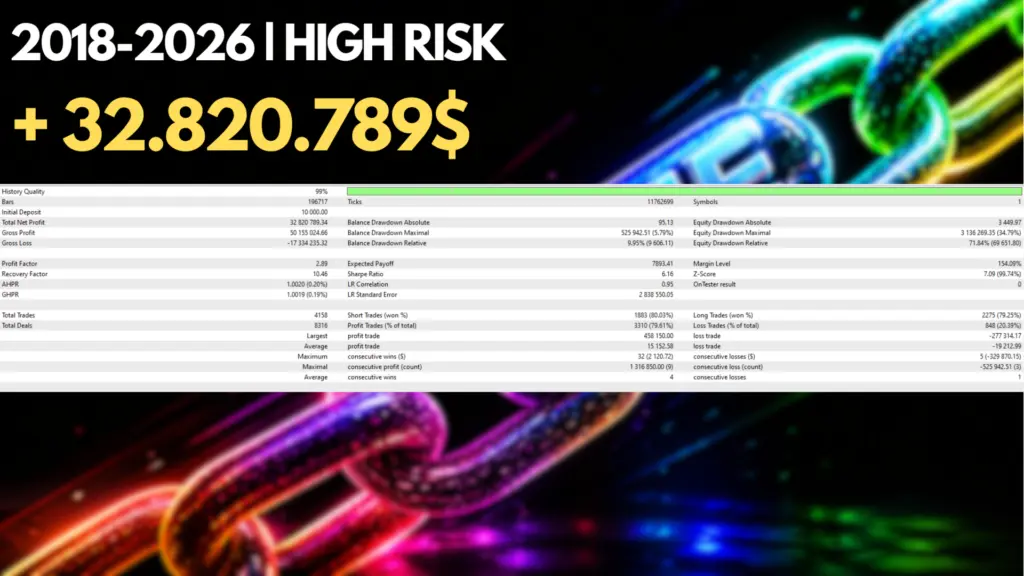
The developer’s published backtest is striking on first read. $10,000 starting deposit becomes $32,820,789. 2.89 profit factor. 79.61% win rate. 4,158 trades over 8 years. 99% history quality. Sharpe ratio 6.16, recovery factor 10.46.
These numbers are technically impressive but require careful contextualisation:
The 99% history quality is a positive signal. Most backtests on poor-quality data produce inflated returns through spread/slippage simulation errors. 99% history quality from MetaQuotes data means the underlying tick data is reliable, so the backtest isn’t being inflated by data quality issues.
The 4,158-trade sample size is substantial. Most EA backtests cover a few hundred trades over short windows where statistical conclusions are impossible. Over 4,000 trades crosses the threshold where backtest patterns become statistically meaningful evidence rather than noise.
The HIGH RISK mode disclosure is the critical caveat. The backtest explicitly states “2018-2026 | HIGH RISK” — meaning the configuration tested is the most aggressive setting available, not a balanced or conservative one. HIGH RISK on grid/Martingale systems means larger initial positions, more aggressive averaging multipliers, and higher floating drawdown tolerance. The 34.79% maximum equity drawdown number reveals the cost — you’d need a starting balance large enough to absorb a 35% account drawdown without triggering margin calls.
The 2018-2026 window includes favourable conditions for grid systems. Gold spent significant portions of this window in range-bound or moderate-trend conditions where grid/Martingale architectures perform well. The window does not include extreme one-way moves like the Gold collapse from $1,900 to $1,180 in 2012-2015 or the rapid moves seen in early 2020 — the backtest tells you how the system would have performed during a specific 8-year window, not how it would have performed during the worst historical periods for Gold.
Don’t extrapolate backtest profits to live expectations. The $32.8 million from $10K result reflects: (a) HIGH RISK mode configuration, (b) compounding across 8 years with zero withdrawals, (c) historical data that doesn’t include the worst-case adverse periods for grid systems. Live trading with the same system on a real account, in real market conditions, with real spreads and slippage, will produce significantly different results — both positive and negative depending on the period.
Grid Averaging in Action — How AnE Places Trades
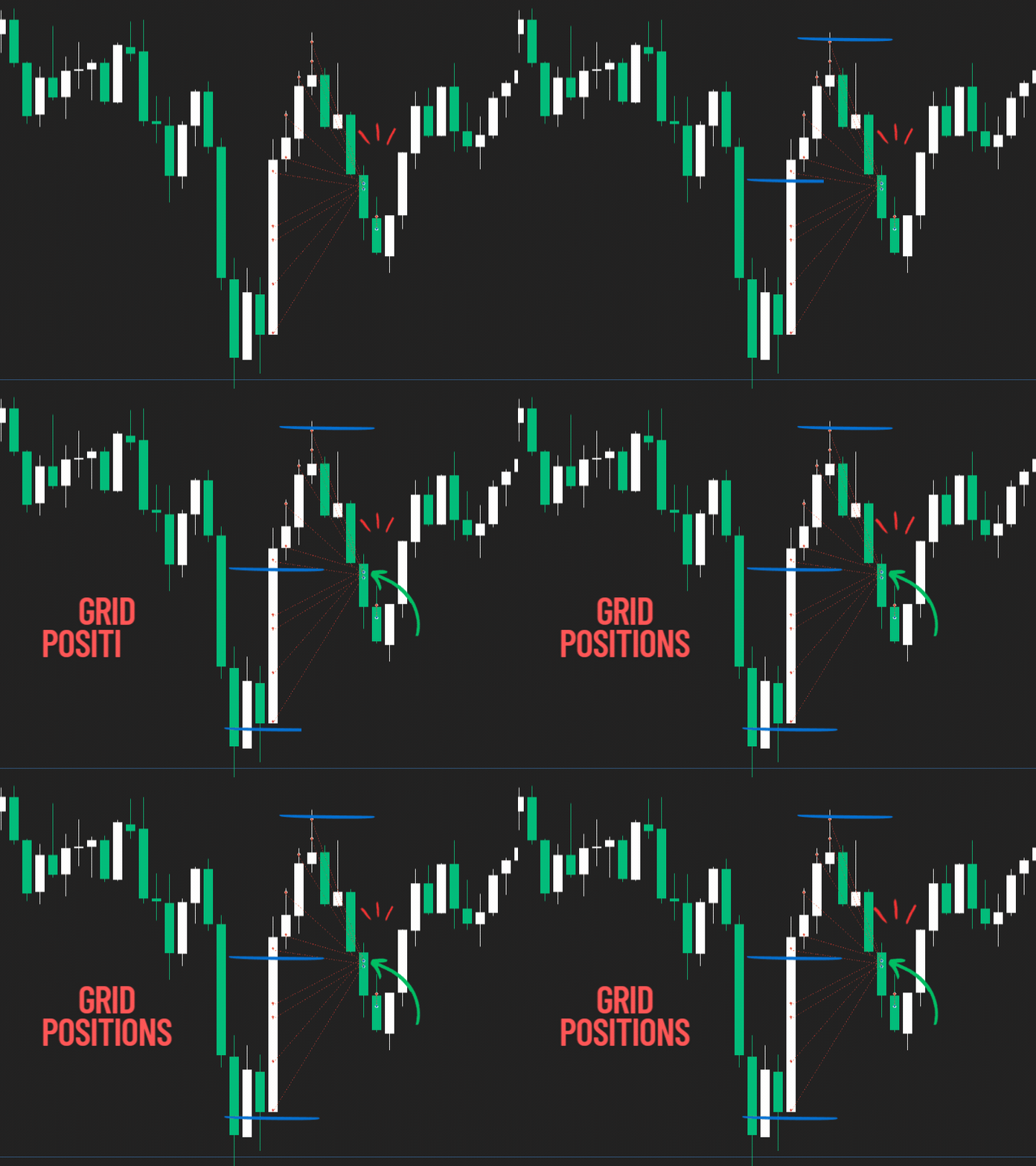
The chart example above shows AnE’s grid mechanics visually. You can see the multiple entries opened at strategic price levels as the market moved adverse to the initial position, then the basket closing in combined profit once price reverted.
This visualisation makes two things clear that the text alone doesn’t convey:
1. The grid spacing is structured, not random. The averaging entries appear at specific intervals rather than randomly scattered, suggesting the system uses a defined averaging logic rather than ad-hoc position layering. This is a positive architectural choice — random averaging tends to over-stack positions during adverse moves, while structured averaging maintains controlled position scaling.
2. The basket closes coherently. All positions in the basket close at the same time when the combined profit target is reached. This is the expected grid behaviour and confirms AnE manages positions as a coordinated group rather than independently. The structural risk remains — if price had continued moving adverse without reversion, the basket would have either continued growing or hit the Max Drawdown Circuit Breaker — but for trades that do close at profit, the mechanics work as documented.
Account Protection Layer — The Max Drawdown Circuit Breaker
The Max Drawdown Circuit Breaker is AnE’s most important safety feature. It stops all trading entirely once the configured drawdown threshold is reached. Default value is 80% — which is permissive enough that most traders should reconfigure it tighter immediately upon installation.
Recommended Circuit Breaker settings by risk profile:
- 10% — Prop firm-style risk management. Aligns with typical prop firm daily drawdown limits but may trigger frequently with grid systems.
- 15-20% — Conservative deployment. Allows the grid to manage normal floating drawdown while protecting against extreme adverse moves.
- 25-30% — Moderate risk. The level we’d recommend for most users running AnE with adequate capital ($1,000+).
- 50% — Aggressive. Only appropriate for traders with substantial account headroom and explicit willingness to accept large drawdowns.
- 80% (default) — Effectively no protection. We’d reconfigure this immediately.
The two other built-in protections are valuable but secondary:
Spread Filter (default 70 points) — Prevents new entries when broker spread exceeds the threshold. Critical for XAUUSD specifically since Gold spreads widen significantly during news events, session changeovers, and low-liquidity periods.
Lot Size Limits — Configurable minimum and maximum lot sizes prevent the auto-lot system from oversizing during account growth or drawdown recovery.
PDF User Manual Quality
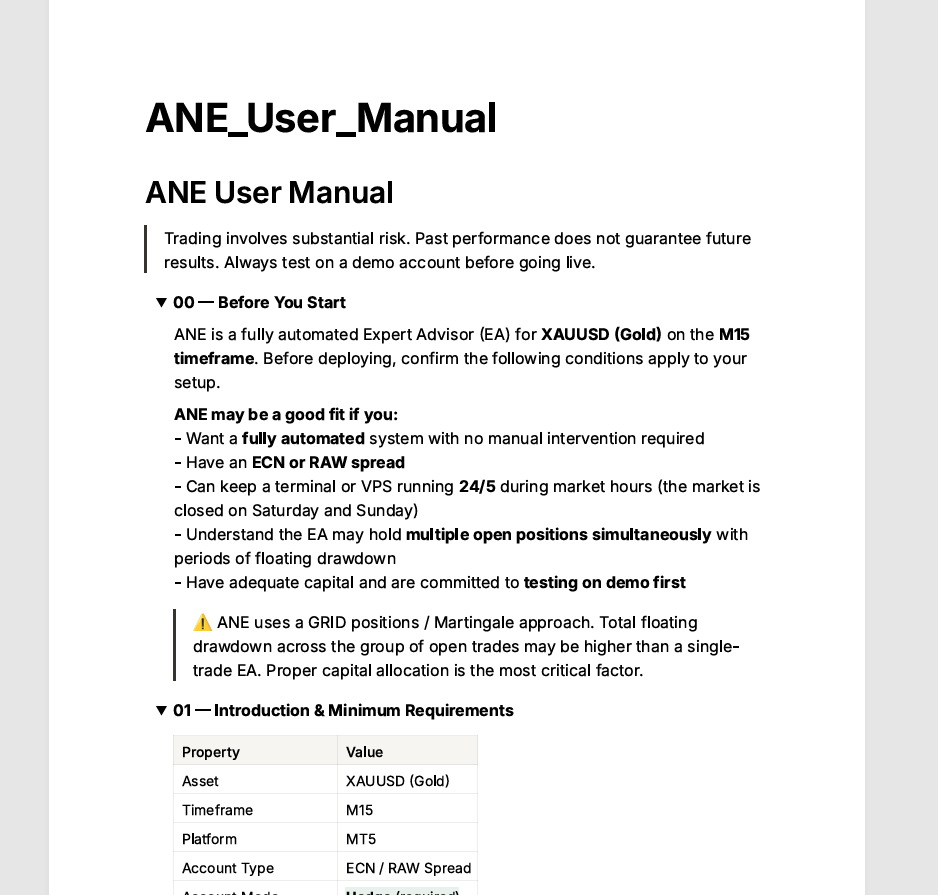
The PDF user manual that ships with AnE is genuinely useful and demonstrates the developer’s seriousness about responsible deployment:
- “00 — Before You Start” section explicitly warns about the grid/Martingale nature and floating drawdown characteristics
- Clear minimum requirements (ECN/RAW spread, 24/5 VPS, adequate capital, demo testing commitment)
- Honest disclosure that the EA “may hold multiple open positions simultaneously with periods of floating drawdown”
- The warning callout: “AnE uses a GRID positions / Martingale approach. Total floating drawdown across the group of open trades may be higher than a single-trade EA. Proper capital allocation is the most critical factor.”
This level of transparency in pre-sale documentation is a positive signal. Many grid system developers obscure the underlying mechanics with marketing language like “intelligent averaging” or “smart recovery.” Thi Ngoc Tram Le’s documentation calls the architecture what it is, which lets buyers make informed decisions about risk fit.
Verified MQL5 Reviews

AnE has accumulated 2 verified MQL5 reviews at the time of writing, both 5-star. Both reviews are recent (May 2026) and from verified purchasers.
Vi Khang Ngo — 6 May 2026 ⭐⭐⭐⭐⭐
“Great start with profits, hope it keeps going well.”
Michael John Malkinson — 6 May 2026 ⭐⭐⭐⭐⭐
“Hands down the best seller on this marketplace. Honestly MQL5 itself is just a cess pit of scammers looking to milk as many gullible people as fast as possible with their backtest and high prices. Thi Ngoc Tram Le however is one of the very few shining stars who actually creates EA’s that genuinely turn profits and have trading plans. This product so far has ran amazingly, although early days, I have every faith in it.”
Two reviews is too small a sample to draw conclusions from, but both are explicitly enthusiastic and one (Malkinson, with 805 forum posts on MQL5) takes the time to praise the developer broadly rather than just the product. The developer’s responses to both reviews are warm, professional, and prompt — a small but consistent positive signal about post-sale engagement.
From Established Developer Thi Ngoc Tram Le
Thi Ngoc Tram Le is an active Vietnamese MQL5 developer with a focused product portfolio that demonstrates a consistent design philosophy across grid-based and mean-reversion systems. Indirect validation for AnE comes primarily from the developer’s track record on other products:
- AOT — The developer’s flagship. Multi-currency mean-reversion EA with 4.76★ across 108 verified MQL5 reviews. AOT is the strongest validation point in the portfolio — sustained 4.76★ across 108 reviews represents real buyer satisfaction over an extended period.
- ABS GoldGrid — The developer’s prior gold-focused grid EA. 3.89★ across 37 verified MQL5 reviews on XAUUSD H1. Most directly comparable to AnE in terms of strategy class (grid-based gold averaging), though the M15 timeframe and updated logic in AnE represent a meaningful evolution.
The portfolio shows the developer has experience shipping both mean-reversion (AOT) and grid-based systems (ABS GoldGrid) over extended periods. AnE appears to be the developer’s refined attempt at a Gold grid system, applying lessons from ABS GoldGrid to a faster timeframe (M15 vs H1). Whether the refinements produce sustained improvements requires more live data to confirm — but the track record of building products that earn verified buyer feedback over time provides reasonable confidence in the developer’s general competence.
Who Should Buy AnE Now vs Wait for More Data
Buy AnE now if:
- You’re an experienced grid/Martingale trader who understands the mechanics and accepts the floating drawdown structure
- You have $1,000+ in dedicated risk capital that you can comfortably lose
- You’ll configure the Max Drawdown Circuit Breaker to 25-30% (not the 80% default)
- You’ll demo-test for 4-6 weeks before any meaningful live deployment
- You’re comfortable with the early-adopter position — small sample size, limited validation, possible future product changes
- You trade on an ECN/Raw spread broker with hedging accounts and 1:100+ leverage
Wait for more data if:
- You’re uncomfortable with grid/Martingale mechanics in principle — this doesn’t change with more data
- You trade prop firm challenges with strict drawdown rules — grid systems can breach daily DD limits
- You’d prefer 6+ months of live signal data before deploying capital — entirely reasonable for any grid system
- You’re early in your EA evaluation journey and want products with extensive review history (137+ reviews like Big Forex Players, or 319-week live signals like Sentinel AI)
- Your account size is below $1,000 and the minimum 0.01 lot margin requirements are tight
The genuinely honest answer is that 2 weeks of live data and 8 years of HIGH RISK backtest aren’t enough validation to deploy substantial capital. But they’re also not nothing — early adopters get the benefit of getting in while the product is new and the developer is most attentive to feedback. The right answer depends entirely on your risk tolerance and where you are in your EA evaluation process.
Where to Download AnE Legitimately
Two sources, and only two:
MQL5 Marketplace — direct purchase from Thi Ngoc Tram Le’s official developer page. AnE on MQL5.
CheaperForex — authorised reseller pricing significantly below MQL5’s price, same official .ex5 file with proper activation, free lifetime updates, same PDF user manual, plus a 7-day money-back guarantee before activation and an extra 20% discount for crypto payments. View AnE at CheaperForex.
Anywhere else claiming to offer AnE — for free, at suspiciously discounted prices, via Telegram, via cracked .ex5 files, via “private group” downloads — is a scam. The MQL5 DRM cannot be cracked. Files from those sources either won’t execute, will execute as fake EAs that don’t trade the documented logic, or contain malware that compromises your trading account credentials.
Why “Free Download” Sites Are a Trap
AnE was published 1 May 2026. Within hours, fake download pages were already being indexed. Here’s what they’re actually selling: nothing functional.
The free-download playbook is consistent across every MQL5 marketplace EA. You search “AnE EA free download.” A site appears in the top results promising the file. You scroll through generic AI-written content — vague descriptions, recycled stock images, no real performance data — looking for a download button. You click. A countdown timer appears. The timer ends. You’re redirected to a Telegram group.
The Telegram group is the actual product. They’ll either pitch you “VIP signals” at $99/month, push a sketchy broker affiliate link where they earn commission on your deposits, or distribute a file containing a credential stealer targeting your MT5 login details. The “free EA” never existed.
Installation and Setup
Once purchased from MQL5 or CheaperForex, installation is straightforward:
Step 1: Activation. If you bought from MQL5, the EA appears automatically in your MT5 Navigator under Market. If you bought from CheaperForex, we activate it remotely on your MT5 terminal in around 2 minutes via UltraViewer or AnyDesk — the EA then appears in your Navigator under Expert Advisors → Market just like a direct MQL5 purchase.
Step 2: Read the PDF user manual. This is more important for AnE than for most EAs because of the grid mechanics. The manual explicitly covers minimum requirements, grid behaviour expectations, and parameter configuration recommendations. Skipping the manual is the most common reason buyers misconfigure grid systems.
Step 3: Open an XAUUSD M15 chart. AnE uses a single-chart setup on the M15 timeframe specifically. Find your broker’s XAUUSD symbol (sometimes XAUUSD.r, GOLD, or similar) and ensure you can see live price action on M15.
Step 4: Enable Algo Trading. Click the Algo Trading button in the MT5 toolbar so it turns green.
Step 5: Drag AnE onto the chart. Find AnE in Navigator under Expert Advisors → Market. Drag onto the open XAUUSD M15 chart. The settings dialog appears.
Step 6: Configure your risk parameters. The critical configurations:
- Max Drawdown Circuit Breaker: Change from default 80% to your preferred risk level (25-30% recommended for most users)
- Spread Filter: Default 70 points is reasonable for most ECN brokers on XAUUSD
- Lot Sizing Mode: Fixed Lot 0.01 for first-time deployment on small accounts; Auto Lot for accounts $1,000+
- Lot Size Limits: Configure minimum and maximum to prevent oversizing
- Broker Time Offset: Match your broker’s server time if needed
- On-Chart Info Panel: Optional — enable if you want real-time balance/equity/positions display
Step 7: Verify the EA is running. A smiley face icon appears in the top-right of the chart when the EA is running correctly. AnE will begin monitoring the XAUUSD M15 chart for signal conditions — the 2.7% trading activity figure on the live signal suggests entries are selective rather than frequent.
Broker Setup and Capital Requirements
Broker: ECN or Raw Spread broker recommended. The live signal runs on IC Markets at 1:1000 leverage. Other suitable brokers include IC Trading, FP Markets, Pepperstone, FxTrading — any reputable broker offering hedging-enabled accounts and competitive XAUUSD spreads.
Account type: Hedging mode required. The grid mechanics rely on multiple positions being open simultaneously on the same symbol, which netting accounts don’t support.
Leverage: 1:100 minimum. The live signal uses 1:1000 leverage, which provides comfortable margin headroom for the grid to scale during averaging.
Minimum deposit: $500 with Fixed Lot 0.01. The PDF manual notes this is the absolute minimum but warns to “monitor margin carefully” because the averaging system may open multiple simultaneous positions. We strongly recommend $1,000+ for comfortable operation, and $2,000-3,000 for grid systems specifically since adverse market periods can require multiple averaging entries before reversion.
VPS: Strongly recommended. Grid systems require continuous management of open positions — a connection drop during active grid management could leave positions unmanaged. A standard forex VPS at $13-25/month resolves this.
Frequently Asked Questions
Where can I download AnE EA legitimately?
Two sources only: MQL5 marketplace at the official developer page, or CheaperForex at a significant discount with a 7-day money-back guarantee. Both deliver the same official .ex5 file, the same MQL5 licensing, the same PDF user manual, and the free lifetime updates.
Does AnE really use grid and Martingale?
Yes — explicitly. The developer is transparent in the MQL5 listing and the PDF user manual: “AnE employs a grid-based averaging strategy (Martingale-style). As a result, the total floating drawdown across open positions may be substantially higher compared to single-trade Expert Advisors.” This is fundamental to the architecture, not a fallback behaviour.
Is the 2-week live signal enough validation?
No. 2 weeks is too small a sample for any grid system. The early numbers (22% growth, 5.6% max DD, 78.8% profit trades) are promising, but grid systems often perform well during favourable conditions and then experience their largest drawdowns during sustained trends. Demo-test for 4-6 weeks minimum before live deployment; ideally wait for 3-6 months of live signal data before deploying meaningful capital.
What about the $32 million backtest result?
The 2018-2026 backtest produced $32.8M from $10K in HIGH RISK mode. The 99% data quality is positive, the 4,158-trade sample is statistically meaningful, but the HIGH RISK configuration produces unrealistic forward expectations. Use the backtest to understand the system’s behaviour (high win rate, structured grid, large compounding), not as a projection of expected live results.
What broker should I use?
ECN or Raw Spread broker with hedging accounts. The live signal runs on IC Markets at 1:1000. IC Trading, FP Markets, Pepperstone, and FxTrading are also suitable. Spread quality matters specifically because the grid opens multiple positions in close succession, and wide spreads compound across the basket.
What’s the minimum capital needed?
$500 absolute minimum with Fixed Lot 0.01. $1,000+ recommended for the auto-lot benefit. $2,000-3,000 ideal for grid systems specifically since adverse periods may require multiple averaging entries. More capital provides better tolerance for floating drawdowns.
How should I configure the Max Drawdown Circuit Breaker?
The default 80% is permissive. We recommend 25-30% for most users, 15-20% for conservative deployment, 10% for prop firm-style risk management. The circuit breaker stops trading entirely once triggered — critical protection for grid systems where unmanaged drawdown compounds quickly.
Can I use AnE for prop firm challenges?
Possible but risky. Grid systems can breach prop firm daily drawdown rules unexpectedly during averaging cycles. If you do attempt it, configure the Max Drawdown Circuit Breaker tightly (8-10%) and monitor the live signal performance during your evaluation period before deploying on a real prop firm challenge. We’d recommend non-grid alternatives for prop firm-specific deployment.
Is there an MT4 version?
No — AnE is MT5-only at this time. The developer has not announced MT4 plans. If MT4 is essential for your broker setup, consider the developer’s other MT5 products or alternative non-grid EAs at CheaperForex.
Who is the developer?
Thi Ngoc Tram Le, a Vietnamese MQL5 developer with multiple products in active circulation. Their flagship product is AOT — a multi-currency mean-reversion EA with 4.76★ across 108 verified MQL5 reviews. Their prior gold grid EA is ABS GoldGrid at 3.89★ across 37 verified MQL5 reviews on XAUUSD H1 — AnE represents a refined evolution of that grid concept on the M15 timeframe.
The Verdict on a Brand-New Grid System
AnE is a brand-new grid/Martingale Gold EA from a developer with a respectable portfolio. The 2-week live signal shows promising early performance (22% growth, 5.6% max DD, 78.8% profit trades), the 2018-2026 backtest in HIGH RISK mode demonstrates the architecture can compound aggressively in favourable conditions, the PDF user manual is transparent about the grid mechanics, and the developer’s flagship AOT product (4.76★ across 108 reviews) provides indirect validation for general competence.
The honest considerations: grid/Martingale systems carry structural risk that single-trade EAs don’t — equity drawdowns during sustained trends can be significant. 2 weeks of live data isn’t enough to validate any forex EA, let alone a grid system. The 2018-2026 backtest in HIGH RISK mode produces returns that won’t materialize in real-world live trading. The default Max Drawdown Circuit Breaker of 80% is far too permissive and should be reconfigured immediately. Only 2 verified MQL5 reviews exist at the time of writing.
We rate AnE 4 out of 5. The 2-week live signal shows genuinely strong early performance (22% growth, 5.6% max DD, 78.8% profit trades), the architecture is honestly disclosed in pre-sale documentation (a positive that distinguishes AnE from grid systems that obscure their mechanics), the developer has meaningful portfolio validation through AOT’s 4.76★ across 108 reviews plus prior grid experience through ABS GoldGrid, and the PDF user manual demonstrates responsible deployment guidance. The full point held back reflects the inherent risk profile of grid/Martingale systems regardless of how well the early signal performs, the small live data sample (2 weeks), the small review count (2 reviews), and the typical caution warranted for early adoption. For experienced grid traders with adequate capital ($1,000+) and proper Circuit Breaker configuration (25-30% rather than the default 80%), AnE is a strong addition to the developer’s portfolio worth serious consideration. For traders new to grid mechanics or working with smaller accounts, demo-testing for 4-6 weeks before live deployment remains the responsible approach.