
Last updated: May 2026
319 weeks. 6+ years. 74 consecutive profitable months. No losing month since February 2020.
Those numbers belong to Sentinel AI — Valeriia Mishchenko’s AI-powered mean-reversion forex system. They’re verified on MQL5. They’re not from a paid promotional video, not from a third-party tracker, not from a screenshot the developer cropped before publishing. They’re from MQL5’s own signal verification system, which has been continuously tracking a live IC Markets account at 1:500 leverage since 2019.
View product details and current pricing.
This makes Sentinel AI’s track record either the strongest validation evidence on the MQL5 marketplace, or one of the most surprising statistical outliers in forex history. We’ve reviewed dozens of EAs at CheaperForex. None has the combination of duration, consistency, and verification that Sentinel AI brings. This review breaks down the live signal, the 18-year backtest behind it, the mean-reversion grid mechanics that produced those numbers, and the legitimate concerns that come with any system this old.
⚠️ Searching for Sentinel AI EA free download? Sentinel AI is an MQL5 marketplace product with built-in DRM. Cracked .ex4/.ex5 files do not exist. Sites offering “free downloads” deliver malware, fake non-functional EAs, or funnel you into Telegram VIP signal scams. CheaperForex offers Sentinel AI at a significant discount on MQL5’s official price — MT4 version here | MT5 version here.
The 319-Week Signal — What 74 Consecutive Profitable Months Means
Before evaluating the EA’s architecture, it helps to understand why the live signal alone makes Sentinel AI an outlier in the EA market.
The typical EA listing on MQL5 follows a predictable pattern: a brand-new product launches with an aggressive backtest, gets a flurry of early purchases, runs a live signal for 3-12 months showing strong returns, and then either disappears (developer abandons it) or evolves into a different product (rebranded, retooled, sold to a new owner). 6+ years of continuous live trading on the same EA with the same developer is genuinely rare.
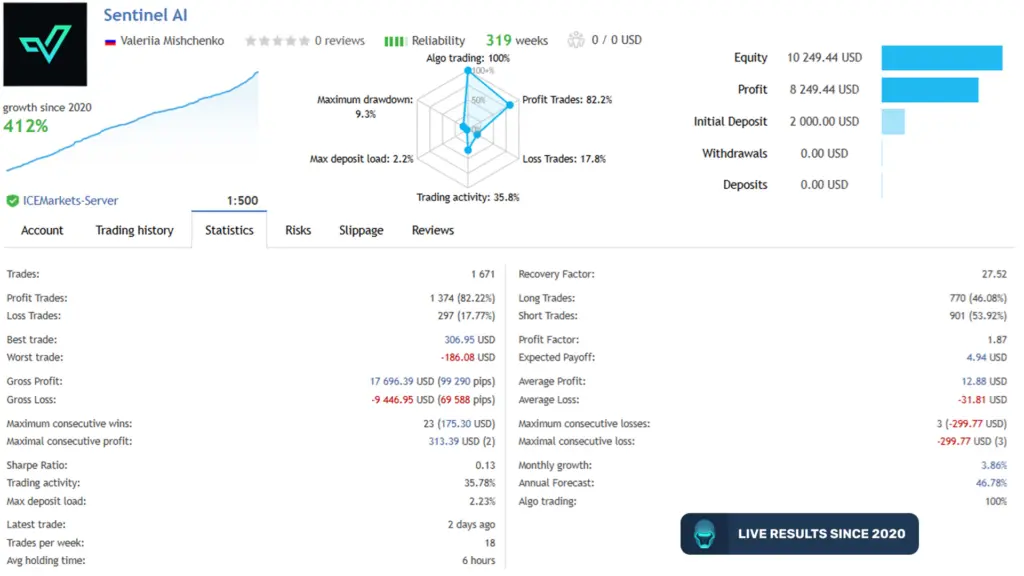
Sentinel AI’s signal numbers:
- 319 weeks live — over 6 years of continuous public verification
- 412.47% total growth — $2,000 initial deposit grown to $10,249.44
- 0 additional deposits, 0 withdrawals — clean compounding growth
- 82.22% win rate across 1,671 total trades
- 9.3% maximum drawdown across the entire 6+ year period
- 1.87 profit factor, 27.52 recovery factor
- Maximum 3 consecutive losses over the entire signal history
- 74 consecutive profitable months from February 2020 to present
- 5.53% average monthly return
- Max deposit load: 2.2% — extremely conservative position sizing
The “no losing months since February 2020” claim is the standout. From February 2020 to present, the EA has produced 74 consecutive profitable months — spanning the COVID-19 market crash, the 2021 melt-up, the 2022 inflation shock, the 2022-2023 rate hiking cycle, the Ukraine conflict, the regional banking crisis, the 2024 tightening cycle, and every other significant market event. Every month profitable.
This is either an extraordinary architectural achievement or statistical anomaly. We lean toward extraordinary achievement based on the developer’s broader portfolio quality, but readers should approach any “no losing months” claim with appropriate skepticism — past performance does not guarantee future results, and 74 consecutive profitable months is unusual enough that the 75th month is mathematically just as likely to break the streak as continue it.
74 Consecutive Profitable Months: The Yearly Breakdown
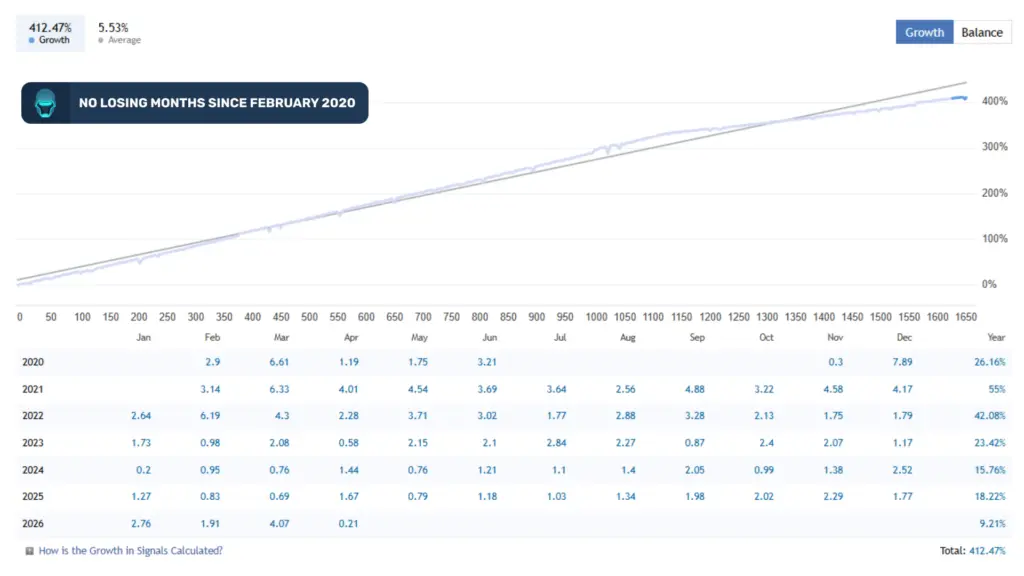
The yearly performance breakdown:
- 2020: 26.16% — including the COVID crash period
- 2021: 55.00% — the peak year, low-volatility forex grinding higher
- 2022: 42.08% — inflation shock, rate hiking starts
- 2023: 23.42% — rate hiking peaks, banking stress
- 2024: 15.76% — lower volatility, tighter ranges
- 2025: 18.22% — slight recovery
- 2026 YTD: 9.21% — through April
The declining returns from 2021’s 55% peak to 2024’s 15.76% are notable. This could be interpreted two ways:
Pessimistic interpretation: The strategy’s edge is eroding. Mean-reversion systems tend to find their best conditions during low-volatility ranges, and as more capital flows into similar algorithmic strategies, the edge naturally erodes. The declining annual returns could signal the strategy approaching its statistical end-of-life.
Optimistic interpretation: The strategy is adapting conservatively to changing market conditions. The fact that every year remains profitable — and 2025’s 18.22% shows partial recovery — suggests the system is calibrating to lower-volatility environments rather than failing. The 2026 YTD figure of 9.21% over 4 months annualizes to ~28%, which is consistent with the recent multi-year average.
Our honest read: expect 15-25% annual returns based on recent performance, not the 55% from 2021. The system is mathematically a known quantity over 74 months — buyers entering now should calibrate expectations to recent reality, not historical peaks.
The 18-Year Multi-Currency Backtest
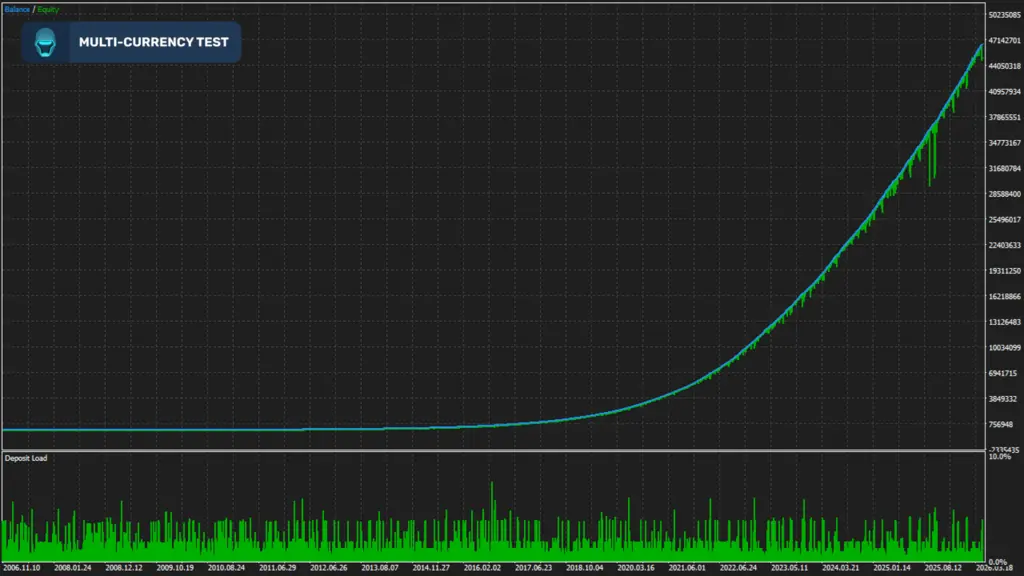
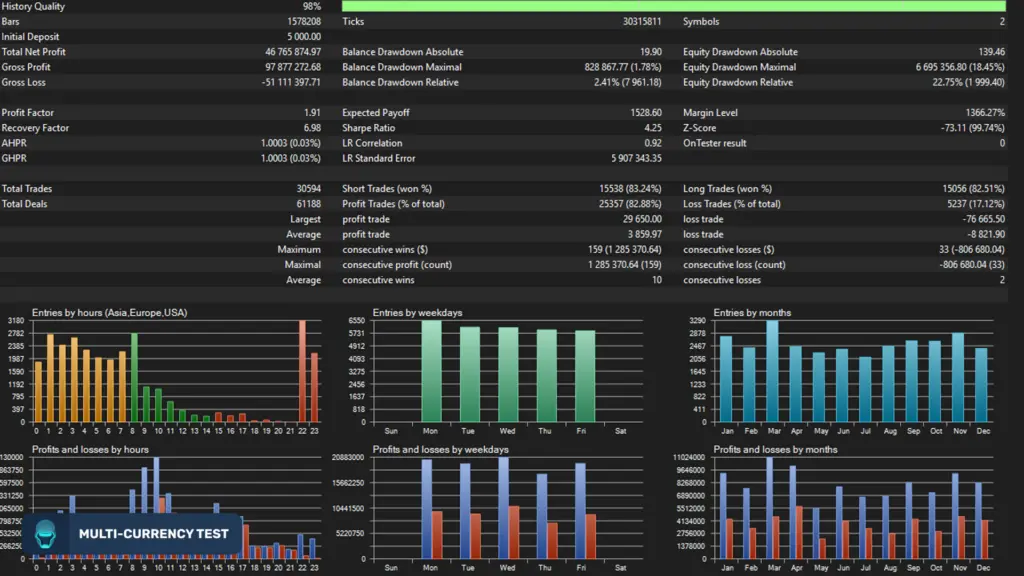
The combined EURUSD + GBPUSD backtest covers 2006 to 2026 — 18 years of price data — producing the following on a $5,000 starting deposit:
- 30,594 total trades across 18 years (over 1,600 trades per year average)
- 98% history quality data
- 1.91 profit factor across two currency pairs
- 0.92 LR correlation — near-linear equity growth
- 82.88% win rate (25,357 wins / 5,237 losses)
- Sharpe ratio 4.25, recovery factor 6.98
- Balance drawdown: 1.78% ($828,867 max on the equity scale shown)
- Equity drawdown: 18.45% ($6,695,356 max)
- Balanced long/short performance — 83.24% short WR, 82.51% long WR
The 0.92 LR correlation across 30,594 trades and 18 years is remarkable. The equity curve grows nearly linearly through the 2008 financial crisis, the 2010-2012 euro debt crisis, COVID, Ukraine, and rate hiking cycles — five separate “once in a decade” forex events all absorbed without breaking the upward trajectory.
The 1.78% balance drawdown vs 18.45% equity drawdown gap is the most important number on this backtest. We address what it means in the next section.
Understanding the Mean-Reversion Grid — Why Equity DD Exceeds Balance DD
Sentinel AI uses a mean-reversion grid architecture. Understanding what this means mechanically is essential before buying — it’s the single most important concept that determines whether you’ll be comfortable trading this system.
How the grid works: When price deviates from its statistical norm (the “mean”), the EA opens an initial position expecting price to revert. If price continues moving against the initial position, the EA opens additional grid positions at predefined intervals — averaging down the entry price. When price finally reverts (which it statistically tends to do in forex on M5 timeframes), the whole basket closes profitably at a weighted-average exit point.
Why this produces the balance/equity DD gap: Closed trades show a 1.78% drawdown because the system rarely closes losing baskets — it waits for reversion before closing. Open equity, however, can show much larger drawdowns (up to 18.45% in the backtest) because positions can sit underwater for extended periods before reverting.
The risk this introduces: If price moves against the grid persistently without reverting (a strong sustained trend), the equity drawdown grows. At some point — defined by your risk settings — the grid hits its maximum position depth and the system must either close at a realized loss or wait further. The 9.3% live max drawdown shows the protection layers and risk settings have managed this well across 6+ years, but past drawdown does not cap future drawdown.
The structural cost: Average winning trades are smaller than average losing trades. Live signal data: $12.88 average win vs $31.81 average loss — roughly 2.5:1. Backtest: $3,859 average win vs $8,821 average loss — roughly 2.3:1. The 82% win rate compensates mathematically, but if the win rate ever drops below ~70%, the math breaks down quickly. Monitor the win rate as your leading indicator — sustained drops below 75% over a multi-month window are the warning signal that the strategy’s edge may be eroding.
For traders comfortable with grid mechanics, this isn’t necessarily a problem — it’s just how the architecture works. For traders who can’t tolerate seeing -10% or -15% equity drawdown during holding periods (even when balance drawdown stays small), this isn’t the right system.
The AI Filter Stack
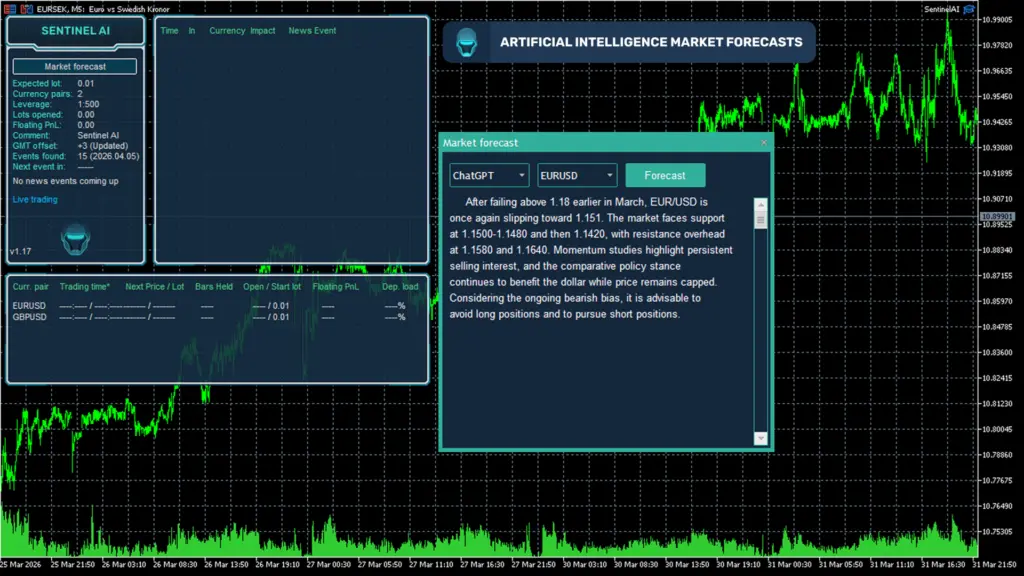
Sentinel AI combines mean-reversion logic with multiple AI filtering layers — each independently configurable:
Deep Learning Trend Filter — evaluates the underlying trend direction using neural network analysis rather than simple indicator crossovers. The trend filter prevents the EA from opening mean-reversion entries against strong directional moves where the reversion thesis is statistically unlikely.
Momentum Filter — assesses whether price movement has genuine persistence or is random noise. Useful for distinguishing real market structure changes from intraday volatility.
Volatility Filter — classifies the current volatility environment to avoid trading during abnormal conditions where the typical mean-reversion behavior doesn’t hold.
AI Trade Quality Filter — uses artificial intelligence forecasts to filter out low-potential setups before any position is opened. This is the layer that does the “is this setup worth trading?” final check.
ChatGPT Forecast Filter (MT5 exclusive) — queries ChatGPT for market forecasts on EURUSD and GBPUSD before opening trades, only proceeding when the AI’s directional view aligns with the EA’s setup.
Gemini Forecast Filter (MT5 exclusive) — same concept using Google Gemini as the AI provider. Both ChatGPT and Gemini can be enabled simultaneously for double-AI validation.
Neural Network Filter (Perceptron-based) — additional optional layer using Perceptron machine learning for signal classification.
Statistics Panel with Self-Diagnostic System — on-chart panel showing real-time performance metrics, system health checks, and the Neural Network Forecast indicator.
News Filter — connects via WebRequest to monitor high-impact economic events and pauses trading during dangerous periods. Configurable per event impact level, with options to close all trades before news, prohibit new positions, or prohibit averaging trades only.
Stock Market Crash Filter — additional protection during extreme market stress events using S&P 500 volatility as the input. Pauses trading when SPX historical volatility exceeds configured thresholds.
The combination of these filters explains the 82% win rate — most low-quality setups are filtered out before they ever become trades. The mean-reversion logic provides the entry opportunities, but the AI stack determines which opportunities are worth taking.
Portfolio Mode — Running Sentinel AI Alongside Other Valeriia EAs
If you own other Valeriia Mishchenko EAs — Night Hunter Pro, Waka Waka, Perceptrader AI, or Golden Pickaxe — Sentinel AI’s Portfolio Mode coordinates position management across all of them on the same account.
How it works: Each EA is assigned a unique UID (0-9). When Portfolio Mode is enabled, each EA recognises the open positions of the others on shared symbols, and skips trading signals that would create duplicate or conflicting exposure. The Initial Delay timing is calculated automatically based on UID, ensuring orderly signal processing across EAs.
Compatibility matrix on the MT4 version:
- Night Hunter Pro — compatible
- Waka Waka — compatible with order recognition (Consider WAKA Orders option)
- Perceptrader AI — compatible with order recognition (Consider PAI Orders option)
- Golden Pickaxe — compatible with order recognition (Consider GP Orders option)
Compatibility matrix on the MT5 version:
- Perceptrader AI MT5 — compatible
- Golden Pickaxe MT5 — compatible
- Multiple Sentinel AI MT5 set files — compatible with unique UID assignment per instance
This is a genuine advantage for traders already running other Valeriia products — Portfolio Mode prevents the most common multi-EA mistake of accidental over-leveraging when multiple systems open positions on the same pair simultaneously.
Comprehensive FTMO/Prop Firm Controls
Sentinel AI’s prop firm risk control suite is the most configurable we’ve seen on any EA listed at CheaperForex:
- Max Floating Drawdown % — closes positions if floating DD exceeds threshold, per-symbol or account-wide
- Max Daily Drawdown (FTMO Rules) — calculates DD according to FTMO’s specific methodology, ignoring non-trading operations like withdrawals during the day
- Max Daily Drawdown in Money — absolute dollar threshold option for traders who prefer money over percentage
- Max Daily Drawdown Reset Hour FTMO Rules — set the daily DD reset time to match your prop firm’s schedule
- Max Daily Drawdown Type FTMO — customize the daily DD calculation methodology
- Max Drawdown Actions — six options: close trades and stop for 24h / stop until end of day / stop until restart / resume normally / prohibit new trades only / prohibit until restart
- Minimum Free Margin % — prevents new orders below a margin threshold
- Max Open Lots filter — caps total position size, adjustable for balance/equity growth
- Currency-Side Protection — prevents opening positions on the same side of a currency (e.g. preventing two CAD shorts simultaneously to avoid correlated exposure)
- Hedging Control — enable/disable multi-directional trades on the same symbol
- Bank Holiday Filter — currency-specific bank holiday detection from real-time economic calendar
- Christmas/New Year filter — on/off holiday trading
This level of granular control is genuinely useful for funded account trading where minor rule violations can trigger profit forfeiture or challenge failure.
MT4 vs MT5 — Which Should You Buy?
Sentinel AI is available for both MetaTrader 4 and MetaTrader 5. The core trading logic is identical between platforms — same entry signals, same exit logic, same mean-reversion grid mechanics, same Portfolio Mode coordination.
The MT5 version adds:
- ChatGPT and Google Gemini AI forecast filters (independently toggleable)
- Neural Network Forecast indicator in the statistics panel
- Tester withdrawal simulation
- Native MT5 economic calendar integration
The MT4 version offers:
- Compatibility with the broader range of Valeriia’s MT4 EAs (Night Hunter Pro MT4, Waka Waka MT4, News Catcher Pro MT4)
- Mature platform with established broker support
- Direct compatibility with the published 319-week live signal which runs on MT4
Our recommendation:
- Choose MT4 if you’re already running Valeriia’s other MT4 EAs, your broker has better spreads on MT4, or you specifically want to mirror the published live signal setup
- Choose MT5 if you want access to the AI forecast filter features, you’re starting fresh, or your broker has better MT5 conditions
Both versions deliver the same fundamental trading system. The choice is primarily about platform ecosystem fit and the AI filter features rather than core trading performance.
Where to Download Sentinel AI Legitimately
Two sources, and only two:
MQL5 Marketplace — direct purchase from Valeriia Mishchenko’s official developer page. MT4 version | MT5 version.
CheaperForex — authorised reseller pricing significantly below MQL5’s price, same official activation, same EA file, free lifetime updates, plus a 7-day money-back guarantee before activation and an extra 20% discount for crypto payments. MT4 version | MT5 version.
Anywhere else claiming to offer Sentinel AI — for free, at suspiciously discounted prices, via Telegram, via cracked .ex4/.ex5 files — is a scam. The MQL5 licensing cannot be cracked. Files from those sources either won’t execute, will execute as fake EAs that don’t trade the documented markets, or contain malware that compromises your trading account credentials.
Why “Free Download” Sites Are a Trap
Sentinel AI has been on MQL5 for some time, which means fake download pages have had years to accumulate in search engine indexes. Here’s what they’re actually selling: nothing functional.
The free-download playbook is consistent across every MQL5 marketplace EA. You search “Sentinel AI free download.” A site appears in the top results promising the file. You scroll through generic AI-written content — vague descriptions, recycled stock images, no real performance data — looking for a download button. You click. A countdown timer appears. The timer ends and you’re redirected to a Telegram group.
The Telegram group is the actual product. They’ll either pitch you “VIP signals” at $99/month, push a sketchy broker affiliate link where they earn commission on your deposits, or distribute a file containing a credential stealer targeting your MT4/MT5 login details. The “free EA” never existed.
Given the strength of the verified 319-week signal, Sentinel AI is particularly targeted by fake-download scammers — they know the legitimate demand is high. Stick to MQL5 or CheaperForex.
Installation Guide
Installation is straightforward on either platform:
Step 1: Activation. If you bought from MQL5, the EA appears automatically in your MetaTrader Navigator under Market. If you bought from CheaperForex, we activate it remotely on your terminal in around 2 minutes via UltraViewer or AnyDesk — the EA then appears in your Navigator under Expert Advisors → Market just like a direct MQL5 purchase.
Step 2: Enable WebRequest. Required for news filter and time server detection. Go to Tools → Options → Expert Advisors and add the three URLs specified in the MQL5 listing (timesrv.online, valeryservice.com, valerytools.com).
Step 3: Open one EURUSD M5 chart. Sentinel AI uses a single-chart setup. The EA handles GBPUSD from the same chart attachment automatically.
Step 4: Enable AutoTrading / Algo Trading. Click the AutoTrading button (MT4) or Algo Trading button (MT5) in the platform toolbar so it turns green.
Step 5: Drag Sentinel AI onto the chart. Find the EA in Navigator under Expert Advisors → Market, drag it onto your EURUSD M5 chart. The settings dialog appears.
Step 6: Choose your risk level and lot sizing method. The Lot-sizing Method parameter offers Fixed Lots, Dynamic Lots, Deposit Load %, or 4 predefined presets. For first-time users on a $1,000–$2,000 account, the predefined “low-risk” preset is the recommended starting point. Configure your symbol suffix if your broker uses one (e.g., EURUSD.a).
Step 7: Configure prop firm settings (if applicable). Set your Max Daily Drawdown FTMO Rules to match your prop firm’s daily DD limit (usually 4-5%). Set Max Drawdown Reset Hour to your prop firm’s reset time. Choose your Max Drawdown Action.
Step 8: Verify the EA is running. A smiley face appears in the top-right of the chart when running correctly. The Sentinel AI on-chart panel appears showing real-time status, trading pairs, news events, and (on MT5 with ChatGPT/Gemini enabled) the AI market forecast.
Broker Setup and Capital Requirements
Broker: ECN broker recommended. The live signal runs on IC Markets at 1:500 leverage. The EA is not highly sensitive to spread and slippage per the developer, but ECN execution still improves overall results. Any major broker with EURUSD and GBPUSD support works — IC Markets, IC Trading, FP Markets, Pepperstone, FxTrading.
Account types: Hedging required for full EA functionality. Standard, ECN, RAW spread, and prop firm accounts all work.
Leverage: 1:100+ recommended. With 1:30 leverage (EU-regulated accounts), use only low-risk settings on accounts below $6,000 to avoid free margin issues. With 1:100+, standard risk settings work on $1,000+ accounts.
VPS: Required. Sentinel AI’s mean-reversion grid must run continuously to manage open positions. Disconnections during active grid management could result in unmanaged floating positions. A standard forex VPS at $13-25/month resolves this.
Minimum deposit: $1,000 with 1:100+ leverage and low-risk settings. $2,000-3,000 comfortable. $6,000+ recommended if you’re on a 1:30 EU-regulated broker.
Frequently Asked Questions
Where can I download Sentinel AI legitimately?
Two sources only: MQL5 marketplace at the official developer page (MT4 | MT5), or CheaperForex at a significant discount (MT4 | MT5) with a 7-day money-back guarantee. Both deliver the same official EA file with proper MQL5 licensing.
What does “no losing months since February 2020” actually mean?
Every single month from February 2020 to present has produced a positive return on the verified MQL5 live signal — 74 consecutive profitable months. This spans COVID, the 2021 melt-up, the 2022 inflation shock, the 2022-2023 rate hiking cycle, the Ukraine conflict, and every other market event in between. The 75th month is mathematically as likely to break the streak as continue it, so don’t extrapolate the consistency forward indefinitely.
What’s the difference between MT4 and MT5 versions?
Core trading logic is identical. The MT5 version adds ChatGPT and Gemini AI forecast filters (independently configurable), a Neural Network Forecast indicator in the statistics panel, and tester withdrawal simulation. The MT4 version offers compatibility with the broader range of Valeriia’s MT4 EAs and direct compatibility with the published 319-week live signal which runs on MT4.
How does the mean-reversion grid work?
When price deviates from its statistical norm, the EA opens an initial position expecting reversion. If price continues moving against the position, additional grid levels open at predefined intervals. When price reverts (as forex on M5 statistically tends to do), the whole basket closes profitably at a weighted-average exit. This is why balance drawdown (1.78% backtest) is much smaller than equity drawdown (18.45% backtest) — positions sit underwater before reverting and closing.
What’s the equity DD vs balance DD difference?
Balance drawdown measures drawdown on closed trades only — the realised losses. Equity drawdown includes unrealised floating losses on open positions. The gap is characteristic of mean-reversion grid systems. The live signal shows 9.3% max drawdown (which is equity DD on the public signal display), exceptionally controlled across 6+ years. Understand that your equity will fluctuate more than your balance during holding periods.
What does the live signal show?
319 weeks (6+ years) on IC Markets at 1:500. $2,000 initial deposit grown to $10,249 equity. 412.47% growth. 82.22% win rate (1,374 wins / 297 losses). 1.87 PF, 27.52 RF. 9.3% max DD. 18 trades/week average, 6-hour average holding time. Max 23 consecutive wins, max 3 consecutive losses across the entire 6+ year period. Zero additional deposits, zero withdrawals — pure trading growth.
Who is the developer?
Valeriia Mishchenko — arguably the most established forex EA developer on MQL5. Her portfolio includes Night Hunter Pro (53 reviews, 282-week signal), Waka Waka (40 reviews, 8+ years live with 12,000% growth), Perceptrader AI (80 consecutive profitable months), Golden Pickaxe (multiple set files with live track records), News Catcher Pro, and Evening Scalper Pro. She actively maintains all products with regular updates including a 2026 neural network retraining across the portfolio.
Can I run it alongside Night Hunter Pro or Waka Waka?
Yes — Portfolio Mode is built specifically for this. Sentinel AI MT4 recognises Night Hunter Pro, Waka Waka, Perceptrader AI, and Golden Pickaxe open positions through configurable options. Sentinel AI MT5 recognises Perceptrader AI MT5 and Golden Pickaxe MT5. Each EA gets a unique UID and the portfolio system prevents simultaneous duplicate entries.
Is it prop firm compatible?
Yes — with the most comprehensive FTMO-specific controls we’ve seen on any EA. Configurable daily DD calculation following FTMO’s methodology, custom reset hour, multiple drawdown actions, per-symbol DD limits, minimum free margin checks, max open lot caps, and currency-side protection. Configurable to meet most major prop firm rules.
Why have annual returns declined from 55% to 18%?
Most likely reflects the strategy adapting more conservatively to changing forex conditions — lower volatility, tighter ranges, and different central bank dynamics post-2022. The declining returns appear to be healthy adaptation rather than strategy failure — every year remains profitable, and 2025 (18.22%) and 2026 YTD (9.21% over 4 months ≈ 28% annualized) show some recovery. Expect 15-25% annual returns based on recent performance, not the 55% peak from 2021.
What pairs does it trade?
EURUSD and GBPUSD only — both from a single EURUSD M5 chart attachment. If your broker uses symbol suffixes (e.g., EURUSD.a), update the Symbol parameter to match. No Gold, no commodities, no exotic pairs.
What about avg loss being larger than avg win?
Live signal: $12.88 avg profit vs $31.81 avg loss (~2.5:1). Backtest: $3,859 avg win vs $8,821 avg loss (~2.3:1). The 82% win rate compensates mathematically, but this is the structural risk of mean-reversion grid systems. Monitor the win rate as your leading indicator — sustained drops below 75% over multi-month windows are the warning signal that strategy edge may be eroding.
What broker should I use?
ECN recommended. The live signal runs on IC Markets at 1:500. The EA is not highly sensitive to spread and slippage, but ECN execution improves results. IC Markets, IC Trading, FP Markets, Pepperstone, FxTrading all work well. With 1:30 leverage, use low-risk settings on accounts below $6,000. With 1:100+, standard risk works on $1,000+ accounts.
Do I need WebRequest enabled?
Yes — required for news filter and time server detection. Enable WebRequest access in your MT4/MT5 settings (Tools → Options → Expert Advisors) for the three URLs specified in the MQL5 listing. Without WebRequest, the news filter won’t function and the EA will trade through high-impact events unprotected.
Do I need a VPS?
Yes — required. The mean-reversion grid must run continuously to manage positions. Disconnections during active grid management could leave unmanaged floating positions. A forex VPS costs $13-25/month and ensures uninterrupted 24/5 uptime.
The Verdict After 319 Weeks Live
Sentinel AI delivers something genuinely uncommon on the MQL5 marketplace: 319 weeks of verified live trading with 74 consecutive profitable months, from a developer with arguably the strongest portfolio on the entire platform. The combination of duration, consistency, and verification puts Sentinel AI in a different category from the typical newly-launched EAs that flood the marketplace each month.
The 18-year backtest covering 30,594 trades with 0.92 LR correlation across the 2008 financial crisis, the 2020 COVID crash, the 2022 inflation shock, and every other major forex event of the past two decades provides genuine statistical evidence rather than curve-fit optimism. The AI filter stack (Deep Learning trend/momentum/volatility filters, ChatGPT and Gemini forecasts on MT5, Neural Network Filter, News Filter, Stock Market Crash Filter) explains how the 82% win rate is achievable — most low-quality setups are filtered out before they become trades.
The honest considerations: mean-reversion grid systems carry inherent equity drawdown risk that’s larger than the closed-trade drawdown suggests. The 1.78% balance DD vs 18.45% equity DD gap in the backtest is the structural cost of the strategy. Average losses are ~2.5x average wins — profitability depends on maintaining the high win rate, and if it drops below 75% sustainably, the math breaks down. Annual returns have declined from 55% (2021) to 15-25% (2023-2025), so calibrate expectations to recent performance rather than historical peaks.
We rate Sentinel AI 4.5 out of 5. The 319-week verified signal is the strongest validation evidence available on MQL5. The developer reputation is unmatched. The AI filter stack and FTMO risk controls are best-in-class. The half-star held back reflects the mean-reversion grid structural risk that’s inherent to the architecture and the declining annual return trajectory that suggests strategy edge erosion (even if every year remains profitable). For forex traders comfortable with mean-reversion grid mechanics who want the most validated EA available, Sentinel AI is the benchmark from a proven developer.