
Last updated: May 2026
The MQL5 marketplace is full of “professional trading systems” that share a depressing pattern: they all use the same combinations of standard indicators (RSI, moving averages, MACD, Bollinger Bands), they all claim 90%+ win rates in their backtests, and they all fail in similar ways during the same market conditions. Because they’re built from the same building blocks.
View product details and current pricing.
Pulse Engine is structurally different. It uses no indicators at all. It isn’t tied to any specific timeframe. Instead, it trades intraday directional patterns identified through proprietary pattern recognition software that Jimmy Peter Eriksson has been building and refining for years. Whether that approach actually produces a sustainable edge is the question this review answers — using both the 20-year combined backtest covering 50,000+ trades and the 11-week verified MQL5 live signal as evidence.
This is also the most ambitious system in the developer’s portfolio. Jimmy Peter Eriksson already ships Prop Firm Gold EA (Gold specialist), Gold Atlas (Gold long-term consistency), Range Breakout EA (multi-instrument breakouts), Market Anomalies EA (USDJPY patterns), and The Bitcoin Core (BTC system) — all with verified MQL5 review track records averaging 4.5+ stars. Pulse Engine combines the multi-market philosophy with the proprietary pattern recognition research into a unified 6-market system.
⚠️ Searching for Pulse Engine EA free download? Pulse Engine is an official MQL5 marketplace product with built-in DRM. Cracked .ex5 files do not exist for marketplace EAs. Sites offering “free downloads” deliver malware, fake EAs that won’t execute, or funnel you into Telegram VIP signal scams. CheaperForex offers Pulse Engine at a significant discount on the official MQL5 price with full activation and a 7-day money-back guarantee.
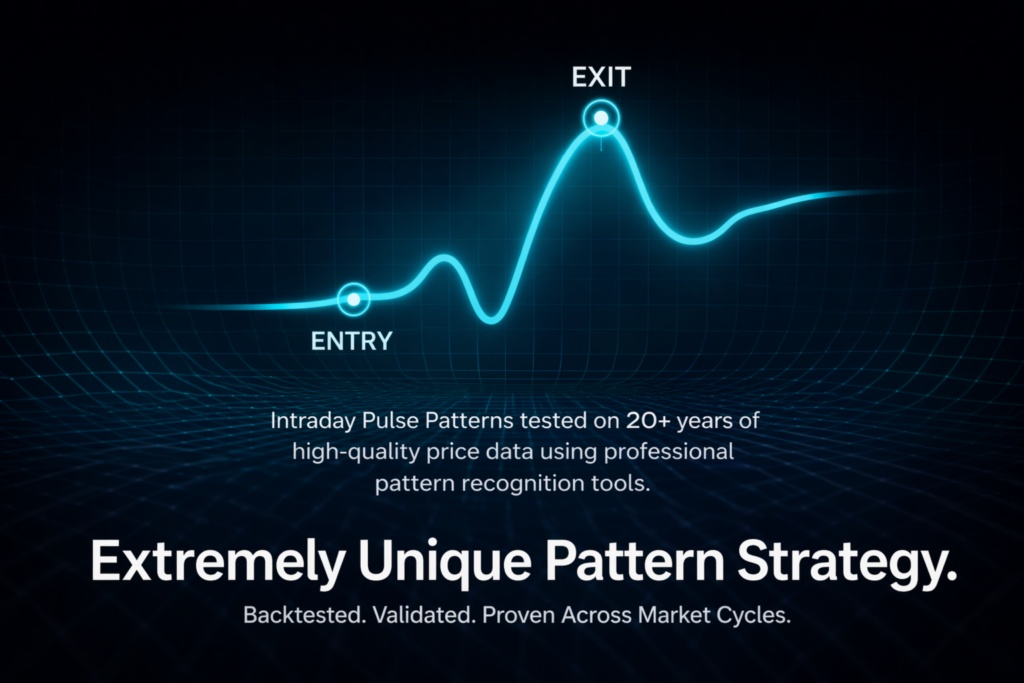
Why Pattern Recognition Beats Indicator Combinations
To understand what makes Pulse Engine genuinely different, it helps to first understand why most indicator-based EAs share similar failure modes.
Standard technical indicators — RSI, MACD, Bollinger Bands, moving averages — are publicly documented mathematical transformations of price data. Every developer building EAs has access to them. Every developer combines them in roughly similar ways: trend-following indicators paired with momentum oscillators, with volatility filters, with time-of-day rules. The result is that thousands of EAs end up making similar trading decisions during similar market conditions.
This isn’t theoretical — it’s why so many indicator-based EAs that show beautiful backtests struggle once deployed. They’re competing for the same trades against thousands of similar systems, with their edge eroded by the very fact that the edge is publicly known and replicated.
Pattern recognition takes a fundamentally different approach. Instead of looking at indicator readings, it looks at price structure — the specific shape of price movements that historically preceded directional moves. These patterns aren’t published in technical analysis textbooks. They’re identified through pattern recognition software running over decades of historical data, looking for statistically significant structural setups that demonstrably preceded specific outcomes.
The patterns Pulse Engine uses are independent of conventional indicator logic. They don’t care whether an RSI is overbought or whether the MACD has crossed. They’re looking at something else entirely — and that “something else” produces a return distribution that’s substantially different from indicator-based EAs.
This matters in two ways. First, it means Pulse Engine can perform during conditions that destroy indicator-based systems (and vice versa). Second, for traders who already run other EAs, Pulse Engine functions as a genuine portfolio diversifier rather than another correlated bet.
Six Markets, One Chart Setup
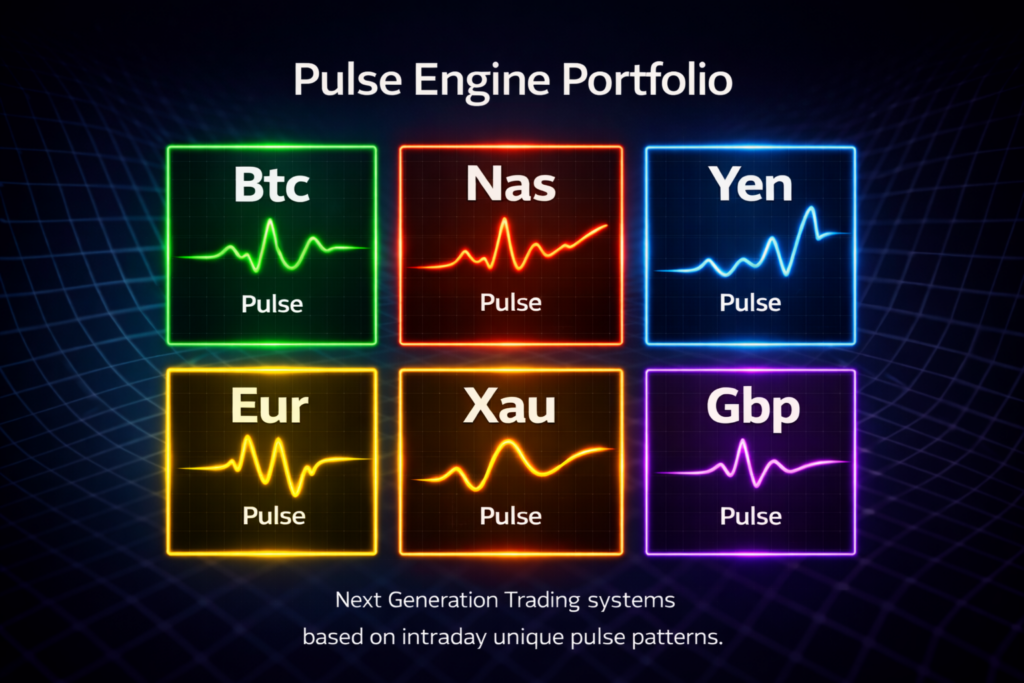
Pulse Engine trades six markets simultaneously: XAUUSD (Gold), USDJPY, EURUSD, GBPUSD, USTEC (Nasdaq 100), and BTCUSD (Bitcoin). Each market has its own dedicated set of patterns calibrated for that instrument’s specific behavior — Gold patterns aren’t applied to Bitcoin, Nasdaq patterns aren’t applied to Forex pairs.
This six-market structure provides three distinct benefits:
Diversified return stream. Six different markets produce six different return distributions. Weak performance on one is statistically offset by stronger performance on others. The combined backtest reflects this — across 50,000+ trades over 20 years, the system shows 87% profitable months, which is significantly higher than what any single instrument could realistically produce.
Different drivers per market. Gold responds to inflation expectations and dollar strength. USDJPY responds to BOJ policy and risk-on/risk-off sentiment. EURUSD responds to ECB policy and EU/US growth differentials. USTEC responds to tech earnings and rate expectations. Bitcoin responds to crypto-specific dynamics. By trading multiple drivers simultaneously, Pulse Engine isn’t dependent on any single macro environment to perform.
Single-chart simplicity. Unlike multi-instrument EAs that require attaching to each chart separately or running multiple instances, Pulse Engine handles all six markets from one EURUSD chart. You configure broker symbol mappings once, set your max drawdown preference, and the system handles everything else internally.
The Combined Backtest — 50,000+ Trades Across 20 Years
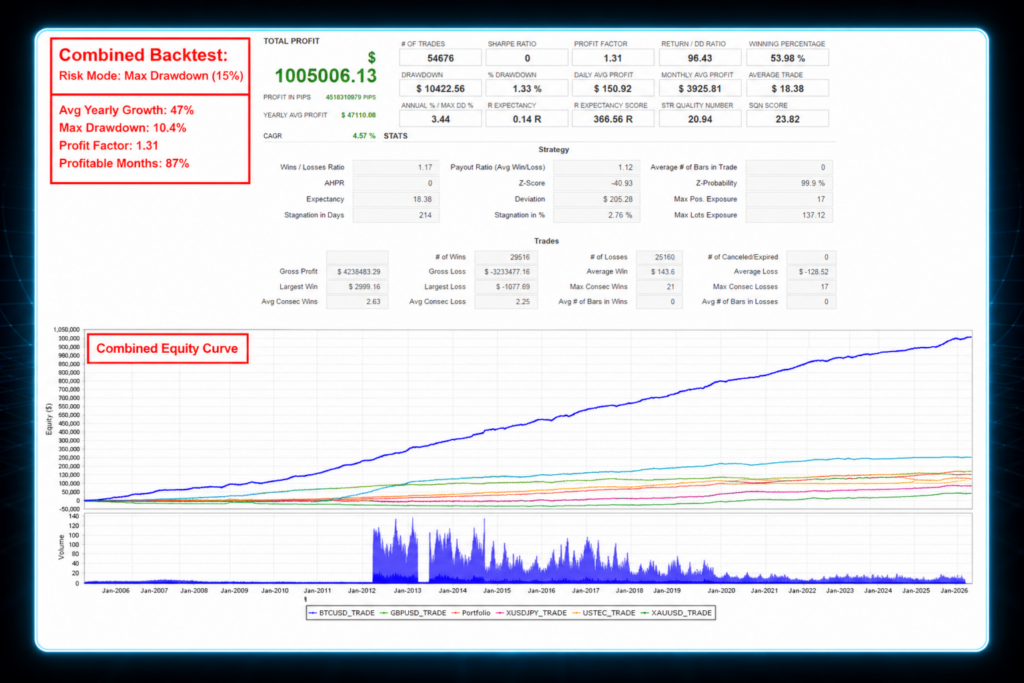
The combined portfolio backtest covers 2005 to present — over 20 years of price data — producing the following statistics on the Max Drawdown 15% risk mode:
54,676 total trades across the 20-year period. This is a genuinely large sample size. Most EA backtests show a few hundred or a few thousand trades over much shorter periods, which makes statistical conclusions impossible. 54,676 trades crosses the threshold where historical patterns become statistically meaningful evidence rather than curve-fit noise.
47% average yearly growth. Substantial annual return that’s aggressive enough to be meaningful but not unrealistic enough to suggest curve-fitting.
10.4% maximum drawdown over the entire 20-year backtest period. This is the number that matters most for risk evaluation. A 10.4% peak drawdown across 20 years of trading — including the 2008 financial crisis, the 2010 flash crash, the 2015 Swiss franc shock, the 2020 pandemic, and the 2022 inflation shock — demonstrates a system that’s designed for sustainability rather than peak returns.
1.31 profit factor. Gross profits 1.31x gross losses across all 54,676 trades. Lower than what scalping systems show in optimised backtests but more honest — and crucially, this profit factor was sustained across two decades of varied market conditions rather than a few months of favourable conditions.
87% profitable months. Across 240 months in the backtest, 87% closed profitable. This consistency is what diversified multi-market systems should produce — the variety of independent return streams smooths out the typical single-instrument volatility.
53.98% win rate, 1.12 payout ratio. Slightly more wins than losses, with average winning trades slightly larger than average losing trades. The combination produces the 1.31 profit factor and supports the 47% annual growth.
Max consecutive losses: 17. Even on the worst losing streak across 20 years, the system experienced 17 consecutive losses. Important to understand: with 6 markets running simultaneously, “consecutive losses” doesn’t mean a long flat period — it means individual losing trades clustered, but other markets may have been profitable during the same window. The 10.4% max DD figure captures the actual worst-case account drawdown.
The combined equity curve shown in the backtest is remarkably linear, with steady upward progression from 2005 through 2026 across all six instruments contributing to the cumulative result.
11 Weeks Live: Reality Check on the Backtest
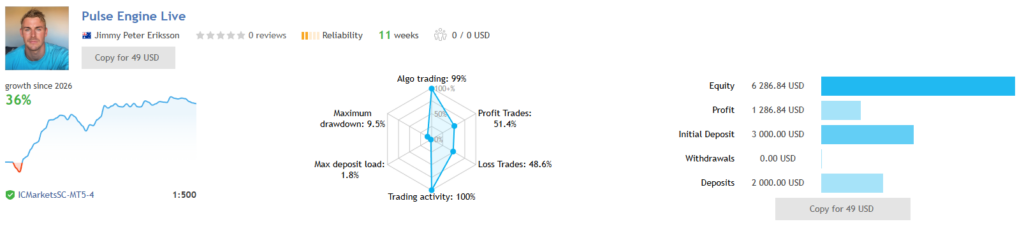
The verified MQL5 live signal has been running 11 weeks on ICMarketsSC at 1:500 leverage. The numbers tell a specific story:
36% growth in 11 weeks on a 3,000 EUR initial deposit (with 2,000 EUR additional deposits added during the period). Equity at the time of writing: 6,286.84 EUR. Profit: 1,286.84 EUR. Growth rate consistent with the backtest’s 47% annual figure when scaled to 11 weeks.
9.5% maximum drawdown over 11 weeks of live operation. This closely mirrors the backtest’s 10.4% max drawdown over 20 years — exactly the alignment you want to see between backtest and live performance. When backtest shows 10% DD and live shows 30% DD, that’s a curve-fit warning sign. When backtest and live show similar drawdown profiles, it’s evidence the system is behaving as designed.
51.4% profit trades. Slightly below the backtest’s 53.98%, which is the small live-execution gap you’d expect from real-world spread, slippage, and execution friction relative to backtest conditions. The gap is small enough to suggest the backtest reflects genuine edge rather than optimisation noise.
1.8% max deposit load, 100% trading activity. The very low deposit load combined with 100% trading activity (algo trading on continuously) tells you the system uses small position sizes per trade across multiple instruments simultaneously. This is consistent with the Daily Loss Protection design — if any single trade went badly wrong, the small position size would limit its account impact.
0 EUR withdrawals. The developer hasn’t withdrawn any profits, letting the account compound. Useful context: the live signal demonstrates the system works rather than serves as the developer’s primary income source.
The 11-week sample is small compared to what we’d want for definitive validation — but it’s enough time to demonstrate the system is real, the patterns are firing, and the live behavior aligns with the backtest. We’d be more confident with 6+ months of live data, and we’d recommend buyers wait at least 4-6 weeks of demo testing before increasing live capital significantly.
Daily Loss Protection and Randomization for Prop Firms
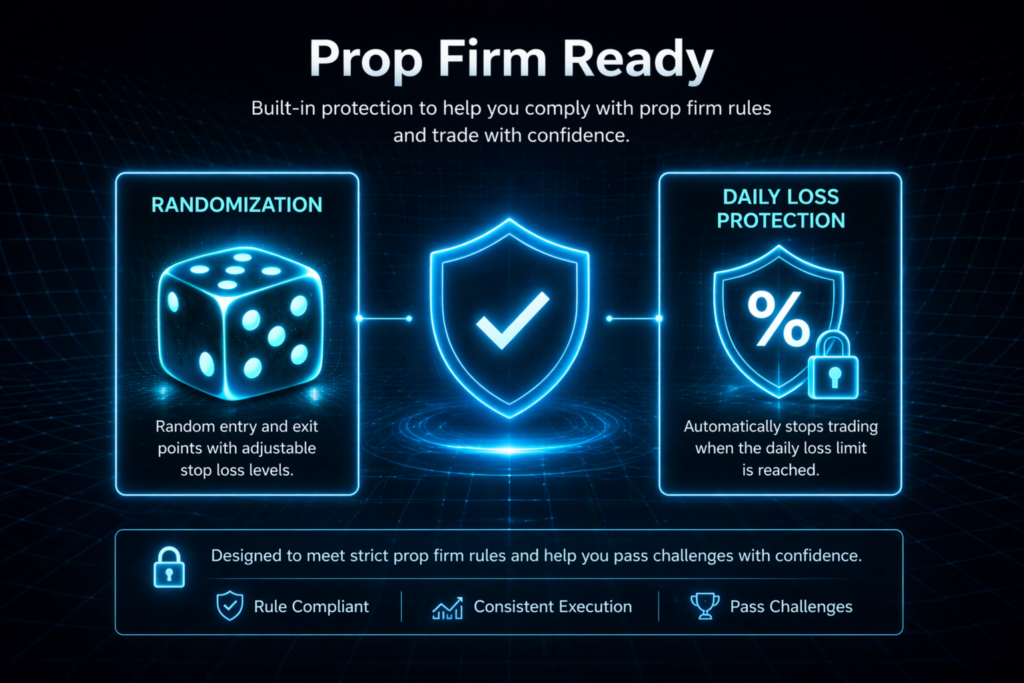
Two features make Pulse Engine genuinely prop firm-ready rather than just “compatible with prop firm rules in theory”:
Daily Loss Protection automatically stops trading when your daily loss limit is reached. You configure a percentage threshold (recommended 9% for prop firm trading) and the system enforces it without exception. This is the feature that separates prop firm survivors from prop firm casualties — most challenges are failed not by bad strategy but by accidentally breaching daily drawdown limits during a bad trading day. With Daily Loss Protection active, this failure mode is mechanically prevented.
Randomization function introduces controlled randomization to entry and exit points with adjustable stop loss levels. The performance impact is statistically neutral — over a large sample, randomized entries produce the same expected returns as deterministic entries. But the visible trade footprint becomes unique per account. This matters because some prop firms flag accounts running identical EA setups across multiple challenges as “coordinated trading” and revoke profits. Randomization prevents that detection pattern.
The combination — Daily Loss Protection prevents rule violation, Randomization prevents detection — makes Pulse Engine particularly suitable for traders running multiple prop firm accounts simultaneously. Each account shows different trade sequences while the underlying pattern logic remains identical.
Advanced News Filter — Configurable Per Event Type
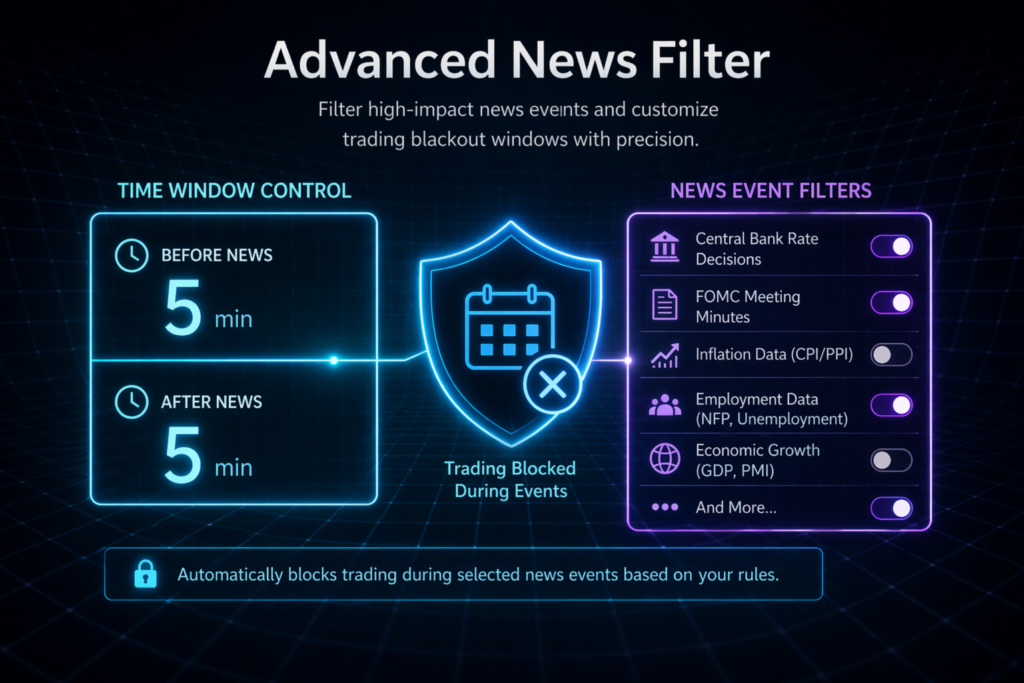
Most EAs ship with a basic news filter that’s either on or off. Pulse Engine takes a more sophisticated approach: you can toggle individual event types and configure custom blackout windows around each.
Event types you can toggle individually: Central Bank Rate Decisions, FOMC Meeting Minutes, Inflation Data (CPI/PPI), Employment Data (NFP, Unemployment), Economic Growth (GDP, PMI), and additional event categories.
Time window control: Configure how many minutes before and after each event the system should pause trading. The defaults are 5 minutes before and 5 minutes after, but you can extend these for high-volatility events (FOMC, NFP) or tighten them for less impactful releases (PMI, regional inflation).
This granular control matters for two reasons. For prop firm trading, news trading restrictions vary by firm — some prohibit trading during major events, others have more relaxed rules. Pulse Engine lets you align with your specific firm’s rules without disabling the news filter entirely. For long-term performance, the news filter prevents the kind of unpredictable spread widening and slippage that destroys backtested edge during major events.
Where to Download Pulse Engine Legitimately
Two sources, and only two:
MQL5 Marketplace — the official developer page for direct purchase from Jimmy Peter Eriksson with instant activation through MQL5’s built-in licensing.
CheaperForex — authorised reseller pricing significantly below MQL5’s price, with the same official activation, the same EA file, free lifetime updates, plus a 7-day money-back guarantee before activation and an extra 20% discount for crypto payments. View Pulse Engine at CheaperForex.
Anywhere else claiming to offer Pulse Engine — for free, at suspiciously discounted prices, via Telegram, via cracked .ex5 files, via “private group” downloads — is a scam. The MQL5 DRM cannot be cracked. Files from those sources either won’t execute, will execute as fake EAs that don’t trade the documented markets, or contain malware that compromises your trading account credentials.
Why “Free Download” Sites Are a Trap
Pulse Engine was published 1 May 2026. Within hours, fake download pages were already being indexed. Here’s what they’re actually selling: nothing functional.
The free-download playbook is consistent across every MQL5 marketplace EA. You search “Pulse Engine free download.” A site appears in the top results promising the file. You scroll through 1,500 words of generic AI-written content — vague descriptions, recycled stock images, no real performance data — looking for a download button. You click. A 30-second countdown timer appears. The timer ends. You’re redirected to a Telegram group.
The Telegram group is the actual product. They’ll either pitch you “VIP signals” at $99/month, push a sketchy broker affiliate link where they earn commission on your deposits, or distribute a file containing a credential stealer targeting your MT5 login details. The “free EA” never existed.
The reason these sites still rank in Google despite providing no actual product: the algorithm sees matching keywords (“free download”), reasonable dwell time (because users scan-read looking for the link), and a click-through to a secondary page. From Google’s perspective it looks like a satisfied search journey. From your perspective it’s wasted time and a potentially compromised trading account.
Pulse Engine Installation Guide
Once purchased from MQL5 or CheaperForex, the installation is straightforward:
Step 1: Activation. If you bought from MQL5, the EA appears automatically in your MT5 Navigator under Market. If you bought from CheaperForex, we activate it remotely on your MT5 terminal in around 2 minutes via UltraViewer or AnyDesk — the EA then appears in your Navigator under Expert Advisors → Market just like a direct MQL5 purchase.
Step 2: Open a EURUSD chart. The system uses one chart setup. Find your broker’s EURUSD symbol (usually just EURUSD, sometimes EURUSD.r or similar). Chart timeframe doesn’t matter — the system uses internal pattern logic rather than chart timeframe.
Step 3: Enable Algo Trading. Click the Algo Trading button in the MT5 toolbar so it turns green.
Step 4: Drag Pulse Engine onto the chart. Find Pulse Engine in the Navigator under Expert Advisors. Drag it onto the open EURUSD chart. The settings dialog appears.
Step 5: Configure Symbol Mapping. On the Inputs tab, find the Symbol Mapping section and set your broker’s correct symbol names for all 6 instruments: XAUUSD, USDJPY, EURUSD, GBPUSD, USTEC, BTCUSD. Different brokers use different naming conventions (XAUUSD.r, GOLD, US100, USTEC.cash, etc.) — the EA needs the exact symbols your broker uses.
Step 6: Set your max drawdown preference. Around 9% is recommended for prop firm trading, allowing you to remain well within typical 10% daily / 12% overall limits. For non-prop firm accounts, configure based on your personal risk tolerance.
Step 7: Verify the EA is running. A smiley face icon appears in the top-right of the chart when the EA is running correctly. Pulse Engine will begin monitoring all 6 markets for pattern signals — entries fire when patterns align with current price structure.
Broker Setup and Server Time
Pulse Engine is designed for brokers using standard US trading time (GMT+2 / GMT+3), which is the most common server time used by major brokers worldwide. If your broker uses non-standard server time, the pattern timing logic may not align correctly. The developer offers help verifying broker server time for buyers who are unsure.
Recommended brokers: IC Markets (where the live signal runs), IC Trading, FP Markets, Pepperstone, FxTrading. Each offers competitive spreads on all 6 instruments with hedging account support and 1:500 leverage availability.
Account requirements: ECN/Raw Spread account preferred for tight spreads. Hedging mode required (the multi-market structure won’t work on netting accounts). Minimum 1:30 leverage works on EU-regulated accounts, 1:500 used by the live signal for reference.
Prop firm accounts: Pulse Engine is fully compatible with major prop firms (FTMO, MyForexFunds, FundedNext, The Funded Trader, etc.) since the architecture is rules-compliant. Always verify your specific firm’s rules around news trading, weekend holding, and minimum trading days before deploying.
Position Sizing, VPS, and Account Management
A VPS is strongly recommended. Pulse Engine operates 24/5 across 6 markets including Bitcoin (which trades almost continuously) and the news filter requires accurate timing relative to economic calendar events. A connection drop during active patterns could miss valid entries. A standard forex VPS at $13–25/month resolves this.
Minimum deposit is $1,000 for conservative multi-market operation. $3,000+ recommended for comfortable position sizing across all 6 markets — this matches the live signal’s deposit level. The system operates concurrent positions across multiple instruments, so it needs sufficient margin headroom to avoid margin warnings during periods when patterns trigger across multiple markets simultaneously.
Position sizing scales with the max drawdown preference you set. The 9% recommendation for prop firms produces relatively conservative position sizes; raising the threshold increases position sizes proportionally. Most users should not raise the threshold above their actual risk tolerance — the system is designed to provide consistency rather than aggressive returns.
Pulse Engine vs Jimmy Peter Eriksson’s Other CheaperForex Products
Jimmy Peter Eriksson has multiple systems available on CheaperForex, each with a different specialization:
Prop Firm Gold EA — XAUUSD specialist designed specifically for prop firm challenges. Multi-strategy approach combining breakout-based concepts with intraday price patterns. 4.5★ from 28 verified MQL5 reviews. Best for traders focused exclusively on Gold and prop firm work.
Gold Atlas — Gold long-term consistency system with built-in Daily Loss Protection and Randomizer function. 4.79★ from 19 verified MQL5 reviews. Best for traders prioritising long-term consistency over aggressive returns on Gold.
Pulse Engine — the multi-market portfolio system. Best for traders who want diversified market exposure rather than single-instrument focus, who appreciate the pattern recognition approach, and who can deploy $1,000+ minimum to access the full 6-market portfolio.
The three systems are complementary rather than competing. A trader could legitimately run all three on separate accounts: Prop Firm Gold EA for prop firm challenges focused on Gold, Gold Atlas for long-term Gold consistency on a personal account, and Pulse Engine for diversified multi-market exposure. The architectural philosophies are aligned (no martingale, no grid, defined risk, prop firm compatibility) but the strategy implementations are distinct.
Frequently Asked Questions
Where can I download Pulse Engine EA MT5?
Two legitimate sources: MQL5 marketplace at the official developer page, or CheaperForex at a significant discount with a 7-day money-back guarantee. Both deliver the same official .ex5 file with proper MQL5 licensing and the free lifetime updates.
Can I download Pulse Engine for free?
No. Pulse Engine is an MQL5 marketplace product with built-in DRM that cannot be cracked. Sites offering “free downloads” distribute malware, fake EAs, or funnel users into Telegram VIP signal scams. The only legitimate sources are MQL5 and CheaperForex.
Does Pulse Engine really not use any indicators?
Correct. Pulse Engine uses no indicators — no RSI, no MACD, no moving averages, no Bollinger Bands. Instead, it identifies intraday directional patterns through proprietary pattern recognition software. This makes the system genuinely different from the thousands of indicator-based EAs that share similar building blocks.
How can it trade 6 markets from one chart?
Pulse Engine attaches to a single EURUSD chart but internally monitors all 6 markets (XAUUSD, USDJPY, EURUSD, GBPUSD, USTEC, BTCUSD) using configured symbol mappings. The system handles multi-market operation autonomously — you don’t need to attach the EA to multiple charts or manage separate instances.
Is the 11-week live signal sample size sufficient?
It’s a useful starting validation but not definitive. The live signal shows 36% growth at 9.5% max drawdown — closely aligned with the backtest’s annualised 47% growth at 10.4% max drawdown. We’d be more confident with 6+ months of live data. Recommend demo testing for 4-6 weeks before increasing live capital significantly.
What’s the difference between Pulse Engine and the developer’s other products?
Prop Firm Gold EA and Gold Atlas are XAUUSD-focused single-instrument systems. Pulse Engine is a 6-market portfolio system covering Gold, Forex (USDJPY, EURUSD, GBPUSD), Nasdaq, and Bitcoin. The architectural philosophy is consistent across all three — no martingale, no grid, prop firm compatible — but the implementation differs significantly.
Does Pulse Engine work on prop firm accounts?
Yes — prop firm compatibility is built into the architecture. No grid trading, no martingale escalation, stop loss on every trade, Daily Loss Protection that automatically stops trading at your configured threshold (recommended 9% for prop firms), Randomization function for unique trade footprints, Advanced News Filter for compliance with news trading rules. Always verify your specific firm’s individual policies.
Can I run Pulse Engine alongside other Eriksson EAs?
Yes — but on separate accounts to avoid trade conflicts. Pulse Engine’s pattern logic is independent of Prop Firm Gold EA’s breakout logic and Gold Atlas’s long-term consistency logic, so they don’t compete for trades. Run each on its own account for clean attribution and risk management.
What broker should I use for Pulse Engine?
IC Markets (where the live signal runs), IC Trading, FP Markets, Pepperstone, or FxTrading. Each offers all 6 instruments with competitive spreads, hedging mode, and 1:500 leverage. The system requires standard US server time (GMT+2 / GMT+3) which most major brokers use.
How much capital do I need?
$1,000 absolute minimum for conservative multi-market operation. $3,000+ recommended (matches the live signal deposit) for comfortable position sizing across all 6 markets. The system runs concurrent positions across multiple instruments simultaneously, so it needs sufficient margin headroom.
Why are there no reviews yet?
Pulse Engine was published 1 May 2026 — too new for buyer reviews to accumulate on the MQL5 listing. Indirect confidence comes from Jimmy Peter Eriksson’s broader portfolio: Gold Atlas (4.79★/19 reviews), Prop Firm Gold EA (4.5★/28 reviews), The Bitcoin Core (5★/11 reviews), Range Breakout EA (4.41★/17 reviews), and Market Anomalies EA (4.5★/16 reviews) — all with established review track records on MQL5.
The Verdict on a Brand-New Pattern Recognition System
Pulse Engine offers something genuinely uncommon in the EA category: a multi-market trading system that uses no indicators, isn’t tied to a specific timeframe, and trades intraday directional patterns identified through proprietary pattern recognition research. The 6-market diversification across Gold, Forex, Nasdaq, and Bitcoin produces a return distribution that’s structurally different from indicator-based EAs — making Pulse Engine a genuine portfolio diversifier rather than another correlated bet.
The 20-year combined backtest covering 54,676 trades shows 47% average yearly growth at 10.4% max drawdown with 87% profitable months. The 11-week live signal aligns with the backtest’s predictions: 36% growth at 9.5% max drawdown with the small win rate gap (51.4% live vs 53.98% backtest) you’d expect from real-world execution friction. Daily Loss Protection, Randomization function, and Advanced News Filter make the system genuinely prop firm-ready rather than just compatible in theory.
The honest considerations: Pulse Engine was published 1 May 2026 — brand new with no MQL5 user reviews accumulated yet. The 11-week live signal is encouraging but a small sample relative to the 20-year backtest’s claims. Pattern recognition is harder for buyers to validate independently than indicator-based logic — you have to trust the developer’s methodology rather than verify the indicators yourself. The minimum $1,000 deposit (recommended $3,000+) prices out smaller traders.
We rate Pulse Engine 4 out of 5. The architecture is genuinely innovative, the developer’s portfolio track record is strong (Gold Atlas at 4.79★ shows quality work), the backtest sample is large enough to be meaningful, and the live signal data aligns with backtest predictions. The full point held back reflects the brand-new product status, the 11-week live sample size, and the typical caution warranted for early adoption of any trading system. If the live signal continues performing over the next 3-6 months as the early data suggests and verified MQL5 reviews accumulate, this rating moves up. For traders who want a multi-market system from a developer with a proven portfolio philosophy, Pulse Engine is one of the most ambitious 2026 launches we’ve seen.