
Last updated: July 2026
Quantum OmniGold EA is a XAUUSD (Gold) Expert Advisor from Bogdan Ion Puscasu — the developer behind the Quantum range, one of the most recognised names in MQL5 gold and index automation. It trades Gold with a conventional, defined-risk trade-management approach: a fixed stop loss on every position, two staged take-profit levels, and a trailing stop to protect open profit. The product launched in mid-2026 with a public MQL5 live signal running on IC Markets at 1:500 leverage.
View product details and current pricing.
This review lands at 4.5 out of 5, and the positive lean comes from two things that genuinely matter. First, unlike a growing number of gold robots that run with no static stop and rely entirely on dynamic exit logic to close losers, Quantum OmniGold caps the risk on every trade with a real fixed stop loss — you can see it in the inputs, it is not just a marketing line. Second, the Quantum studio pedigree is a meaningful trust anchor: Bogdan Ion Puscasu’s catalogue (Quantum Emperor, Quantum Queen and the wider range) has a long, well-known track record on the marketplace, which matters when a specific product is new and still building its own review base.
The half-point we hold back captures the honest caveats. Quantum OmniGold ships with a “lot size doubling in strong trends” feature enabled by default, which amplifies exposure and is the engine behind the enormous backtest totals — it needs to be understood and sized around. The developer’s backtests show compounded results ($1.2 million at Medium risk, and a far larger figure at the Extreme setting) that are best read as illustrations of what the risk settings do, not forecasts. And the live signal is only about three weeks old, with a headline growth figure amplified by additional deposits during tracking — encouraging early evidence rather than a proven record.
⚠️ Looking for a Quantum OmniGold EA “free download”? Don’t.
Every legitimate marketplace EA ships with built-in DRM or licensing. There is no working cracked file in existence — so a “free” copy is always one of two things:
- malware, or
- bait for a Telegram payment scam where you pay and get nothing.
The only safe routes are the MQL5 marketplace or a reputable reseller. CheaperForex offers Quantum OmniGold EA at a significant discount versus the marketplace price — Get Quantum OmniGold EA MT5 at CheaperForex.
🚀 Ready to Buy Quantum OmniGold EA MT5?
$399.96 with crypto · $499.95 by card
Official version · Instant download · Free lifetime updates · 7-day money-back guarantee
The Developer: Bogdan Ion Puscasu (Quantum)

Bogdan Ion Puscasu develops the Quantum family of Expert Advisors, one of the most established brands on the MQL5 marketplace. The catalogue spans several instruments — Quantum Emperor on the major pairs, Quantum Queen and Quantum Valkyrie on gold, Quantum Bitcoin, and others — and has built a large, long-running buyer base over multiple years.
That history is the reason a brand-new product like Quantum OmniGold gets evaluated more on the studio’s reputation than on its own (currently empty) review count. A developer with years of catalogue history and an active, visible presence has more at stake in a new release than an anonymous one-product account does. It is not a guarantee — every EA has to prove itself on your own broker — but it is a legitimate reason to give the product a serious look while its individual track record is still young.
Defined Risk: The Trade-Management Stack
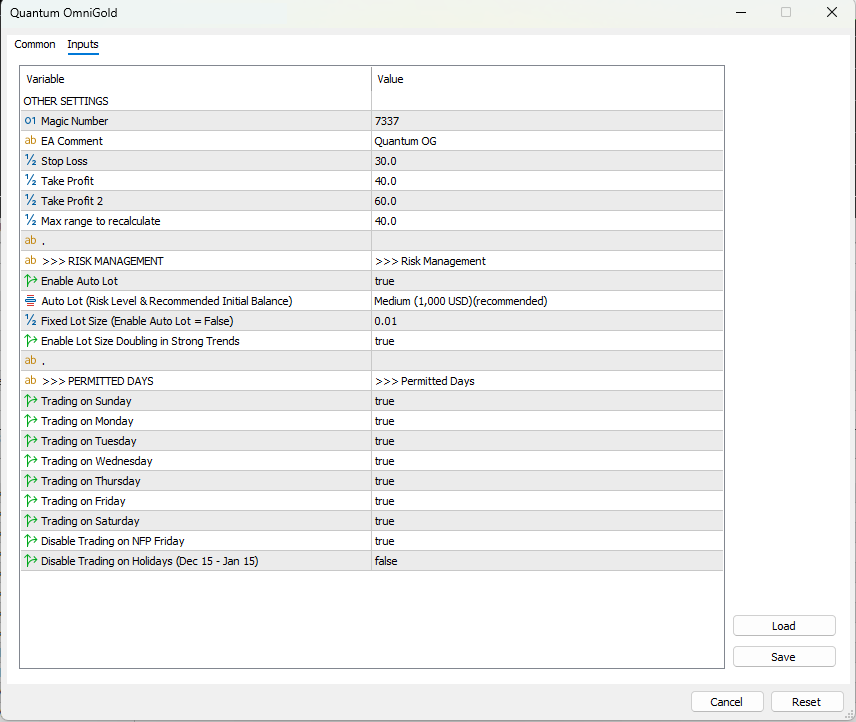
The inputs panel is where the marketing headlines become concrete. The relevant defaults:
- Stop Loss 30: A fixed, price-based stop on every position. This is the headline strength — losing trades have a hard cap rather than being left open to dynamic logic
- Take Profit 40 / Take Profit 2 60: Two staged profit targets, so the EA banks gains in stages rather than closing everything at a single level
- Max range to recalculate 40: Governs how the EA re-evaluates levels as price moves
- Enable Auto Lot: true / risk level Medium ($1,000 recommended): Position sizing scales with your account through a selectable risk level; Medium is the developer’s recommended setting for around a $1,000 balance
- Fixed Lot Size 0.01: Manual lot size used when auto-lot is turned off
- Enable Lot Size Doubling in Strong Trends: true: The aggressive scaling feature — see the dedicated section below
- Permitted days: All seven days enabled, with Disable Trading on NFP Friday: true — built-in protection around one of gold’s most volatile scheduled events
Taken together this is a conventional, understandable risk framework: define the loss, take profit in stages, trail the rest, and sidestep the worst scheduled news. For a gold EA, having a real fixed stop as the default is a genuine point in its favour — it makes the system’s per-trade risk knowable in advance, which is exactly what the no-static-stop gold robots cannot offer.
The Lot-Size Doubling Question
The most important input to understand before going live is “Enable Lot Size Doubling in Strong Trends”, which is on by default. This is the feature that drives the enormous backtest totals, and it deserves a clear, honest explanation.
First, what it is not: it is not loss-averaging martingale. Classic martingale increases lot size after losing trades, doubling down to try to recover a loss — the pattern that blows accounts up. Quantum OmniGold’s doubling triggers in strong trends — it adds size when the market is moving in the trade’s favour. That is pyramiding into momentum, a fundamentally different (and more defensible) mechanism than martingale. It is also not a grid system — there is no ladder of averaging orders building up against a losing position. The promo’s “no grid, no martingale” claim is fair on that specific point.
What it is: a genuine exposure amplifier. When the doubling is active, the EA is running larger size than the base lot, so a sharp reversal against a scaled-up position is a bigger hit than a single base-lot trade would be. The fixed stop loss still caps each position, but the combined exposure during a doubling sequence is what buyers need to size around.
Practical read: keep the auto-lot risk selector at the recommended Medium level while you validate, rather than reaching for a higher setting because the Extreme-risk backtest looks spectacular. The doubling behaviour plus a conservative risk level is a sensible combination; the doubling behaviour plus a maximum-aggression risk level is how the backtest reaches nine-figure fantasy numbers — and how a live account could take an outsized drawdown in a bad stretch. Understand the feature, size for it, and let the fixed stop do its job.
The Live Signal — Read the Deposits
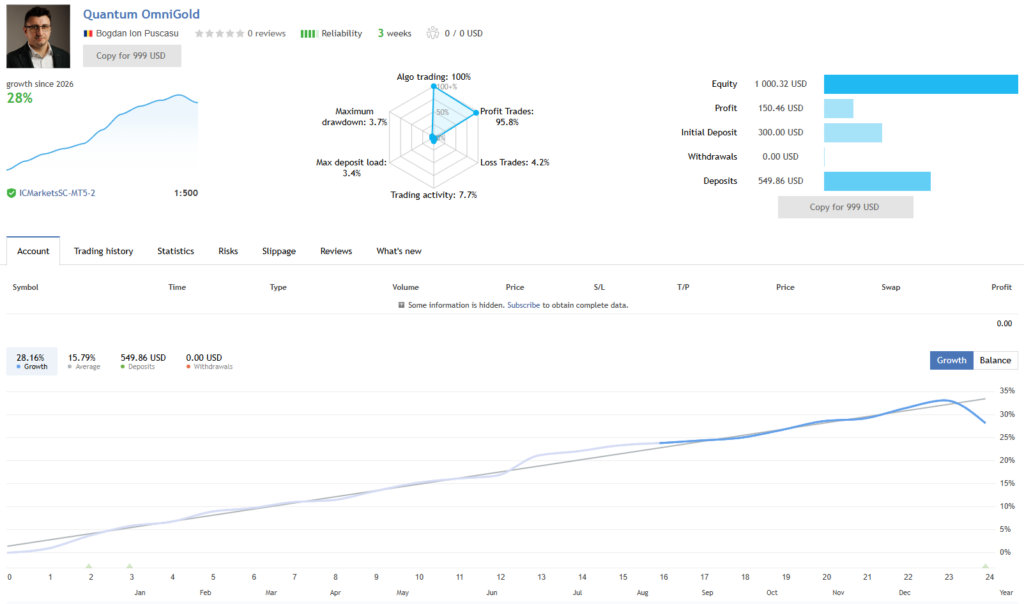
The public live signal is real money on IC Markets at 1:500 leverage, with roughly three weeks of tracked history at the time of writing.
The headline numbers: 28% growth, 95.8% profit trades, 4.2% loss trades, 3.7% maximum drawdown, 3.4% max deposit load, 7.7% trading activity.
The deposit context. The signal opened on a $300 initial deposit. Additional capital was added during the three-week period, bringing total deposits to roughly $850, with equity around $1,000 and cumulative profit of about $150. The 28% headline growth is calculated against the original $300; the cleaner read on actual absolute return is roughly $150 profit against the ~$850 total capital deployed, which works out closer to 18%. Neither number is wrong, but the ~18% figure is the one to anchor forward expectations on — MQL5’s growth percentage is amplified when fresh capital flows in against a small initial base.
On the 95.8% win rate. A win rate that high is characteristic of a small-take-profit style: the EA banks frequent modest gains and takes losses rarely. The number to watch is not how often it loses but how large the losing trades are when they come — high-win-rate gold systems typically have losses that are bigger than their average win, so the risk lives in the size of the occasional loser rather than its frequency. This is exactly why the fixed stop loss matters here, and why the lot-doubling exposure matters too.
What three weeks doesn’t tell us yet. Whether the system holds its profile through a genuinely adverse gold stretch, how the lot-doubling behaves in a whipsaw market, and whether the drawdown stays contained as the sample grows. Three weeks is early — treat the live signal as a promising start that will become meaningful evidence over the coming months, not as a settled track record.
The Backtests
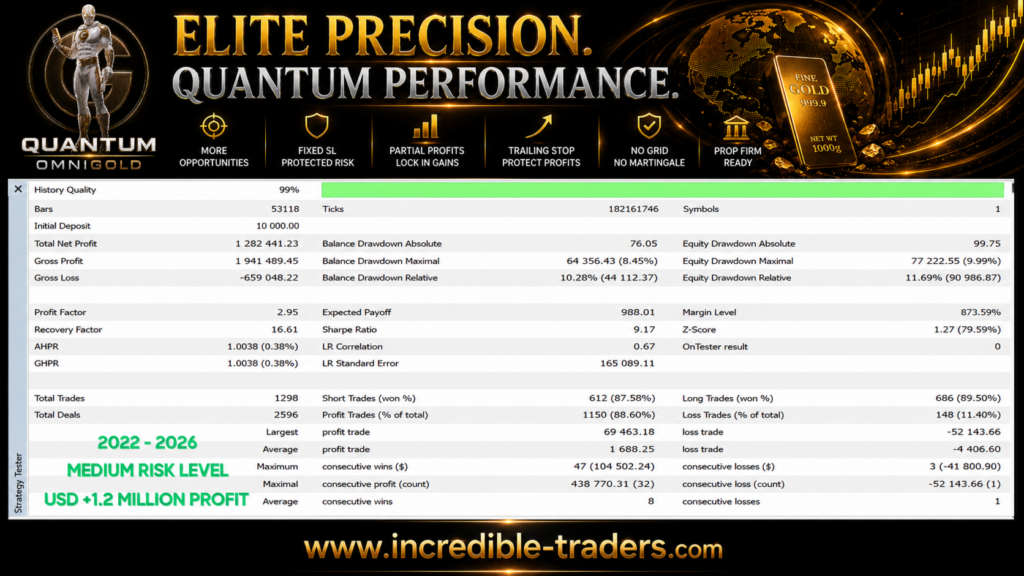
The Medium-risk backtest covers 2022 to 2026 at 99% history quality — a multi-year window spanning the 2022 rate-hike regime and gold’s 2024–2026 rally. On paper it turns $10,000 into roughly $1.28 million, with a profit factor of 2.95, maximum drawdown under 10%, and an 88.6% profit-trade rate.
Standard framing applies. The million-dollar total is a product of compounding a percentage return on a growing balance with lot-size doubling active — it is an illustration of the strategy’s behaviour under the Medium risk setting, not a forecast of what your account will do. What is more useful than the headline dollar figure is the underlying shape: the system ran across multiple gold regimes without breaking, and drawdown stayed in single digits on the test. One detail worth noting for realism — the average losing trade in this test was larger than the average winner, which is the small-take-profit asymmetry the live signal shows too. That is the profile to expect: many small wins, occasional bigger losses, capped by the fixed stop.
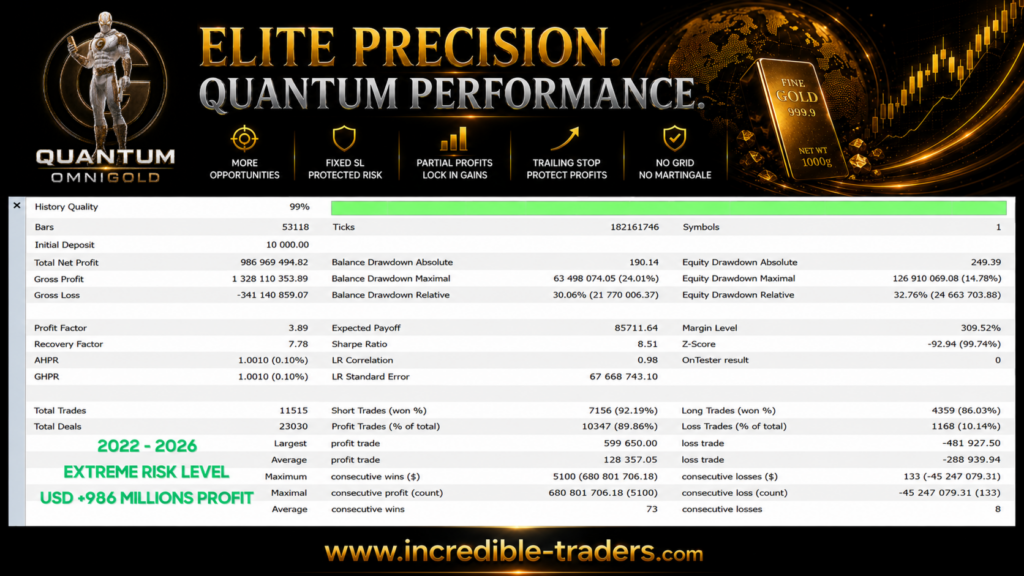
The developer also publishes an Extreme-risk backtest over the same period that reaches a nine-figure total (close to $987 million from $10,000). It is important to read this for exactly what it is: a demonstration of what maximum lot-doubling aggression produces in a compounded backtest, not a realistic expectation and not a setting most traders should run. The higher risk setting also carries a materially higher backtest drawdown (into the mid-20s in percent). We show it here for transparency because it is part of the product’s marketing, but the Medium-risk profile is the sensible reference, and even that should be read as behaviour illustration rather than a forward projection. If a backtest total looks too good to be true, the honest answer is that the risk setting that produced it is too aggressive to run in reality.
Who Quantum OmniGold EA Is For
It might be a fit if you:
- Want a gold EA with a real fixed stop loss on every trade, rather than a system that relies on dynamic logic with no static stop
- Value the reassurance of an established developer’s catalogue reputation on a product that is still building its own review base
- Understand the lot-size doubling feature and are willing to keep the risk selector at the recommended Medium level rather than chasing the Extreme-risk backtest numbers
- Are comfortable being an earlier buyer on a roughly three-week live signal, with the understanding that more evidence accumulates over the coming months
- Are running a prop-firm or funded account and want a system built with fixed stops and defined drawdown in mind (set the risk level conservatively for those rules)
- Can read a live signal headline in deposit context rather than taking the growth percentage at face value
Look elsewhere or wait if you:
- Are uncomfortable with any position-scaling feature, even trend-following doubling with a fixed stop in place
- Want a long, multi-month or multi-year live track record before buying — this signal is about three weeks old
- Need an established review base for purchase confidence — this specific product currently has none, and the trust case rests on the developer’s wider catalogue
- Trade only on MT4 — this is an MT5 product
- Would rather wait a few months for the live signal to mature through more market conditions before evaluating
Our Verdict
We rate Quantum OmniGold EA 4.5 out of 5.
The upper-half score is earned by two real strengths. The trade-management stack is conventional and transparent — a fixed stop loss on every position, two staged take-profits, and a trailing stop — which gives the system a knowable per-trade risk profile that no-static-stop gold robots simply cannot match. And the Quantum studio’s established catalogue is a legitimate trust anchor on a product that is brand new, letting buyers evaluate the developer’s reputation while the individual track record matures. The live signal’s early metrics — contained drawdown, selective activity, a defined-profit style — are a promising start on IC Markets real money.
The half-point we hold back captures the honest caveats. The lot-size doubling feature is a genuine exposure amplifier that must be understood and sized around, even though it is trend-following rather than loss-averaging martingale. The backtest totals ($1.2 million at Medium, nine figures at Extreme) are illustrations of compounding under specific risk settings, not forecasts — and the Extreme figure in particular should be read as an aggression ceiling, not a target. The three-week live signal is early evidence rather than a proven record, and its headline growth is amplified by additional deposits during tracking.
Practical recommendation: if you want to buy it, buy it and run it conservatively. Keep the auto-lot risk selector at the recommended Medium level (not Extreme), validate on demo and then a small live account for at least four to six weeks on your own broker before scaling, keep the NFP-Friday filter on, and treat the fixed stop loss as the feature that makes this more controllable than no-stop gold systems — while sizing for the lot-doubling that runs alongside it. Buying through CheaperForex at a significant discount keeps the cost of being an early evaluator modest.
How to Get Quantum OmniGold EA Safely
Two legitimate sources, and only two.
CheaperForex — the same EA at a significant discount versus the marketplace price. Get Quantum OmniGold EA MT5 at CheaperForex.
The MQL5 marketplace — direct from Bogdan Ion Puscasu’s developer page. Here is the official MT5 listing.
Anywhere else offering it free or via a Telegram seller is a trap — there is no working cracked file, only malware or pay-and-vanish scams.
Frequently Asked Questions
Is Quantum OmniGold EA legit, or a scam?
Legitimate. It is a published MQL5 marketplace product from Bogdan Ion Puscasu’s established Quantum studio, with a real-money public live signal on IC Markets. The scams are the “free download” sites and Telegram sellers offering cracked copies that cannot exist — every legitimate marketplace EA is licence-protected, so a free copy is either malware or a payment scam.
Does it have a stop loss?
Yes — a fixed, price-based stop loss (30 points in the developer’s defaults) on every position, alongside two take-profit levels (40 and 60) and a trailing stop. This is a real advantage over the many gold robots that run with no static stop and rely on dynamic logic to close losing trades. It is also why the product is positioned as prop-firm friendly.
Is the “lot size doubling” feature a martingale?
No. Martingale increases lot size after losing trades to recover them; Quantum OmniGold’s doubling triggers in strong trends, adding size when the market is moving in the trade’s favour (pyramiding into momentum), with the fixed stop loss still in place. It is a genuine exposure amplifier, so it should be sized around — keep the auto-lot risk selector at the recommended Medium level rather than a higher setting — but it is not the loss-averaging pattern that blows accounts up.
How should I read the 28% live growth figure?
As technically accurate but amplified by deposits. The 28% is calculated against the $300 initial deposit, but additional capital added during the roughly three-week tracking period brings total deposits to around $850. The cleaner read on actual absolute return is roughly $150 profit against that total — closer to 18%. Anchor forward expectations on the deposit-adjusted figure rather than the headline percentage.
What do the huge backtest numbers ($1.2M and $987M) actually mean?
They are illustrations of compounding under specific risk settings, not forecasts. The $1.2 million figure is the Medium risk level over 2022–2026; the nine-figure total is the Extreme risk level, which demonstrates the ceiling of the lot-size doubling feature rather than a realistic expectation. Run the Medium setting, read the backtest as a behaviour profile (multi-regime consistency, single-digit drawdown at Medium), and anchor real expectations on the live signal.
How does it compare to other Quantum EAs?
Quantum OmniGold is the studio’s gold-focused defined-risk release, and it doesn’t use a grid. The closest sibling is Quantum Valkyrie — another Quantum gold system that also avoids grid trading, which makes it the most natural head-to-head if you are deciding between them. Quantum Queen is also a gold system, while Quantum Emperor trades the major pairs. The wider range also includes Quantum King, Quantum Athena, Quantum Bitcoin, Quantum Baron and Quantum StarMan. If you want gold specifically, OmniGold, Valkyrie and Queen are the three to compare — the choice comes down to which risk profile and trade style suits your account.
Is it suitable for prop firm challenges?
It is built with prop rules in mind — the fixed stop loss and defined drawdown profile help with the daily and maximum loss limits most firms enforce. The caveat is the lot-size doubling and the risk-level selector, both of which affect how much you can lose in a single stretch. On a challenge or funded account, set the risk level conservatively, understand the doubling behaviour, and test on the firm’s demo before running it live.
Why is it cheaper at CheaperForex?
The product is identical — same EA, free lifetime updates. You pay significantly less. For a Quantum-studio gold EA with a genuine defined-risk stack and a young live signal, paying less to test it on demo and validate before scaling is the practical approach.