
ORB Revolution EA MT5 automates opening-range trading, with Nasdaq US100 M5 defaults and breakout, retest, reversal and Rebreak choices. Its distinctive controls include range/context filters, touch or candle-close confirmation, daily risk thresholds and separate breakout/reversal management.
Our assessment: the appeal is a configurable session strategy with explicit entry and exit controls. It suits traders prepared to test those settings carefully. The public account is only two weeks and 22 trades old; the optional loss-linked reversal multiplier also qualifies the overview’s no-martingale claim.
View ORB Revolution EA MT5 features and pricing

We examined the developer listing, linked input guide, release notes and public MQL5 signal on October 2, 2026. We have not independently traded the EA or reproduced a performance test. The listing identified version 3.3, updated September 2, 2026; its February release date does not make the current linked account an eight-month live record.
What the opening range does
The opening range is the high/low formed during a chosen session window. ORB Revolution exposes the start and end hours/minutes, then evaluates entries around that range. An immediate breakout seeks continuation as price leaves it; a retest waits for a return toward the broken boundary. Reversal behavior adds a different response when the initial move fails.
A touch can enter sooner but catch a move that quickly reverses; candle-close confirmation waits but changes the entry price and opportunity. Neither is inherently superior across markets and costs. Compare them without changing several filters simultaneously.
Range-size limits and a breakout buffer restrict initial opportunities. ATR, oscillator, optional VWAP/MA, gap and opening-range context filters provide further gates. Rebreak, added in September, seeks another opportunity after price returns, restructures around the boundary and breaks again. Failed ORB is different: it countertrades a breakout that fails and returns into the range.
Nasdaq defaults and broker-specific settings
The developer recommends US100 on M5, with starting guidance of a 200 USD account and approximately 1% risk per trade. Broker symbol names, contract sizes, minimum lots and point values differ. A minimum deposit recommendation does not establish that the smallest available volume matches your intended cash risk.
Both MT5 netting and hedging modes are supported according to the listing. Check the actual behavior with other trades on the same instrument. The author offers alternative setups, including Gold presets privately on request; those are not evidence that Nasdaq defaults can be attached unchanged to any chart.
Match opening and cutoff times to the broker’s clock and intended market session, including daylight-saving changes. Use distinct Magic Numbers for separate instances. The guide’s Strategy Name groups historical performance under a readable label; it does not replace trade-management isolation.
Risk sizing, daily limits and exits
Breakout and reversal engines have independent fixed-lot, percentage-risk or cash-risk settings. The guide scales stops, targets and some management thresholds in RSM: Range Size Multiples. With a 100-point opening range, 0.5 RSM is 50 points. Confirm the calculated volume and resulting cash exposure rather than treating a range multiple as a risk percentage.
The overview says no grid, martingale or averaging, but the July 21 release adds an optional reversal lot multiplier when a breakout closes in loss. If set above one, this increases reversal volume after the loss. It is not evidence of an unlimited doubling sequence, but it prevents an unqualified promise that every setting avoids loss-linked escalation. Evaluate both legs together.
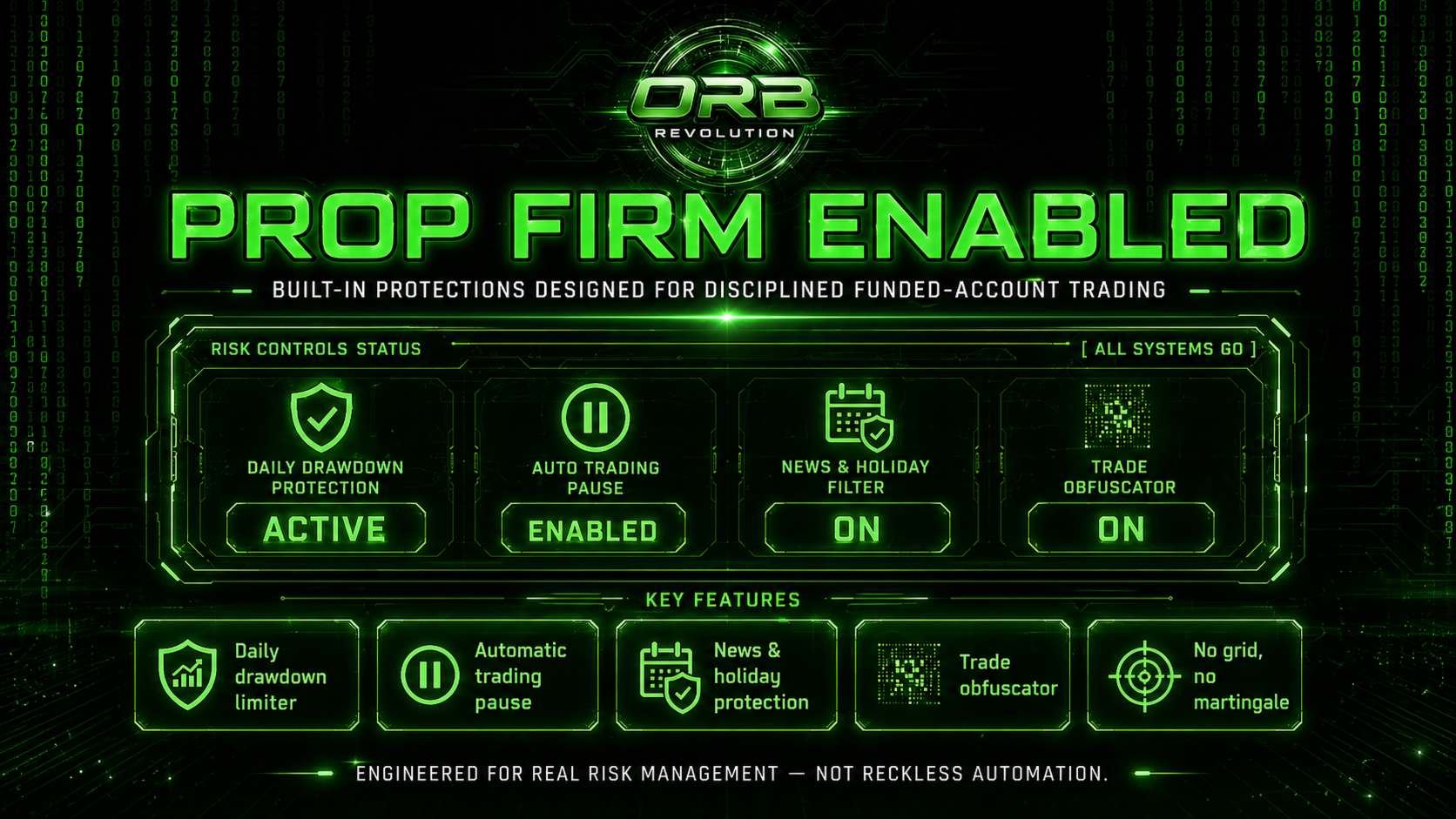
Daily controls include floating-P&L inclusion, daily reset timing, a safety buffer, breach actions and Magic-number scope in the guide. Closing a strategy’s own trades and closing all account trades have different consequences. Check those settings against the firm’s actual equity and day-boundary rules; daily targets are not guaranteed loss ceilings.
Stops, targets, partial closes, breakeven and trailing management can be configured separately. Later releases add structure/candle-based stops and a same-direction exit that arms after a chosen number of candles, then exits on an opposite close. Virtual TP/SL remains dependent on a running terminal: the guide explicitly says offline virtual protection cannot be enforced.
Current build versus the older public guide
The linked February 13 guide is useful for RSM, the two engines and the risk module, but predates several changes. July’s release notes switch news to the internal MQL5 calendar, superseding the guide’s Investing.com WebRequest setup. The old Trend Filter was also renamed Oscillator Filter, with VWAP/MA and later gap/context options added.
The guide describes optional actions on existing positions as well as entry restrictions. Verify the current news mode and breach actions; a pause need not close trades. Release notes document breakeven/slippage and stop-risk fixes, making build/preset identification relevant to comparing results.
The current signal: small sample across several markets
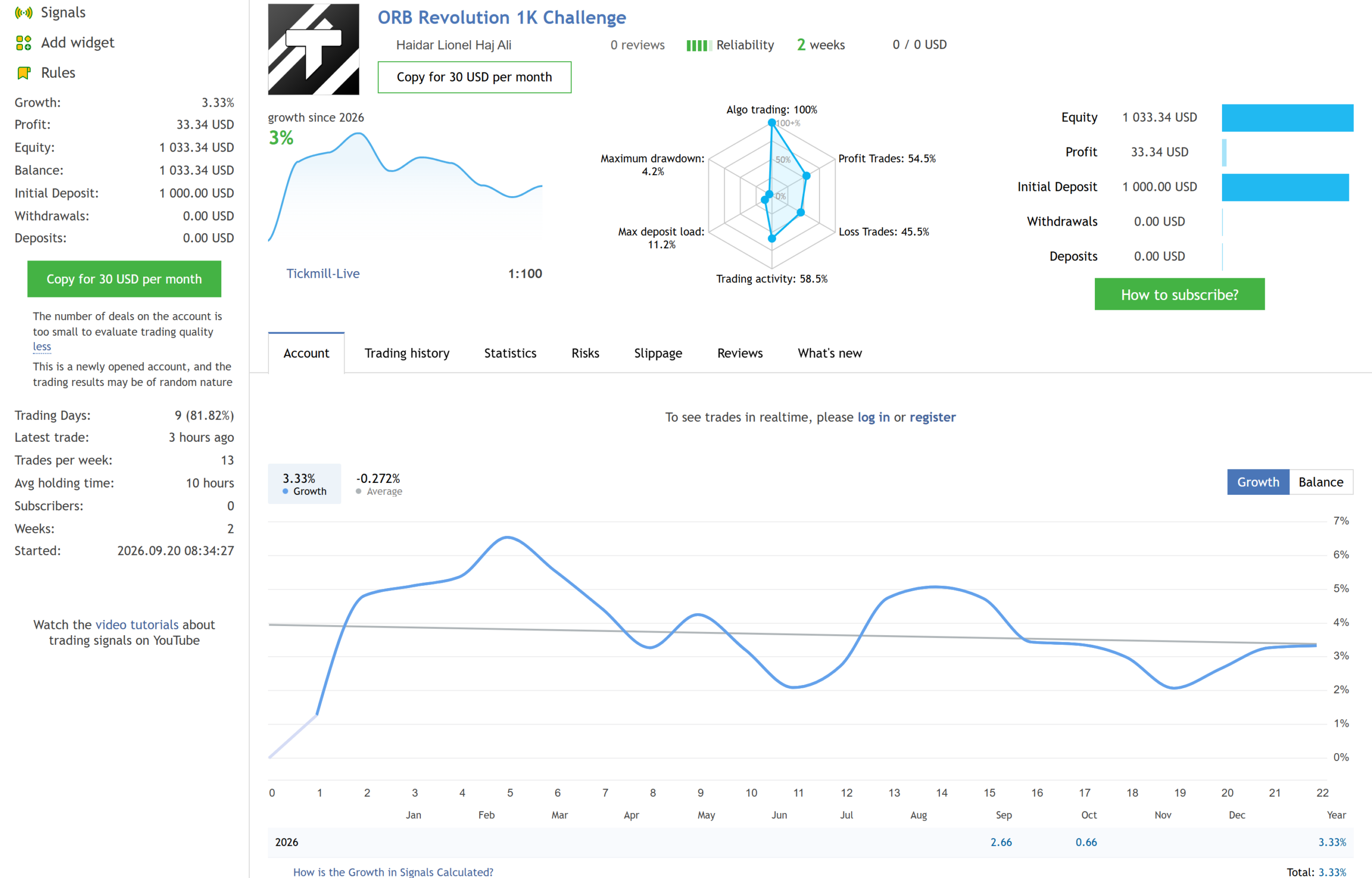
The linked account is ORB Revolution 1K Challenge on Tickmill-Live at 1:100 leverage. MQL5 reported a September 20, 2026 monitoring start, two weeks of history and 22 trades at our October 2 check. It showed 3.33% growth, 33.34 USD profit and equal balance/equity of 1,033.34 USD from an initial 1,000 USD, with no additional deposits or withdrawals shown.
- Trade sample
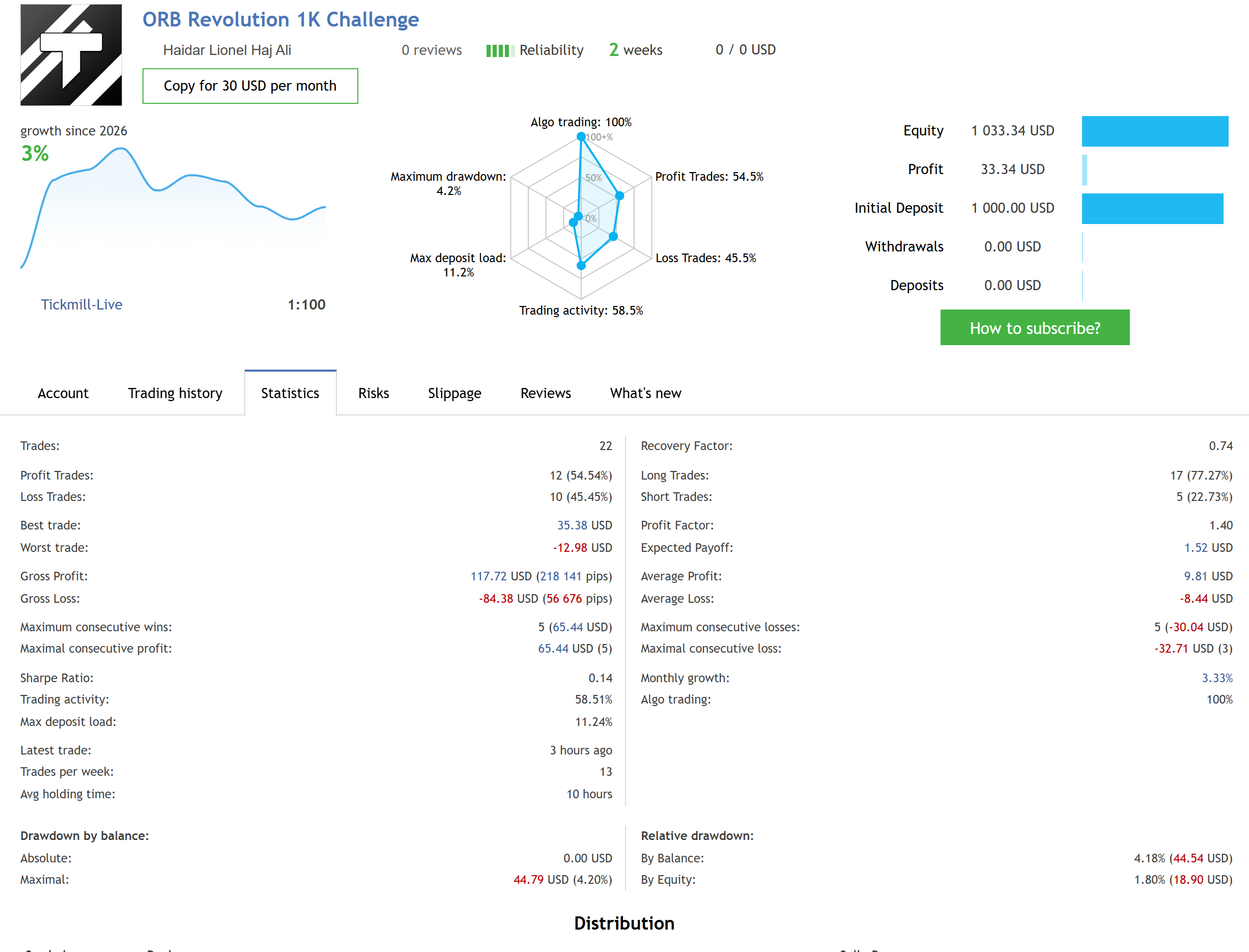
- 22 trades: 12 profitable and 10 losing, a 54.54% winning share.
- Profit factor
- 1.40 at the dated check.
- Relative balance drawdown
- 4.18% (44.54 USD).
- Relative equity drawdown
- 1.80% (18.90 USD).
- Maximal balance drawdown
- 44.79 USD (4.20%), a separate measure from relative balance drawdown.
- Holding time and load
- Ten-hour average holding time; 11.24% maximum deposit load.
GBPUSD accounts for eight trades; JP225 four; USTEC, DE40 and USDJPY three each; US30 one. This is a mixed-market account, not a controlled Nasdaq-only test. The page identifies 100% algorithmic trading, but that label does not independently verify which build and preset generated every trade.
MQL5 explicitly warns that this account is newly opened, results may be random and there are too few deals to evaluate trading quality. Keep those warnings beside the growth figure. The separate drawdown measures describe this short observation; they are not risk ceilings. Equal balance and equity at the capture also does not describe floating exposure throughout the history.
What customer reviews add
The listing showed 26 MQL5 reviews at the check. Buyers discuss configurable entries, support and the learning curve, which are useful usability themes. They are customer opinions on the MQL5 product, separate from CheaperForex verified-purchase ratings and from audited performance.

“small drawdowns or choppy performance”
coffeefcy, MQL5 customer review, March 17, 2026. This short phrase refers to ranging markets; the original sentence is retained in the genuine screenshot above.
In a March 17 review, coffeefcy describes using Nasdaq and DAX and reports uneven performance when markets range, with stronger moves helping offset small losses. That describes the tradeoff of the buyer’s own setup; it does not quantify an independently verified edge. Earlier February feedback from Czerni praises flexibility while still waiting to see long-run live behavior.
April comments describe supportive responses and continued development, while ChrisYamaSan says the initial settings felt overwhelming. Together, these accounts support the view that ORB Revolution is a configurable framework requiring time to understand. Access to the author’s private community or an extra free EA is not implied by the CheaperForex offer.
How to evaluate the configuration
Record the Nasdaq defaults, session clock, contract and calculated volume on demo. Verify range construction, daily limits and exits through news pauses and disconnections. Compare entry modes with unchanged costs/risk, reserve data not used to select settings and observe forward execution. The configurable structure is useful; the young mixed-market account cannot establish durable Nasdaq performance.
Explore ORB Revolution EA MT5 and current pricing
Primary sources, checked October 2, 2026: ORB Revolution listing and customer feedback; input configuration guide; release notes; current public signal.