
Cosmos Orion EA MT5 trades XAUUSD breakouts from three confirmed swing points on H2. Chen Jia Qi’s system uses pending stop entries, individually protected trades, percentage-risk sizing and several restrictions on new orders. Its public MQL5 listing launched October 3, 2026.
Our assessment: Orion has an understandable price-structure entry model and a useful range of order and sizing controls. It suits traders who want to examine a gold breakout setup rather than rely on a prediction claim. The main consideration is its very young public record: six historical trades and monitoring that began only October 3 cannot establish durable performance.
View Cosmos Orion EA MT5 features and pricing

This review examines the developer’s listing and original gallery, its public comments and the linked MQL5 signal, checked October 4, 2026. We have not independently traded the EA or reproduced its historical tests. Source versions and screenshots describe what was available at that date, rather than proving the contents or results of a different build.
What the H2 structure entry means in practice
The EA waits for three closed-candle swing points before preparing a Buy Stop or Sell Stop. Price must then reach the breakout order; simply identifying a structure does not immediately open a market trade. The developer describes cancellation when a setup becomes invalid or a pending order expires.
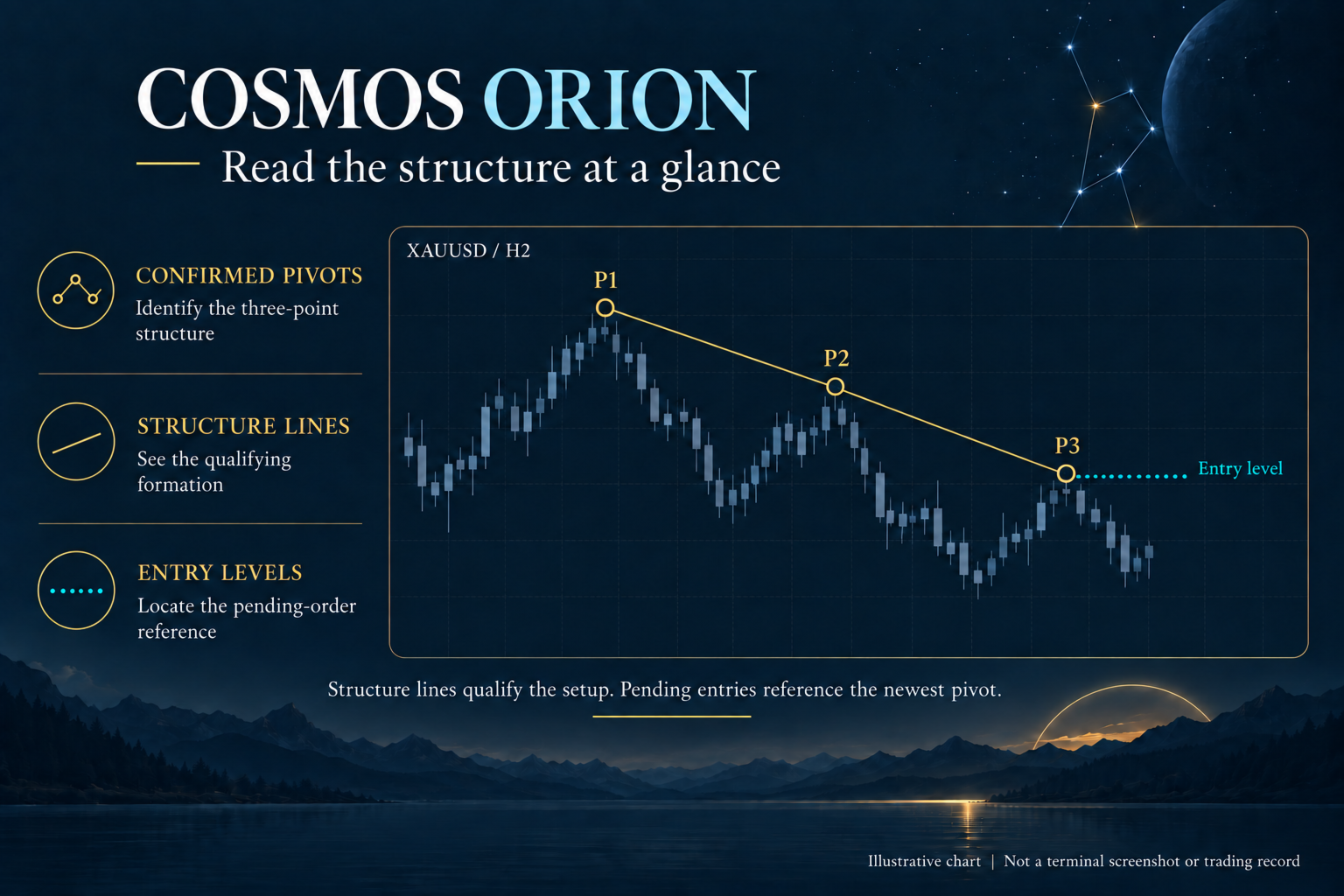
This makes the setup easier to inspect on a chart: compare the displayed swing points, intended entry and actual fill. Confirmation can reduce reactions to an unfinished candle, but it also introduces delay. A completed structure can still lead to a failed breakout, and a fast move can execute a stop entry at a worse price than its intended level.
The listing distinguishes the attached chart from the signal timeframe. H2 data drives the logic even when the EA is loaded on another chart timeframe. For a reproducible test, preserve the symbol, history, parameters and broker costs; changing the chart label alone is not a different trading model.
Stops, partial exits and restrictions on new trading
The advertised exit sequence combines initial stop loss and take profit with breakeven, trailing management and partial profit-taking. Distances are described as adapting to gold’s price. That is a design feature to inspect in the terminal, not evidence that losses remain equally small under every price regime.
Partial closing changes the exposure left in a trade. A protected remainder can still give back unrealized profit, and the broker’s minimum volume and volume step can affect how a small position is split. Record the actual volumes before and after a partial exit rather than judging the trade solely by a screenshot of the entry.
After two consecutive profitable trades, the daily profit lock stops new entries for the rest of that day. It is a limit on subsequent activity, not a daily profit target or a guarantee that an account keeps every earlier gain. Friday protection removes unfilled pending orders; open positions continue to be managed, so weekend exposure is still possible.
Spread, volatility, margin and scheduled-session checks restrict when orders are prepared. The description does not establish that the fixed-time protection reads a live economic-news feed. Automatic broker-time detection also has a fallback. Check the panel’s detected GMT and DST result instead of assuming every broker’s daily gold closure is identical.
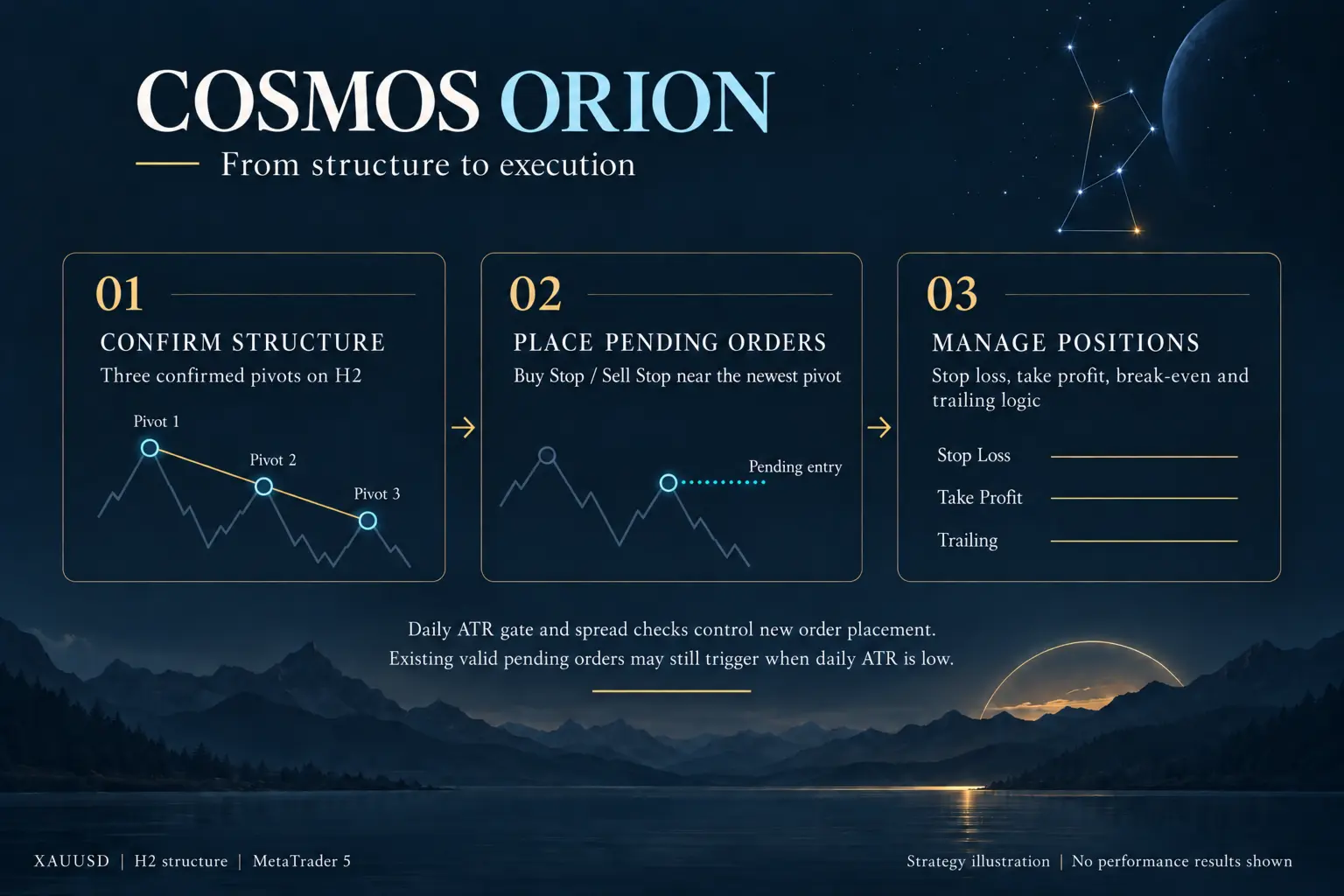
The execution illustration distinguishes creating a new pending order from an existing valid order being triggered: low daily ATR can block new placement while a previously placed order can still fill. An entry filter should not be treated as a guarantee that no trade can occur once its threshold is crossed.
Position sizing and the small-account limitation
- Account requirement
- MT5 hedging account; netting is not supported.
- Risk modes
- L1–L5 use 1–5% risk per trade. The listed default is 3%, with custom-percentage and fixed-lot alternatives.
- Balance reference
- Current balance allows volume to grow with the account; initial balance retains the original reference.
- Starting guidance
- The developer recommends a minimum 200 USD deposit, low spreads and continuous operation.
A minimum deposit is a setup recommendation rather than proof that the smallest account can reproduce the selected risk. If the calculated volume falls below a broker’s minimum lot, the minimum tradable position may expose more money than intended. Check cash loss at the actual stop distance, contract size and account currency before placing a trade.
A 3% per-trade setting is not a 3% total drawdown ceiling. Consecutive losses compound, and concurrent exposure can add up. A no-martingale design avoids a particular recovery mechanism; it does not turn a volatile gold breakout strategy into a low-risk investment.
Developer tests: inspect the assumptions, not only the ending curve
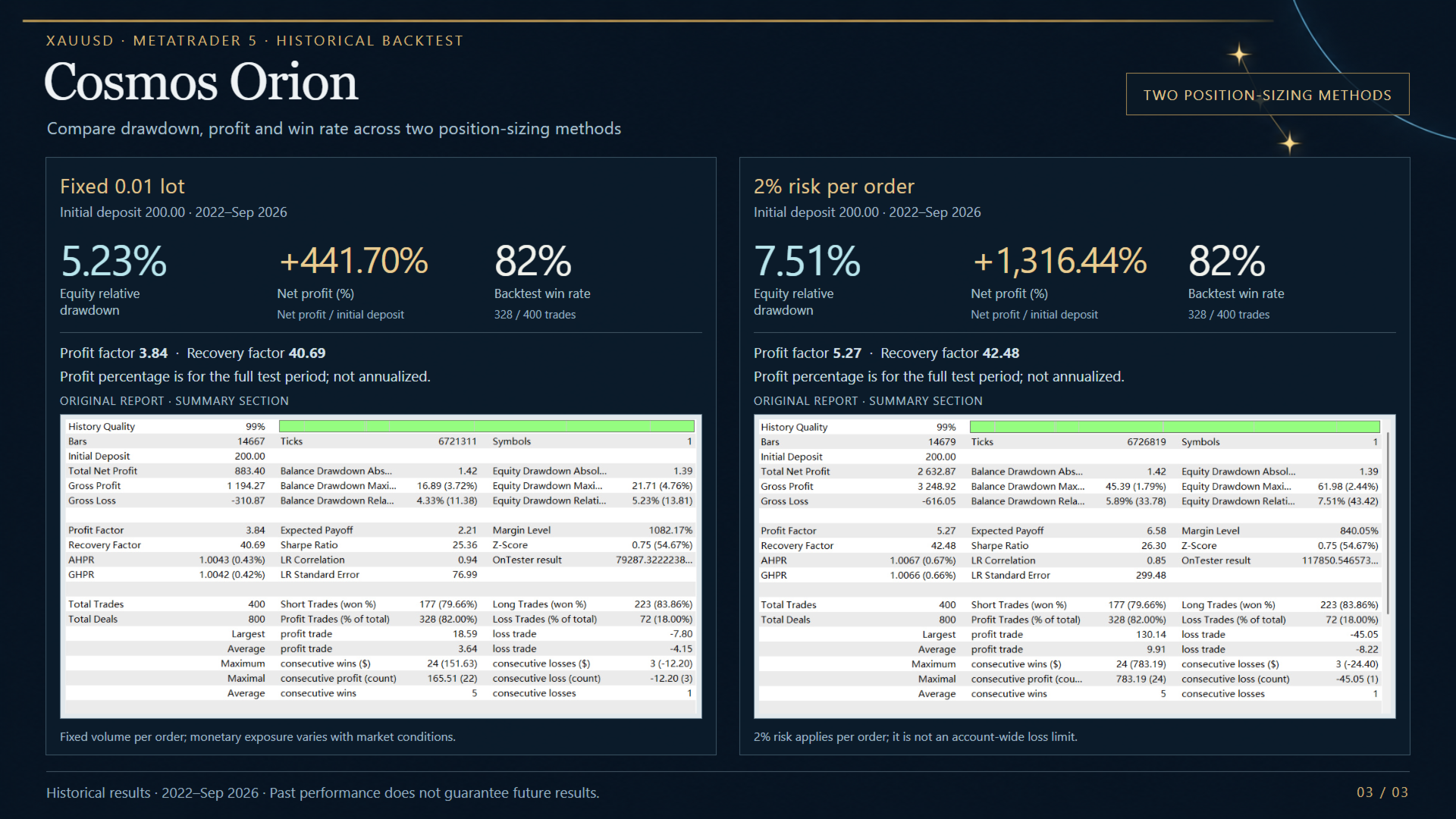
The comparison covers 2022–September 2026, with 400 trades and a 200 USD starting balance in both examples. Fixed 0.01 lots show 5.23% relative equity drawdown and profit factor 3.84; 2% per-order sizing shows 7.51% and 5.27. These full-period simulations differ in sizing, so their percentages are not annual returns or equivalent cash-risk settings. The snippets show 99% history quality, but no raw tester report or public preset was linked for independent reproduction.
The original developer screenshots are historical simulations. Their inputs, lot calculation, date range, modeling method and execution assumptions determine what can be compared. A rising curve is more useful when accompanied by its settings and drawdown report; it does not establish that retail fills will match the simulation.
Re-test the intended configuration with your broker’s gold contract and realistic spread, commission and delay. Keep a fixed-lot result separate from a percentage-risk result, and inspect losing sequences as well as the total. A test selected after trying multiple settings also needs genuinely unseen data before it supports a stronger reliability claim.
The signal: six historical trades, with public monitoring just started
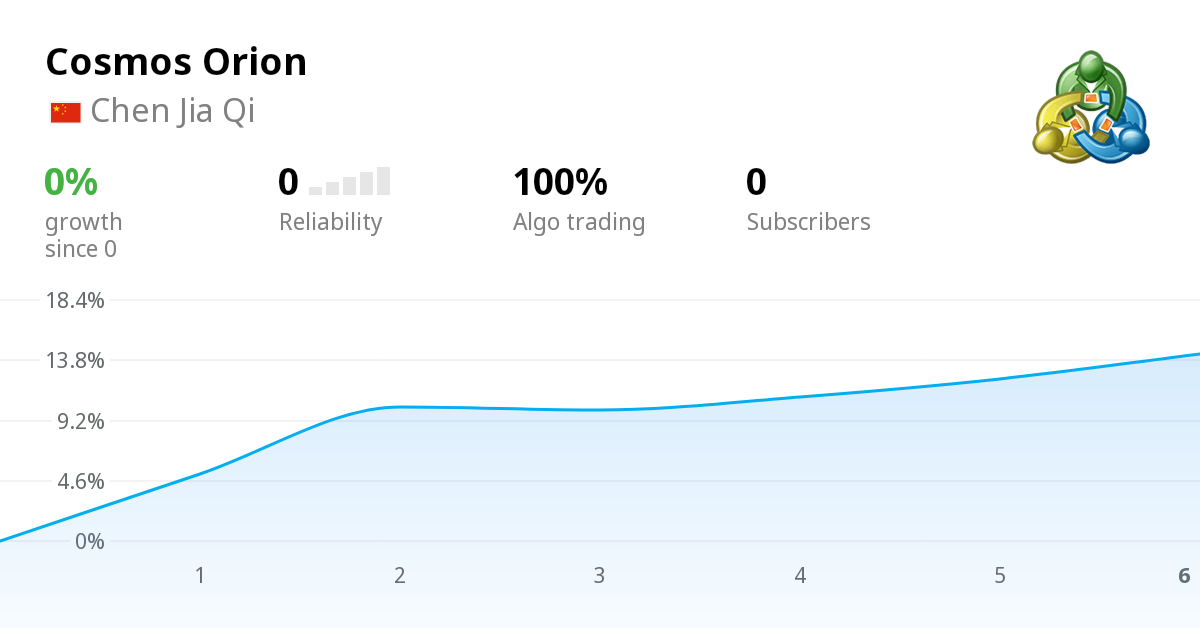
At the October 4 check, the account was on Tickmill-Live with a 2,000 USD initial deposit and 2,285.72 USD balance/equity. It contained six trades, five profitable, all short XAUUSD positions. MQL5 reported public monitoring started October 3, 2026 at 05:06:03, with the latest trade three days earlier and subscriptions not yet permitted until trading starts.
The listing quotes 14.29% for the initial history, and the signal’s monthly field shows 14.29%, but its main Growth field currently shows 0.00%. These fields should not be collapsed into one claim of verified post-monitoring growth. Likewise, its balance-based historical maximum drawdown is 5.55 USD / 0.25%, while the relative balance and equity fields show zero. That is insufficient to establish a zero-drawdown trading system.
The reported two-minute average holding time makes fills and costs relevant. Six sell trades also leave a narrow directional sample: they do not demonstrate how the EA behaves through repeated losing breakouts or a different gold regime. The useful next evidence is additional trading recorded after monitoring began, with both equity and balance visible. Do not infer a mature live track record from the server’s Live label or a short profitable imported history.
Manuals, release details and buyer feedback
The public listing identifies version 2.0 at this check. Its comments concern requests for a manual and configuration files, with the developer confirming that these were sent privately to a buyer. We found no public manual link to inspect and no scored product reviews at this check. Those setup requests are not performance testimonials, and ratings on Gold Snap or Gold House are not ratings for Cosmos Orion.
There is also a sizing inconsistency in the public materials: the prose calls 3% per-trade risk the default, while a settings illustration labels fixed 0.01 lots as the default. These are different modes. Inspect the actual Inputs panel and configuration file before assuming which one the supplied EA will use.
Because the public manual is unavailable, this review does not invent input behavior beyond the listing. In particular, confirm the actual pending-order expiry, simultaneous-order limits, session settings and partial-close behavior in your own terminal before relying on them.
Compare with Gold Snap and Gold House
Gold Snap EA MT5 and Gold House EA MT5 are other gold systems by Chen Jia Qi already in our catalog. The Gold House guide provides another strategy reference. Orion’s identity is its confirmed three-point H2 structure setup; sharing an author does not make another product’s settings or account results transferable.
Orion is worth evaluating for that explicit entry framework and its visible controls. The decision should rest on the setup fitting your account and on additional evidence, rather than on a few launch-period trades. Start with a demo hedging account, verify sizing and broker time, and observe both successful and cancelled setups.