
Available from CheaperForex $119.99 · $95.99 with crypto
Classic Breakout Surfer MT5 is a gold-breakout EA built around multi-timeframe market analysis, dynamic order handling and profit protection. Its distinctive controls let the trader allocate only part of an account to the EA, cap combined risk and count open trades and pending orders under one limit.
Our assessment: the appeal is the combination of a focused gold entry model and clear controls over total active and waiting exposure. It suits traders who want to inspect execution and configure account allocation. The main considerations are proprietary entry logic, broker sensitivity and the gap between historical testing and the live news filter. Sources were checked 8 November 2026; this is a source-based review, not a firsthand terminal test or an independently reproduced backtest.

The gold chart is M1; the decision model uses more information
Buti Andy Moeng identifies XAUUSD as the primary market and M1 as the host chart. The EA obtains the additional market information it needs internally, so attaching it to a one-minute chart does not mean its decisions use one-minute prices alone. The public description explains the purpose of the entry model, while keeping the exact calculations proprietary.
Orders are adjusted as market conditions develop, and the developer describes an attempt to avoid chasing moves that have already occurred. That is a stated design aim rather than proof that every entry avoids a false breakout. Independent stop management and disciplined sizing remain relevant when gold quickly reverses through a level.
Three controls answer different sizing questions
- Balance used by the EA
- Selects the portion of account balance used for this EA’s calculations.
- Max total risk
- Limits the configured combined risk of open trades and pending orders against that allocated balance.
- Max trades
- Caps the combined number of open trades and pending orders. A value of one permits one position or one waiting order.
These controls should be read together. Restricting the calculated balance changes the sizing base; it does not create a separate protected subaccount. A count limit does not describe the cash risk per position, while a combined-risk setting does not stop separate losses accumulating over time. The optional daily loss setting addresses the latter by stopping trading and closing positions at its configured threshold.
The source also warns that a broker’s minimum lot can force actual percentage exposure above the selected input on a small account. Check the cash loss at the stop, commissions and simultaneous waiting orders in the terminal. A configured limit is not a guaranteed realized loss ceiling when gaps, slippage or connection problems occur.
Profit protection has an execution trade-off
The EA offers tick-based and candle-based profit-protection calculations. Its spike-protection controls specify when the feature becomes active, sensitivity and the share of favorable movement to protect. These choices affect how quickly the system reacts and how much room a trade retains after moving into profit.
Protecting more of a sharp move may reduce a later giveback, but can also cause earlier exits during an otherwise continuing trend. The source does not establish one universally best setting for every broker or market. Compare exit behavior, trading costs and adverse periods rather than selecting a setting only because its best historical run looks strongest.
The news-filter backtest limitation matters
Classic Breakout Surfer uses the MT5 economic calendar without requiring a separate news website or API. The filter can pause new entries around selected currencies and impact levels; existing positions continue to be managed. This makes the timing inputs and the currency list part of the chosen operating configuration.
MT5 does not provide that calendar to the Strategy Tester. The developer explicitly notes that the live/demo filter cannot normally be reproduced in historical tests. A backtest and a live run with news protection enabled therefore differ in an important input, even if the other settings match. Record that difference when comparing results.
Additional markets and broker assumptions
The listing also names GBPUSD, USDJPY and BTCUSD, but presents gold as the default optimized market. It recommends separate adjustments and tests for the other instruments. Supporting a symbol is different from establishing that the gold profile is suitable for it without further work.
The developer optimized around IC Markets Raw Spread conditions and recommends competitive Raw/ECN execution. Other brokers may differ in spread, commissions, fills and server time. The strategy is designed around GMT+2/GMT+3, with an adjustment for other server clocks. Hedging is recommended; netting is supported with applicable position limitations. Keep these conditions alongside any test figures rather than treating results from one environment as portable unchanged.
Evidence and customer feedback
A small gold account, checked 8 November 2026
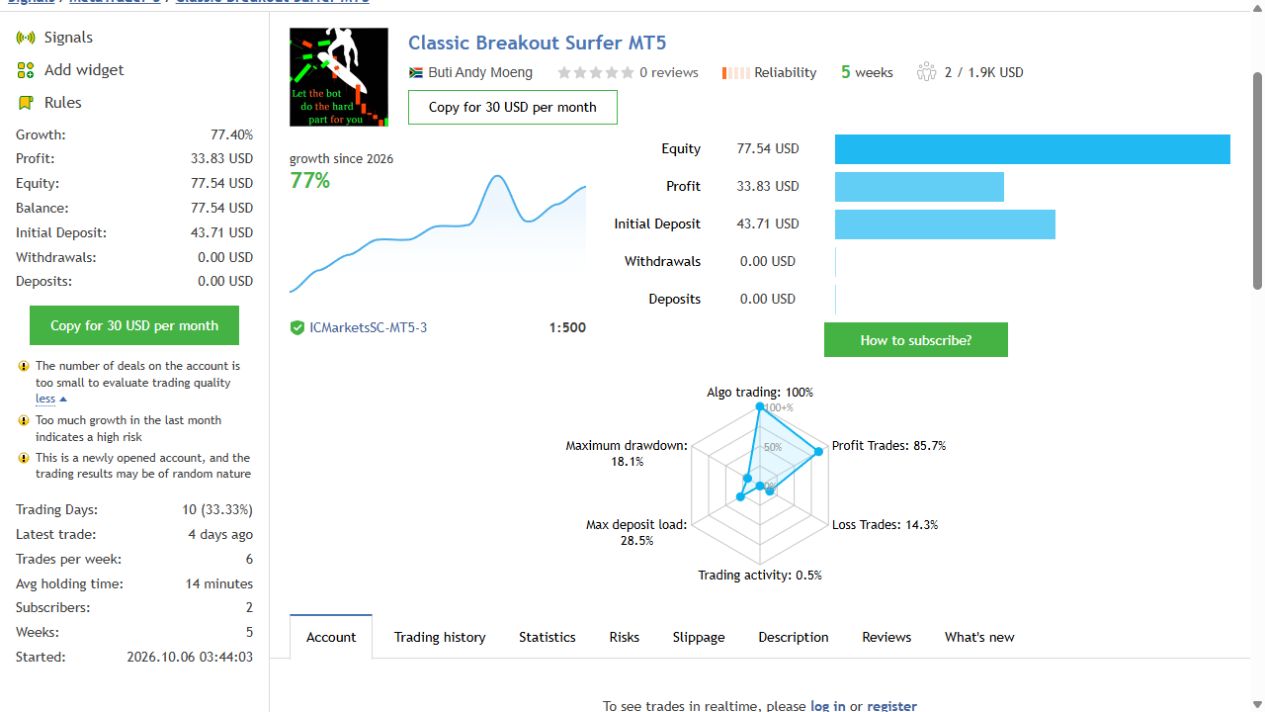
The developer links Classic Breakout Surfer signal 2394414. The dated account snapshot is useful for seeing actual gold trades, while its size and short history limit what can be concluded.
- Account and sample
- MT5 on ICMarketsSC-MT5-3, leverage 1:500. Started 6 October 2026; MQL5 displays five weeks and 14 trades, all XAUUSD.
- Growth and cash amounts
- 77.40% reported growth; $43.71 initial deposit, $33.83 profit and $77.54 balance/equity. No additional deposits or withdrawals reported.
- Drawdown and exposure
- Relative balance drawdown 18.07%; relative equity drawdown 14.18%; maximum deposit load 28.46%.
- Trade statistics
- Profit factor 2.38; 12 winning and two losing trades. Average profit $4.86 versus average loss $12.24; average holding time 14 minutes.
The large percentage gain should be read alongside the small dollar starting balance and only 14 closed trades. Losing trades were larger on average than winning ones in this sample. The source warns that the account is newly opened, the deal count is too small to assess trading quality and rapid recent growth can indicate high risk. These warnings remain relevant beside the favorable headline figure.
The account began on the retail publication date, while version 1.2 on 11 October added balance allocation and revised order/risk controls, including a total-risk bug fix. Version 1.3 on 2 November made the one-order limit strict, accepted the nearest valid value for out-of-range inputs and expanded spike-profit protection. The aggregate account history does not establish one unchanged build and configuration throughout.
One early customer opinion
The overview displayed one customer review. Stephen J Martret, writing on 8 October, praised the trading behavior, developer help and tests he said he had performed under varied broker costs. That is an attributed customer assessment, rather than a test reproduced or independently verified by CheaperForex. It also predates both the 1.2 risk-control changes and the current 1.3 release.
Read the full customer discussion and the dated account record before treating either the favorable feedback or the percentage growth as evidence of long-term robustness.

Before enabling live trading
Use a demo account to inspect the selected configuration under your broker’s actual trading conditions. Check position size, simultaneous exposure, stop behavior, spread and execution costs. Compare floating equity losses with closed-trade results, and retain the settings and test dates when comparing configurations.
Read the current Classic Breakout Surfer MT5 listing, release notes and customer feedback in full. Historical results and customer opinions do not guarantee future returns.
Explore Classic Breakout Surfer MT5 from CheaperForex $119.99 · $95.99 with crypto