
Kingdom Knight Gold is a selective XAUUSD H1 portfolio EA with three higher-timeframe strategies, broker-side stops and three risk ranks. Its appeal is the developer’s detailed test disclosure and an approach built around larger winners rather than a high win rate. The main consideration is that meaningful drawdowns and long losing sequences remain part of the design, while live evidence is still minimal.
We reviewed the current listing, developer comments, original test images and linked public account on 13 September 2026. This is an analysis of those sources, not our own forward test.
View product details and current pricing.

How the strategy is described
Lewis Kosasih combines three gold strategies with H4, H12 and weekly directional bias. Entries operate on H1 and look for liquidity sweeps. The current release is 15.5, first published on MQL5 on 18 August 2026; the developer describes the version number as a development generation, not fifteen years of live trading.
The stated design places a hard stop loss at the broker on every order and excludes grid, martingale and averaging. That is a useful distinction from recovery systems, but it does not mean there can be no floating loss. A position can lose before its stop is reached, and a market gap can produce an execution price beyond the requested stop.
The return profile: frequent losses, larger winners
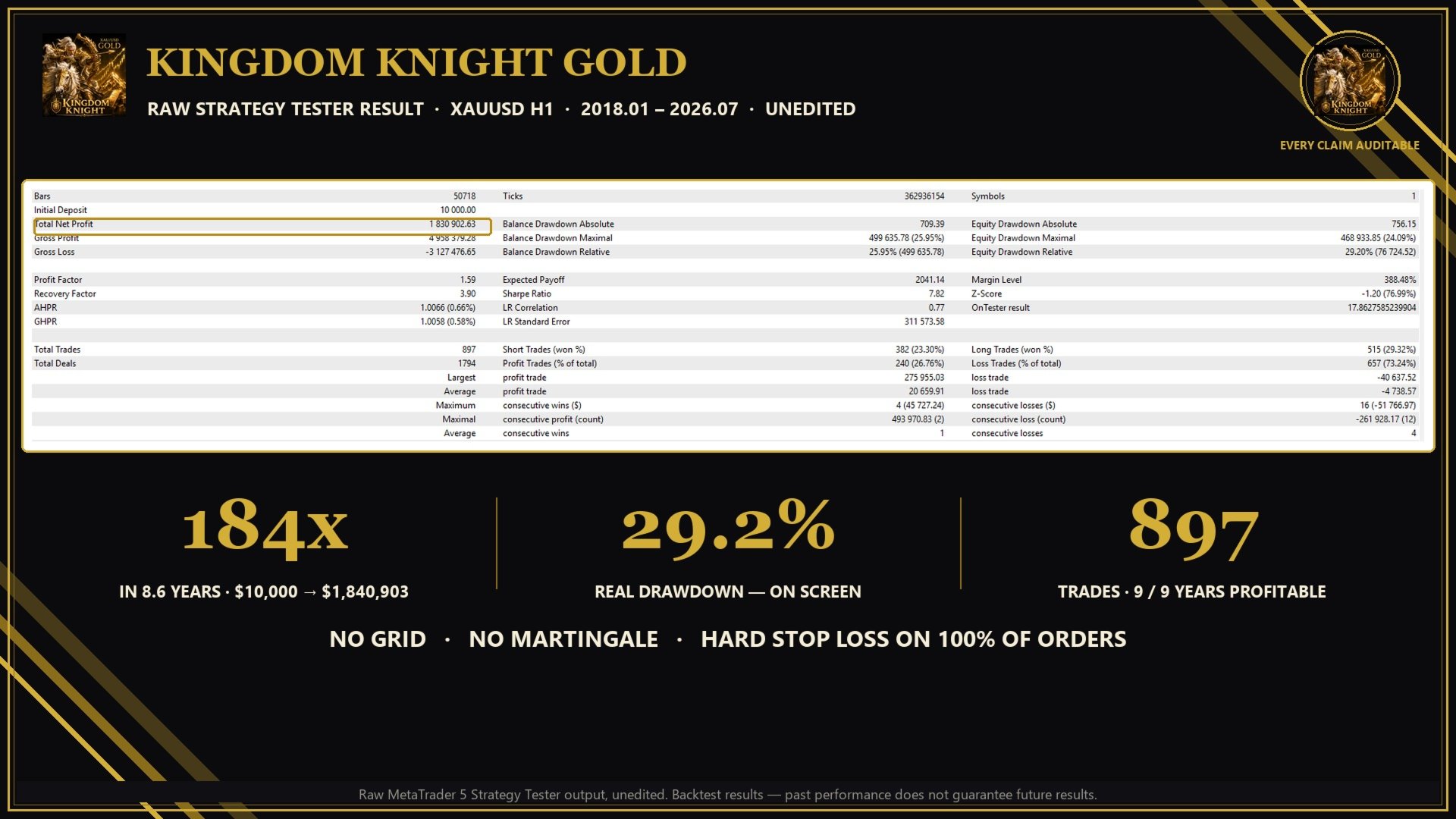
The developer reports a 26.8% test win rate and an average winner around 4.4 times the average loser. That combination can produce positive expectancy in a simulation, but most individual trades still lose. Someone judging the EA after three or four stopped trades could easily misunderstand its intended behaviour.
The disclosed test includes a run of sixteen losses. Comments also identify 35 losing months out of 103. Those numbers make the risk discussion more useful than a claim of consistently profitable trading: a profitable full-period test can still contain uncomfortable stretches that require financial and emotional tolerance.
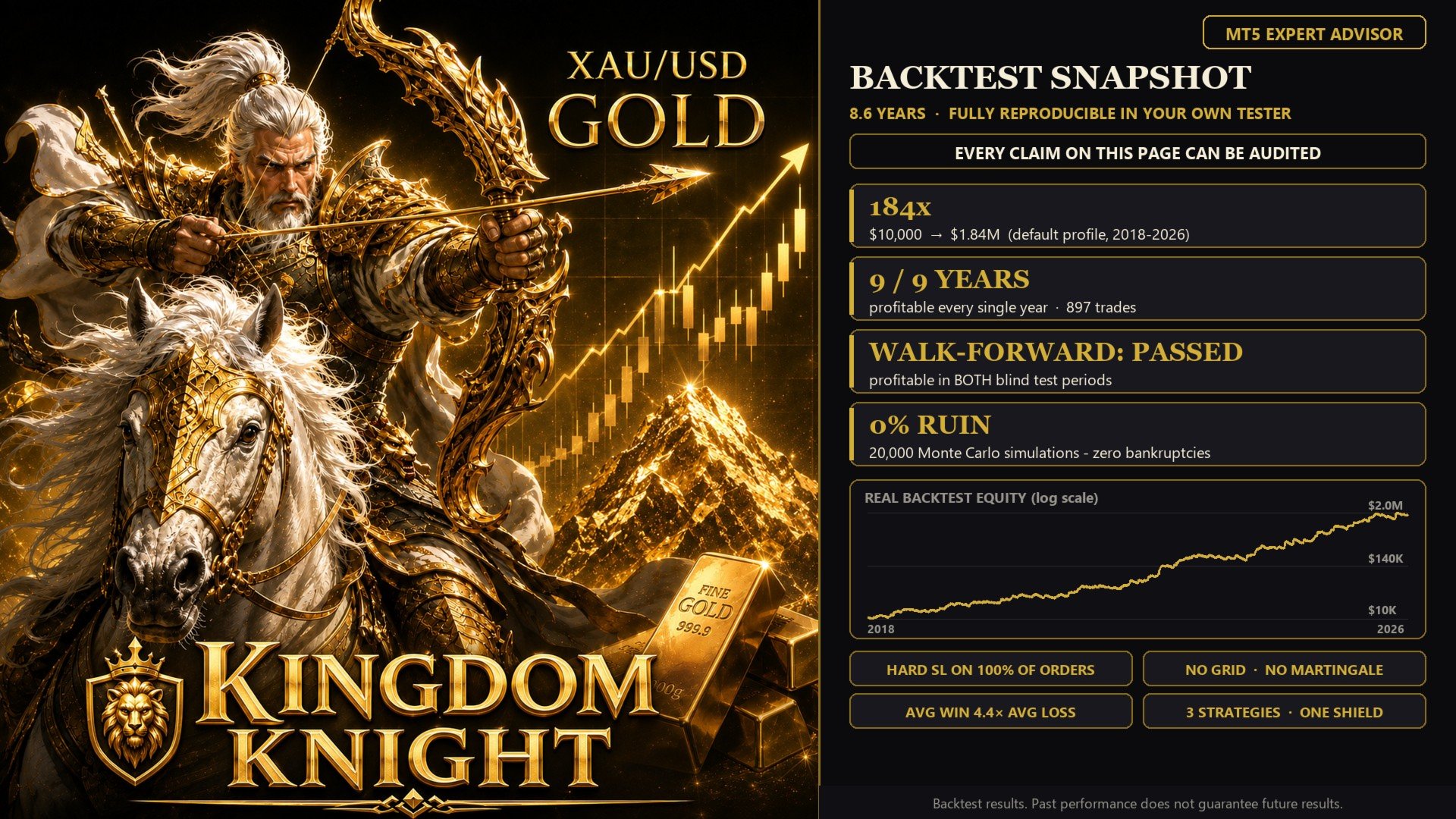
What the 184-times backtest actually represents
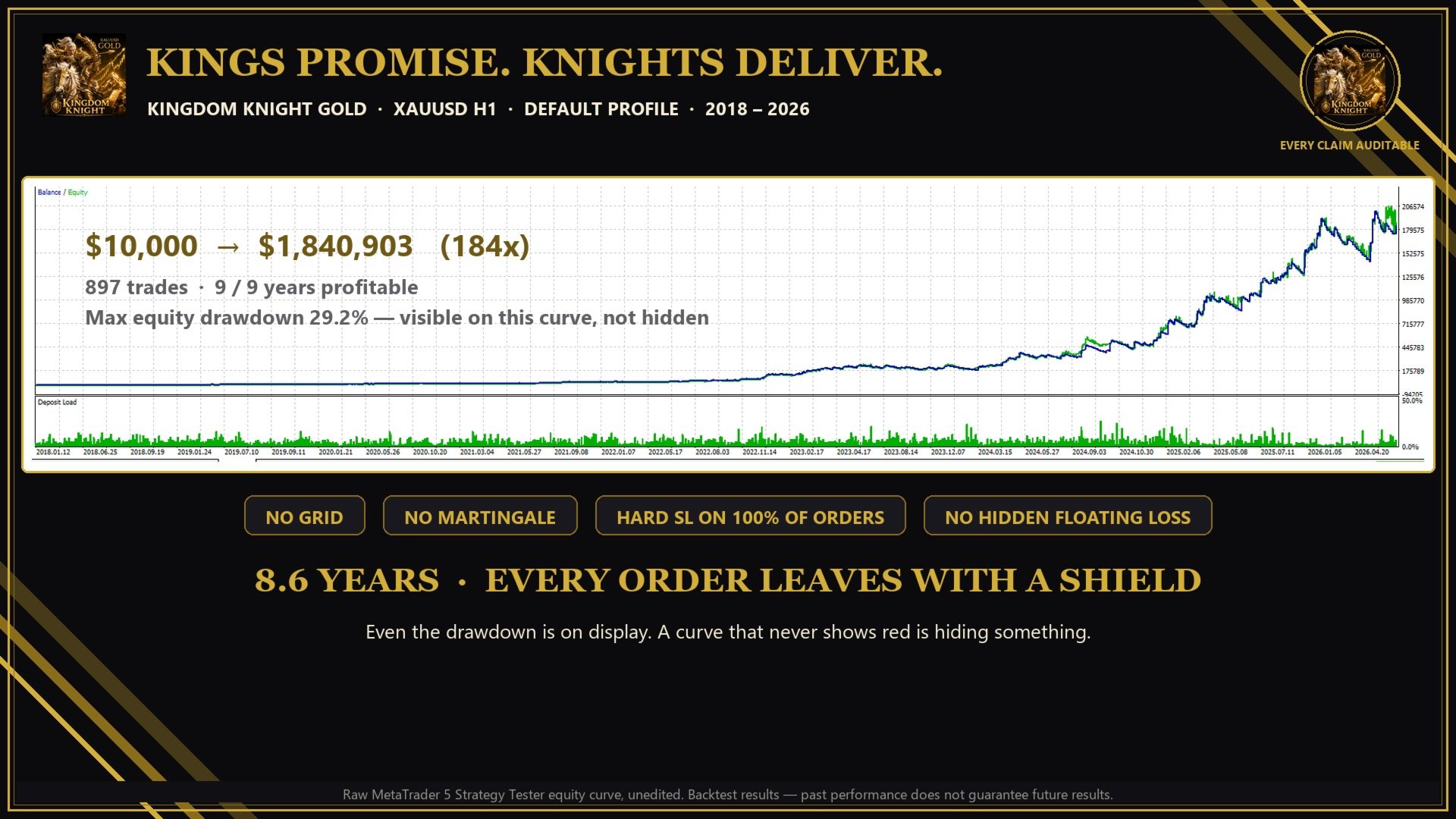
The headline result is a developer-run test from January 2018 through July 2026: approximately 897 trades, $10,000 starting capital and about $1.84 million final balance. The displayed equity drawdown is 29.2%. This is a historical simulation with compounding, not money shown in a live brokerage account.
The developer supplies specific reproduction conditions in the comments: XAUUSD H1, default Knight Commander rank, 1:500 leverage and MT5’s real-tick model, using IC Markets RAW conditions. That is helpful because it provides a test to compare rather than only a marketing curve. We have not independently reproduced it. Broker data, costs, contract specifications and tester assumptions can affect the outcome.
Walk-forward testing and Monte Carlo
The published methodology describes fitting parameters on 2018–2022 and testing on 2023–2026, then reversing the periods. It also describes 20,000 Monte Carlo simulations per rank and an abandoned time filter that looked attractive until further testing exposed hindsight bias.
Separating parameter selection from evaluation is a sensible aim. However, the label “blind” does not itself demonstrate that the broader research process never used information from the test periods. Likewise, zero ruin events in a finite simulation is not zero real-world ruin risk. The usefulness of that result depends on the simulation’s assumptions and definition of ruin.
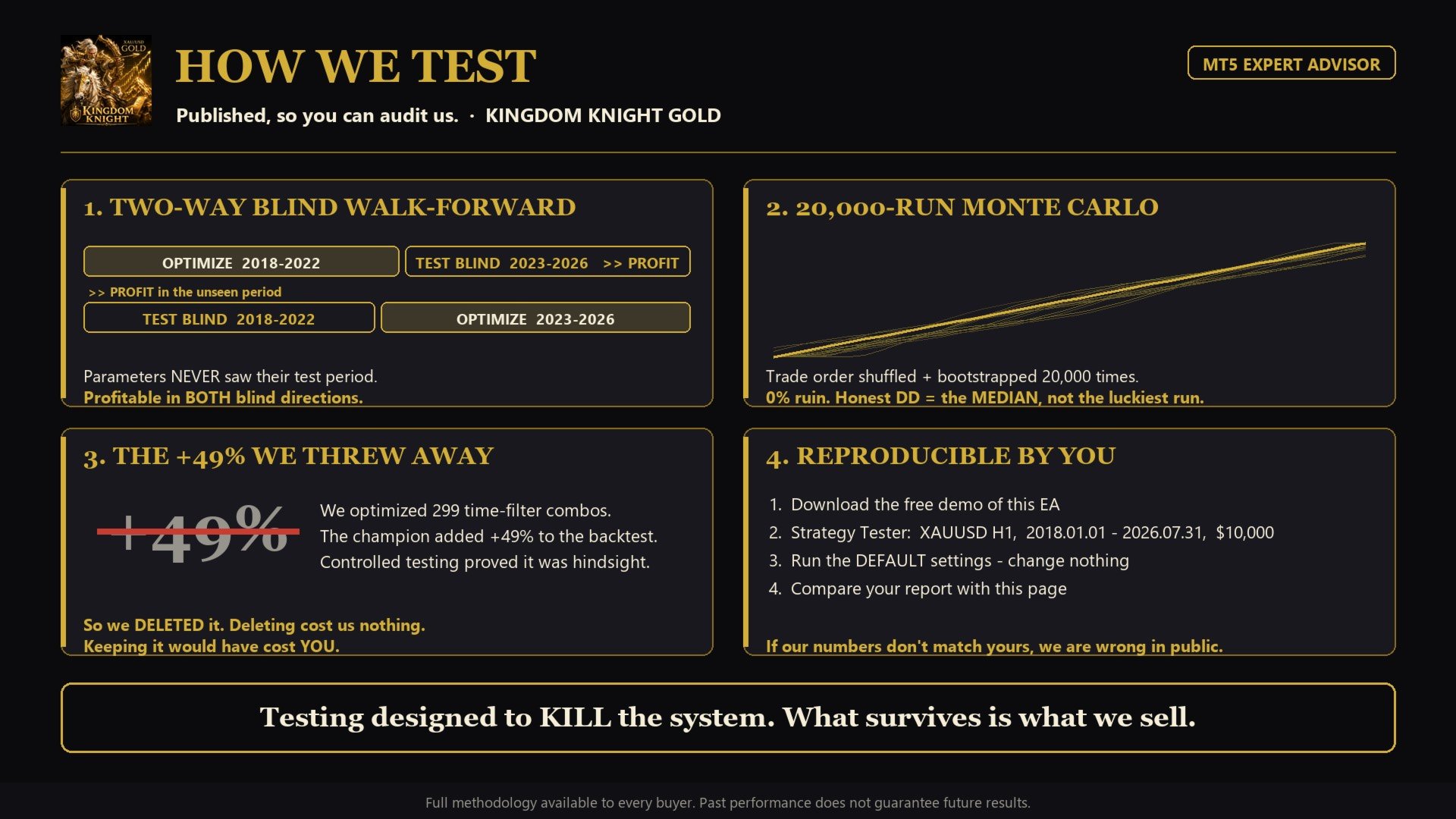
The risk disclosure is particularly relevant: the developer cites Monte Carlo drawdown around 33% for the default profile and acknowledges that adverse regimes can exceed 40%. The 29.2% historical drawdown should therefore not be marketed as a future maximum. The Monte Carlo estimate and the single backtest drawdown answer different questions.
Squire, Knight and Knight Commander
The three ranks use the same underlying trade selection, with different position sizing. Squire is described as 0.7% risk per strategy and Knight as 1.0%; Knight Commander is the default behind the largest growth illustration. Risk per strategy should not be confused with a guaranteed limit on total account drawdown when several strategies trade.
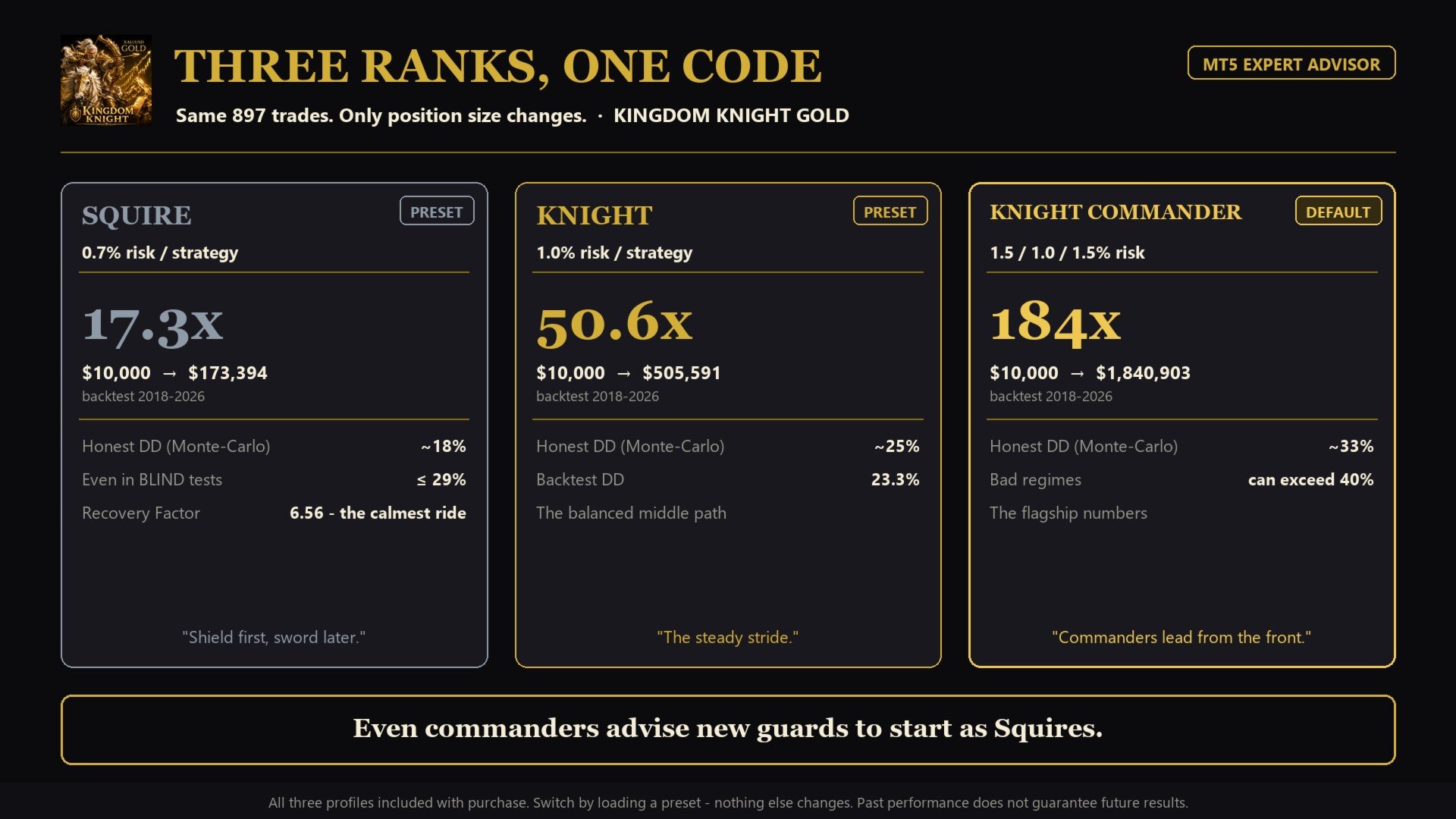
The developer associates Squire with simulated drawdown around 18% and Knight with around 25%, with higher stress-test figures possible. These are profile illustrations, not assurances. The trade-off is lower exposure and potentially lower growth; a smaller rank does not turn the system into a low-risk investment.
A live signal exists, but it is not yet persuasive evidence
The product description still says the signal is launching. The seller profile now links to Kingdom Knight Gold signal 2387362, identified by MQL5 as a real MT5 account on ICMarketsSC-MT5-3 with 1:500 leverage.
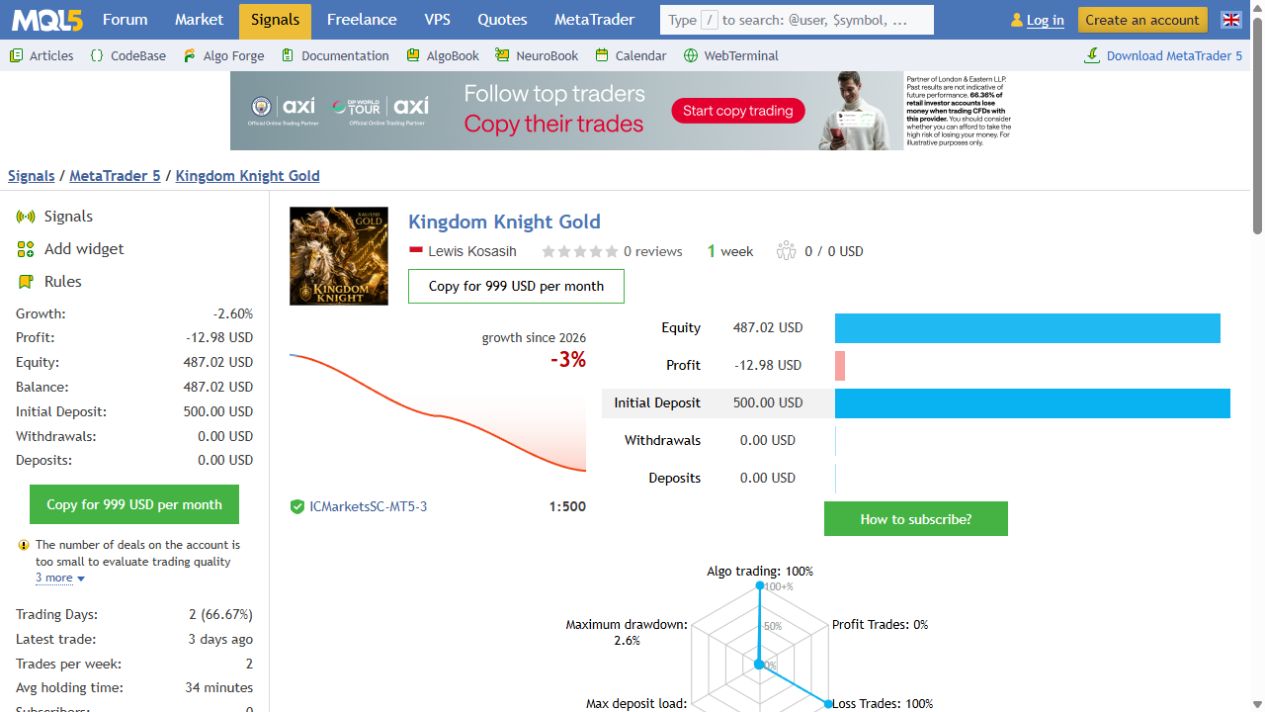
- Initial deposit
- $500
- Balance / equity
- $487.02 / $487.02 at the check.
- Profit / growth
- -$12.98 / -2.60%.
- Trade sample
- Two XAUUSD trades, both losses; MQL5 explicitly warns the sample is too small.
- History fields
- The page displays one week and a Started date of 19 August 2026. These fields should not be treated as a long forward record.
- Cash flows
- No additional deposits or withdrawals reported in the current summary.
Two losses do not invalidate a strategy designed to win infrequently. Equally, this account cannot validate the extensive backtest or demonstrate resilience through different market conditions. We would want a much larger trade sample before making a performance recommendation. The account is useful because it can be followed as evidence develops.
Broker compatibility is unusually specific
This EA requires a hedging account and two-decimal XAUUSD quotes. The listing explicitly excludes three-decimal gold brokers. These are purchase-relevant constraints: using MT5 alone is not sufficient. A broker’s gold symbol specification should be checked before assuming compatibility.
The leverage guidance is less tidy. It states 1:100 minimum and recommends 1:500 where available, but also says Squire and Knight can operate at 1:20. We would verify the intended profile and available margin on a demo account rather than interpreting either statement as universal compatibility. Higher leverage changes margin capacity; it does not make trading losses impossible.
Small deposits can change which trades are taken
The listing recommends $1,000 minimum and describes $5,000+ as providing fuller fidelity to the strategy’s sizing. It also says accounts below roughly $3,000 may skip wide-stop opportunities when the minimum lot would exceed the intended risk. Squire is described as needing at least $1,000, despite some other ranks being tested at $500.
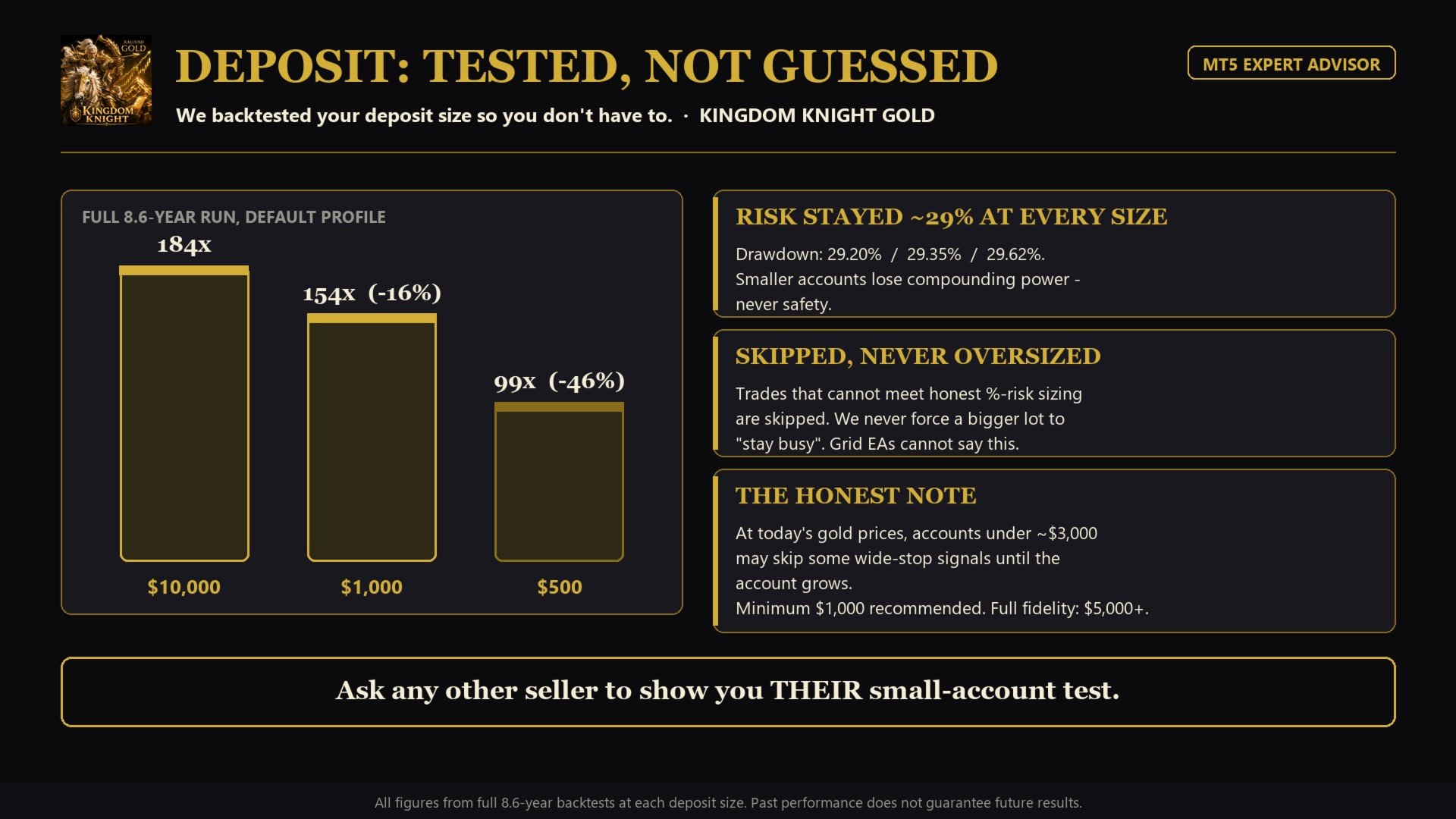
The deposit-size illustration differs slightly from the prose in its growth multipliers. The useful conclusion is the same: the available account size can change execution of the intended portfolio. We do not present any of those simulated multipliers as a likely return on a buyer’s deposit. Skipping a trade because it cannot be sized appropriately is a sensible control, but does not prove a small account is safe.
What customers currently say
The listing displays one rating entry from EricST123 Tang dated 9 September 2026. It contains no written comment. There is therefore no substantive customer account of setup, support or performance to assess at this stage.
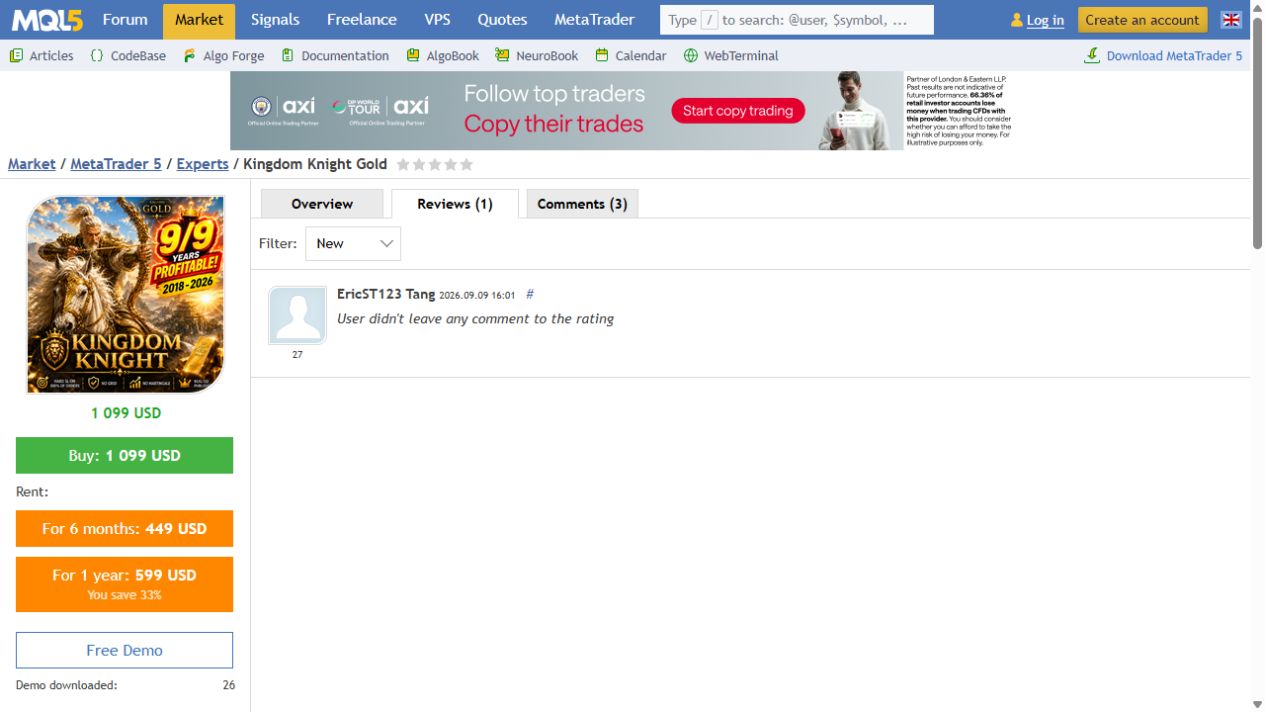
View the original customer-rating panel. This is third-party feedback and is not imported into CheaperForex’s verified-purchase ratings. The three visible comments are developer explanations, not three additional customer testimonials.
Manual and practical setup
The installation and rank manual is distributed privately by the developer; no public manual link was available in the checked listing. The public comments do provide a quick start and test settings, but they are not a substitute for the supplied build’s full instructions. We have not invented an additional manual or promised private developer support as part of this offer.
A VPS can keep the terminal available for entries. Broker-side stop and target orders remain submitted when the terminal disconnects, but that does not guarantee execution at the requested price. Test the actual broker account type, quote precision and selected rank before using live capital.
Our assessment
Kingdom Knight Gold offers a clearly stated alternative to averaging and recovery systems: selective gold entries, hard stops and profile-based sizing. Its disclosure of losing months and larger possible drawdowns is a positive feature of the presentation.
The case for buying currently rests mostly on the stated design and developer testing. The live record is much too young and written buyer feedback is absent. It is better suited to a trader prepared to test and monitor a low-win-rate approach than someone seeking an already established live track record or frequent small wins.
View Kingdom Knight Gold MT5 at $649.95
Sources checked 13 September 2026: product specification and gallery, developer testing and setup comments, seller profile and current public signal.