
Last updated: April 2026
When we first reviewed Quantum Valkyrie in February 2026, it had been live for six weeks with zero MQL5 reviews. We rated it 4/5 based almost entirely on Bogdan Ion Puscasu’s reputation — the developer behind Quantum Queen (4.96★, 445+ reviews), Quantum Emperor (4.87★, 496+ reviews) and Quantum King (4.97★, 121+ reviews). The EA itself was an unknown quantity with promising architecture but no community validation.
View product details and current pricing.
Two months later, the picture has changed. 148 verified MQL5 reviews at 4.86★. Fifty purchases per month. Six major updates pushing it to version 3.6. Over 6,600 demo downloads. And most importantly, real user feedback that reveals exactly how Quantum Valkyrie trades — including details the marketing doesn’t emphasise.
This is what we’ve learned.
⚠️ Searching for Quantum Valkyrie EA free download? Quantum Valkyrie is an official MQL5 marketplace product — cracked .ex5 files do not exist for marketplace EAs. Sites offering “free downloads” deliver malware or fake EAs that won’t execute. CheaperForex offers Quantum Valkyrie at a fraction of MQL5’s price with official activation and a 7-day money-back guarantee.

What 148 Reviews Actually Tell Us
The headline rating — 4.86★ from 148 reviews — puts Quantum Valkyrie among the highest-rated EAs on MQL5 for a product that’s only existed since February 2026. That’s an extraordinary adoption rate. But the individual reviews tell a more nuanced story than the number alone.
The positive feedback falls into two camps. First, traders praising the precision and short hold times. One reviewer noted the EA was closing trades within 3 to 10 minutes with a 100% win rate over their first 10 days, calling it “a highly effective scalping algorithm optimised for Gold’s high volatility.” Another described Bogdan as “very available and clear on providing all needed info.” These match what we’d expect from a well-engineered scalper backed by one of MQL5’s most responsive developers.
The more interesting feedback comes from a user who ran Valkyrie for six weeks and provided a detailed technical breakdown. Their observation: the strategy is a breakout system with a trailing stop. It almost never reaches the 500-pip take profit level. When the trade works, the trailing stop locks in a smaller profit. When it doesn’t work, the full 500-pip stop loss gets hit. The result is a poor risk/reward ratio compensated by a high win rate.
This is the kind of insight you only get from actual users running the EA for weeks, and it’s worth understanding before you buy. Quantum Valkyrie isn’t a system where winners and losers are roughly equal and you profit from having more winners. It’s a system where each loss is significantly larger than each win, but losses happen rarely enough (roughly 1 in 9 trades) that the math works out. This architecture means a losing streak of even 3–4 trades can create a meaningful drawdown, and recovery requires many winning trades to compensate.
That’s not a flaw — it’s a deliberate design tradeoff. But it’s something every buyer should understand, and the marketing doesn’t spell it out this clearly.
The Signal After 9 Weeks
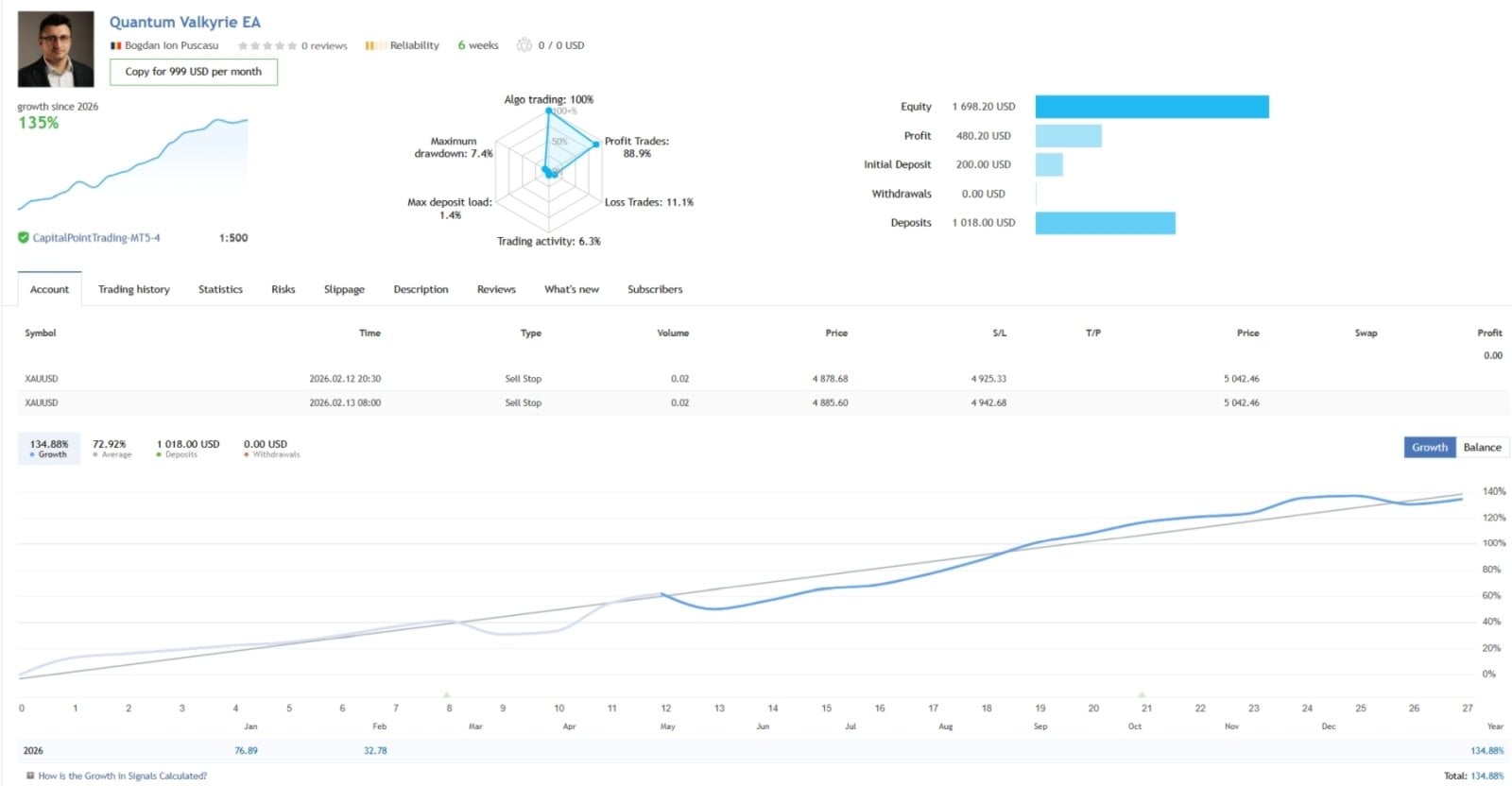
The verified MQL5 signal (Signal #2355692) now has 9 weeks of data:
| Metric | February (Our First Review) | April (Now) |
|---|---|---|
| Growth | 134.88% | 140% |
| Win Rate | 88.9% | 89% |
| Total Trades | 27 | 38 |
| Profit Factor | 4.77 | 3.22 |
| Max Drawdown | 7.40% | 7% |
| Avg Holding Time | 5 hours | 4 hours |
| Weeks | 6 | 9 |
| MQL5 Reviews | 0 | 148 (4.86★) |
The comparison tells a story. Growth has plateaued slightly (135% to 140% over three additional weeks), which aligns with the user feedback about the breakout/trailing stop architecture — the EA appears to have entered a lower-frequency phase where it’s being more selective about entries. The profit factor dropped from 4.77 to 3.22, which is the natural result of additional losses being added to a small sample (still an excellent PF, just no longer anomalously high). Win rate has held steady at 89%, and max drawdown remains at 7% — both promising signs of consistency.
The most important number: 38 trades over 9 weeks. That’s roughly 4 trades per week. Valkyrie is selective, not trigger-happy. It waits for specific breakout conditions on Gold’s M15 chart and only fires when its criteria are met. During quiet Gold periods, it may not trade for days.
How Valkyrie Actually Trades (Now That We Know)
Our February review described Valkyrie’s fixed SL/TP architecture but couldn’t detail the specific strategy because it hadn’t been disclosed. User feedback and version update notes have since filled in the gaps.
The strategy is a breakout system. Valkyrie identifies compression/consolidation patterns on Gold’s M15 timeframe and enters when price breaks out with momentum. Every trade opens with a 500-pip stop loss and a 500-pip take profit — but the trailing stop is the real exit mechanism. When a breakout works, the trailing stop follows price and locks in profit (typically well below the 500-pip TP target). When the breakout fails, the full 500-pip SL gets hit.
This creates the asymmetric risk/reward profile that the user review identified: average wins are significantly smaller than average losses, but wins happen roughly 9 times out of 10. The math works because the frequency of wins overwhelms the magnitude of losses — but it’s a fundamentally different feel from an EA where wins and losses are similar sizes.
What version 3.6 changed: Six updates in under two months is aggressive iteration. The key improvements include dynamic stop loss calculation (v3.4), improved trailing auto-calculation based on SL distance (v3.4), ATR conflict fix with SL calculation (v3.6), lot calculation fixes for certain brokers (v3.5), and a display panel addition. The EA is now timeframe-independent — it trades on M15 internally regardless of which chart timeframe you attach it to, solving a common user setup error. The rapid update cadence reflects a developer actively monitoring live performance and fixing issues as they emerge.
Valkyrie vs Queen: The Real Tradeoff
Since both trade XAUUSD and come from the same developer, this is the comparison every buyer asks about. Having now seen Valkyrie in action for 9 weeks alongside Queen’s 20+ month track record, the differences are clearer than they were in February:
Quantum Queen uses grid trading. During favourable conditions, it’s exceptionally profitable — 912% growth over 81 weeks speaks for itself. During adverse conditions, positions accumulate and drawdown compounds. The 36% max drawdown on Queen’s signal reflects grid risk working as designed. Queen’s edge comes from being right about direction eventually and profiting from mean reversion across multiple positions.
Quantum Valkyrie uses single breakout trades with defined risk. The 7% max drawdown over 9 weeks is dramatically lower than Queen’s 36%. But growth has also been more modest relative to time. Valkyrie’s edge comes from being right about direction immediately and locking in profit with a trailing stop before the trade can turn against it.
The philosophical difference: Queen bets on reversion. Valkyrie bets on continuation. They’re fundamentally different strategies that happen to trade the same instrument. Running both on separate accounts provides genuine strategy diversification — not just instrument diversification.
Choose Valkyrie if: you want bounded, predictable risk on every trade and can accept that growth may be slower than Queen’s during strong trending periods. Choose Queen if: you want the 20-month track record and can stomach 30%+ drawdowns knowing the grid historically recovers. Choose both if: you want to hedge the weaknesses of each strategy against the strengths of the other.
What Bogdan Gets Right (and What Still Concerns Us)
The architecture is genuinely clean. Fixed SL/TP from the first tick. No grid. No martingale. No position stacking. Each trade lives and dies on its own. In a Gold EA market drowning in grid systems that eventually blow accounts during strong trends, Valkyrie’s approach is structurally safer. The 7% drawdown over 9 weeks bears this out.
The iteration speed is impressive. Six version updates in under two months shows a developer who’s actively monitoring live performance and fixing issues quickly. The v3.4 improvements to trailing stop calculation and dynamic SL suggest Bogdan is fine-tuning the exact mechanics that determine profitability. This isn’t a “launch and forget” product.
Developer support is consistently praised. Across 148 reviews and 182 comments, the developer’s responsiveness is a recurring theme. Bogdan personally responds to technical questions and setup issues. For a developer managing an entire ecosystem of products (Queen, Emperor, King, StarMan, Baron, Bitcoin, Valkyrie), that’s significant effort.
What concerns us:
The risk/reward asymmetry. When a loss hits, it’s big relative to the average win. The 89% win rate compensates for this mathematically, but psychologically it’s hard to watch a single loss wipe out multiple winning trades. If the win rate degrades even slightly — from 89% to, say, 80% — the equity curve can flatten or turn negative quickly because each loss requires so many wins to recover from.
Nine weeks is better than six, but it’s still not a full market cycle. We haven’t seen how Valkyrie handles an extended ranging Gold market, a flash crash, or a period where breakouts consistently fail (which happens periodically in any market). The live signal needs 6+ months before we’d call the track record “established.”
The price has climbed from $599 to $1,099 on MQL5. Bogdan’s “price goes up every 10 purchases” model means early adopters got a better deal. At $1,099 the expectation bar is higher.
The Backtest in Context
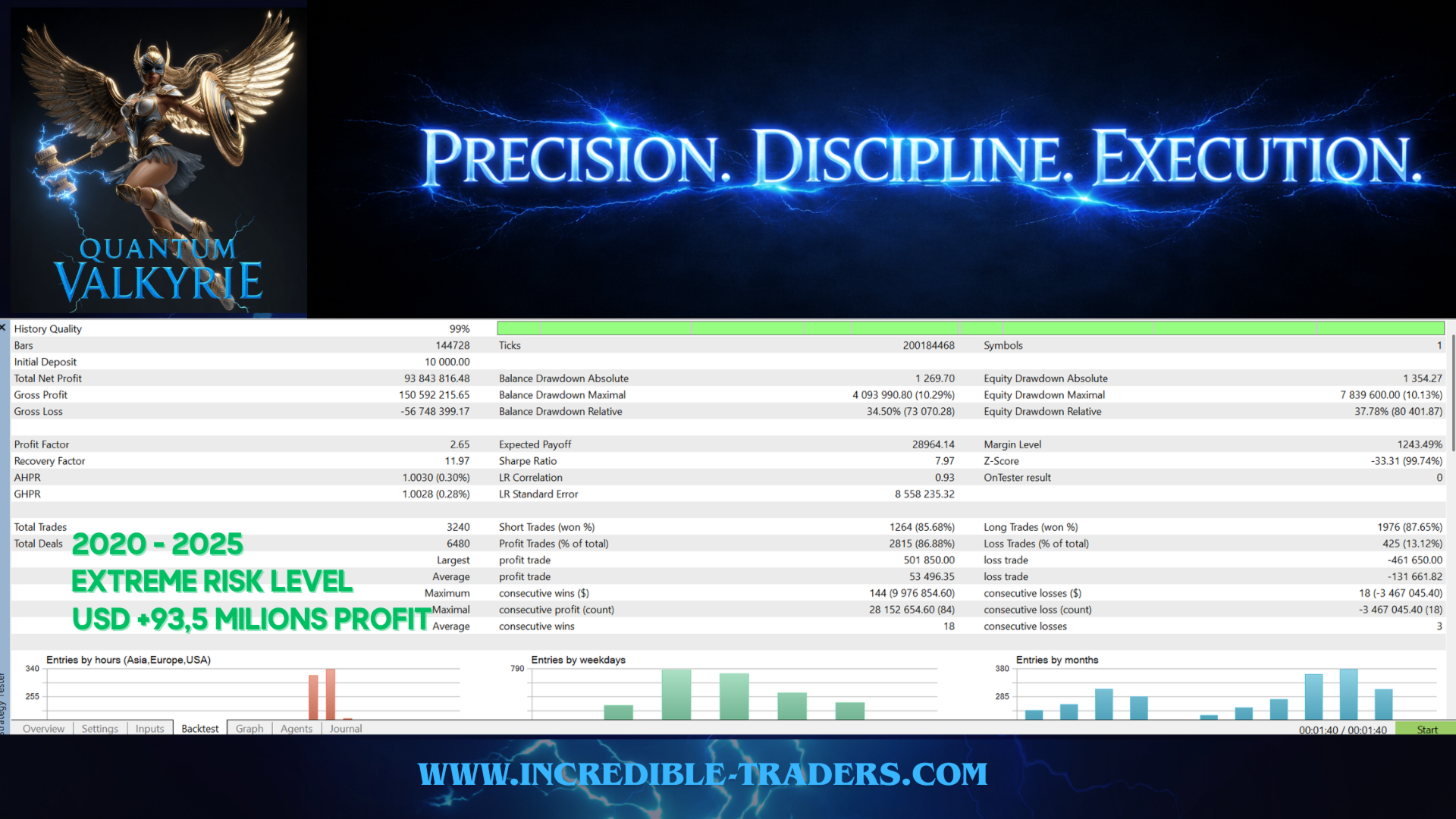
The 5-year backtest (2020–2025) at extreme risk produced $93.8 million from $10,000. Ignore the dollar figure — it’s meaningless at that compounding level. What matters is the consistency metrics: 86.88% win rate (closely matching the live 89%), profit factor of 2.65 (live is 3.22 — outperforming), and 3,240 trades across 5 years (~12/week).
The backtest validates that the underlying breakout logic has maintained edge across the COVID crash, inflation surge, rate hike cycle and various Gold regimes. The live signal’s metrics slightly outperforming the backtest is a healthy sign — the reverse (live underperforming backtest) would be concerning.
Requirements
| Requirement | Details |
|---|---|
| Platform | MetaTrader 5 |
| Pair | XAUUSD (Gold) exclusively |
| Timeframe | M15 (auto-detected from v3.6 — attach to any timeframe) |
| Strategy | Breakout + trailing stop. Fixed 500-pip SL/TP. No grid, no martingale |
| Account type | Hedging mode (not netting). ECN/Raw Spread essential |
| Minimum capital | $500 minimum, $1,000+ recommended |
| Leverage | 1:500 recommended (1:100 minimum) |
| Broker | IC Markets, IC Trading, or any ECN with low Gold spreads |
| VPS | Required — developer is explicit about this |
| Prop firm | Compatible — fixed SL/TP, 7% max DD, no grid |
Frequently Asked Questions
How does Quantum Valkyrie’s strategy work?
It’s a breakout system on Gold’s M15 timeframe. Every trade opens with a 500-pip stop loss and take profit. A trailing stop follows price during winning trades and locks in profit — usually well below the 500-pip TP target. The result is a high win rate (89%) with small average wins, offset by larger but infrequent losses (roughly 1 in 9 trades). No grid, no martingale, no position stacking.
Is 9 weeks enough to trust this EA?
It’s better than the 6 weeks we had in February, but still not a full market cycle. The 148 MQL5 reviews at 4.86★ provide strong community validation that the 6-week version lacked. The win rate holding steady at 89% across 38 trades is encouraging. We’d call it “promising with increasing confidence” rather than “proven.”
Why is the drawdown so much lower than Quantum Queen?
Fundamentally different strategies. Queen uses grid trading — positions accumulate during adverse moves, creating higher drawdown but also higher eventual returns when price reverts. Valkyrie uses independent single trades with fixed stop losses — drawdown is bounded by the SL size, not by position accumulation. The 7% vs 36% max drawdown difference reflects this structural difference, not a quality difference.
Why did the profit factor drop from 4.77 to 3.22?
Statistical normalisation. With 27 trades, a small number of losses produces an anomalously high PF. With 38 trades including additional losses, the PF naturally converges toward its true value. A PF of 3.22 is still excellent — anything above 2.0 is considered strong. The drop reflects a growing sample size, not degrading performance.
Can I use Valkyrie on a prop firm account?
Yes, and it’s arguably better suited than most Gold EAs. Fixed stop loss on every trade means predictable maximum loss per position. The 7% max drawdown is comfortably within most prop firm thresholds (typically 5–10% daily, 10–12% total). No grid or martingale means no position accumulation risk. Verify your specific prop firm’s rules regarding EA trading before committing.
What’s the risk/reward ratio?
Poor on a per-trade basis — average losses are larger than average wins because the trailing stop takes profit early while the stop loss is at the full 500-pip distance. The system compensates with a high win rate (89%). This means a losing streak of 3–4 trades creates a meaningful drawdown that requires many wins to recover from. Understand this dynamic before trading live.
Is there a free download available?
No. Quantum Valkyrie is an official MQL5 marketplace product requiring server-side license validation. Sites offering “free downloads” or “cracked” versions are scams — MQL5 marketplace EAs cannot be cracked. You’ll get malware or a fake EA that doesn’t execute. The only legitimate sources are MQL5 directly or authorised resellers like CheaperForex.
Our Updated Verdict
Quantum Valkyrie has done something rare in the EA space — it’s actually gained credibility over time rather than losing it. Going from zero reviews to 148 reviews at 4.86★ in under two months, with a live signal that’s held consistent metrics through 38 trades, and six version updates showing active development — that’s a trajectory that earns trust.
The key insight from real user feedback — that it’s a breakout/trailing stop system with asymmetric risk/reward — is something every buyer should understand. This is not an EA where you can afford to have the win rate degrade. If Gold enters an extended period where breakouts consistently fail, Valkyrie will struggle harder than most because each loss is larger than each win. The 89% win rate needs to stay roughly in that neighbourhood for the math to work.
We’re raising our rating from 4/5 to 4.5/5. The community validation that was missing in February has arrived in force. The strategy architecture is clean and honest. The developer continues to iterate rapidly and support users directly. The signal has maintained its metrics through an additional month of live trading. The remaining half-star stays held back until we see 6+ months of signal data and the EA’s behaviour during a genuine Gold correction or extended range.
For traders who want Gold automation without grid risk, Quantum Valkyrie is the strongest option currently available on MQL5 — backed by the most successful EA developer on the platform.
Buy Quantum Valkyrie EA MT5 at CheaperForex →