
Quantum Commander EA MT5 Review: An Honest Look at Bogdan Ion Puscasu’s US30 Trend-Pullback System (2026)
Last updated: September 2026
Quantum Commander is a fully automated Expert Advisor for MetaTrader 5 built exclusively for the US30 (Dow Jones) index, from Bogdan Ion Puscasu — the developer behind the Quantum range and, by volume of verified feedback, the most successful EA seller on the MQL5 marketplace.
It was published on 1 September 2026. At the time of writing it carries a single review, which reads in full: “First to buy.” We mention that immediately because it frames everything else — this is a day-one product, and no amount of catalogue reputation changes what that means for the evidence available to you.
What makes it worth writing about anyway is the instrument. After a run of gold releases, this is the first Quantum system built for an index, and that matters more than it might sound. Anyone already running two or three Quantum gold EAs is concentrating risk, not diversifying it. Quantum Commander is the first release in the range that genuinely spreads exposure rather than doubling down on the same market.
We rate Quantum Commander 4 out of 5. The positives are a genuinely disciplined architecture — one position at a time, fixed stop loss, no grid or martingale anywhere — a clean and undistorted live signal on a sensible account size, a nearly six-year backtest whose figures reconcile properly, and the strongest developer credentials on the platform. What holds it back is that it is one day old with three weeks of live data, a backtest the developer himself labels an extreme risk configuration, and a headline drawdown that understates the real one by nearly four times.
Cheaper than the MQL5 marketplace · or keep reading for the full analysis
⚠️ Looking for a Quantum Commander EA “free download”? Don’t.
Every legitimate marketplace EA ships with built-in DRM or licensing. There is no working cracked file in existence — so a “free” copy is always one of two things:
- malware, or
- bait for a Telegram payment scam where you pay and get nothing.
The only safe routes are the MQL5 marketplace or a reputable reseller. CheaperForex offers Quantum Commander EA at a significant discount versus the marketplace price — see the product page here.
The Developer: Bogdan Ion Puscasu

Bogdan Ion Puscasu runs Incredible Traders from Romania and holds a developer rating of 4.8 across more than 2,600 individual marketplace ratings, spread over thirteen products and nine published signals. No other EA developer on MQL5 combines that volume of feedback with that score. Individual products in the range carry hundreds of reviews each — Quantum Emperor alone has over 500.
For a product published today with one review, that catalogue is the entire trust case. It is a legitimate one as far as it goes: a developer with thousands of paying customers and years of continuous publishing has considerable reputational exposure in each release, and a demonstrated record of supporting products through updates.
Two balancing points, both of which we have raised in our other Quantum reviews and will restate here rather than let a reader discover later. First, inherited credibility is not the same as a proven strategy — the catalogue tells you about the developer, not about this specific system. Second, live signals have historically been withdrawn from some products in this range when performance turned unfavourable, which is a fair transparency concern when a product’s entire case rests on one young signal. Bookmark it and check it yourself over the coming months rather than treating today’s snapshot as permanent.
Why US30 Is the Point
This is the section that matters most if you already own Quantum products, and it is the strongest argument for the release.
The Quantum range has become heavily gold-weighted. Quantum Queen, Queen X, Titan, Valkyrie, Athena and OmniGold all trade XAUUSD. Running several of them on one account does not diversify anything — it concentrates exposure into a single instrument while each EA operates unaware of the others. We have flagged that risk in every gold review we have written in this range.
Quantum Commander breaks that pattern. US30 has its own character: strong directional movement, sharp intraday pullbacks, volatility that shifts quickly, and a session profile driven by US equity hours rather than gold’s round-the-clock flow. A drawdown on the Dow does not automatically coincide with a drawdown on gold.
Beyond the gold cluster, the range covers Quantum Emperor on GBPUSD, Quantum King on AUDCAD, Quantum Bitcoin on BTCUSD, Quantum Baron on crude oil and Quantum StarMan across several currency pairs. Commander fills the index gap. If you are building a genuinely diversified Quantum allocation rather than stacking gold systems, that is the practical case for it.
The Architecture — Disciplined, and Verifiable
The strategy is straightforward to describe, which is itself a point in its favour. Commander identifies the prevailing trend on US30 and waits for a pullback within it, entering in the direction of established momentum rather than chasing a move that has already extended.
The trade management is where the design earns its marks:
- Fixed stop loss and take profit on every position, set at entry, giving a defined exit structure from the outset
- Dynamic trailing stop that follows favourable movement and progressively secures accumulated gains while letting the trade run toward its target
- M1 opposite-signal exit — if a position moves into loss and a valid signal appears in the opposite direction, the EA can close early, before the full stop loss is reached, cutting exposure rather than waiting to be stopped out
- Strictly one open position at a time
On the mechanics the developer is emphatic and specific: no grid strategy, no martingale, no averaging into losing positions, no escalating lot sizes, no extended recovery cycles. His own phrasing is “one signal, one position, one controlled exposure.”
And unusually, the numbers back it up. We routinely find published backtests that contradict the architecture described alongside them. This one does not. The backtest reports 8,517 winning trades at an average of $7,208.38 and 562 losing trades at an average of $37,092.10. Multiply those out and you get gross profit within about $40 of the stated $61,393,814 and gross loss matching the stated $20,845,760 to the dollar. The report is internally coherent, and its structure — a modest number of large losses rather than a long tail of small ones — is what a genuine single-position system with a fixed stop produces, not what a grid produces.
That verification is worth something. It does not prove the strategy is profitable going forward, but it does mean the description and the data agree, which we cannot say about every product we review.
The Win Rate Is Not What It Looks Like
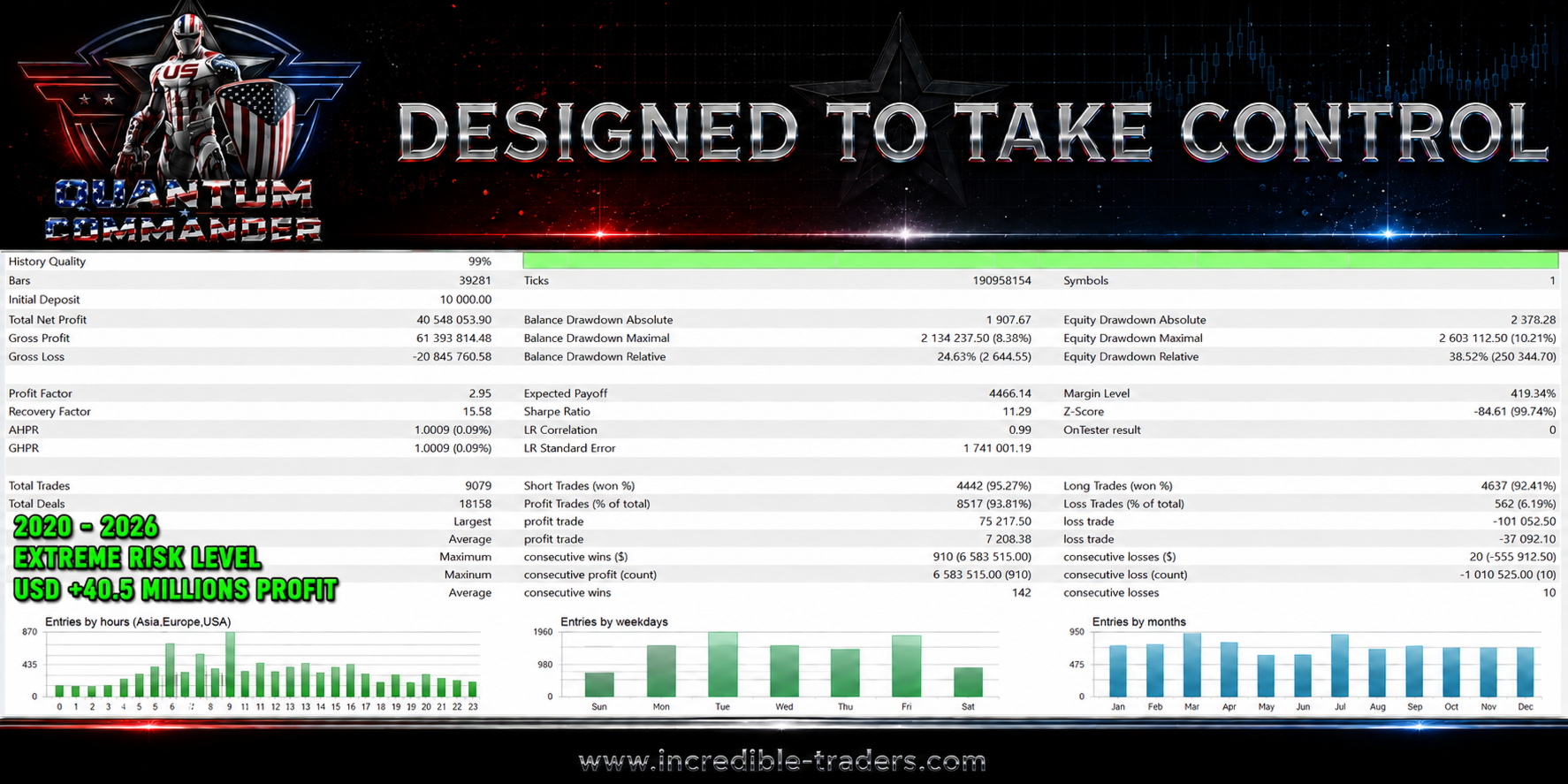
The backtest shows a 93.81% win rate — 8,517 winners against 562 losers across 9,079 trades. On a marketing graphic that number does a lot of work. It should not.
The average winning trade is $7,208. The average losing trade is $37,092. Losses run roughly five times the size of wins.
That is not a defect and it is not hidden — it is the arithmetic of a low-risk-reward design. The system takes profit readily at a target closer than its stop, so it is right most of the time and wrong expensively. The profit factor of 2.95 tells you the maths still works out favourably over the tested sample.
But it changes what a losing streak feels like. Win ninety-four trades out of a hundred and the six losses cost you more than the gains from a substantial share of the winners. The test recorded a maximum of 20 consecutive losses. At five times the average win each, a run like that is a meaningful hit, and it is the scenario to size for rather than the comfortable 94% figure.
The practical implication: do not let the win rate persuade you to size up. The risk in this system lives entirely in the losing trades, and there are few enough of them that they cluster unpredictably.
The Drawdown Figure That Matters
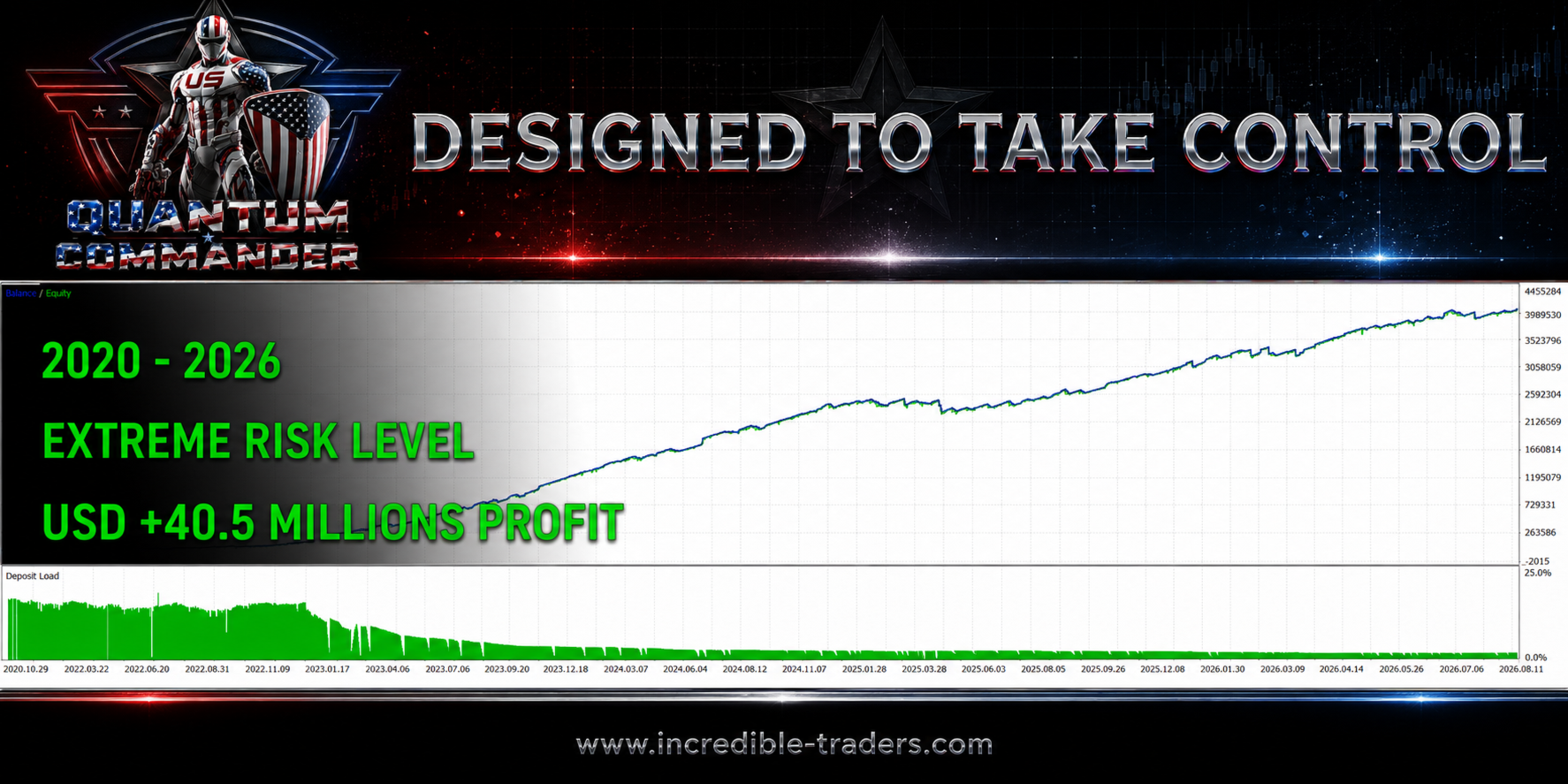
The backtest reports a maximum equity drawdown of 10.21% and a maximum balance drawdown of 8.38%. Those look manageable.
The same report records a relative equity drawdown of 38.52% and a relative balance drawdown of 24.63%.
The gap is the familiar one: the low headline percentages are measured against the large balance the account had accumulated by the test’s later years, while the relative figures are the deepest percentage drops actually experienced — and those happened earlier, when the balance was modest. That is precisely the position a new buyer occupies today.
The equity curve’s deposit-load band makes the point visually. Exposure ran around 25% of the account in the early period and declined steadily toward zero as the balance grew. Heavy relative exposure at the start, light relative exposure later. A buyer starting now is in the first phase, not the second.
Plan for a drawdown near 38%, not near 10%. And note the developer’s own labelling: the backtest is marked an extreme risk level configuration. That is honest of him, and it is a warning worth taking at face value rather than reading past.
One figure to ignore: the reported Sharpe ratio of 11.29 is not a meaningful real-world number — elite quantitative funds operate at two to three — and it should carry no weight in your assessment.
The Live Signal — Clean, Short, Sensibly Sized
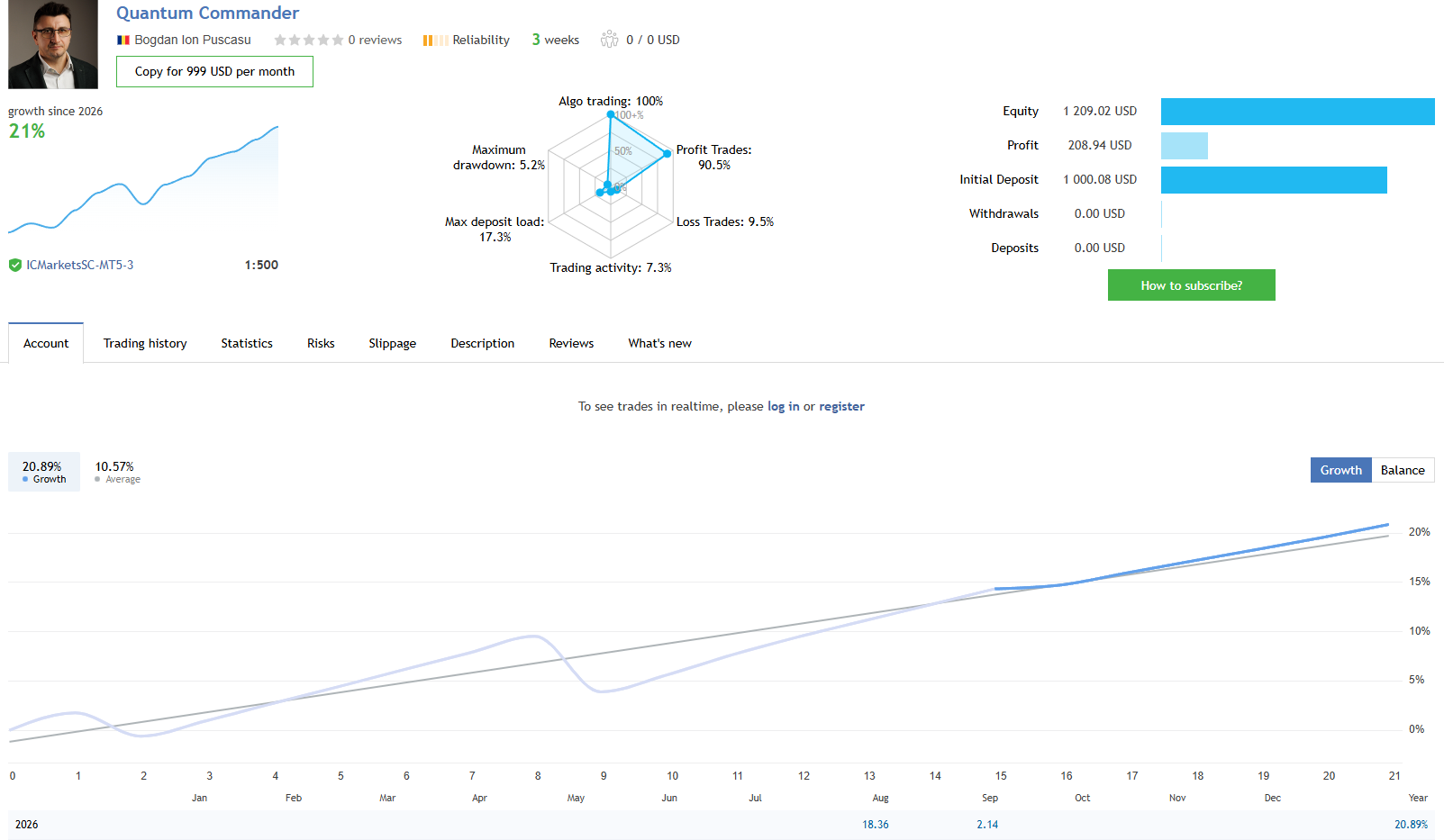
The public signal runs on IC Markets at 1:500 leverage.
What is good. The account opened at $1,000.08 and stands at roughly $1,209.02, with zero deposits and zero withdrawals throughout — so the 20.89% growth is a genuine return on capital that was there from the start. After a run of signals we have had to unpick for deposit inflation, that matters. The account size is also more meaningful than the $60 to $200 balances that have become common on new listings: $1,000 sits at the developer’s own recommended minimum, so it reflects a configuration a real buyer might actually run.
The supporting metrics hold up. A 90.5% live win rate sits sensibly below the backtest’s 93.81%, which is the direction honest live results move. Maximum drawdown of 5.2% is modest. Maximum deposit load of 17.3% is consistent with the single-position claim — a grid running multiple legs would show considerably more.
What limits it. Three weeks. That is the whole caveat, and it is a large one. The monthly breakdown shows the great majority of the gain arriving in the first month with the current month essentially flat so far, which is normal variance on a sample this small but tells you nothing about durability. Twenty percent in three weeks is not a rate to annualise, and a system whose risk lives in rare five-to-one losses needs considerably longer to reveal its true shape.
Who Quantum Commander Is For
It might be a fit if you:
- Already run Quantum gold EAs and want genuine instrument diversification rather than more of the same exposure
- Want a strictly single-position system with a fixed stop, no grid and no martingale
- Trade US30 specifically, or want automated index exposure alongside a forex or gold allocation
- Understand that a 93.81% win rate with five-to-one losses means the risk sits entirely in the rare losing trades
- Will size for a 38% drawdown rather than the 10% headline, and run below the extreme risk configuration
- Are comfortable buying a day-one product on the strength of the developer’s catalogue and a three-week signal
Look elsewhere or wait if you:
- Need an established review base — there is one review at the time of writing, and it contains no information
- Want a live record longer than three weeks before committing capital
- Would read the 93.81% win rate as safety rather than as a description of trade shape
- Would size on the 10.21% headline drawdown instead of the 38.52% relative figure
- Prefer a proven Quantum product — Quantum Queen and Quantum Emperor both carry hundreds of reviews and years of history
- Cannot run a VPS, which the developer describes as mandatory
Our Verdict
We rate Quantum Commander 4 out of 5.
The design deserves credit. A strictly single-position system with a fixed stop loss, a trailing stop and an opposite-signal early exit is a disciplined structure, and the explicit refusal of grid, martingale and averaging is meaningful in a catalogue that includes grid-based systems. Better still, the backtest’s trade distribution corroborates that architecture instead of contradicting it — the averages reconcile to the gross figures precisely, which is more than most published reports manage. And the US30 focus is the first genuine diversification the Quantum range has offered in several releases, which is the clearest practical reason to consider it.
What holds it at four is simply how little there is to go on. The product was published on 1 September 2026 with one review that says nothing. The live signal is three weeks old — clean and properly sized, but three weeks. The backtest is labelled an extreme risk configuration by its own author, and its real drawdown figure is 38.52% rather than the 10.21% shown prominently. And the win rate that looks so reassuring describes a system where losses run five times the size of wins, meaning the risk is concentrated in exactly the trades you see least often.
Practical recommendation: if you already run Quantum gold systems, this is the release worth considering, because it adds exposure rather than duplicating it — but put it on a separate account or at least size the combined allocation deliberately. Run below the extreme risk setting. Size for a drawdown near 38%, not 10%. Use a VPS as the developer requires, and a broker with genuinely competitive US30 spreads. Demo first, then run small for a few months — long enough to experience a cluster of those five-to-one losses and see how the account handles it, because that is the real test. Bought through CheaperForex at a significant discount, the cost of that evaluation is modest.
Frequently Asked Questions
Is Quantum Commander EA legit, or a scam?
Legitimate. It is a published MQL5 marketplace product from Bogdan Ion Puscasu, who holds a 4.8 developer rating across more than 2,600 marketplace ratings and thirteen products, with a public real-money live signal showing no deposit or withdrawal distortion. The scams are the “free download” sites and Telegram sellers offering cracked copies that cannot exist. Legitimate does not mean proven, though — this product was published on 1 September 2026 and has one review.
Does it use a grid or martingale?
No. The developer states explicitly that it holds one open position at a time with no grid, no martingale, no averaging into losses, no escalating lot sizes and no recovery cycles. The backtest supports the claim: 8,517 winners averaging $7,208 and 562 losers averaging $37,092 reconcile exactly with the reported gross profit and loss, which is the pattern a single-position system with a fixed stop produces rather than a grid.
Why does it trade US30 instead of gold?
Because the Quantum range is already saturated with gold systems, and running several of them together concentrates risk rather than spreading it. US30 has a different character — strong directional moves, sharp intraday pullbacks, US session-driven volatility — so a drawdown on the Dow does not automatically coincide with one on gold. For anyone already running Quantum gold EAs, that is the main practical argument for this product.
What does the 93.81% win rate really mean?
That it wins small and often, and loses larger occasionally. The average winning trade is around $7,208 against an average loss of roughly $37,092 — about five times bigger. That is a coherent low-risk-reward design rather than a flaw, and the profit factor of 2.95 shows the maths works over the tested sample. But it means your risk lives entirely in the rare losing trades, and a cluster of them costs more than a long run of winners earned. Do not let the win rate tempt you to increase size.
What drawdown should I plan for?
Around 38%, not 10%. The backtest reports a 10.21% maximum equity drawdown, but the same report shows a relative equity drawdown of 38.52% and a relative balance drawdown of 24.63%. The relative figures are the deepest percentage falls the account genuinely experienced, and they occurred early when the balance was small — the position a new buyer is in. The developer also labels that backtest an extreme risk configuration, which is worth taking literally.
How much live evidence is there?
Three weeks. The signal shows a $1,000.08 initial deposit grown to about $1,209.02 with zero deposits and zero withdrawals, giving roughly 20.89% genuine growth, a 90.5% win rate and a 5.2% maximum drawdown. It is clean, undistorted and on a sensible account size at the developer’s own recommended minimum. It is also far too short to demonstrate durability, particularly for a system whose risk sits in infrequent large losses.
Can I run it alongside my other Quantum EAs?
More safely than adding another gold system, which is the point of it. Because it trades US30 rather than XAUUSD, it is not competing for the same exposure as Quantum Queen, Titan or OmniGold. That said, multiple EAs on one account still share margin, so use separate accounts or size the combined allocation deliberately.
What broker, account and hosting do I need?
A hedging account with US30 on MetaTrader 5, a minimum deposit of $500 with $1,000 or more recommended, and leverage of at least 1:100 with 1:500 suggested. The developer names VT Markets, TMGM and StarTrader, or any ECN, RAW or low-spread account. A VPS is described as mandatory rather than advisable, and for an index system using M1 signals to manage exits we would agree.