
Bitcoin SuperTrader EA MT5 trades BTCUSD with a buy-and-sell grid, basket-profit controls and rolling equity bands. Amer Ali Mousa Jaradat’s system centers on managing repeated trading cycles, with a separate target for stopping the EA altogether.
Our assessment: the configurable equity exits and visible dashboard offer useful controls for experienced grid traders. The main consideration is what happens after a losing reset: trading resumes, so further cycles can deepen the account’s loss. Public evidence does not establish long-term profitability.
Ready to Buy Bitcoin SuperTrader EA MT5?
$519.99 with crypto · $649.99 by card
Official version · Instant download · Free lifetime updates · 7-day money-back guarantee

Rolling equity bands: an exit followed by a restart
The developer’s overview describes upper and lower equity steps measured from a baseline. Reaching a step closes positions and establishes a fresh baseline. The upper step can realize a gain; the lower step can realize a loss. Neither outcome ends the sequence permanently.
For a simple hypothetical example, start with 100 units and a lower step of 10 units. One losing reset leaves 90; a second leaves 80, before any additional execution effects. The accumulated loss is now 20 units even though each cycle had a 10-unit threshold. This illustrates the reset mechanism, not a proposed preset or observed result.
The final equity target behaves differently: the listing says it closes positions and shuts down the EA until restart. Likewise, disabling new trading is described as pausing fresh grids while existing positions finish. A pause is not an instruction to liquidate everything immediately. Test those three actions separately. The public description does not define how unrelated positions are handled; verify the scope before sharing an account with another EA.
Grid spacing and fixed lots still require exposure checks
The published controls include volume per grid order, grid distance and minimum duplicate spacing. Fixed volume does not mean fixed total exposure: additional positions increase gross volume. Opposing buys and sells also incur spread and other trading costs, even where their directional exposure partly offsets.
Spacing is expressed in broker points. Convert the chosen number through the symbol’s point size, then inspect its cash effect alongside BTCUSD contract size and lot volume. The same input number can represent different economic exposure at another broker. Volume normalization helps an order fit allowed lot increments; it does not validate the strategy’s risk.
The overview specifies BTCUSD examples for an Exness Professional account. It does not publish a complete maximum-position policy. Before a demo trial, check order accumulation during a sustained trend, margin pressure and actual closure prices. An equity-triggered close can execute beyond its threshold when quotes move quickly.
What the older input screenshot tells us
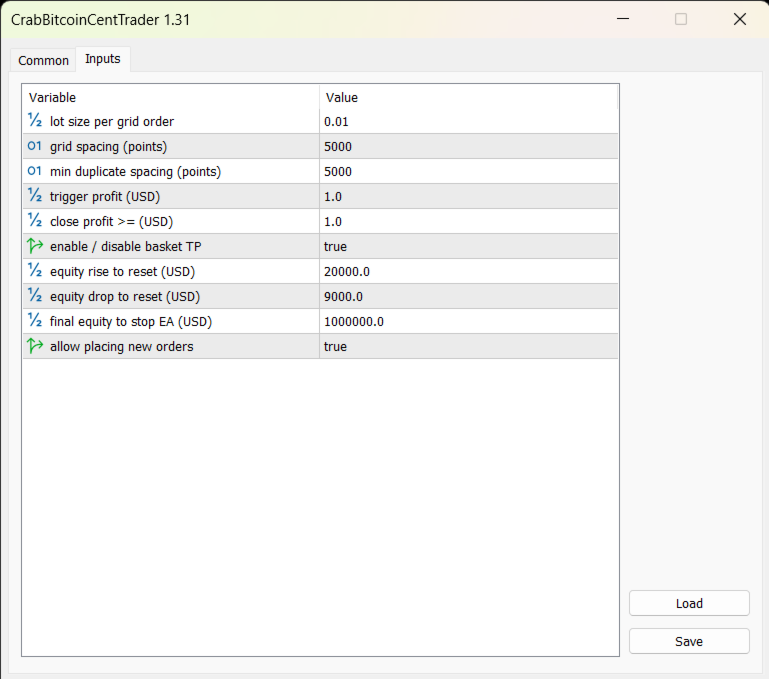
The image makes the controls concrete: order volume, two spacing settings, basket take profit, equity rise/drop amounts, a final equity target and permission to place new orders. It also exposes a documentation mismatch. The screenshot shows 5,000-point spacing, while the current prose suggests 50,000 points. Profit-close examples differ too.
The listing currently reports version 1.36, updated April 26, 2025. Its release notes give little detail about that revision. The preceding version mentions dashboard and take-profit changes. Check the supplied build’s labels and behavior instead of treating the older image as a current configuration guide.
A tester window is not a live trading record
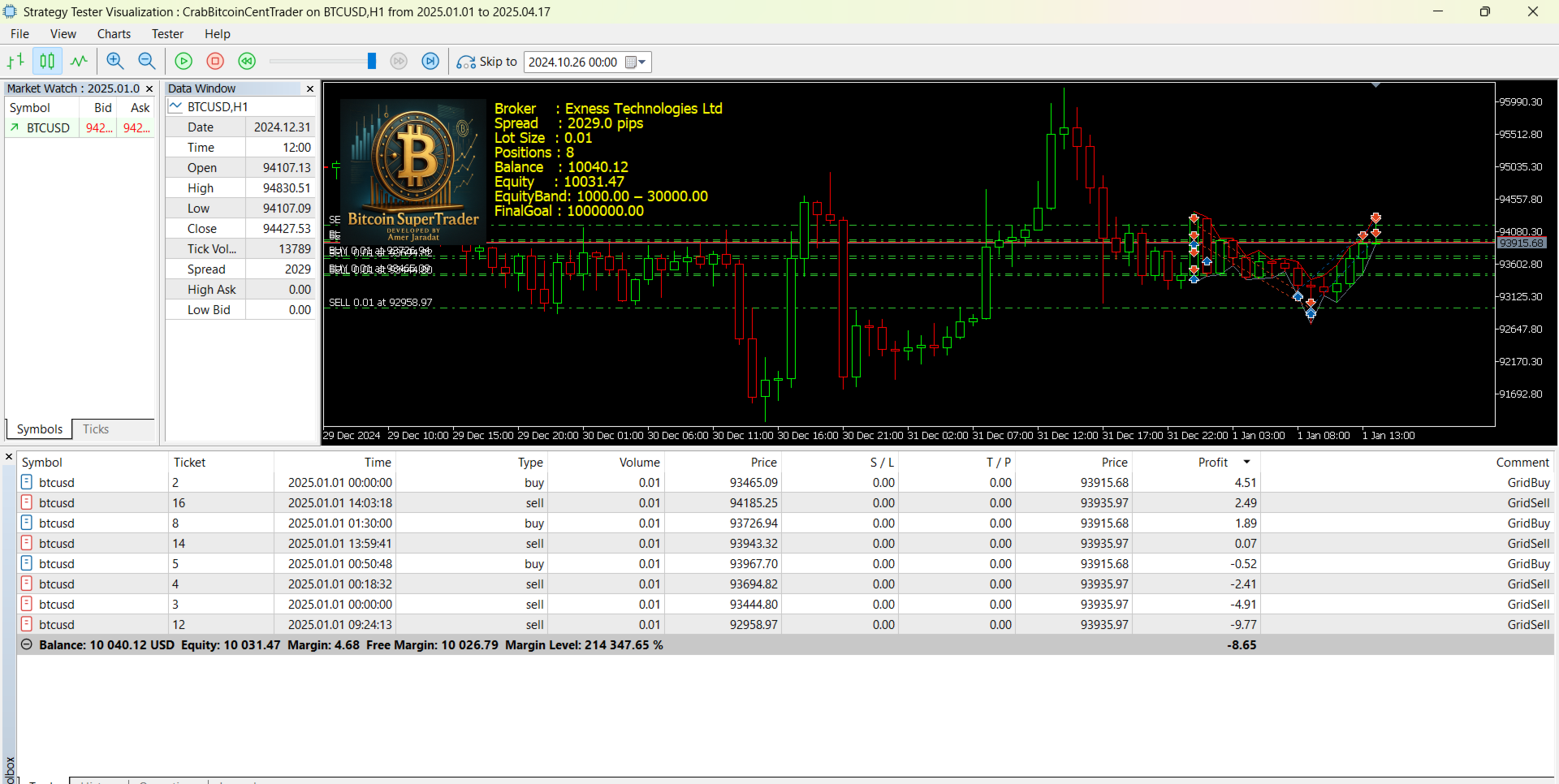
This frame shows simultaneous buy and sell positions, an equity dashboard and zero entries in the displayed stop-loss and take-profit columns. It therefore does not demonstrate broker-side protection on those individual trades. The dashboard’s equity logic is a separate mechanism, whose behavior is not independently tested here.
H1 appears in the tester, but the current description does not require that timeframe. The image’s different executable label also cannot establish the internals of today’s build. Neither screenshot supplies the full trade history, test assumptions or out-of-sample evidence needed to evaluate returns.
Evidence, alternatives and who should consider it
At our September 29, 2026 check, there were no customer reviews or public comments, no linked product-specific live signal and no separate public manual. The developer profile showed no published signals. We have not run an independent terminal test or audited the executable. This review evaluates the published design and original images.
Consider it if you already understand Bitcoin grid exposure and want to evaluate explicit cycle controls. The same developer’s Doubling Force EA MT5 instead documents manually selected direction and martingale escalation. Our Doubling Force review examines that distinction; shared authorship is not evidence of shared results.
Bitcoin SuperTrader review FAQs
Does the lower equity step guarantee a maximum account loss?
No. A losing reset starts a new baseline, allowing additional losing cycles. Execution can also differ from the requested closing threshold.
Can it be described as martingale-free?
The public inputs show a configurable lot size, without a documented multiplier. That alone does not verify every sizing behavior, and the grid still carries exposure risk.
Verify it yourself
Read the Bitcoin SuperTrader source specifications, release history and the developer’s public products.