
Doubling Force EA MT5 is a BTCUSD martingale system with a trader-selected Buy/Sell direction. The central question is how much exposure its sequence can accumulate before its maximum-lot stopping condition is reached.
Our assessment: its appeal is direct control over direction and sizing. It suits an experienced operator prepared to supervise those choices. The volume cap needs careful interpretation, and the written exit instructions differ from the published input screenshot. Neither the screenshot nor the marketing description establishes profitability.
Ready to Buy Doubling Force EA MT5?
$519.99 with crypto · $649.99 by card
Official version · Instant download · Free lifetime updates · 7-day money-back guarantee

What the published evidence supports
This assessment uses the developer’s public listing and original settings image, checked on September 29, 2026. The listing identifies Amer Ali Mousa Jaradat, the JoSignals name and version 1.0. We have not run the EA, audited its code or independently measured returns.
No product-specific public live signal, customer reviews or separate user manual was available through the checked listing and seller page. That leaves a description of intended operation and a view of the inputs, rather than a monitored performance history.
Manual direction is a continuing responsibility
The trader chooses Buy or Sell, with a direction change affecting the next order. This is a meaningful distinction from an EA that independently determines a trend. An execution engine can follow the chosen instruction accurately while the directional decision itself is wrong.
Before using it, define how that decision will be reviewed: what would invalidate a bullish or bearish view, and when would new entries be paused? Changing direction after a losing trade is not, by itself, evidence that the next trade has a better chance of succeeding. Frequent discretionary changes also make it harder to evaluate one consistent configuration.
The genuine input image and the exit-setting discrepancy
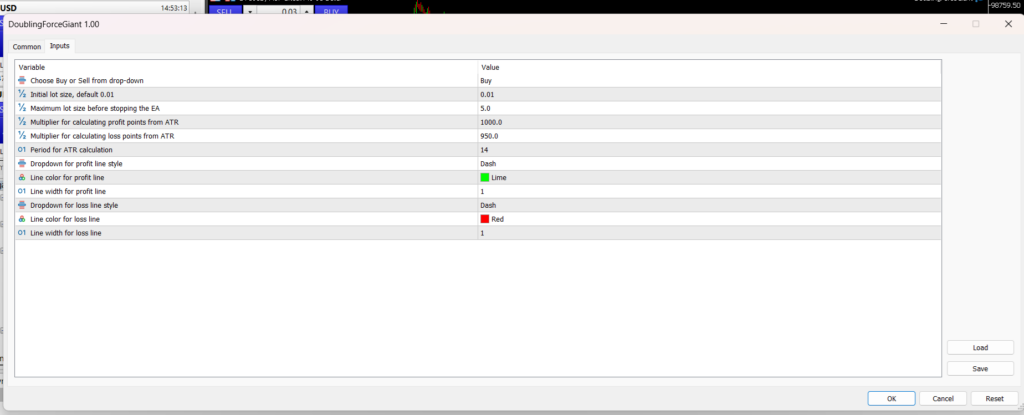
The visible controls include starting volume, a maximum-lot stopping level, ATR-based exit multipliers and an ATR calculation period. These are useful evidence of the interface, but they do not prove which defaults a supplied build will contain.
The written overview describes exit distances in points. The image instead connects the profit and loss settings to ATR. Those formats cannot safely be treated as interchangeable. A point distance depends on the symbol’s point size; an ATR-based calculation also depends on the volatility measurement and the implementation’s scaling.
Resolve that distinction before copying a number into an input. On demo, compare the resulting exit distances with the intended exposure and the broker’s BTCUSD specification. An unexplained numerical preset is not a portable setup.
A maximum-lot stop is not an account-loss limit
The screenshot describes the maximum volume as a stopping point for the EA. It should not be presented as a setting that simply holds future trades at the capped size. The public material does not fully explain what happens to an already-open position at that boundary or how restarting affects the sequence.
More fundamentally, volume and money lost are different quantities. Several losing trades may already have reduced equity before the stopping condition is reached. Their total cost depends on order sizes, price movements and execution costs. A lot ceiling does not specify a maximum percentage drawdown or promise recovery.
Evaluate the sequence as a whole. A small opening trade can coexist with much greater later exposure under martingale. The product name is not enough to infer an exact multiplication factor, restart rule or maximum number of losing steps; those details need confirmation from the actual inputs and observed demo behavior.
BTCUSD setup deserves broker-specific checks
The overview allows any chart timeframe and suggests overnight broker-server hours and weekends. This does not establish that every timeframe produces identical ATR behavior, or that those sessions reliably reduce trading risk.
Check the symbol’s contract size, point value, volume increments, trading hours and margin terms. Use demo observations to confirm direction changes, exit distances and the maximum-lot stopping behavior. Keep a record of the settings and changes so a favorable period is not mistaken for evidence covering every configuration.
How it differs from Bitcoin SuperTrader
The same developer’s Bitcoin SuperTrader EA MT5 describes a buy-and-sell grid with rolling equity thresholds. Doubling Force centers on manually selected direction and martingale sizing. Those are different exposure controls, not evidence that one produces better returns. Our Bitcoin SuperTrader review examines its cycle resets and their limits.
Doubling Force is most relevant when its explicit direction choice matches how you intend to trade. Its public evidence supports examining the controls; it does not support a claim of verified performance.
Verify it yourself
Inspect the Doubling Force source specifications and the developer’s public products.