Gold Impulse Scalper EA MT5 trades XAUUSD on M15 within intraday ranges around key price levels. Its separate strategy blocks each have their own Stop Loss and Take Profit, while lot sizing can use a fixed volume, account balance or selected percentage risk per trade.
Our assessment: the appeal is a focused gold setup with separate exits and clear sizing choices, without grid or additions to losing trades according to the developer. It suits traders prepared to check broker execution and combined exposure across the blocks. The main consideration is whether the chosen sizing mode and gold trading costs suit the intended account; individual stops do not remove slippage or simultaneous-position risk.
View Gold Impulse Scalper EA MT5 features and pricing

This review uses the public listing and supporting sources checked October 13, 2026. We have not independently traded the EA or reproduced its results.
Intraday price levels and independent blocks
Evgenii Aksenov describes trading within the intraday range of key XAUUSD price levels. Several blocks independently analyze market dynamics and each has its own Stop Loss and Take Profit. The public overview does not disclose the full entry formula, identify a specific indicator combination or state a single shared account-risk ceiling.
The developer explicitly says the system does not use grid trading, martingale or increasing losing positions. That differs from averaging into an adverse move, but several active blocks can still expose the account to the same underlying gold movement. Assess the simultaneous positions, total volume and floating drawdown rather than treating each block’s stop as the whole account’s risk limit.
Three lot-sizing modes do different jobs
Fixed Lot uses the volume set by the trader. The volume remains fixed rather than automatically changing with the account balance. Its monetary risk still depends on gold contract size, the trade’s stop distance and execution.
Auto Lot per Balance scales volume with account balance. This is proportional exposure sizing; it should not be confused with a stop-distance-based percentage-risk calculation. Rising balance can lead to larger positions.
Risk per Trade (% of Balance) is described as sizing in proportion to selected risk for each trade. The overview does not document every rounding, broker-volume or simultaneous-trade constraint. Inspect actual accepted lots and stops on demo before relying on the setting’s label.
The Exchange Rate parameter handles account currencies other than USD, with 1.0 representing USD. Currency conversion is a setup input, not proof that the EA can ignore the broker’s contract and volume specifications. Check the required conversion for the actual account denomination.
Gold M15 operation, broker costs and Friday close
The listed setup is XAUUSD on M15, default settings recommended and a VPS required by the developer. Standard, ECN, Pro and Raw account types are listed. A VPS keeps the terminal available; it does not eliminate adverse fills, broker interruptions or market risk.
The minimum-deposit statement is from $250 for a 0.01 lot. That is a developer threshold rather than a capital recommendation for every sizing mode. Margin, overlapping positions and a sequence of losses can require more headroom.
The spread requirement is expressed as below 30 pips for two-decimal gold quotations. Pip, point and tick conventions differ across brokers, so do not convert that phrase into a universal numeric input without checking the quotation convention. Commission and slippage can also change a scalper’s net results.
In a September 16 developer comment, Aksenov recommends reliable execution and raw gold spreads of 10–15 pips. This is broker advice, not a documented universal default for the EA’s max-spread input.
All open trades are described as closing on Friday evening. The overview does not give an exact hour or guarantee a successful fill. Verify the supplied build’s schedule and the broker’s trading hours, and keep the terminal connected while positions remain open.
Original tester reports: 1% and 3% risk examples
Two gallery composites identify Gold Impulse Scalper 1.2.ex5 on XAUUSD M15, with a selected test period January 1, 2024 to June 1, 2026, USD 1,000 starting deposit and 1:500 leverage. Both show Every tick modelling, 100% history quality and zero latency, ideal execution. That is a historical simulation assumption, not a live-fill environment.
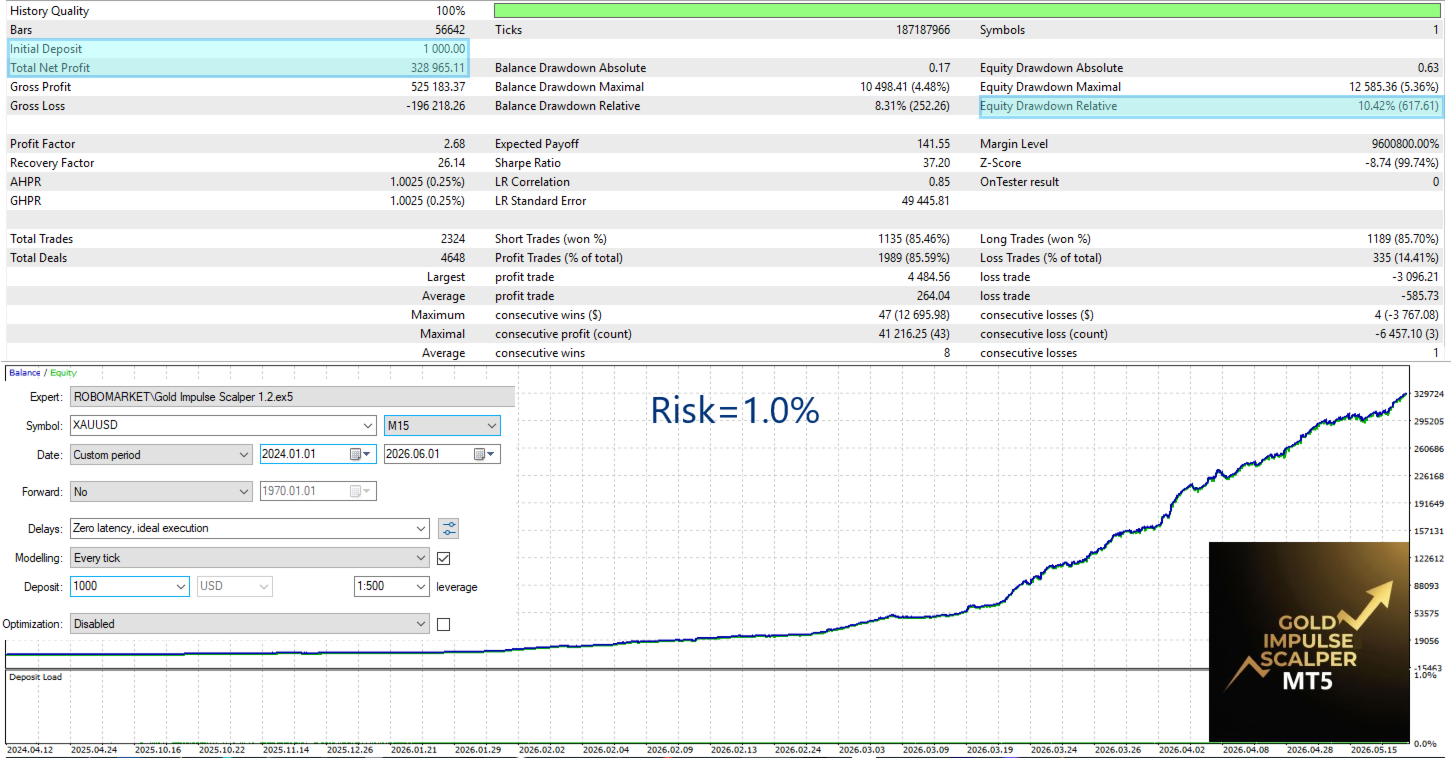
The 1% report shows net profit 328,965.11, profit factor 2.68 and 2,324 trades. Relative balance drawdown is 8.31% and relative equity drawdown 10.42%. The separate maximal equity figure is 12,585.36 (5.36%); use the reported labels rather than presenting the smaller percentage as the complete drawdown measure.
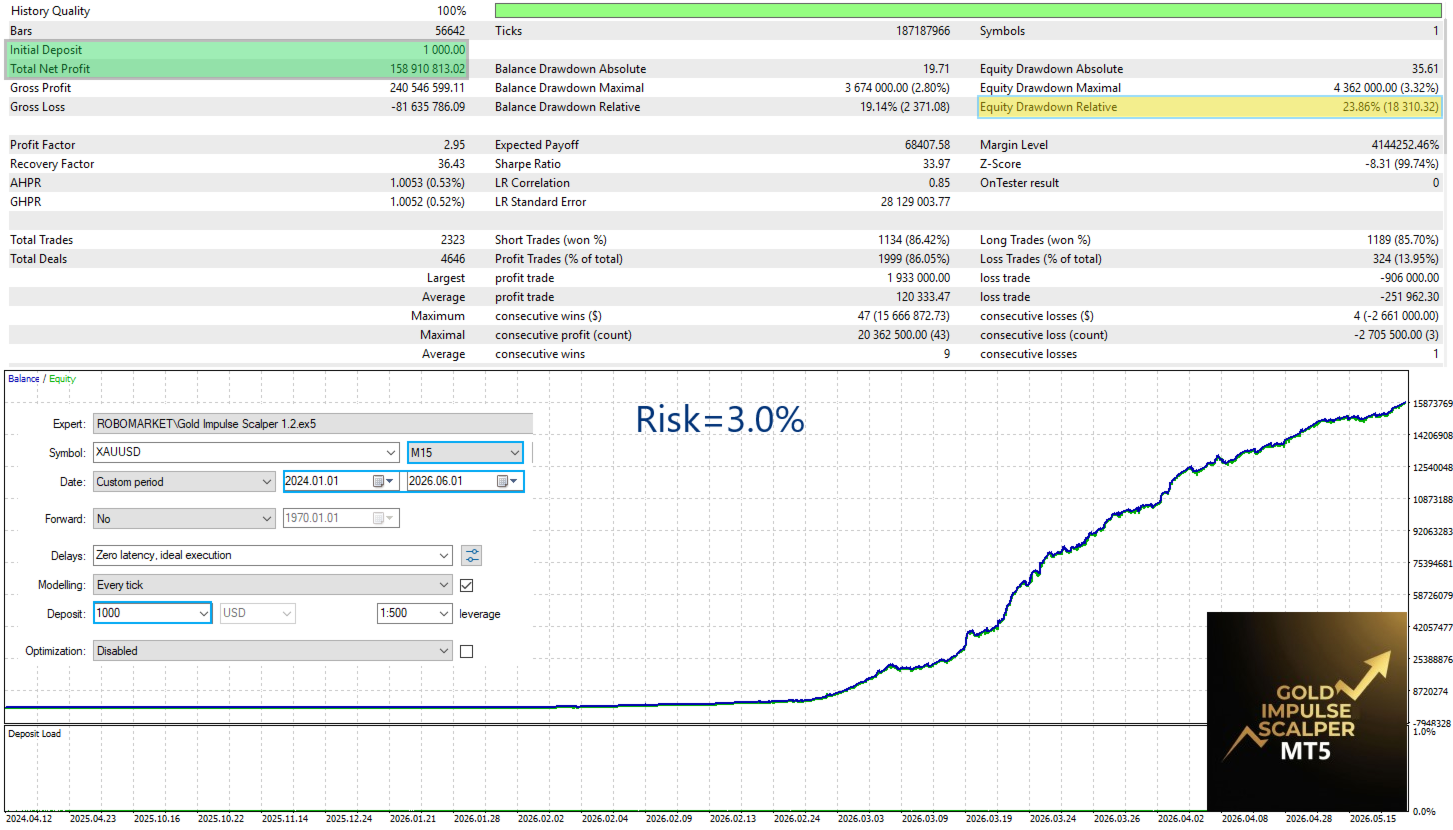
The 3% example shows net profit 158,910,813.02, profit factor 2.95 and 2,323 trades. Relative balance drawdown is 19.14% and relative equity drawdown 23.86%; the separate maximal equity measure is 4,362,000 (3.32%). Scaling exposure changes both the simulated growth path and drawdown. We have not independently reproduced these reports, and the old build and ideal-execution assumptions limit their use as evidence for version 1.6.
The developer’s May 29 comment also links a downloadable RoboForex tester-report archive. Its HTML identifies GoldImpulseScalper_1.0 on M5, January 1, 2024 to May 29, 2026, at Risk 3. It reports 98% history quality, profit factor 3.07 and relative equity drawdown 22.85%, while the maximal figure is 2.61%. Its currency field says “profit in pips”; do not treat its dramatic totals as cash returns. These historical inputs do not replace the current listing’s M15 instruction or establish version 1.6 results.
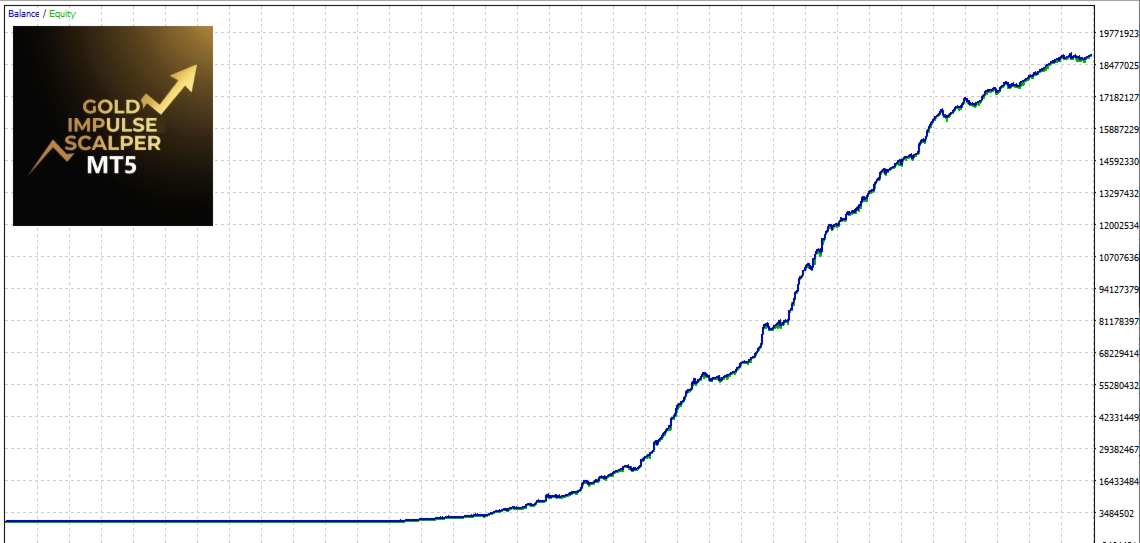
Historical signal-page and trade illustrations
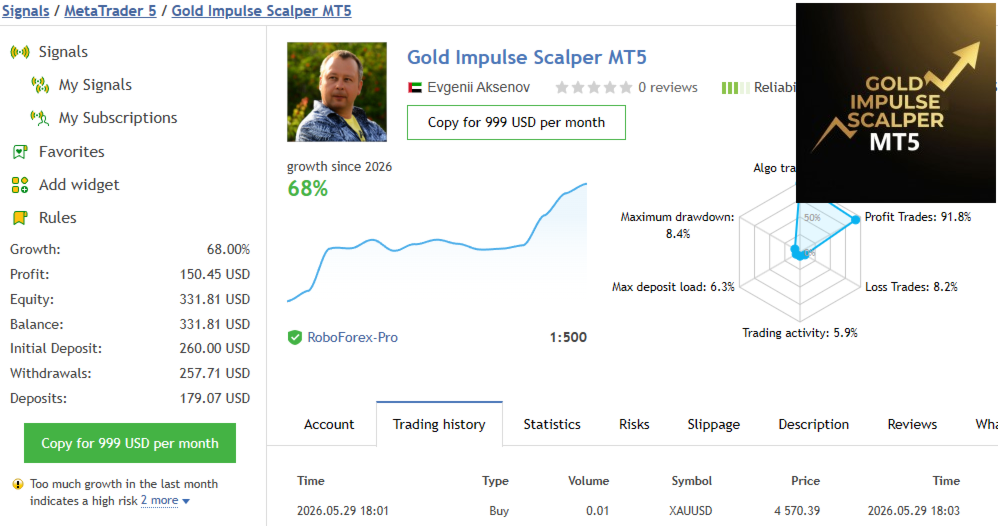
This historical image shows RoboForex-Pro and 1:500 leverage, but its growth figure is not a current monitored result. Retain the cash-flow and risk warning context rather than inferring account growth solely from balance. Its screenshot labels do not verify every later software build.
No current Gold Impulse product-specific public monitor was identified in the checked listing and seller information. No linked public manual or verified preset was found; a historical tester report is not a setup manual or a current live record.
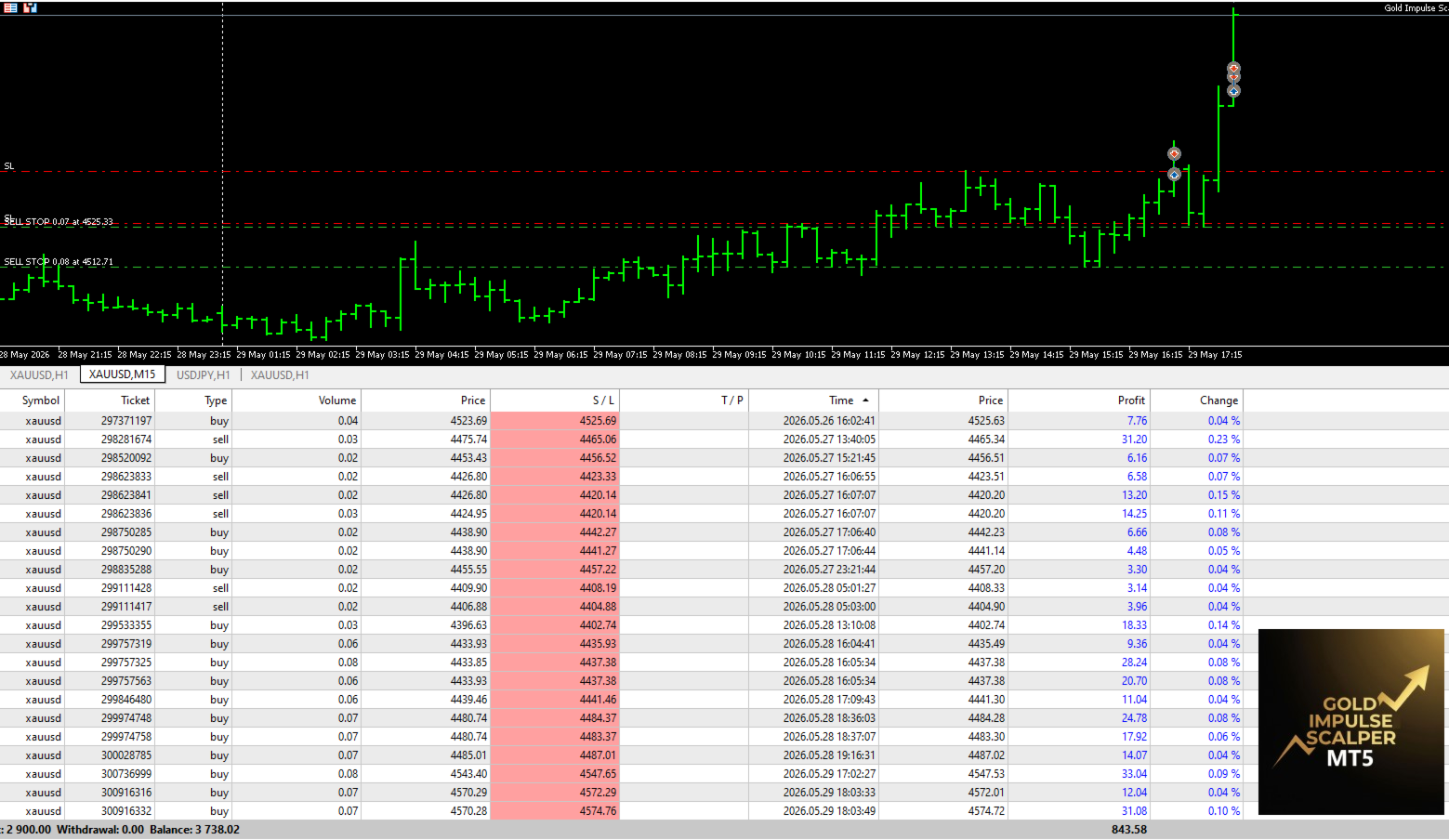
The chart and trade-history image illustrates stop/order lines and different position volumes. It is useful operational context, but the cropped account view does not establish a complete performance record.
Release notes and risk controls
The checked listing showed version 1.6, dated September 21, 2026. Its note says the strategies and risk function were updated, without a full technical explanation. Version 1.5 revised the strategy and repeated the low-spread broker recommendation. Earlier notes added a Max spread control in 1.1, a Friday-close function in 1.3, and a Max daily drawdown % setting in 1.4.
The developer labels the latter a prop-firm setting. Its presence does not establish compliance with every firm’s daily-loss definition, reset time, floating-loss rule or evaluation policy. Check its active setting and actual behavior alongside the provider’s current rules. The notes do not let us assign every historical gallery result to version 1.6.
Read the developer’s full release history.
Customer feedback: one rating without written experience
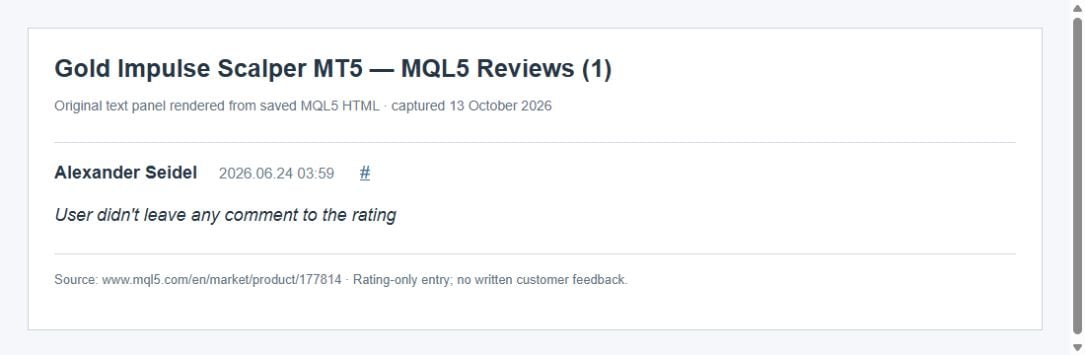
The checked listing has one review entry from Alexander Seidel, dated June 24, 2026, displaying “User didn’t leave any comment to the rating.” It provides no information about broker, settings, drawdown or sustained operation. The date also predates version 1.6. A rating-only entry offers little evidence for a purchase decision and cannot substantiate the tester results or current-build performance.
Another EA from the same developer
We also list Wall Street Scalper EA MT5 from Evgenii Aksenov. Its shared MT4/MT5 review explains that separate product’s editions and evidence. Compare their own strategies, settings and records; Wall Street Scalper results are not evidence for Gold Impulse Scalper.
Verify it yourself
Read the official Gold Impulse Scalper MT5 listing and Evgenii Aksenov’s seller profile. Compare the actual supplied build’s controls and trade behavior on your own broker; this is source analysis, not an independent trading test.