
AI Gold Master EA MT5 is an XAUUSD M15 trading robot with long and short entries, multiple concurrent positions and stop-based exits. The developer’s fixed-lot test held order size constant at 0.01 lot and realized most winning trades through stops that had been moved into profit.
Our assessment: its appeal is a documented fixed-lot alternative to the more aggressive risk-based mode. The main considerations are combined exposure across layered entries, occasional long holding periods and sensitivity to broker data and execution. This review separates developer simulations from the linked forward account, using sources checked 20 October 2026. It is not a firsthand test of the executable.
View AI Gold Master EA MT5 features and pricing

What the documented trading behavior shows
Across the reported fixed-lot test, the EA took 1,099 long and 877 short trades. It opened sequences of up to seven positions on one side and reached eight open positions at once. Lot size remained 0.01 within that test, so the sequence did not use escalating volume there. These are observations from that run, not confirmed hard limits in every configuration.
Constant lot size does not make the sequence equivalent to one small trade. Several positions can lose together, and their combined margin and stop exposure matter. Nor does one fixed-lot run establish how every risk-based configuration sizes later orders.
High winning frequency, with larger losing moves
The developer’s analysis says every exit in the fixed-lot report occurred at a stop level. Stops moved into profit closed 91.65% of trades. The reported median distance from entry was about 3.746 for profitable exits versus 18.807 for losing exits. These are price-distance figures, not universal pip values: frequent smaller wins still have to cover less frequent larger losses.
The largest reported losing trade was $57.73. Historical losing sequences and drawdown cannot establish a future loss ceiling.
Average holding time was about four hours and 25 minutes, but the longest position lasted almost 96 hours and 48 trades crossed a weekend. A strategy that usually exits within a day can still carry overnight financing and gap exposure.
Read the fixed-lot and high-risk tests separately
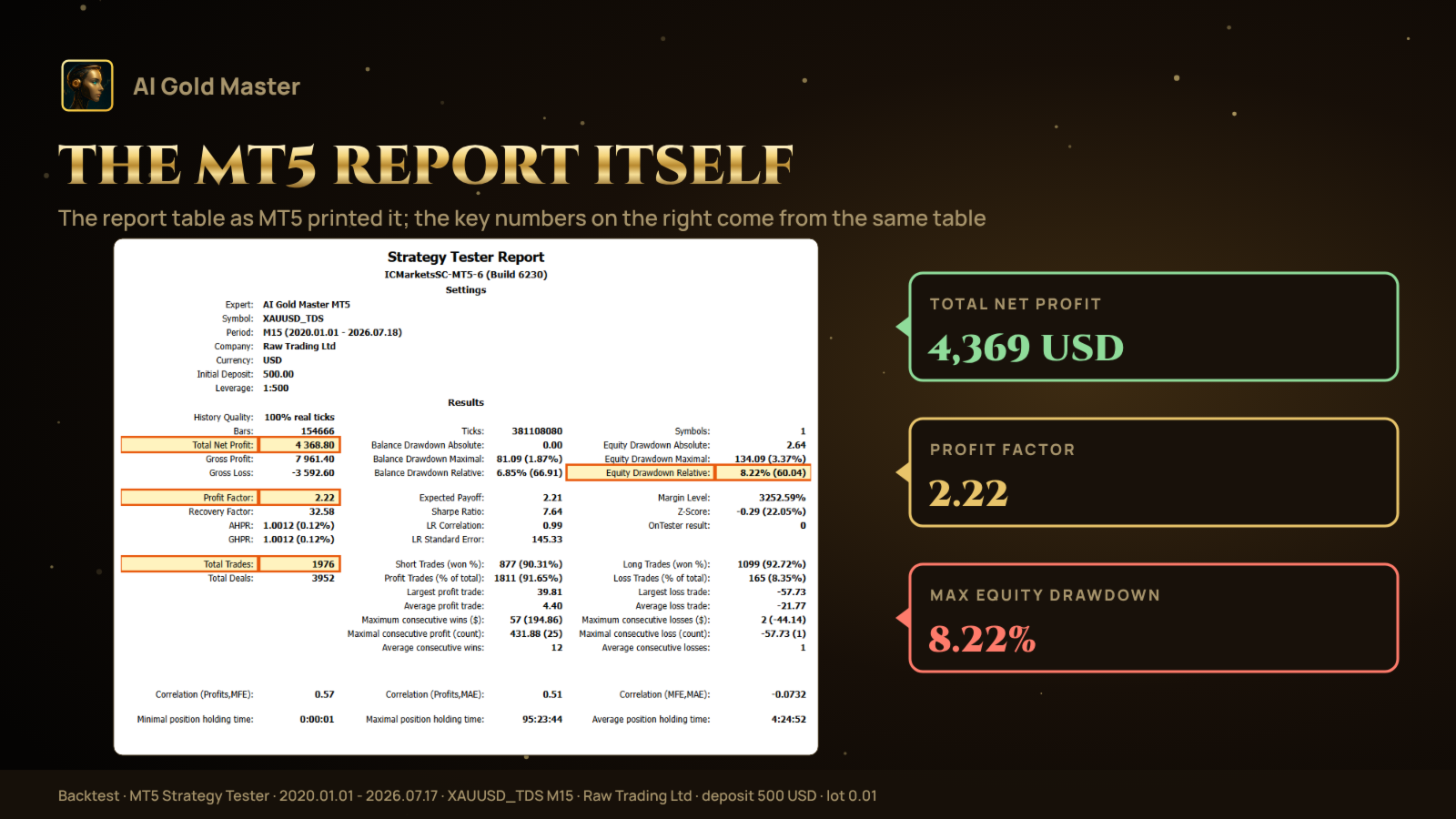
The developer’s embedded MT5 report covers XAUUSD_TDS M15 from January 2020 to July 2026, with a $500 deposit, 1:500 leverage and history labeled 100% real ticks. The accompanying description identifies fixed 0.01-lot sizing. The report records:
- Results
- 1,976 trades; $4,368.80 net profit; profit factor 2.22; recovery factor 32.58; Sharpe ratio 7.64.
- Relative drawdown
- Equity: 8.22% ($60.04). Balance: 6.85% ($66.91).
- Maximal drawdown
- Equity: $134.09 (3.37%). Balance: $81.09 (1.87%).
The graphic’s prominent 8.22% label is the report’s relative equity drawdown, not its separately named maximal field. Different labels should not be substituted for one another.
The overview separately claims a much larger +120,097.9% result and 24.1% drawdown for its “High Risk” sizing mode. Those are developer claims about another configuration; the fixed-lot report above does not validate them. A mode described with a 30% drawdown target does not guarantee that limit in future trading.
These simulations establish what the publisher reports from selected history and settings. They do not prove an independently reproduced result, out-of-sample robustness or comparable live returns.
The linked account: 15 trades and a short monitoring window
The developer-linked MT5 signal, checked 20 October 2026, was labeled Real Account on ICMarketsSC-MT5-6 with 1:500 leverage. It displayed five weeks of account history, but its monitoring “Started” field was 16 October 2026. Those are different time references; this is not five weeks of continuous public forward monitoring.
- Growth and trades
- 62.42% source-calculated growth; 15 XAUUSD trades, with 14 wins and one loss.
- Cash flows and current funds
- $100 initial deposit, $200 additional deposits, no withdrawals, $55.74 profit; balance and equity both $355.74.
- Profit factor and average outcomes
- Profit factor 3.04; average profit $5.94 versus average loss −$27.37.
- Maximal balance drawdown
- $26.15 (15.56%), using the signal’s own field label.
- Relative drawdown
- By balance: 7.09% ($26.11). By equity: 6.42% ($23.63).
The growth percentage uses the source’s cash-flow-adjusted calculation; it is not simply profit divided by the current balance. The separately reported maximal balance figure is 15.56%, so retain each field’s definition when comparing drawdowns.
MQL5 flags too few deals, a newly opened account whose results may be random, unusually high recent growth and high average monthly growth. One loss is too small a sample to assess losing streaks. The public data does not establish that the account uses the fixed-lot test settings, and the account label is not our independent verification of its transactions.
Testing and setup
Use XAUUSD M15 as the source’s recommended chart. The developer gives a minimum balance guideline of $500 per 0.01 lot and a preferred $700 per 0.01 lot. The associated drawdown language is an expectation based on the developer’s work, not a guarantee that a live account cannot lose more than a stated percentage.
Compare sizing modes using the same history, costs, deposit and leverage. Inspect floating drawdown and concurrent positions as well as closed results. Include gold contract size, spread, commission, swaps and weekend gaps; the linked broker article reinforces the importance of different feeds without proving identical results at any named broker.
What the linked AI setup guide establishes
The developer’s general setup guide, dated 2 March 2026, describes local technical scanning followed by centralized OpenAI/Perplexity verification, WebRequest permissions and license authentication. It says an interrupted server response prevents new entries.
This is the developer’s description of an all-product architecture, not an independent inspection of AI Gold Master. Its H1 processing example predates this October M15 listing, which does not specify the exact model or entry rules. The source therefore does not establish which service requirements or authentication arrangements apply to this particular supplied build.
Source scope and customer feedback
The listing was published on 16 October 2026 and showed version 1.0 when checked. It had no product reviews at that point, so customer feedback was not yet available to complement the published evidence.
Also in the catalog: AI Gold Sniper EA MT5 and AI Gold Scalp Pro EA MT5. Compare each product’s own settings and evidence.