
DayTrade Pro Algo trades price action around daily support and resistance across 12 Forex pairs and XAUUSD. Both editions combine a single-chart portfolio setup with stop loss, take profit, trailing exits and several sizing methods. MT4 and MT5 share the published strategy, but their testing procedures differ.
Our assessment: the appeal is broad market coverage with practical exposure controls. The main considerations are correlated currency positions, the optional OnlyUp sizing behavior and a public account that sometimes holds trades for days. This review covers current documentation and evidence checked 20 October 2026; it is not a firsthand trading test or an independently reproduced backtest.
View DayTrade Pro Algo EA MT5 features and pricing · View the MT4 edition

How the strategy works
The EA looks for price-action opportunities around major daily highs, lows, support and resistance. It manages pending orders, protective stops, profit targets and trailing exits. OneChartSetup lets the user select markets and operate them from one EURUSD Daily chart rather than opening a separate chart for every pair.
The supported list is EURUSD, GBPUSD, USDJPY, AUDUSD, XAUUSD, GBPJPY, USDCAD, EURJPY, EURNZD, EURAUD, NZDUSD, AUDJPY and CHFJPY. That is a varied portfolio, but several positions can share USD, JPY or other currency exposure. More symbols do not automatically mean lower combined risk.
Position sizing: the important distinction
Alongside fixed lots and balance/equity scaling, the developer recommends a method based on each pair’s historical maximum drawdown. The March 2024 release notes explain that different lot sizes are assigned to equalize the markets’ historical risk. Current examples label Max Risk Per Pair values of 3, 7 and 15 as low, medium and high.
These are historical sizing references, not a promise that the next trade or the entire account cannot lose more than a specified percentage. A different market regime, several simultaneous losses, contract specifications and minimum lot sizes can all change the outcome.
OnlyUp deserves separate attention. It prevents lot size from decreasing after losses, so the same position size can become a larger proportion of the remaining capital. MT5’s May 2026 update stores the balance high across restarts; its October update adjusts the calculation after withdrawals. This is a sizing choice, not evidence by itself of a grid or martingale strategy.
MT4 and MT5: different testing instructions
For live operation, both listings specify EURUSD D1 with OneChartSetup enabled. For testing, follow the instructions for the selected platform:
- MT4: test each pair separately on M1, with OneChartSetup disabled. The developer suggests Open Prices Only or Control Points as faster modeling choices.
- MT5: test the portfolio on EURUSD D1 with OneChartSetup enabled. The listing suggests 1-minute OHLC; recent release notes also describe faster real-tick testing.
The developer says simplified modeling gives similar results. Check that claim against suitable tick history, realistic spreads, commission, swaps and the intended broker conditions. Separate MT4 pair reports also need a combined exposure assessment; adding their profits does not establish portfolio drawdown.
The monitored account is MT4
The linked Daytrade Pro Live account is labeled Real Account and runs on MT4 at ICMarketsSC-Live20 with 1:500 leverage. Its source Started field showed 8 May 2023, alongside 180 weeks of displayed history; these fields do not prove that every part of the history was monitored contemporaneously. On the check date it showed 78.73% growth, 1,305 trades and a 1.19 profit factor.
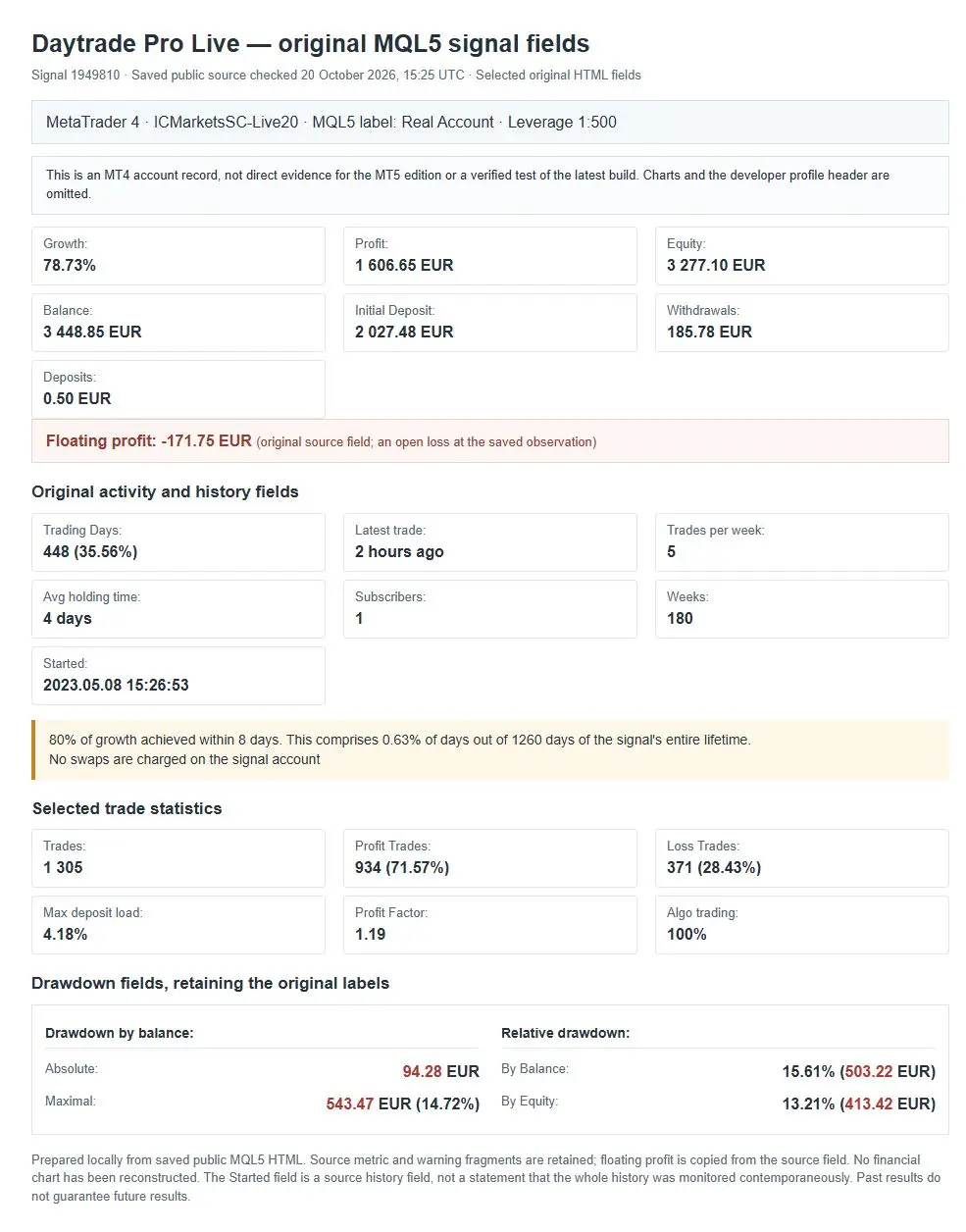
Reported profit was €1,606.65, from an initial €2,027.48 deposit, €0.50 in additional deposits and €185.78 withdrawn. Balance was €3,448.85 while equity was €3,277.10, leaving €171.75 of floating loss at that snapshot. Relative balance drawdown was 15.61% and relative equity drawdown 13.21%; the separate maximal balance drawdown field was 14.72%.
The source warned that 80% of growth came in eight days and that no swaps are charged on the account. Average holding time was four days, making overnight financing a meaningful difference for brokers that do charge it. Average winning trades were €10.61 versus average losing trades of €22.37 in magnitude: the 71.57% win rate should not be read alone.
This is a substantial history, but it spans earlier builds and changing settings. The account was labeled 100% algorithmic; that does not establish an unchanged configuration throughout or prove identical MT5 execution. Its latest trade was two hours before the source check, so an earlier inactivity notice should not be presented as a current warning.
The original portfolio backtest
The developer’s gallery includes a tester report labeled Prop Firm Set, 2020–2023, 100K start. It shows 13 symbols, 1,808 trades, a 1.96 profit factor, 7.98% relative balance drawdown and 8.57% relative equity drawdown. The report labels history quality as 100%.
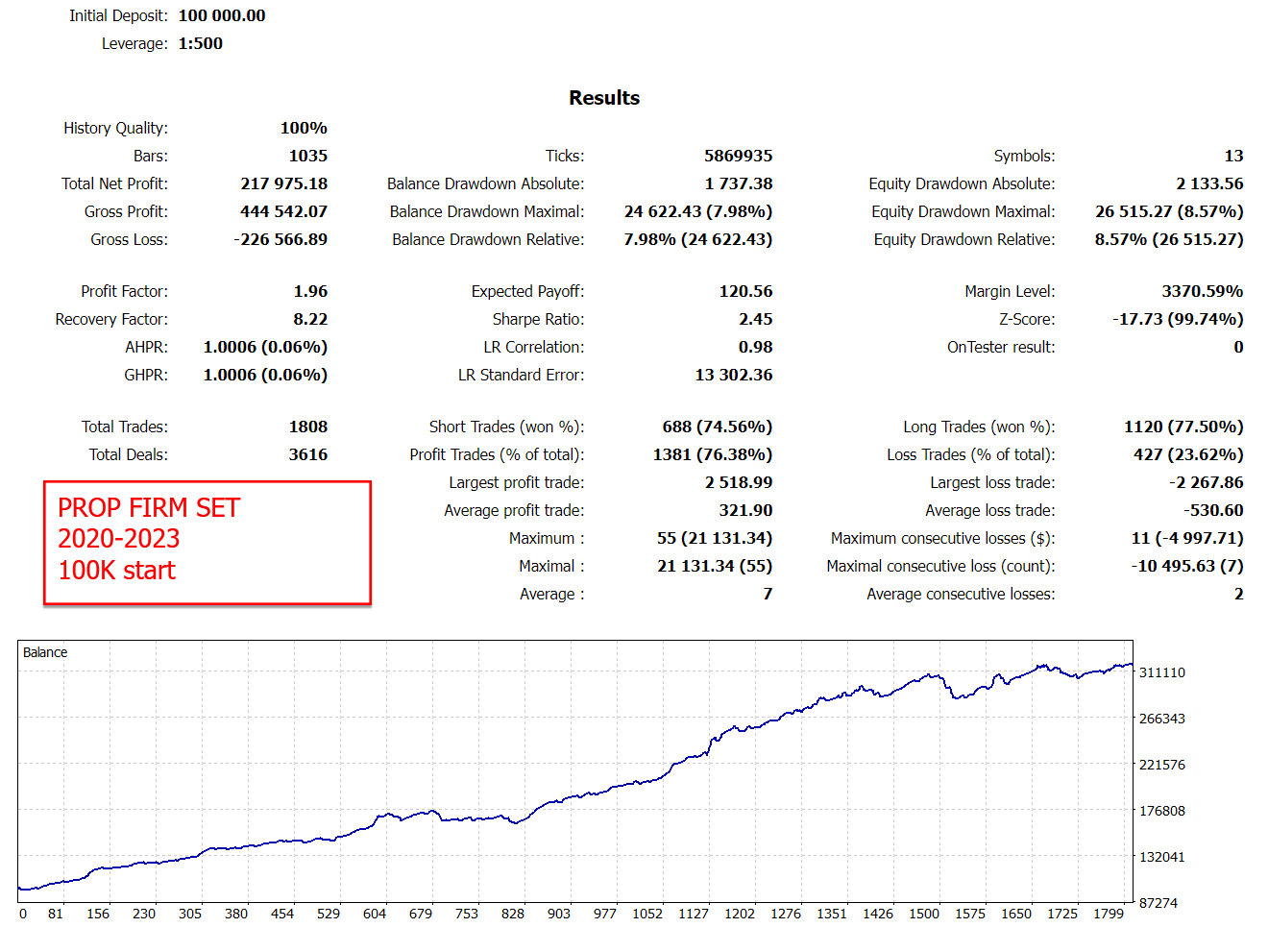
This is a historical simulation supplied by the developer, not a live return or a fresh test of the October 2026 releases. The image does not provide all inputs and execution assumptions needed to reproduce it. Its prop-firm label is not evidence of meeting a particular firm’s daily loss, total loss, news or consistency rules.
Current releases and older settings
The current listings show MT4 version 4.5 and MT5 version 4.51, both updated 19 October 2026. The latest strategy changes improve EURJPY and GBPJPY; MT5’s additional patch is described as a license fix. Earlier 2026 updates adjusted XAUUSD behavior to changing gold prices.
The linked public settings discussion contains files for version 2.4 from March 2024, including risk examples and a prop-oriented preset. They are historical starting points, not confirmation of today’s defaults or a package entitlement. Release notes also document daily-drawdown controls, a weekend-close option, limits on open trades per pair and entry/exit offsets. Test changes to those offsets before live use; they do not guarantee acceptance by a prop firm.
Customer feedback in context
The MT5 reviews include praise for adjustable controls and long-term use alongside reports of losing periods. Gravity Tool’s December 2023 feedback praised the parameters while acknowledging setbacks. Martin Rasmussen’s June 2023 review described small wins and larger live losses after one month. Both observations predate later sizing and strategy changes.
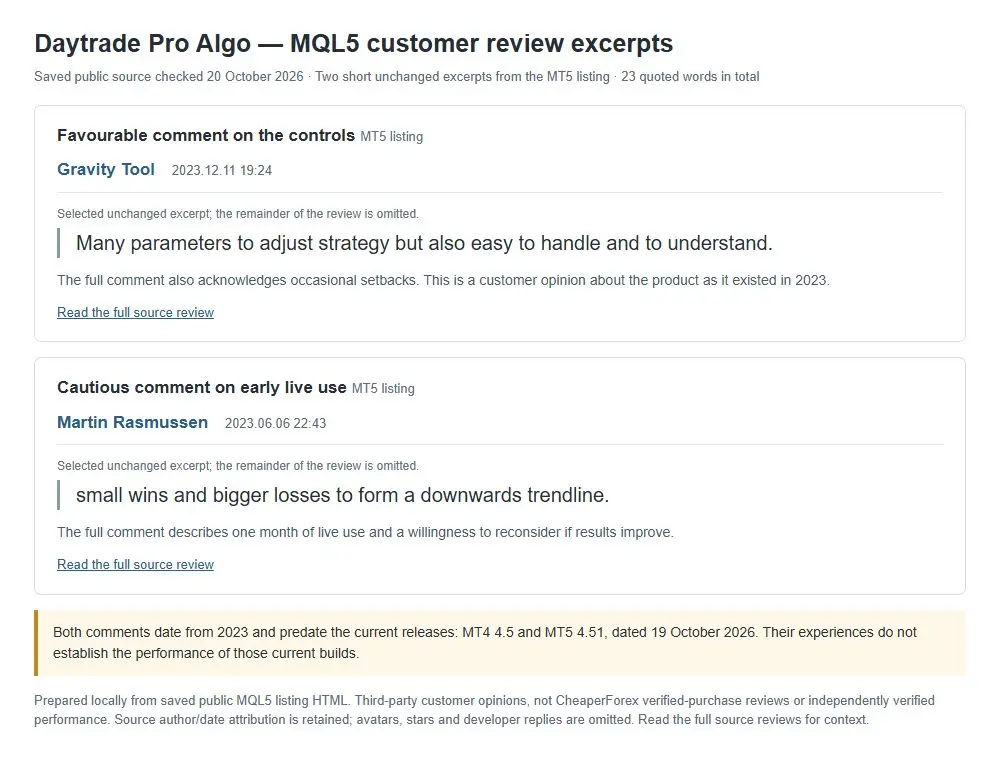
A favorable November 2025 reviewer says they run DayTrade alongside several other systems, which prevents attributing their whole account’s outcome to this EA. These are third-party customer opinions, not CheaperForex verified-purchase ratings or independently verified performance. They are most useful as prompts for testing configuration, costs and the behavior of losing trades.
Choosing an edition
Choose the edition supported by your broker and testing workflow. Both publish a recommended minimum balance of $400, but suitable capital depends on the selected markets, contract sizes, leverage and sizing. Start with a realistic demo configuration, inspect concurrent exposure and overnight costs, and verify that daily-drawdown settings align with any external account rules. Stops reduce exposure but do not remove gap or slippage risk.