Three Little Birds EA MT5 is an H4 grid, martingale and hedge system with several ways to manage a trading cycle. It combines recovery additions, additions during profitable momentum and opposing positions, supported by extensive chart controls and exit rules.
Our assessment: its appeal is control over complex basket management. The main consideration is the capital and time committed to a cycle that may remain underwater for days. This review examines the listing, original interface images and developer notes checked 20 October 2026; it is not a firsthand trading test.
View Three Little Birds EA MT5 pricing

What the three approaches do
The losing-side grid adds orders as price moves against the cycle, using martingale sizing to work toward a combined exit. The winning-side approach, called Brute Force in the developer’s notes, adds exposure when a cycle is profitable and price is moving quickly. It is subject to configured limits and available margin, but a reversal after adding size can still be costly.
The hedge opens opposing exposure when the core recovery structure needs it. That can alter sensitivity to the next price move, but it does not make the existing floating loss disappear. Spread, swaps, unequal position sizes, execution timing and margin requirements remain relevant while the system waits for an exit.
H4, account mode and supported instruments
The MT5 edition requires a hedging account; netting is unsupported. H4 is the stated operating timeframe. The defaults cover XAUUSD, XAGUSD, BTCUSD, oil, DXY, US30, US100, US500, TSLA and GOOGL. The author says other instruments can run but require testing. Broker symbol recognition and contract sizes should be checked rather than assuming similarly named instruments behave identically.
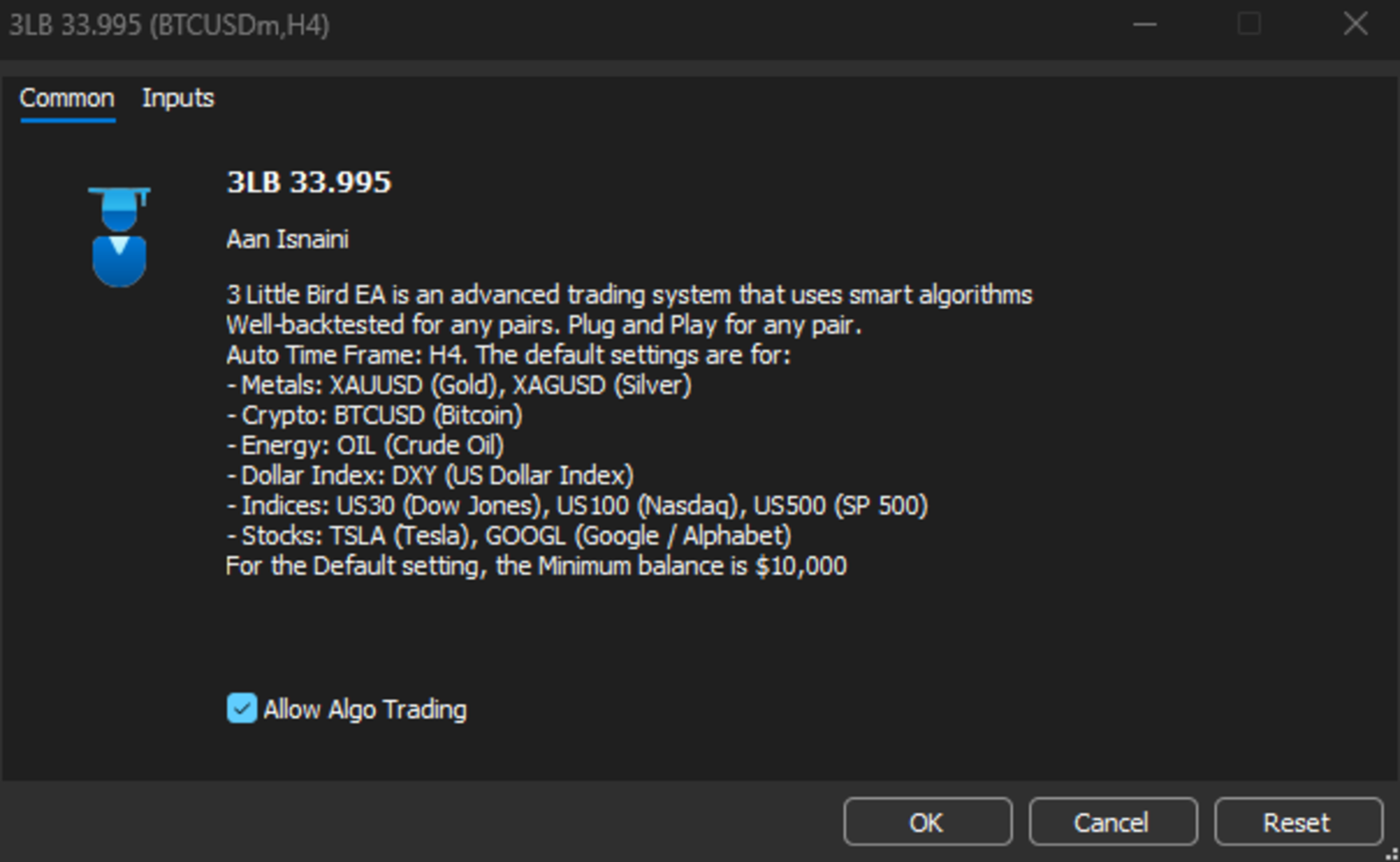
The developer specifies a $10,000 minimum balance for the default setup. The 18 October operating notes describe those defaults as targeting high return with correspondingly high risk. The interface image’s broad claims about testing and plug-and-play operation do not establish consistent results across the instrument list.
Several exits, with important differences
The core grid/hedge mode substitutes a hedge for a conventional initial stop loss. That does not mean the software never uses stops: it also has per-order trailing, a separate OneShot mode and an optional drawdown limiter.
The documented trailing structure uses a Director to decide when trailing is permitted and a Manager to run its layers. Trailing may be held back while a hedge is open or market conditions favor letting the cycle continue. Basket-equity trailing activates after profit reaches its configured level, follows the cycle’s equity peak and can request closure after a retracement.
Force Close is on by default, but it is not a loss-cutting stop. The author says it acts once the cycle is sufficiently profitable and market movement threatens that profit; it never closes a cycle that is already in the red. The separate drawdown limiter can close losing positions, but it is off until enabled. These distinctions matter more than the reassuring names of individual controls.
Manual controls and defaults that affect other trades
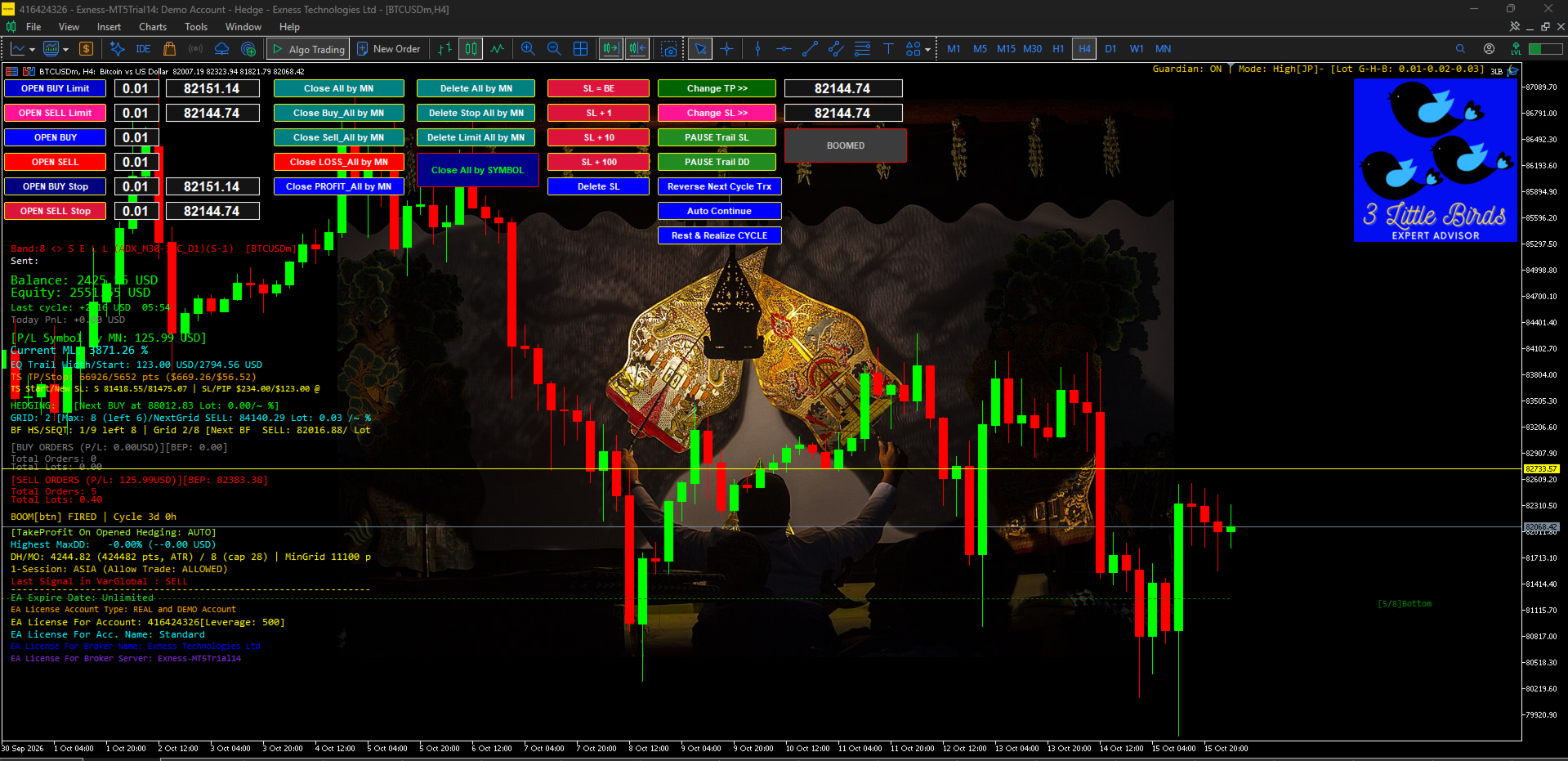
Guardian Mode is on by default and takes over every manual trade on the same symbol. Users combining manual orders with this EA need to decide whether that behavior is intended. The dashboard includes order entry, closing by side or result, pending-order deletion, break-even, stop and target changes, trailing switches and cycle controls.
The Grid margin-level filter is off by default, while the Brute Force margin filter is on. Session, daily, weekly and monthly limits and the drawdown limiter are initially off. Optional Telegram reports are also off and require the user’s own bot plus terminal WebRequest permission. The availability of a control is different from having it enabled and correctly configured.
Boom, OneShot and the two-chart exception
Boom Trade adds a position only to a winning cycle and attempts to secure the winning side at break-even or better. The automatic mode is off by default, although its chart button can still request a manual Boom. It is not designed to rescue a losing basket.
OneShot is a separate optional mode: one trade at a time with stop loss and take profit, without grid or hedge. It uses the main system’s entry logic but accepts the loss when its stop is hit. It is off by default and should not be used to describe the standard grid mode as a no-grid strategy.
Double EA mode, also off, places buy-only and sell-only instances on two charts of the same symbol with distinct magic numbers and a shared exit. The developer requires $10,000 per chart, $20,000 total. It cannot be evaluated in the single-chart Strategy Tester or MQL5 demo; it needs a forward test. A shared profit objective does not establish how long a round will take, how much margin it will consume or whether the account survives until that exit.
What the available evidence supports
The MT5 listing was published on 16 October 2026 and showed source version 33.995 when checked. Its review pane contained no purchaser reviews. Neither the listing nor the seller page linked a product-specific public signal, and the author explicitly says personal backtests are not published. The two gallery images are interface evidence; the dashboard is visibly a demo account, not proof of live performance.
The developer recommends visual Strategy Tester runs using the broker’s own symbol, several periods and Debug enabled, followed by forward evaluation. Those are proposed checks, not results we have independently reproduced. The 18 October blog is useful current operating documentation, while the MT4 history and any older edition’s reputation are not an MT5 trading record.
Three Little Birds is consequently a candidate for buyers who specifically want to examine a configurable, capital-intensive recovery system. It is a poor fit for a requirement that every default trade starts with a hard stop or that a profitable basket exit is guaranteed. Hedging and martingale restrictions may also make it unsuitable for a particular trading account.
Already using MetaTrader 4? See the existing Three Little Birds MT4 product. This review describes the newly listed MT5 edition and its documented account requirements.
Other products from this developer in the catalog include BTCUSD Grid EA MT4 and Velora EA MT4. Their features and evidence should be evaluated separately.
Public sources
Three Little Birds MT5 listing and original images · 18 October operating notes · Developer’s seller page