AuroraX EA MT5 combines momentum and trend-continuation entries on XAUUSD with an adaptive grid recovery engine. It offers active gold trading with configurable basket controls, but exposure accumulates if the expected continuation fails to arrive.
Our assessment: the developer provides a public trading account and useful shared documentation, but the attractive recent account curve needs to be read alongside sizable drawdowns in the supplied simulations. This review evaluates sources checked 16 October 2026; it is not a firsthand trading test or an audit of the executable.

What AuroraX is designed to do
The listing describes measuring gold’s momentum, entering in the same direction and seeking a relatively quick continuation profit. When price moves against the initial trade, the grid adjusts its spacing and sizing.
The aim is to close the combined basket profitably on a later continuation. Adaptive spacing changes how positions accumulate; an extended adverse trend can still exhaust the account’s risk or margin capacity.
The controls and operating conditions
AuroraX’s own listing specifies XAUUSD, any chart timeframe, a VPS and an AutoLot level input. It gives minimum account and leverage requirements of $1,000 on a standard account or $10 on a cent account, and 1:500 leverage. These are the developer’s setup requirements. Higher leverage reduces the margin needed to open positions but does not reduce trading losses.
The linked February 2026 TickStack parameter reference predates AuroraX’s release. It describes a shared front end, while noting that each system’s entries and grid logic differ. Generic symbol labels do not establish AuroraX support beyond gold.
That reference covers fixed and balance-linked sizing, linear or exponential lot progression, ATR-based spacing, grid-position limits, maximum lot size, spread filtering, news windows and trading hours. It also describes optional drawdown stops, emergency margin protection and a grid-disabled mode using a stop-loss distance. It does not establish AuroraX’s enabled defaults or the public account’s settings.
The reference defines AutoLot level 1 as a 0.01-lot starting size per $1,000 of balance. Later grid exposure can be larger; this is not a fixed percentage loss limit.
The current public account: encouraging, but still short
The developer’s signal directory links to the AuroraX account on ShowMyTrades. Our 16 October check showed a USD MetaTrader 5 account on RoboForex-Pro at 1:1000 leverage. The site displayed green Real Account and Track Record markers; Trading Privileges was gray, so we do not describe that separate verification as complete.
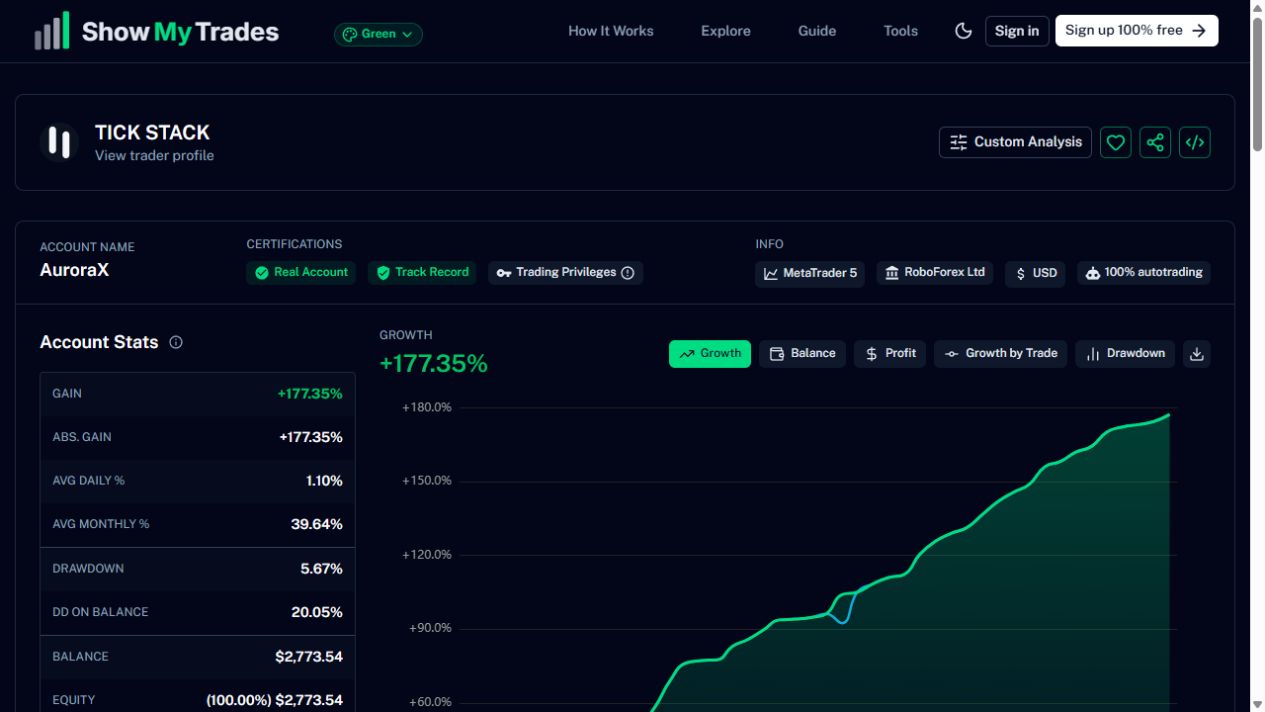
The record displayed 177.35% gain, $1,000 in deposits, no withdrawals and matching balance and equity of $2,773.54. It labeled drawdown 5.67% on equity and 20.05% on balance. These are separate platform metrics; the smaller figure is not a universal risk measure.
The visible curve begins in July, before the product’s 9 October retail release. Monthly figures were 35.98% for July, 43.18% for August, 31.51% for September and 8.33% for October to the check date. October is incomplete, and this short history does not establish the current retail configuration’s behavior across a full market cycle.
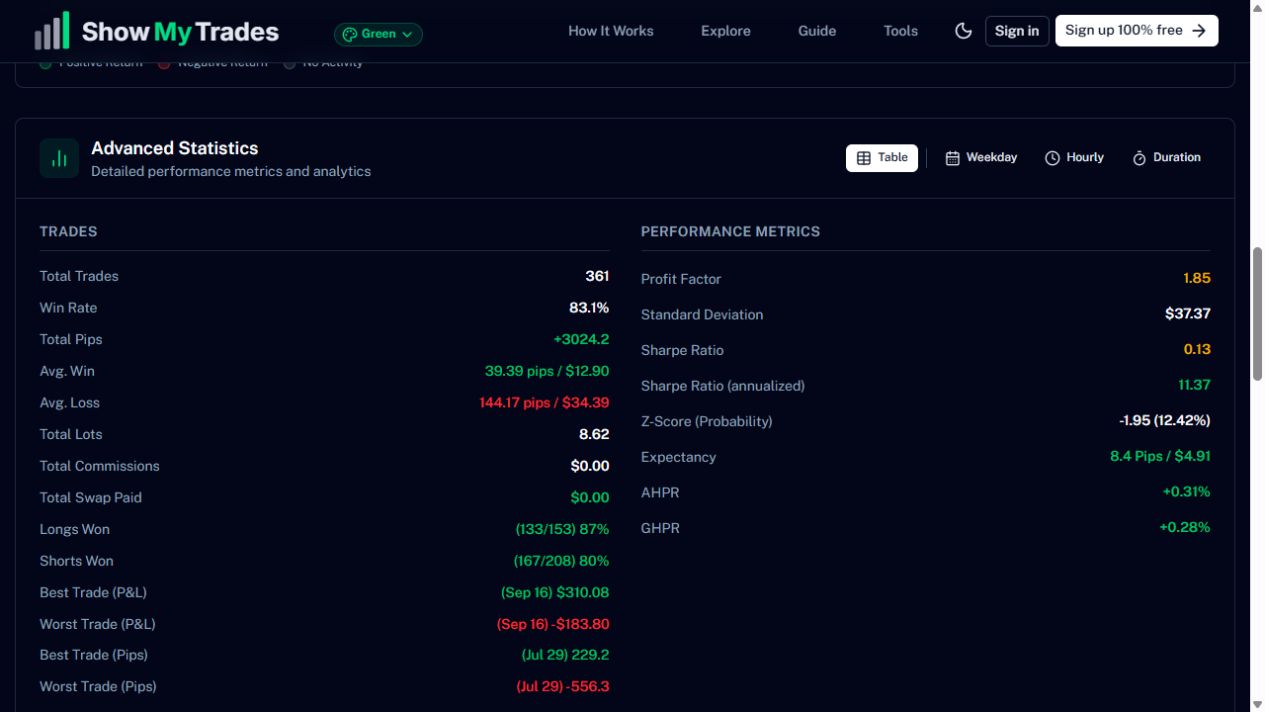
The account showed 361 trades, an 83.1% win rate and a 1.85 profit factor, with an average holding time of 1.1 hours. The average winning trade was $12.90, versus a $34.39 average losing trade. Losses were larger than wins on average, so the win rate alone is insufficient. Future basket losses could change this account’s record materially; we have not independently reproduced its results.
The longer simulations show the other side of the risk
The original gallery supplies two AutoLot 1 reports. The 2020–2026 test shows 5,939 trades, a 2.04 profit factor and 99% history quality; the 2010–2026 test shows 12,137 trades, a 2.43 profit factor and 98% history quality. Both are developer-supplied strategy-tester simulations.
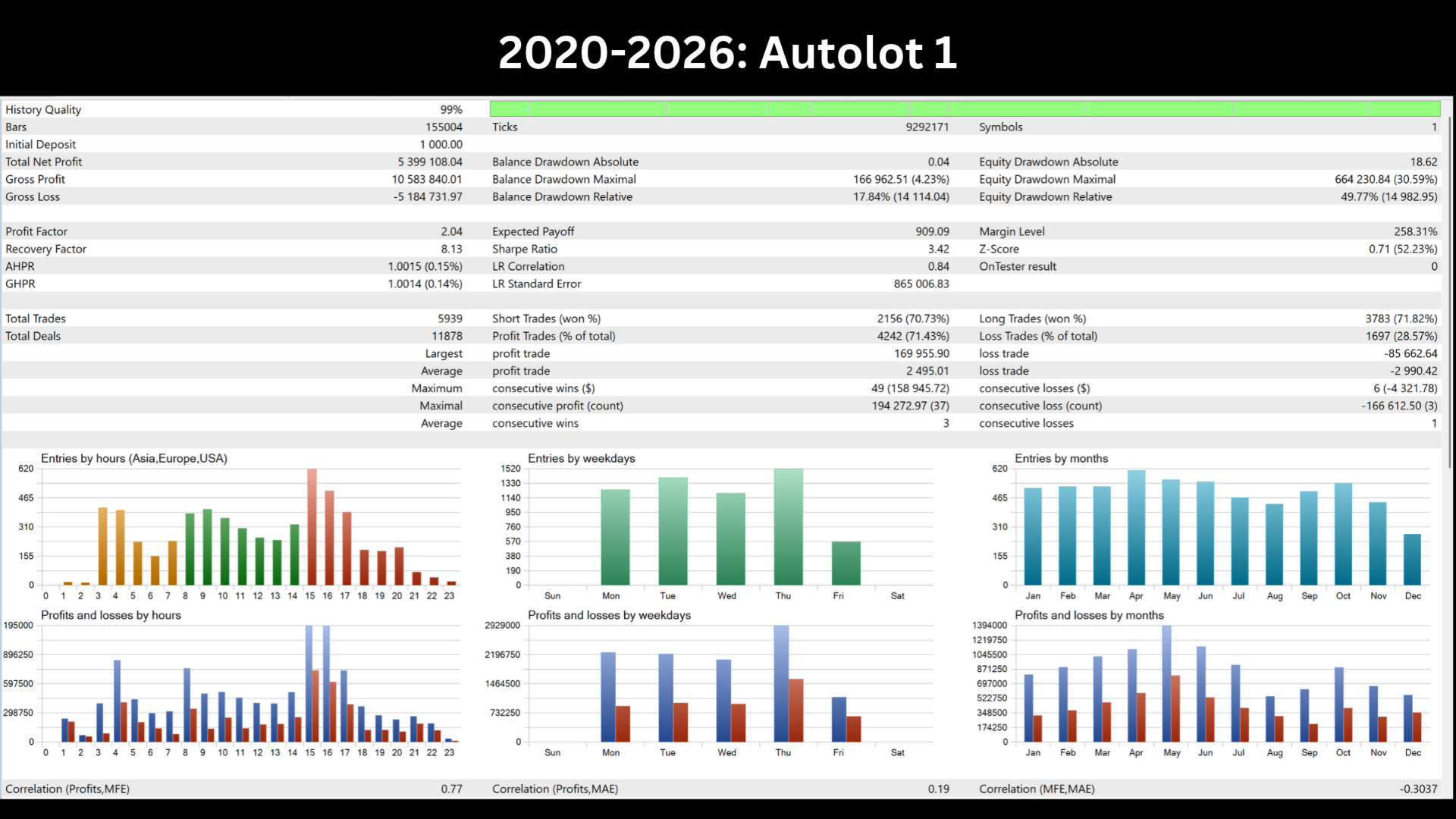
The shorter report’s relative equity drawdown is 49.77%, while relative balance drawdown is 17.84%. The longer report lists 51.85% relative equity drawdown and 16.90% relative balance drawdown. Floating losses therefore matter considerably more than the smooth closed-balance growth might suggest.
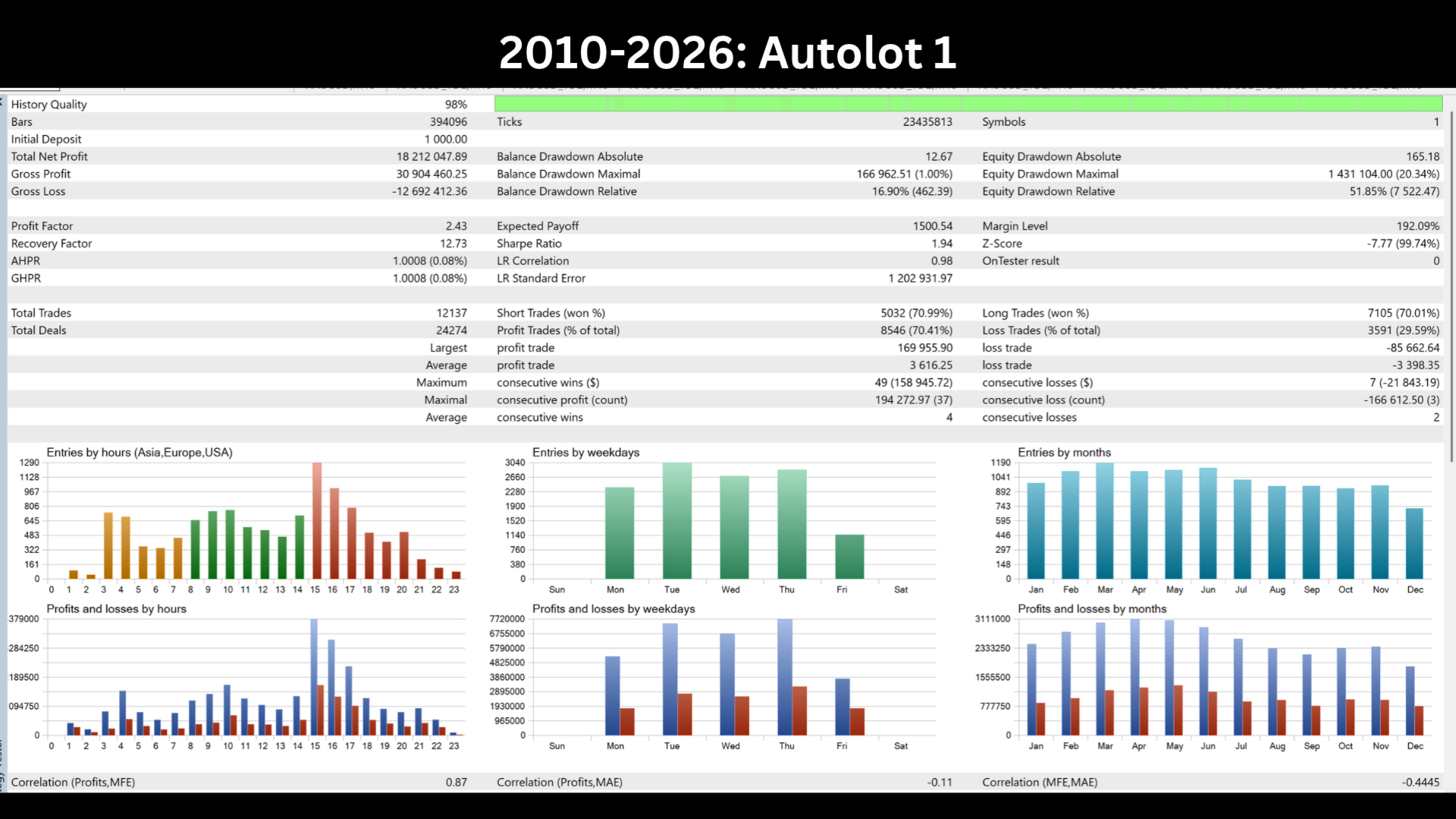
The reports also show different figures for maximal drawdown amounts and percentages. Those fields are not interchangeable with relative drawdown. The large compounded profits and long date ranges do not turn the tests into live results, and the history-quality labels do not establish an independent out-of-sample validation. We have not rerun the tests or verified their complete settings and execution assumptions.
Grid risk and early customer commentary
The developer’s linked risk article explicitly discusses progressive sizing, margin exhaustion and complete account loss. Its aggressive approach accepts account failures. Adaptive recovery should not be read as capital protection. A news filter or optional stop also cannot guarantee a particular exit price during gaps or poor liquidity.
No purchaser reviews appeared in the product’s review pane at the check. The single public comment, posted by BM17 on 9 October, praised the author but expressly said more time was needed to assess this EA’s results. This is early sentiment, not performance evidence or a CheaperForex verified-purchase rating.
Who the design may suit
AuroraX suits buyers prepared to evaluate progressive exposure and monitor their configuration. It is a poor fit for anyone seeking a no-grid strategy or treating a few profitable months as assurance that future gold moves will be contained.
For a separate product from the same developer, compare ChronomaX EA MT5 and its strategy review. Shared documentation does not make their entry models or results interchangeable.
Public sources
AuroraX listing and original test images · Shared TickStack parameter reference · Developer’s grid-risk explanation · Developer’s signal directory · AuroraX public comments