
GQL Session Value Expert makes the trading session—not just a price crossing—the context for its gold entries. Its gallery shows value-area boundaries and a point of control, while the source describes automated execution around intraday structure. The useful question for a buyer is how reliably those areas and decisions carry across broker data and session settings; the public specification does not disclose the full calculation.
View product details and current pricing.

- Official listing: GQL Session Value Expert MT5 on MQL5
- Public track record: none linked by the developer as of 15 September 2026.
Source material and gallery checked 15 September 2026. This is an assessment of the developer’s published information, not our own test of the executable. Original illustrations below retain their capture-date captions.
What “value” means in the available material
The listing says the system identifies important areas formed during particular sessions, then evaluates direction from price and structure. The chart labels make that concept easier to visualise. They do not establish whether the internal model is identical to a familiar volume-profile indicator, nor whether two similarly labelled charts will produce the same trade.
This matters when choosing the EA: it is a configured proprietary system, not a published recipe for calculating a point of control. If your decision depends on a particular calculation method, the public description is insufficient to confirm it. The named controls are more concrete: session restrictions, sizing, stop and target management, spread and execution settings.
Session timing is part of the experiment
A session-based structure is defined by the prices admitted to its time interval. Changing that interval can change the area itself, not merely the hour at which an order is allowed. When checking a broker configuration, record server time and any daylight-saving behaviour before comparing two test runs.
A useful controlled comparison would keep the sizing unchanged, use the intended session boundaries and examine several periods. Then inspect differences in the actual identified areas and entry times rather than comparing only the final profits. This is a testing method suggested by the strategy concept, not a claim that we reproduced the EA’s internal calculations.
Three original images, three different kinds of information
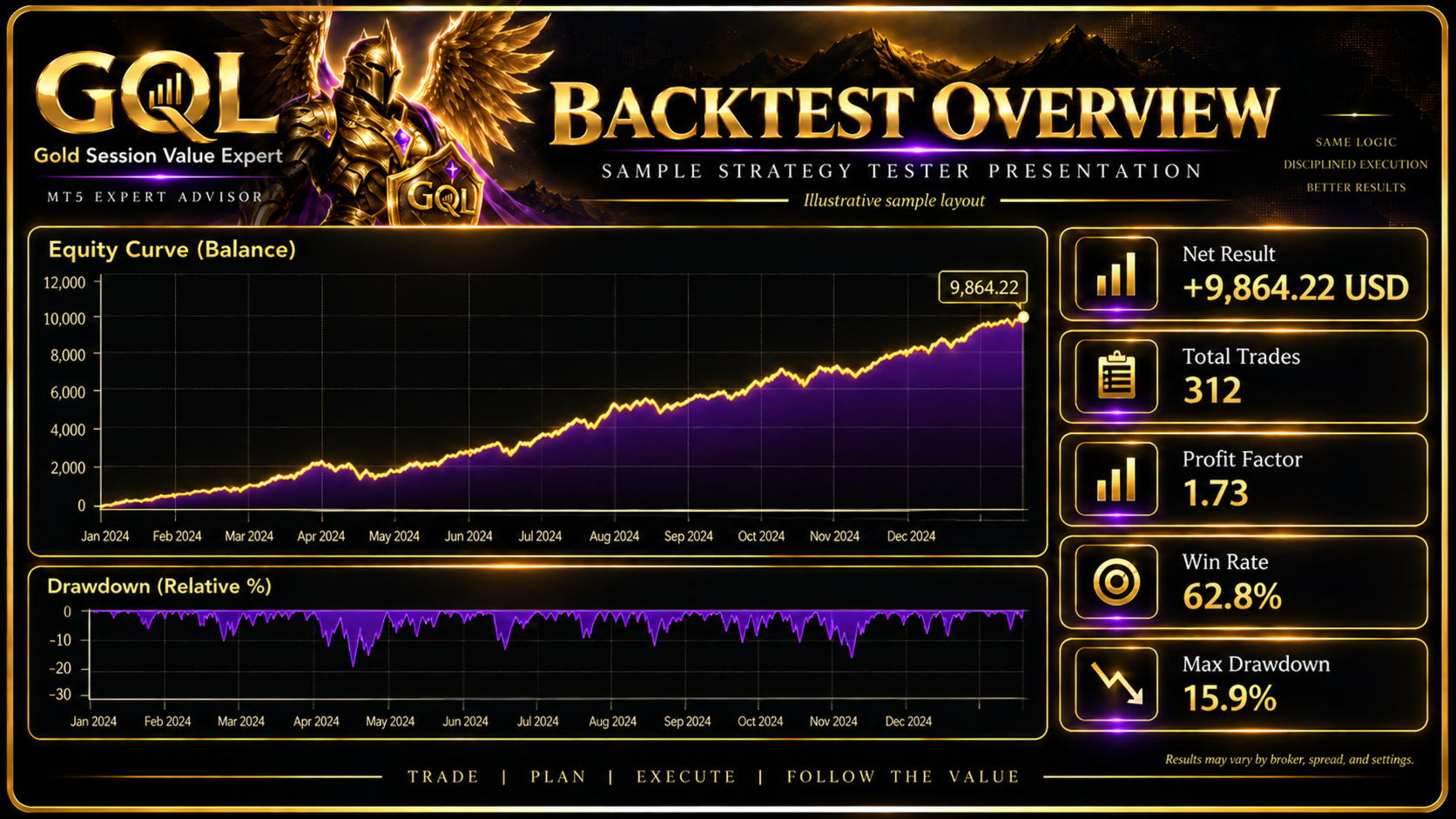
The overview illustration reports 312 trades, profit factor 1.73 and 15.9% maximum drawdown. These are developer sample statistics and have not been independently verified. They do not identify a public account on which every trade can be inspected.
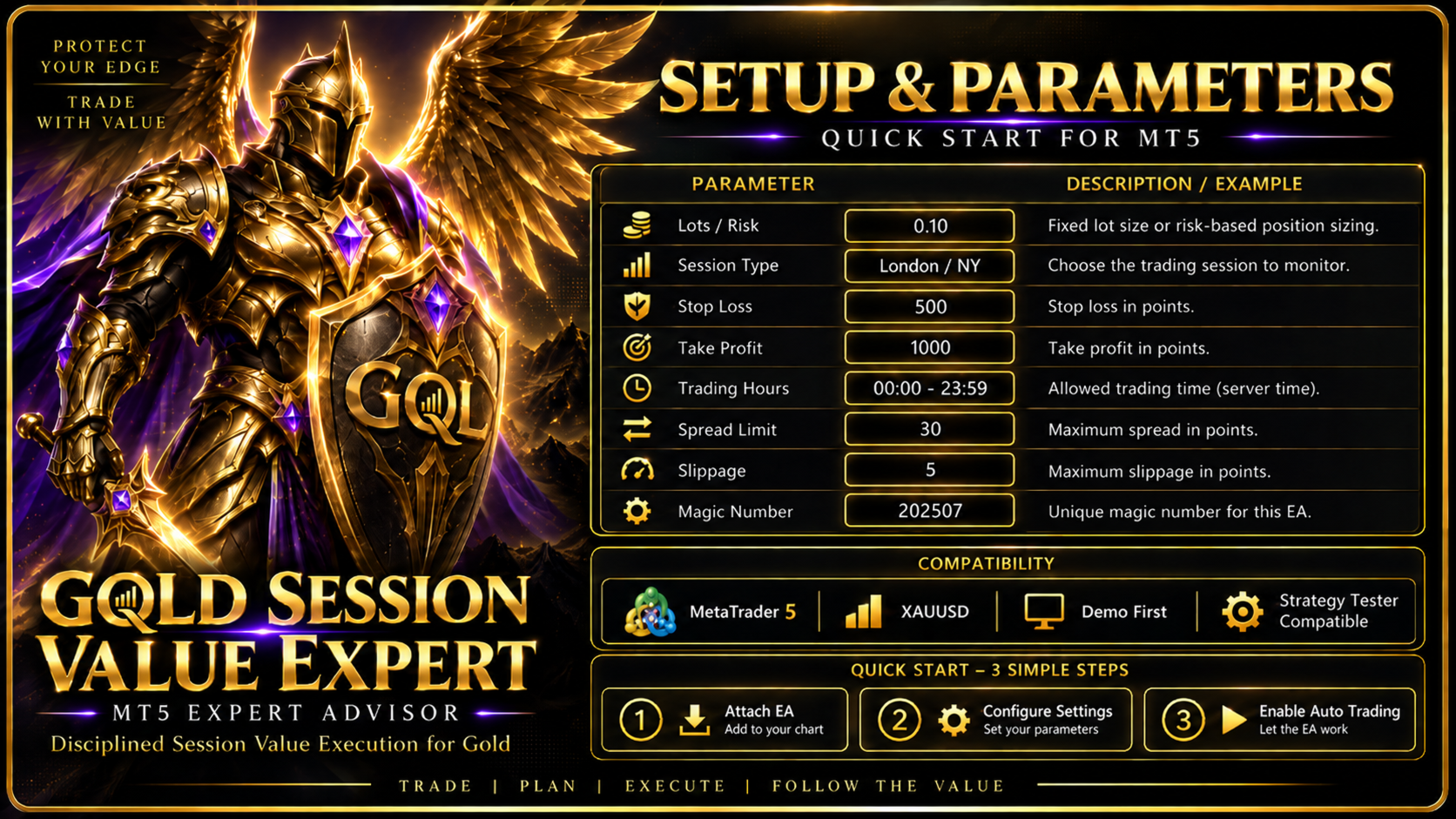
The setup panel shows example inputs. It helps identify the kinds of choices exposed to the user, but its numbers should not be copied as a universal risk preset. Capital, the broker’s gold contract and the maximum permitted exposure determine what the same inputs mean in money.
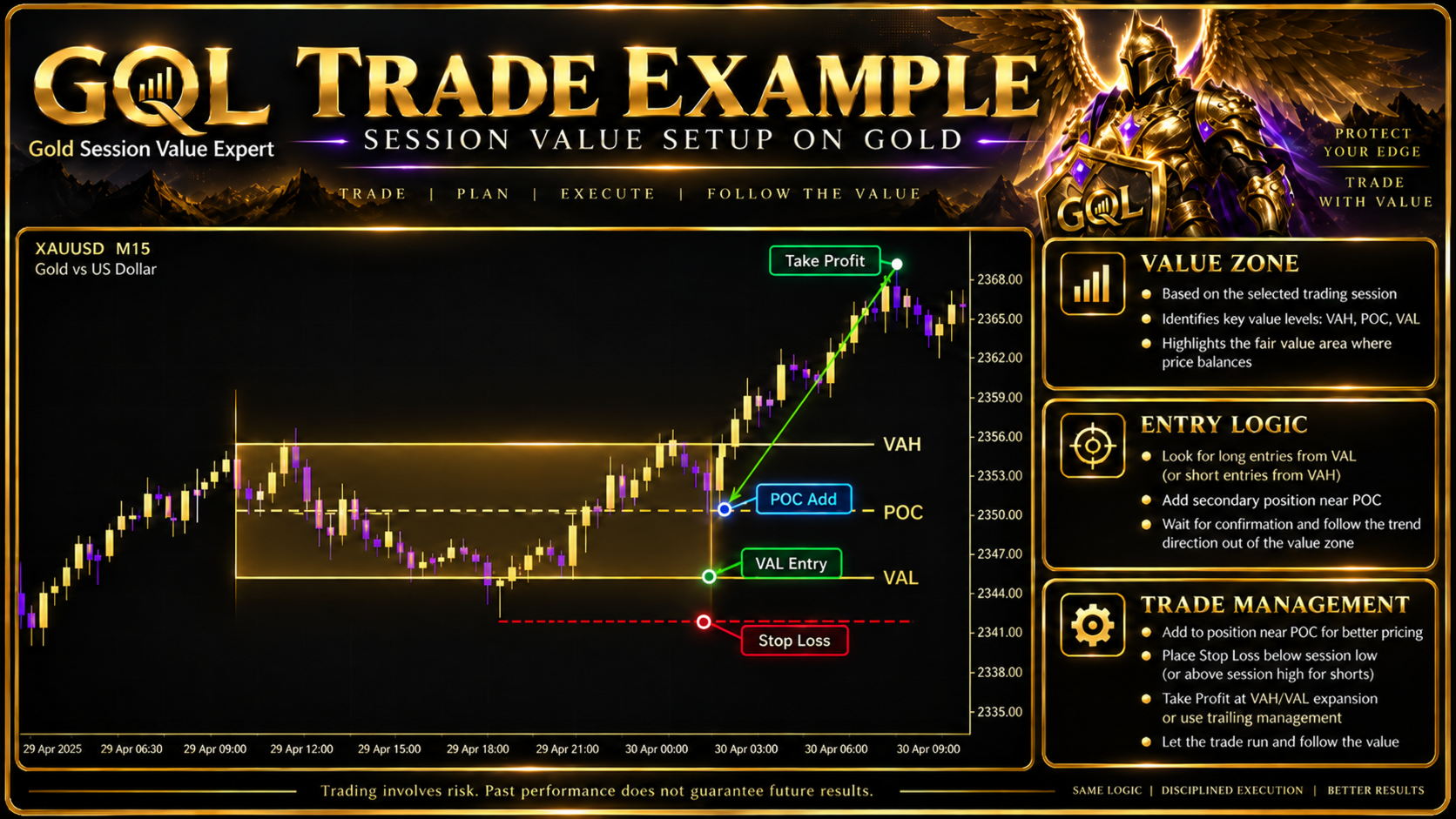
The trade illustration connects price movement to the marked value area. Use it to understand the intended relationship between structure and execution. A single annotated example cannot establish which variations of that structure are rejected, or what happens after a sequence of unsuccessful signals.
Reading the drawdown alongside the control choices
A percentage drawdown from one sample is an outcome, not a built-in loss ceiling. Fixed lots and risk-based sizing can create different exposure paths as the balance changes. To assess the listed controls, examine losing periods, the number of trades active together and the cost of entering near session transitions. The public material does not provide enough detail to assert a specific maximum concurrent position count.
The source check on 15 September found no linked product-specific live signal, customer reviews, public manual or separate release history. The available gallery is therefore explanatory evidence about the intended setup, not a replacement for a monitored execution record.
Practical suitability
The developer asks for MT5 hedging, XAUUSD and continuous VPS operation, states a $500 minimum and recommends at least $1,000. It also specifies 1:500 minimum leverage and prefers 1:1000. Verify these requirements with the broker; none establishes that the resulting risk is appropriate for a particular balance. The written listing does not settle the required chart timeframe, so the delivered instructions matter.
Session Value is most relevant when you want to evaluate a defined intraday context and are prepared to keep the clock, symbol and test configuration consistent. A generic desire for “gold automation” is less useful than understanding whether this session framework matches the behaviour you want to investigate.
Compare concepts within the developer’s catalogue
The linked alternatives below use breakout continuation, failed-break reversal or timed order management. Session Value’s distinction is the way the trading day supplies the decision context; it should not be assumed to contain those other strategies or reproduce their results.
- GQL Pending Breakout Gold Expert MT5 · GQL Pending Breakout Gold Expert MT5 review
- GQL Gold False Breakout Expert MT5 — False breakout reversal. Read review
- Gemini Quant Apex Series Expert MT5 — Timed pending-order execution. Read review
Assessment
The value-area illustrations and explicit session controls provide a sensible basis for evaluating the product’s workflow. The unresolved points are the proprietary area calculation and its forward execution on a real account. The most informative next evidence would connect the actual session settings and marked areas to a monitored trade record, rather than add another isolated profitable chart.
View GQL Session Value Expert MT5 pricing and product details