
Razor EA trades mean reversion across three Forex crosses and uses additional positions to manage adverse moves. Its strongest attraction is a substantial public MT5 trading record at Tickmill: 1,872 trades, 2,131.51% displayed growth and a 1.96 profit factor at our latest check. It deserves attention from traders comfortable evaluating recovery strategies; the key consideration is the exposure behind that recovery, not simply the headline growth.
This review covers the current MT5 edition and the older MT4 edition we still sell. Signal figures and source checks are dated 13 September 2026. We have analysed public evidence, not independently forward-tested these files on our own account.
View product details and current pricing.

How Razor approaches the market
Anton Kondratev’s standard configuration follows AUDCAD, AUDNZD and NZDCAD from one AUDCAD M15 chart. The entry premise is mean reversion: prices that move away from their recent range may return towards it. A volatility filter and broker-condition controls aim to improve entry conditions, while spread and slippage monitoring address the practical cost of execution.
That entry logic is only half the strategy. The public guide states that a grid can activate when a trade moves against the system. The release history also documents multipliers and limits on additional positions. Although the overview uses “not simple grid” language, calling Razor a no-grid system would hide an important part of its behaviour.
Recovery entries can make a modest rebound sufficient to close a basket, but they also increase exposure while the original trade is losing. Correlated moves across the three crosses can compound that problem. Stop losses, news filters and drawdown controls are useful safeguards, not assurances that a basket will recover.
The Tickmill signal: why it stands out
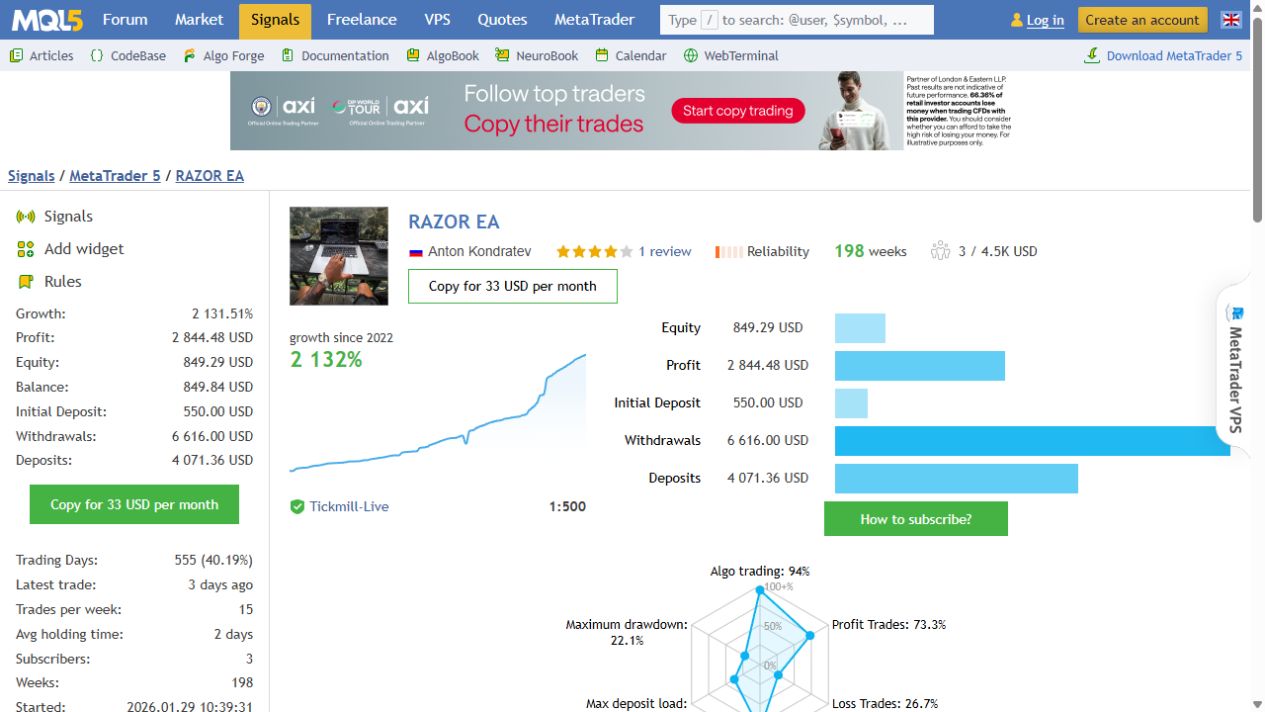
The developer links to Razor’s public MQL5 signal, identified as a real MT5 account on Tickmill-Live with 1:500 leverage. A visible broker, a sizeable trade sample and accessible trade statistics make this more informative than an isolated screenshot of a backtest.
- Displayed growth
- 2,131.51%
- Trades / win rate
- 1,872 trades; 1,373 profitable, or 73.34%.
- Profit factor
- 1.96: gross profit $5,800.35 divided by gross loss $2,955.87.
- Net trading profit
- $2,844.48
- Balance / equity
- $849.84 / $849.29 at capture.
- Trading pattern
- About 15 trades per week and two days average holding time, as reported at the check.
- Relative drawdown
- Balance 22.09%; equity 15.26%. These are different reported measures.
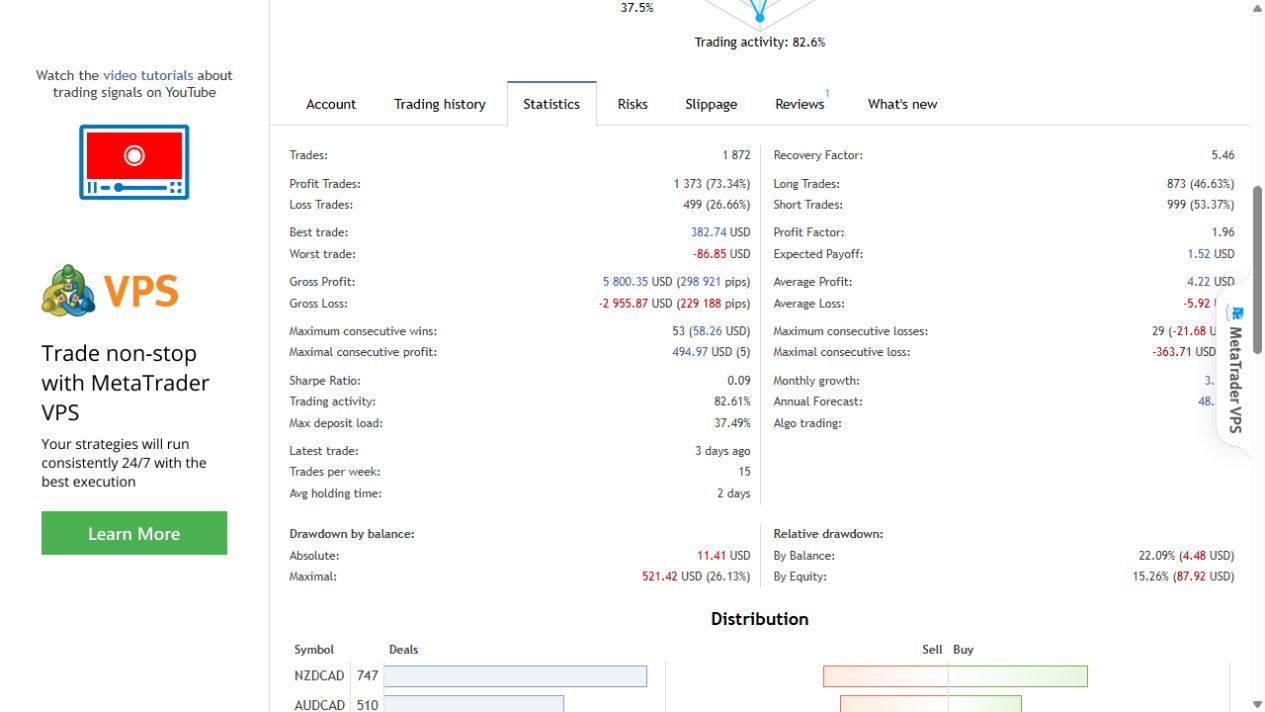
The profit factor is a meaningful positive: aggregate winning trades earned nearly twice the losses in this recorded sample. The win rate is also high enough to support a strategy that takes frequent smaller profits. However, the average win was $4.22 against an average loss of $5.92. The system depends on winning often enough; it is not a record of each winner comfortably outweighing each loser.
The largest winning trade was $382.74 and the largest losing trade was $86.85. These extremes help describe the history but do not tell us the size of a complete losing basket or the risk of the next trade. The screenshot below preserves the wider statistics rather than presenting only the most flattering numbers.
Drawdown: read the separate figures carefully
MQL5 reports 22.09% relative balance drawdown and 15.26% relative equity drawdown. Its separate maximal monetary balance drawdown field shows $521.42 (26.13%). These should not be collapsed into one “maximum risk” figure: the measures and their reference points differ, especially in an account with changing capital.
Balance reflects closed trades; equity also incorporates open profit and loss. A smooth balance curve can therefore coexist with more uncomfortable periods while recovery positions remain open. The maximum deposit load shown was 37.49%, another reason to inspect margin use before choosing a lot size.
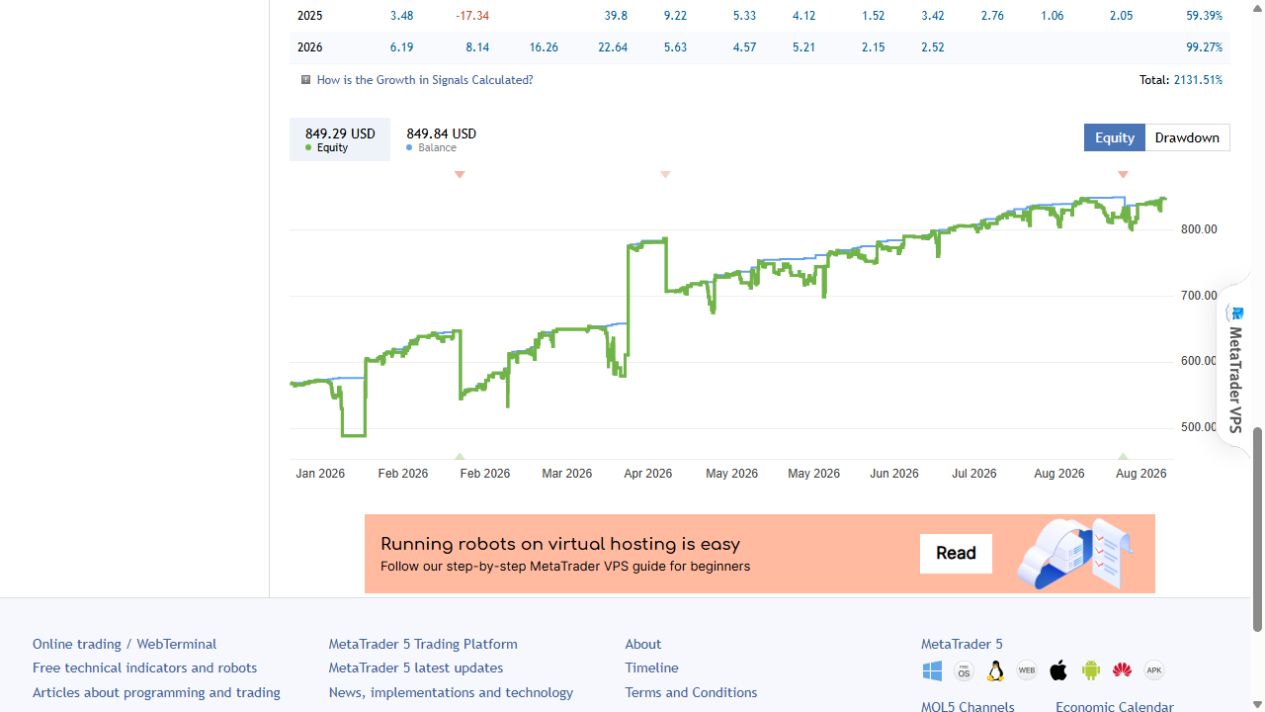
The balance and equity chart provides useful context for those episodes. The amount of risk a buyer experiences will depend on their own capital, leverage, sizing and broker conditions. Copying a small initial lot does not necessarily reproduce the signal’s overall exposure.
198 weeks of history is not 198 weeks of the current build
The account shows 198 weeks and growth history beginning in 2022. The current signal’s “Started” field reads 29 January 2026, while the displayed equity chart begins in January 2026. Older account history and the current monitoring presentation should therefore be distinguished. This is a long historical record, but not evidence that every earlier period was observed in the same way.
Version 8.88 was released on 19 January 2026. The account’s earlier years necessarily predate that release and span previous Razor builds. It would be misleading to label the entire growth curve an 8.88 forward test.
The monthly record includes setbacks
Displayed annual growth was 92.36% in 2023, 136.85% in 2024 and 59.39% in 2025. The 2026 figure stood at 99.27% through the partial September period. These are the platform’s growth percentages, not simple dollar profits on an untouched initial deposit.
February 2025 shows a 17.34% decline, followed by a strong 39.8% April. That setback matters when assessing the developer’s claim about profits every month. Blank months in the table are not evidence of zero losses or uninterrupted activity; they should remain blank rather than being filled with assumptions.
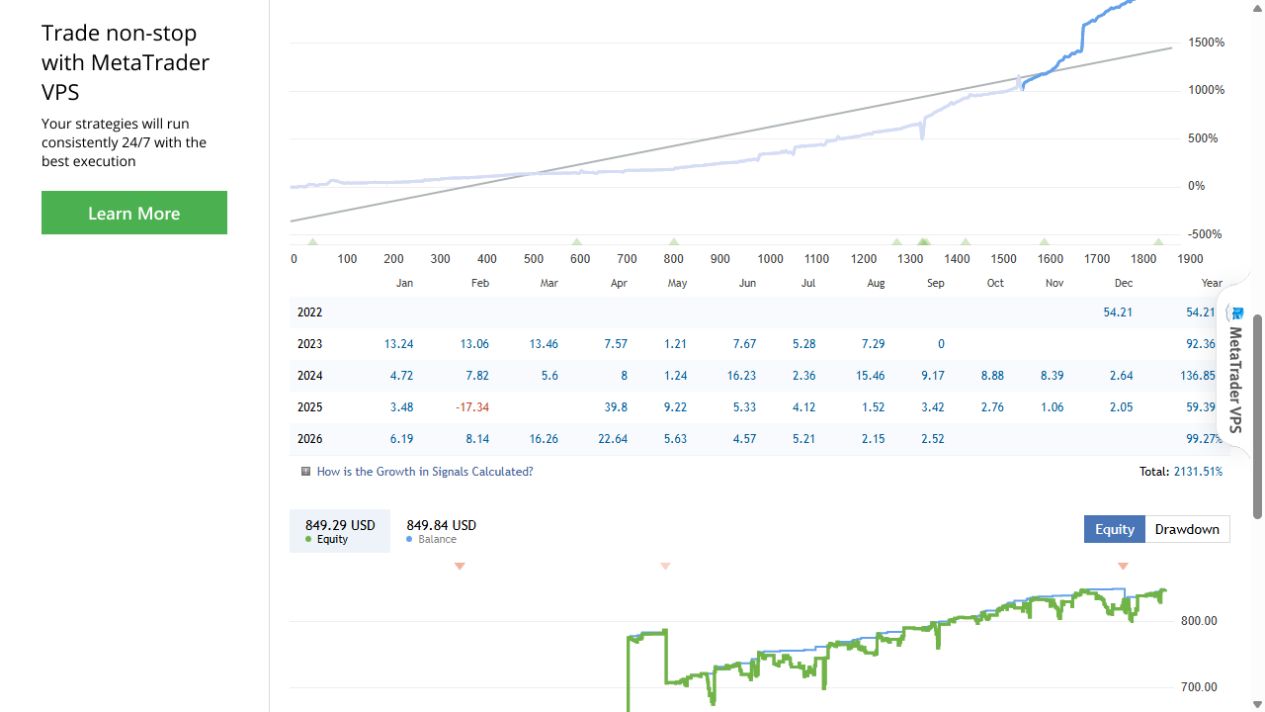
There have also been inactivity notices in the signal history. Selective trading and quiet periods can be reasonable, but buyers should not expect a fixed daily trading frequency.
Growth, withdrawals and actual trading profit
The account began with $550, then received $4,071.36 of additional deposits and made $6,616 of withdrawals. Its recorded net trading profit is $2,844.48. The cash reconciliation is straightforward:
$550 + $4,071.36 + $2,844.48 − $6,616 = $849.84 balance.
The withdrawals are encouraging evidence that money was taken out of the account, but they are not all profit. Some represent contributed capital. Likewise, 2,131.51% displayed growth does not mean an untouched $550 deposit currently sits at more than $12,000. Keeping the platform’s percentage calculation separate from the cash flows gives a much fairer picture.
Does the account only trade the default three pairs?
No. AUDCAD, AUDNZD and NZDCAD account for 1,694 of 1,872 trades—about 90.5%—and $2,561.03 of net profit. AUDCAD contributed $1,518.04, NZDCAD $710.50 and AUDNZD $332.49. The account also includes silver, gold and several other symbols.
Silver contributed $489.83, while gold lost $175.63 in the displayed breakdown. The platform labels 94% of trades algorithmic, which does not identify every trade as Razor or establish the exact settings used. The signal supports an evaluation of the account’s history; it is not a controlled demonstration of the default three-pair setup alone.
Tickmill is a positive part of the evidence
Tickmill is a recognisable broker with published regulatory information for its group entities. That adds useful context compared with an unfamiliar broker and an untraceable screenshot. The signal’s Tickmill-Live server label alone does not identify the legal entity serving that account, however, so we do not assume a particular regulator’s protections.
Broker quality also does not remove strategy risk. Razor’s developer explicitly warns about spread and slippage sensitivity and recommends RAW/Pro/ECN conditions. A different broker, lower leverage or wider overnight spread can change results even with similar settings.
Latest MT5 version versus our MT4 8.55 edition
- MT5
- Our MT5 standalone offer is $549.95.
- MT4
- Our existing standalone version 8.55 remains available. Its former MQL5 page was removed; we have not inferred a newer MT4 build from MT5 notes.
- Current MT5 additions
- Skip First Deals; Ultra Virtualization for position multiplication; separate control over early positions and later multipliers.
- Signal platform
- The Tickmill account discussed here is MT5. It must not be described as proof of MT4 8.55 results.
MT5 is the clearer choice for someone seeking the current documented release and a platform match to the linked signal. MT4 remains an option for an existing MT4 workflow, with the older build limitation understood. The files are separate editions, not interchangeable terminal formats.
What the developer’s test images contribute
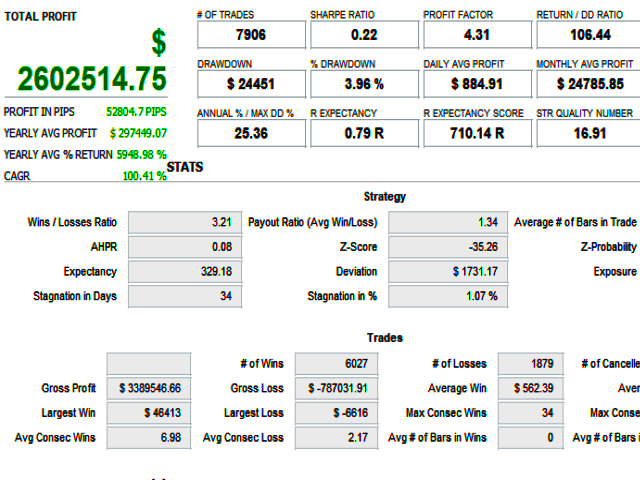
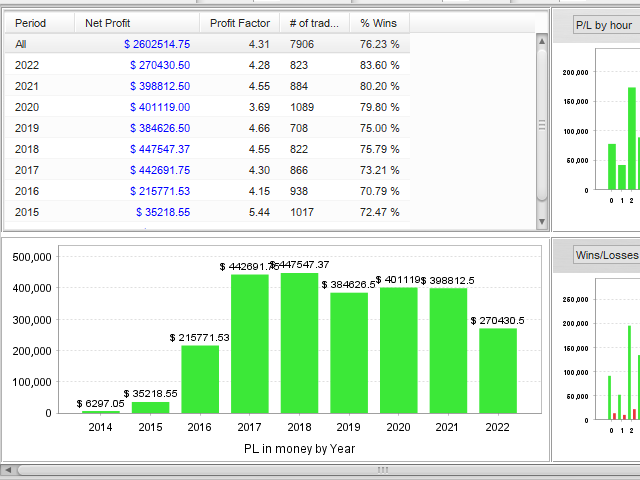
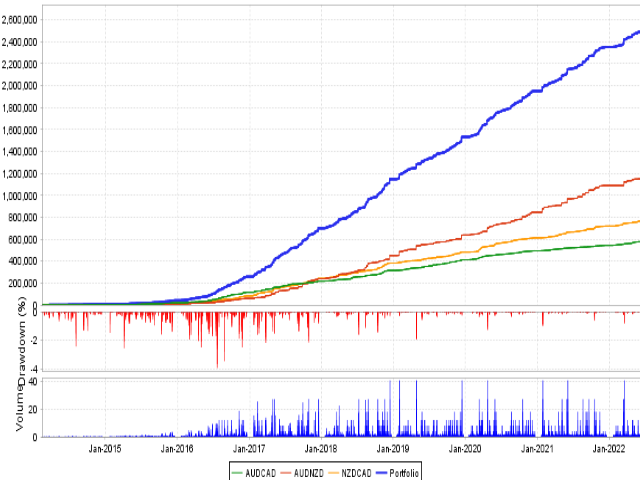
The current listing still includes historical test material showing roughly $2.6 million net profit from a $500 starting deposit, with a 4.31 profit factor across 7,906 test trades. These are striking simulated figures. They are not live earnings, a realistic earnings promise, or a fresh test of version 8.88.
The report’s historical dates and assumptions matter more than the promotional headline. In particular, a simulated equity curve cannot establish that the same fills, spreads, margin availability and position sizing would have been obtainable in live trading. The live account’s 1.96 profit factor is a different dataset and should not be blended with the test’s 4.31.
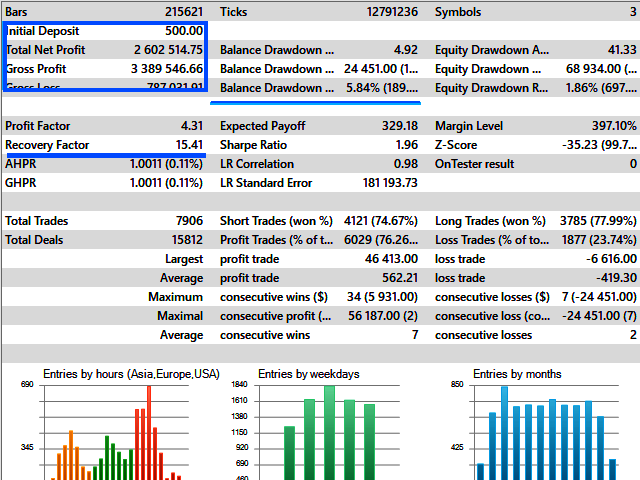
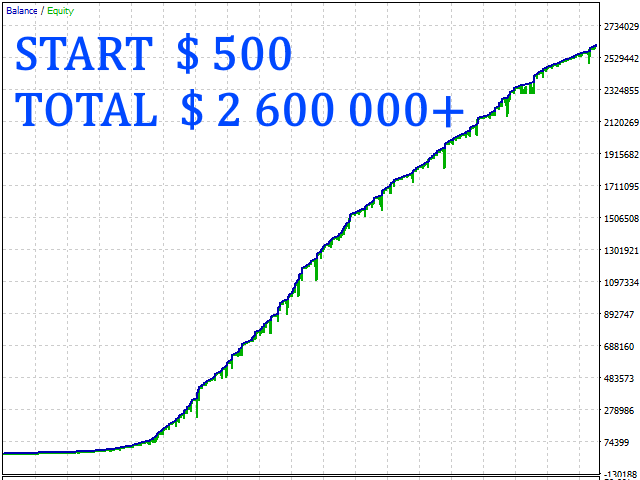
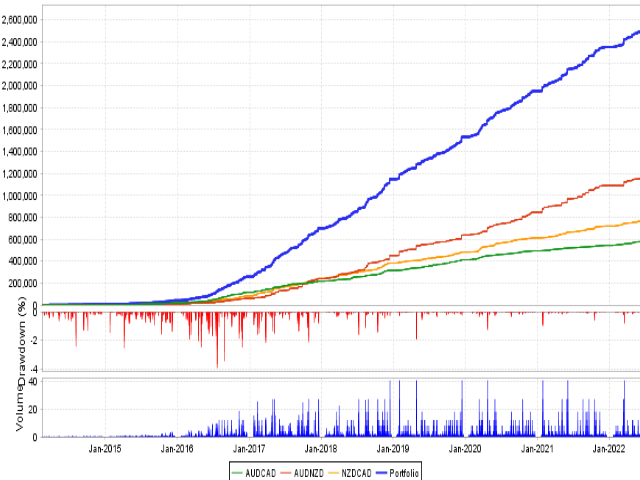
The additional portfolio breakdowns show how the simulated pairs contributed and how performance varied by year. They are useful supporting material for understanding the developer’s testing approach, rather than independent confirmation of future returns.
View the historical portfolio statistics and annual charts
Customer reviews: positive, but older and limited
The MT5 listing displays ten ratings. Only three contain written feedback, with the remainder leaving no comment; the newest rating is from May 2024. The written comments praise results, resilience and the developer’s support. That is positive sentiment, but a small and dated body of evidence for a build released in January 2026.
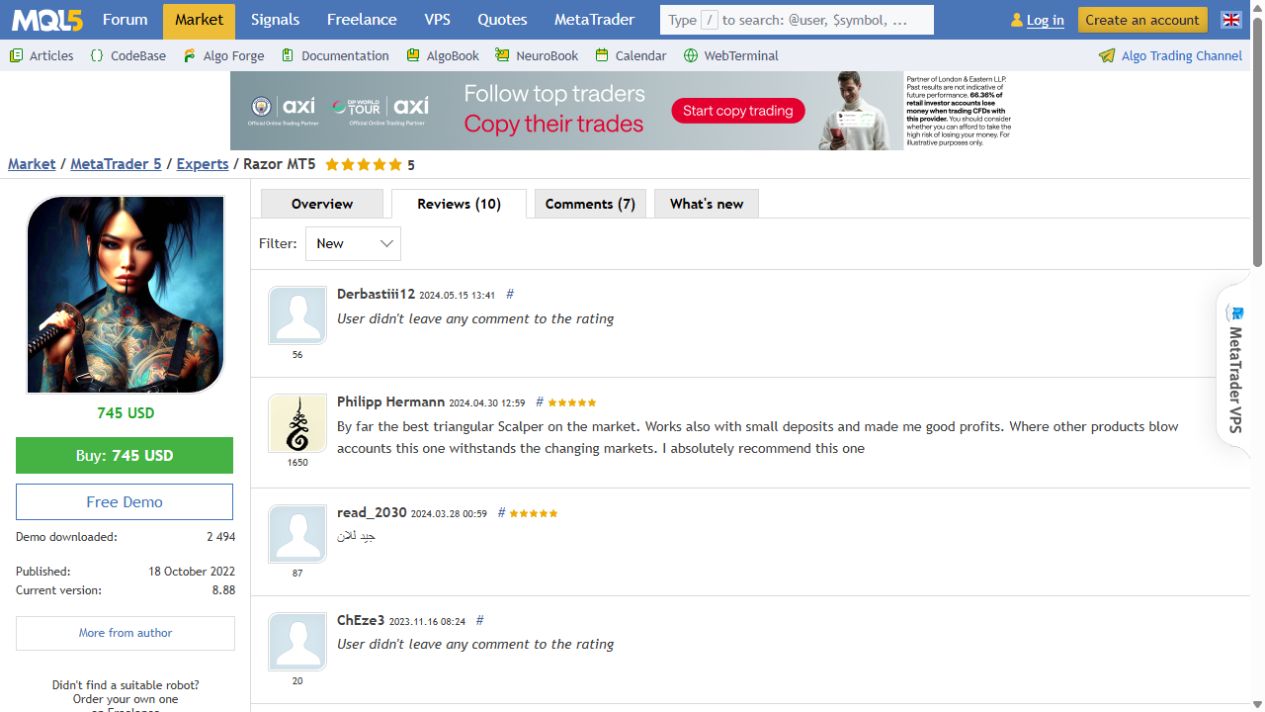
Read the complete MQL5 reviews for context. These are third-party customer opinions, not CheaperForex verified-purchase ratings or independently audited performance. A favourable review cannot establish a safe lot size or confirm that another broker will reproduce the reviewer’s experience.
Setup and sizing considerations
The public guide is dated 2022 and contains older instructions. Later comments revised the all-three-pair balance reference from the guide’s $500 to $900, or $300 per pair. Treat these as historical developer references, not a universal safe minimum. Required capital changes with leverage, lot size, recovery depth and the number of simultaneously active symbols.
Start with the relevant edition’s supplied settings, check the current inputs and test on your broker. The developer’s default MT5 setup is one AUDCAD M15 chart. Avoid combining old custom-symbol presets, outdated guide steps and new version controls without validating them. Low leverage can make margin constraints more significant; the current MT5 virtualization option does not eliminate trading losses.
The listing mentions prop-firm settings, but that is not confirmation that any particular firm permits the strategy or that its drawdown rules will be met. Check the actual account rules before deployment.
Our assessment
Razor’s public Tickmill history is a real strength: a substantial sample, profitable aggregate results and accessible statistics give buyers more to examine than most promotional backtests. We especially value being able to compare the growth figure with cash flows, individual pair contributions and equity behaviour.
The trade-off is clear. This is a recovery-based system with multiplier options, correlated Forex exposure and recorded setbacks. It is most appealing to someone willing to size conservatively and inspect basket risk. The evidence supports taking Razor seriously, not expecting uninterrupted profits or treating the headline growth as a forecast.
Explore Razor EA MT5 at $549.95 · Compare the existing Razor EA MT4 offer
Sources: current listing, release notes, public guide, developer comments and public signal. Checked 13 September 2026. Screenshots retain their original source context; figures will change.