
Last updated: August 2026
Zoomini is a compact set of machine-learning models for XAUUSD (Gold) on the H1 timeframe, released by Gennady Sergienko at the end of July 2026 out of his ongoing GoGoPips research project. The models trade a single order at a time using equal stop loss and take profit, support netting accounts and any leverage, and are built for a medium-term style that accommodates larger deposits.
View product details and current pricing.
What makes this release worth writing about is not a performance claim. It is the posture. In a marketplace where gold EAs routinely advertise triple-digit monthly returns and thousand-percent growth figures, this developer states plainly that the models are not a guarantee of profit, that they are published as they are without hiding shortcomings or exaggerating advantages, and that nobody — himself included — can predict how any individual model will perform in future. He calls it an experiment you can participate in. That is an unusual thing to put on a sales page, and it is the right frame for evaluating what follows.
We rate Zoomini 4 out of 5. The positive lean comes from a genuinely defined-risk design, a clean and undistorted live signal, walk-forward validated research with the out-of-sample periods actually marked, and a level of pre-purchase verification almost no marketplace EA offers. What holds it back is simply how new and unproven this is: the product is days old, the live record spans about three weeks, the models keep continuous market exposure by design, and the developer himself frames the whole thing as research rather than a finished product.
⚠️ Looking for a Zoomini EA “free download”? Don’t.
Every legitimate marketplace EA ships with built-in DRM or licensing. There is no working cracked file in existence — so a “free” copy is always one of two things:
- malware, or
- bait for a Telegram payment scam where you pay and get nothing.
The only safe routes are the MQL5 marketplace or a reputable reseller. CheaperForex offers Zoomini at a lower price than the marketplace — Get Zoomini EA MT5 at CheaperForex.
The Developer: Gennady Sergienko and GoGoPips

Gennady Sergienko has been publishing on MQL5 since 2015 and maintains a catalogue spanning both Expert Advisors and indicators, several of which are free. His work runs under the GoGoPips banner, a project he describes as research into machine learning and new approaches to analysing and predicting markets, with the models released along the way being the by-product rather than the destination.
That framing is worth taking seriously rather than treating as marketing philosophy. It explains why his catalogue reads the way it does — a mixture of experiments, some far more successful than others. Buyers should read his overall marketplace ratings in that light: a research programme that publishes its outputs honestly will inevitably show more variance than a studio that only ships polished, heavily-marketed products. His best-established Expert Advisor, Mad Turtle, carries a strong rating across a large review base and is the natural comparison point for anyone weighing Zoomini.
The practical takeaway: this is not an anonymous first-time seller, but nor is he offering a guaranteed product. He is offering the current output of an active research line, and saying so out loud.
How Zoomini Actually Trades
The mechanics are refreshingly simple to state, and worth being precise about because they determine the risk profile.
- One order at a time, equal SL and TP. A single position, with the stop loss and take profit set at equal distance. Risk on each trade is defined before it opens, and there is no order ladder, no averaging into a losing position and no lot progression after losses. This is a genuinely defined-risk structure, not a grid dressed up as one.
- Continuous market exposure. The models were deliberately trained not to hunt for convenient entry points. Instead they predict price direction on an ongoing basis, which means the system stays in a trading state rather than sitting out waiting for setups.
- Medium-term style. Positions are held over a meaningful horizon rather than scalped, which is why the developer notes that larger deposits are supported.
- Netting accounts and any leverage. Broader account compatibility than many gold EAs, which typically demand hedging accounts.
The live data supports the defined-risk claim. Maximum deposit load on the public signal is 1.9% — extraordinarily low. Deposit load measures how much of the account’s usable margin is committed at once, and a figure that small is only achievable with a single, modestly-sized position. Grid and martingale systems produce loads many times higher because they accumulate exposure. On this metric the described design and the observed behaviour agree, which is exactly what you want to see.
Continuous exposure cuts both ways, though. Most EAs filter heavily, trading rarely and claiming selectivity as a virtue. Zoomini does the opposite by design. The upside is that no single trade carries much weight and the model’s edge, if it has one, gets many opportunities to express itself. The downside is that the system is always carrying risk — there is no sitting out an ugly week, no news filter standing between you and a volatile session. Whether that suits you is a genuine question of temperament as much as strategy.
The Live Signal — Clean, and Very Short
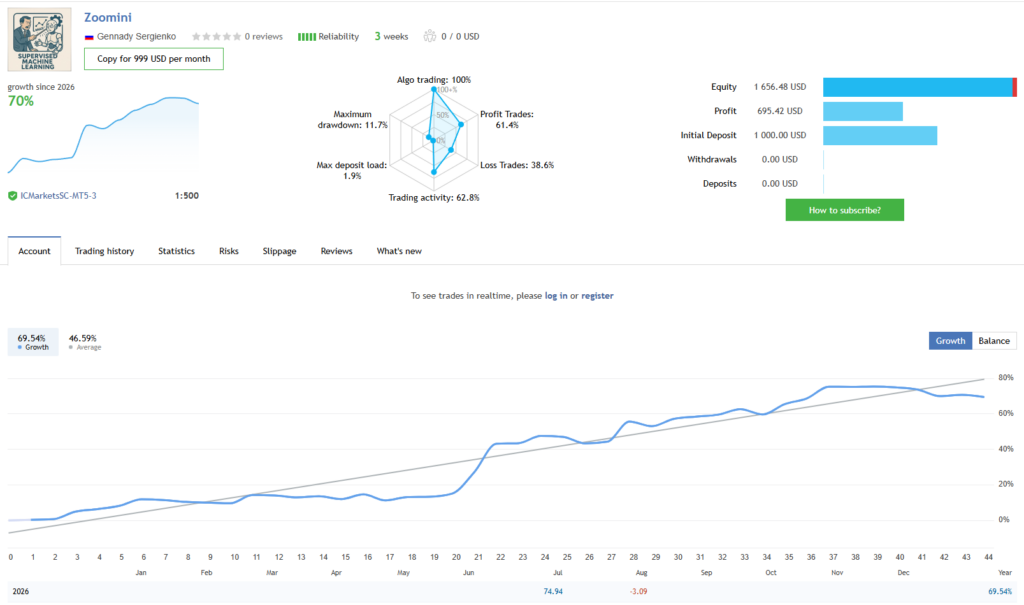
The public live signal runs on IC Markets at 1:500 leverage.
What is genuinely good about it. A $1,000 initial deposit grew to roughly $1,656, with zero deposits and zero withdrawals across the period. That matters more than it sounds. A large share of the signals we examine carry headline growth figures inflated by topping up a small starting balance or cycling withdrawals; unpicking them is usually the first job of a review. Here there is nothing to unpick — the roughly 69.5% is a real return on the money that was actually there. The win rate of 61.4%, with a genuine 38.6% of trades losing, is likewise a believable distribution rather than the near-perfect figures that signal curve-fitting. Maximum drawdown of 11.7% is reasonable for the return generated.
What you must not do with it. Do not annualise it, and do not expect it to continue. Roughly 70% in three weeks is an extraordinary rate that no strategy sustains — and the signal itself already shows why: virtually all of the gain landed in a single strong month, and the following month opened slightly negative. Three weeks is not a track record; it is a promising start that happens to have coincided with favourable conditions. A buyer who purchases expecting 70% a month will be disappointed, quickly.
The honest summary: the quality of this signal is high — clean, believable, well-structured — but the quantity of evidence is small.
The Research — Walk-Forward Validation, Marked Out
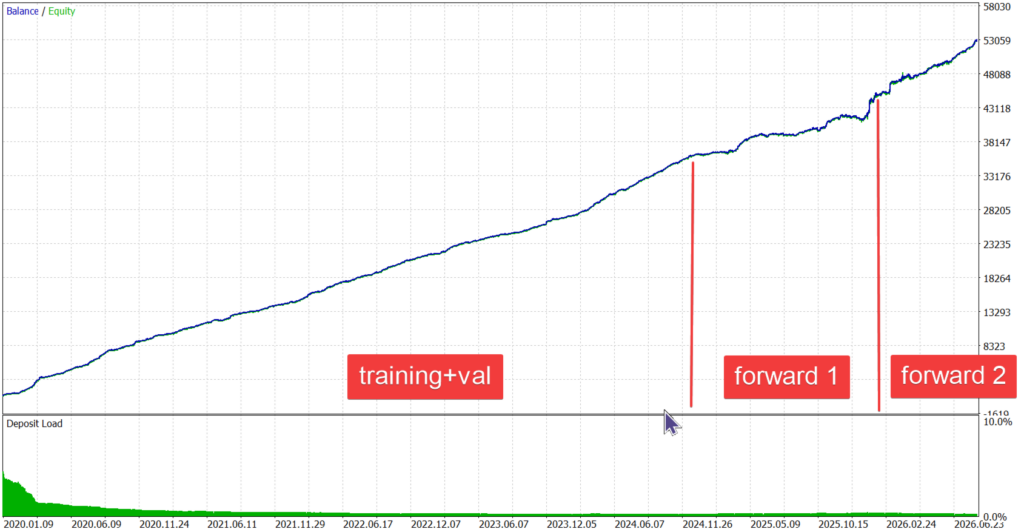
This chart deserves attention because of what it shows about method, not because of where the line ends up.
The curve runs from January 2020 to June 2026, and it is divided into three labelled segments: a training and validation period covering roughly the first five years, then two separate forward-testing periods on data the models were not trained on. That is walk-forward validation, and publishing it with the boundaries marked is rare. Most machine-learning EAs show you a single smooth curve and leave you unable to tell where the model was fitting data it had already seen — which is precisely the information that determines whether a backtest means anything at all. Marking it invites the scrutiny that most listings avoid.
The forward segments continue in the same direction as the training period rather than deteriorating, which is the outcome you would hope for. The deposit load band along the bottom stays consistently low throughout, reinforcing the single-position structure discussed above.
The honest caveat. Marked forward testing is a meaningful step above the norm, but it is not proof. When a research programme runs roughly a hundred models and publishes the ones that forward-tested well, the selection itself introduces bias — some models will clear an out-of-sample period on luck alone, and you cannot tell which from the chart. The curve is also notably smooth for gold across six years. So: credit the methodology, which is genuinely better than most, without treating the result as a guarantee. Which, to be fair, is exactly what the developer says himself.
You Can Verify It Before Buying
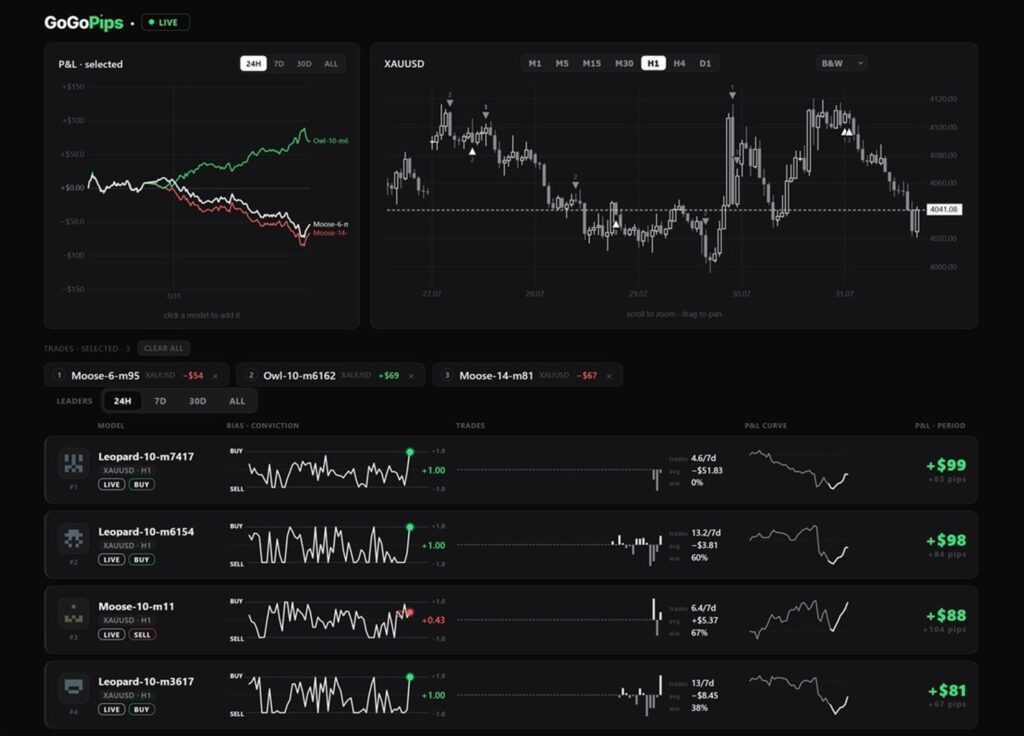
This is the most unusual thing about the product, and the strongest argument in its favour.
The models trade on a public live leaderboard on the developer’s website, where all statistics and all trades are shown without delays or filters, and where roughly a hundred models from the wider project are running. A prospective buyer can watch the actual models before spending anything — their bias and conviction readings, trade frequency, average result, win rate and running P&L curves, updating live.
What makes it credible is what it does not hide. The board displays losing models right alongside profitable ones — open positions sitting at a loss, models with poor win rates, curves heading the wrong way. A developer assembling a sales tool would not build it that way. Showing the failures is what makes the successes worth anything, and it is consistent with the research framing the whole project operates under.
The practical value for a buyer is real: instead of trusting a backtest, you can form your own view from live behaviour first. Given how new this product is, that is not just a nice feature — it is the sensible way to approach it.
Zoomini or Mad Turtle?
Since both come from the same developer and both trade XAUUSD with machine learning, this is the comparison most buyers will actually want.
Mad Turtle is the established option: a substantially longer track record, a large base of marketplace reviews accumulated over time, and a settled reputation. It runs XAUUSD on H1 to M15 and is the developer’s best-known Expert Advisor. If you want the version whose behaviour is documented across a meaningful stretch of market history, that is the one.
Zoomini is the newest research output — days old, explicitly experimental, built from the developer’s July 2026 model work. Its appeal is being current: newer models, newer research, and the pre-purchase verification the leaderboard provides. Its drawback is being unproven.
Our honest read: if you are buying one gold EA and want the safer choice, buy Mad Turtle. If you follow this developer’s research and specifically want the latest output while accepting it is an experiment, Zoomini is that. They are not really competing for the same buyer, and there is no wrong answer between them.
What Early Buyers Are Saying
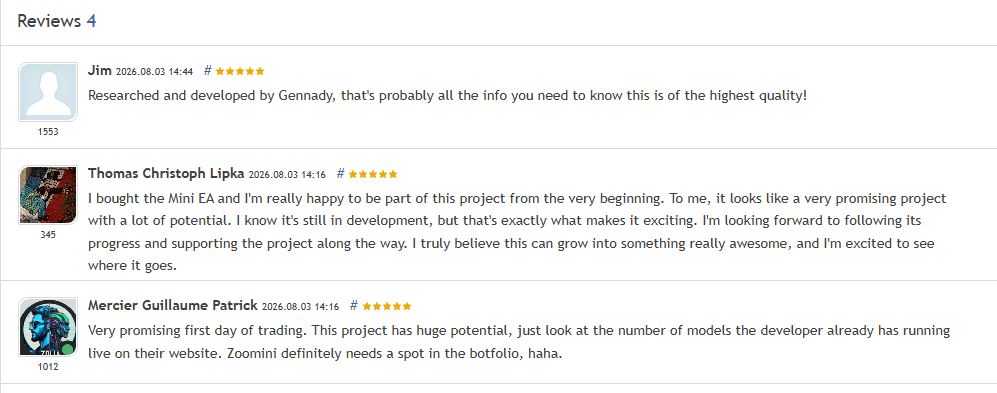
The review base is tiny and brand new — a handful of five-star ratings, all posted within one day of the product going on sale. That limits what they can tell you, but the substance is more interesting than the star count.
One buyer described a promising first day of trading and pointed specifically at the number of models the developer already runs live on the public website as the reason for their confidence — which is the leaderboard doing precisely the job it is there for. Another was candid that they saw this as joining a project at the very beginning, explicitly noting that it is still in development and framing that as part of the appeal rather than glossing over it.
That last point is the most useful thing in the review set, and we would underline it rather than downplay it: the people buying this understand they are backing an ongoing research effort, not purchasing a finished, proven product. If that is not how you want to spend money on trading software, this is the wrong product — and no amount of early enthusiasm changes that. If it is, the early buyers seem to have gone in with clear eyes.
Who Zoomini Is For
It might be a fit if you:
- Want a genuinely defined-risk gold system — one order at a time, equal SL and TP, no grid or martingale anywhere
- Value being able to verify live model behaviour on a public leaderboard before spending anything
- Appreciate walk-forward validated research with the out-of-sample periods actually marked
- Understand you are buying current research output rather than a finished, proven product, and are comfortable with that
- Are comfortable with continuous market exposure rather than a system that filters and sits out
- Read a clean three-week signal as a promising start rather than a rate of return to expect
Look elsewhere or wait if you:
- Want a proven track record before buying — consider Mad Turtle, the same developer’s established system, instead
- Would extrapolate the signal’s roughly 70% in three weeks into an ongoing expectation — it is not one
- Need a system that stays out of the market during volatile or unfavourable conditions
- Are uncomfortable buying software the developer openly describes as an experiment still in development
- Require a substantial review base for purchase confidence — this one is days old
- Trade only on MT4 — this is an MT5 product
Our Verdict
We rate Zoomini 4 out of 5.
The positive lean is earned on honesty and architecture, which is a rarer combination than it should be. The trading structure is genuinely defined-risk — a single order with equal stop and target, confirmed by a maximum deposit load of just 1.9% on the live account, which no grid or martingale system could produce. The live signal is clean and undistorted, with a believable win-rate distribution and no account flows inflating it. The research is walk-forward validated with the out-of-sample periods marked rather than hidden. And the public leaderboard, showing losing models next to winners, lets a buyer verify behaviour before spending anything. Set alongside a developer who explicitly refuses to promise results, this is a more intellectually honest offering than most of what the gold-EA category produces.
What holds it at four is that honesty cuts in the other direction too. This product is days old with a handful of one-day-old reviews. The live record is three weeks, its headline growth is not remotely repeatable, and the month following its strong run opened negative. The models carry continuous market exposure by design, so there is no shelter from a bad stretch. And the developer’s own position — that this is an experiment whose future performance cannot be predicted — is not false modesty; it is the accurate description of what you are buying.
Practical recommendation: treat this as a research participation rather than an investment in a proven system. Watch the models on the public leaderboard first, which costs nothing and tells you more than any backtest. Then demo on your intended broker, size small, and judge it on your own record over months rather than weeks. If you want the developer’s proven work instead, Mad Turtle is the established alternative and there is no shame in preferring it. Bought through CheaperForex at a lower price, participating in the experiment costs you meaningfully less.
How to Get Zoomini Safely
Two legitimate sources, and only two.
CheaperForex — the same EA at a lower price than the marketplace. Get Zoomini EA MT5 at CheaperForex.
The MQL5 marketplace — direct from Gennady Sergienko’s developer page. Here is the official MT5 listing, which also offers a free demo you can run in the strategy tester.
Anywhere else offering it free or via a Telegram seller is a trap — there is no working cracked file, only malware or pay-and-vanish scams.
Frequently Asked Questions
Is Zoomini legit, or a scam?
Legitimate. It is a published MQL5 marketplace product from Gennady Sergienko, who has been publishing there since 2015, with a public real-money live signal and models running openly on a public live leaderboard. If anything the listing under-promises rather than over-promises. The scams are the “free download” sites and Telegram sellers offering cracked copies that cannot exist — every legitimate marketplace EA is licence-protected, so a free copy is either malware or a payment scam.
Does it use a grid or martingale?
No. The models trade one order at a time with equal stop loss and take profit, so there is no order ladder, no averaging into losers and no lot progression. The live signal’s maximum deposit load of 1.9% confirms it — a figure that low is only achievable with a single modestly-sized position, whereas grid and martingale systems show loads many times higher because they accumulate exposure.
What does continuous market exposure mean for me?
The models were trained to predict direction continuously rather than wait for favourable setups, so the system stays in a trading state instead of sitting out. The upside is that no single trade carries much weight and the model’s edge gets many opportunities to express itself. The downside is that you are always carrying risk, with no filter keeping you out of an ugly session. It is a deliberate design choice, and whether it suits you is partly a question of temperament.
Can I expect the live signal’s growth rate to continue?
No, and this matters. Roughly 70% in three weeks is not a sustainable rate for any strategy. The signal itself shows why: nearly all of that gain arrived in one strong month, and the following month opened slightly negative. The record is genuinely clean — no deposits or withdrawals inflating it — but it is short, and it caught favourable conditions. Treat it as evidence the models work as described, not as a projection.
What does the walk-forward chart actually prove?
It shows the training and validation period and two separate forward-test periods on unseen data, with the boundaries marked — which is meaningfully better disclosure than the single unlabelled curve most machine-learning EAs publish. It does not prove future performance. When a research project runs around a hundred models and publishes those that forward-tested well, some will have cleared out-of-sample periods on luck. Credit the method; do not treat the result as a guarantee.
Should I buy Zoomini or Mad Turtle?
Mad Turtle is the same developer’s established XAUUSD machine-learning system, with a much longer track record and a large review base — the safer choice if you want proven behaviour. Zoomini is the newest research output: current models, public leaderboard verification, but days old and explicitly experimental. If you are buying one gold EA, Mad Turtle is the more conservative pick; if you follow this developer’s research and want the latest work, Zoomini is that.
What account, leverage and setup does it need?
MetaTrader 5 with XAUUSD on the H1 timeframe. Netting accounts are supported and any leverage works — the live signal runs at 1:500. The medium-term trading style means larger deposits are accommodated. A broker with competitive XAUUSD spreads matters, and a low-latency VPS is strongly recommended since the models evaluate direction continuously rather than waiting for occasional setups.
Why is it cheaper at CheaperForex?
The product is identical — the same EA and free lifetime updates. You pay less. Since this is a new and openly experimental release, testing on demo and validating on your own broker before committing capital is essential, and paying less to run that evaluation is the practical approach.